Showing posts with label Stars. Show all posts

Sunday, July 12, 2026

Deep Field in the Constellation Lupus by Rubin

Deep Field in the Constellation Lupus by Rubin
Click the image for higher resolution (7.1 MB)

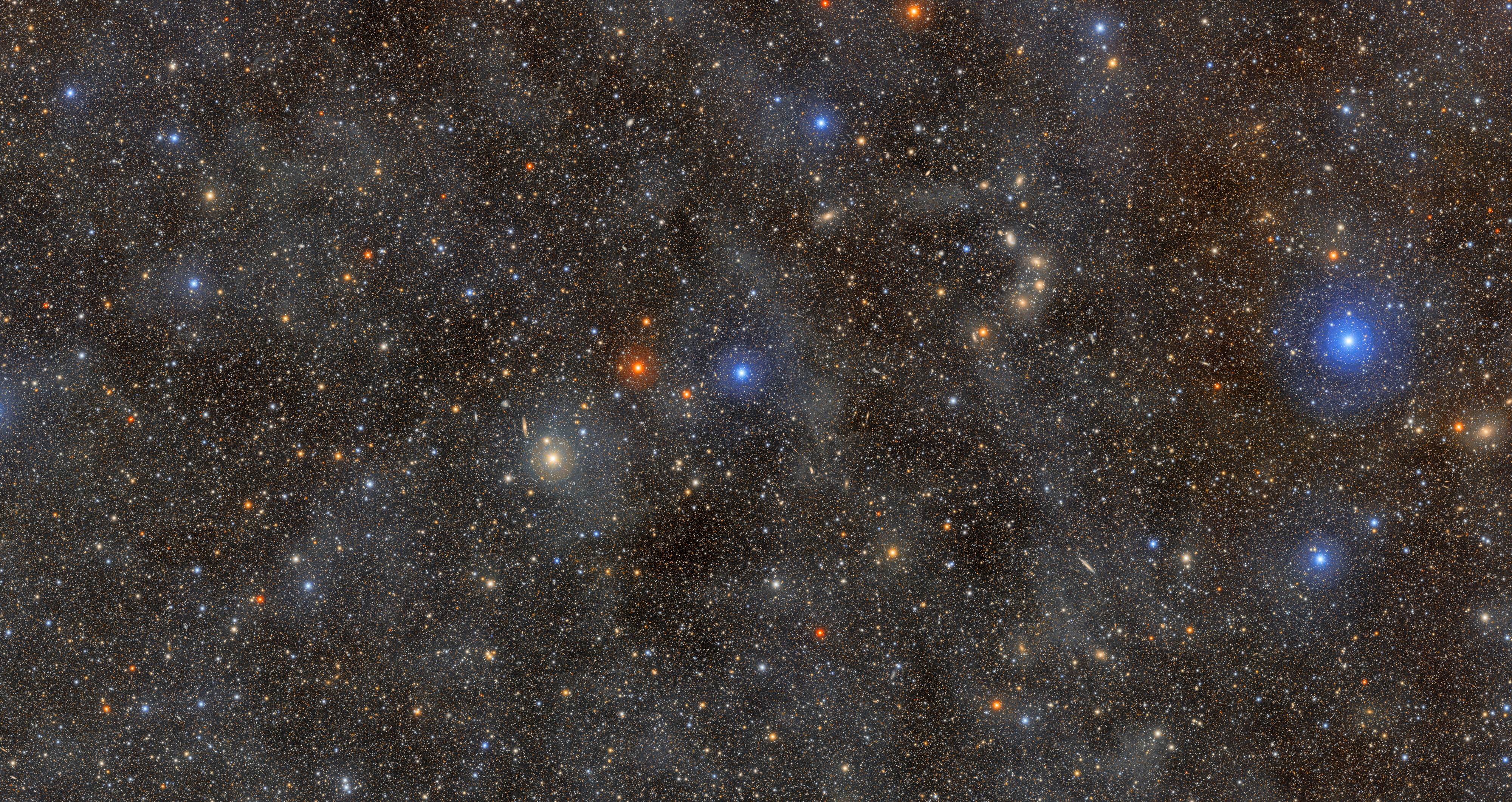
This 1.7-gigapixel image of a field of stars in the constellation Lupus showcases the unprecedented view of the Universe that NSF–DOE Vera C. Rubin Observatory gives us. Equipped with the LSST Camera – the largest digital camera in the world – Rubin combines a wide view of the sky with the ability to detect extremely faint objects. With this capability, Rubin can reveal details of the cosmos across an enormous range of scales, from distant galaxies, to individual stars, to the wispy clouds of dust spread throughout our galaxy.
The faint, glowing clouds spread across this image are galactic cirrus: clouds of interstellar gas and dust that can be seen in the foreground of the Milky Way. Rubin's ability to capture scenes like this in unmatched detail will open new windows into the structure of our galaxy and the Universe beyond it.
Imaqge Credit: NSF–DOE Vera C. Rubin Observatory/NOIRLab/SLAC/AURA
Image enhancement: Jean-Baptiste Faure

Tuesday, January 2, 2024

Herbig-Haro object HH 46/47 seen by Webb

Herbig-Haro object HH 46/47 seen by Webb
Click the image for higher resolution (2.5 MB)

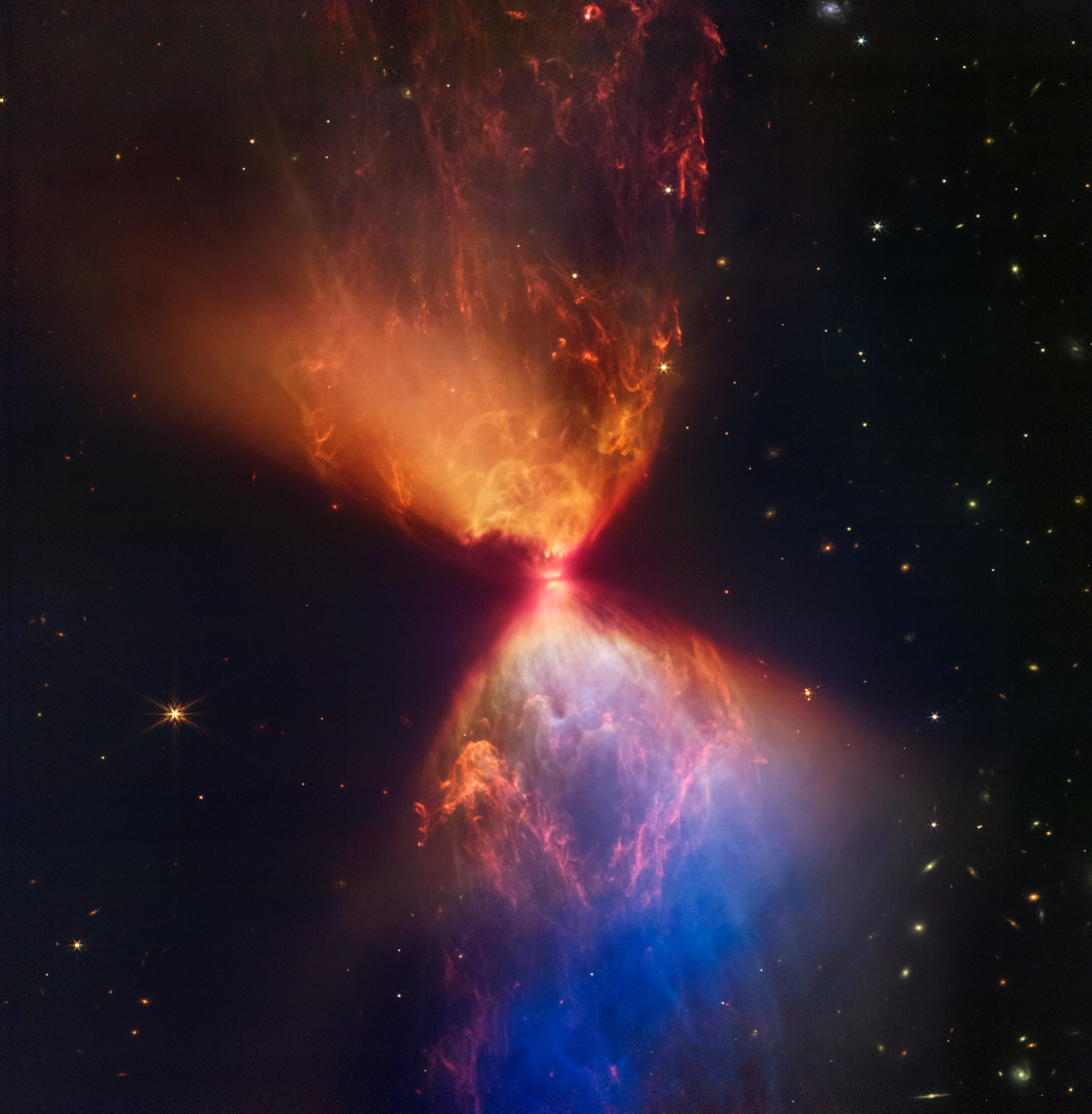
The James Webb Space Telescope has captured a high-resolution image of a tightly bound pair of actively forming stars, known as Herbig-Haro 46/47, in near-infrared light. Look for them at the center of the red diffraction spikes. The stars are buried deeply, appearing as an orange-white splotch. They are surrounded by a disc of gas and dust that continues to add to their mass.
Herbig-Haro 46/47 is an important object to study because it is relatively young – only a few thousand years old. Stars take millions of years to form. Targets like this also give researchers insight into how stars gather mass over time, potentially allowing them to model how our own Sun, a low-mass star, formed.
The two-sided orange lobes were created by earlier ejections from these stars. The stars' more recent ejections appear as blue, thread-like features, running along the angled diffraction spike that covers the orange lobes.
Actively forming stars ingest the gas and dust that immediately surrounds them in a disc (imagine an edge-on circle encasing them). When the stars "eat" too much material in too short a time, they respond by sending out two-sided jets along the opposite axis, settling down the star's spin, and removing mass from the area. Over millennia, these ejections regulate how much mass the stars retain.
Don't miss the delicate, semi-transparent blue cloud. This is a region of dense dust and gas, known as a nebula. Webb's crisp near-infrared image lets us see through its gauzy layers, showing off a lot more of Herbig-Haro 46/47, while also revealing a wide range of stars and galaxies that lie far beyond it. The nebula's edges transform into a soft orange outline, like a backward L along the right and bottom of the image. The blue nebula influences the shapes of the orange jets shot out by the central stars. As ejected material rams into the nebula on the lower left, it takes on wider shapes, because there is more opportunity for the jets to interact with molecules within the nebula. Its material also causes the stars' ejections to light up.
Over millions of years the stars in Herbig-Haro 46/47 will form fully – clearing the scene.
Take a moment to linger on the background. A profusion of extremely distant galaxies dot Webb's view. Its composite NIRCam (Near-Infrared Camera) image is made up of several exposures, highlighting distant galaxies and stars. Blue objects with diffraction spikes are stars, and the closer they are, the larger they appear. White-and-pink spiral galaxies sometimes appear larger than these stars, but are significantly farther away. The tiniest red dots, Webb's infrared specialty, are often the oldest, most distant galaxies.
Image Credit: NASA, ESA, CSA, J. DePasquale (STScI)
Image enhancement: Jean-Baptiste Faure

Tuesday, September 26, 2023

Protostellar Object OH 339.88-1.26

Protostellar Object OH 339.88-1.26
Click the image for higher resolution (2.1 MB)

The protostellar object OH 339.88-1.26, which lies 8 900 light-years from Earth in the constellation Ara, lurks in this dust-filled image from the Hubble Space Telescope. Winding lanes of dark dust thread through this image, which is also studded with bright stars crowned with criss-crossing diffraction spikes.
The dark vertical streak at the center of this image hides OH 339.88-1.26, which is an astrophysical maser. A maser – which is an acronym for "microwave amplification by stimulated emission of radiation" – is essentially a laser that produces coherent light at microwave wavelengths. Such objects can occur naturally in astrophysical situations, in environments ranging from the north pole of Jupiter to star-forming regions such as the one pictured here.
This image comes from a set of Hubble observations that peer into the hearts of regions where massive stars are born to constrain the nature of massive protostars and test theories of their formation. Astronomers turned to Hubble's Wide Field Camera 3 to explore the massive protostar G339.88-1.26, which is estimated to be about 20 times the mass of the Sun and is lurking in the dusty clouds in the center of the image. The Hubble observations were supported by other state-of-the-art observatories including ALMA, the Atacama Large Millimeter/submillimeter Array. ALMA is composed of 66 moveable high-precision antennas which can be arranged over distances of up to 16 kilometers on a plateau perched high in the Chilean Andes. Further data were contributed by the Stratospheric Observatory For Infrared Astronomy (SOFIA), which is a telescope that – until recently – operated out of a converted 747 aircraft.
The field is filled with hundreds of bright stars. They are primarily blue in colour, with scattered smaller stars visible in yellow/orange. The background is dominated by cloudy grey dust, with permeating regions of dark black and orange.
Image Credit: ESA/Hubble and NASA, J. C. Tan (Chalmers Univ. & Univ. of Virginia)
Image enhancement: Jean-Baptiste Faure

Friday, February 17, 2023

Variable Star V 372 Orionis

Variable Star V 372 Orionis
Click the image for higher resolution (3.6 MB)

The bright variable star V 372 Orionis takes center stage in this image from the Hubble Space Telescope, which has also captured a smaller companion star in the upper left of this image. Both stars lie in the Orion Nebula, a colossal region of star formation roughly 1450 light years from Earth.
V 372 Orionis is a particular type of variable star known as an Orion Variable. These young stars experience some tempestuous moods and growing pains, which are visible to astronomers as irregular variations in luminosity. Orion Variables are often associated with diffuse nebulae, and V 372 Orionis is no exception; the patchy gas and dust of the Orion Nebula pervade this scene.
This image overlays data from two of Hubble's instruments. Data from the Advanced Camera for Surveys and Wide Field Camera 3 at infrared and visible wavelengths were layered to reveal rich details of this corner of the Orion Nebula. Hubble also left its own subtle signature on this astronomical portrait in the form of the diffraction spikes surrounding the bright stars. These prominent artefacts are created by starlight interacting with Hubble's inner workings, and as a result they reveal hints of Hubble's structure. The four spikes surrounding the stars in this image are created by four vanes inside Hubble supporting the telescope's secondary mirror. The diffraction spikes of the James Webb Space Telescope, on the other hand, are six-pointed as a result of Webb’s hexagonal mirror segments and 3-legged support structure for the secondary mirror.
Image Credit: ESA/Hubble and NASA, J. Bally, M. Robberto
Image enhancement: Jean-Baptiste Faure

Saturday, February 4, 2023

Protostar L1527 as seen by Webb

Protostar L1527 as seen by Webb
Click the image for higher resolution (3.9 MB)

The protostar L1527, shown in this image from the James Webb Space Telescope, is embedded within a cloud of material that is feeding its growth. Material ejected from the star has cleared out cavities above and below it, whose boundaries glow orange and blue in this infrared view. The upper central region displays bubble-like shapes due to stellar 'burps,' or sporadic ejections. Webb also detects filaments made of molecular hydrogen that has been shocked by past stellar ejections. Intriguingly, the edges of the cavities at upper left and lower right appear straight, while the boundaries at upper right and lower left are curved. The region at lower right appears blue, as there’s less dust between it and Webb than the orange regions above it.
Image Credit: NASA, ESA, CSA, and STScI, J. DePasquale (STScI)
Image enhancement: Jean-Baptiste Faure

Friday, September 30, 2022

Young Stellar Object IRAS 05506+2414

Young Stellar Object IRAS 05506+2414
Click the image for higher resolution

A bright young star is surrounded by a shroud of thick gas and dust in this image from the Hubble Space Telescope. Hubble's Wide Field Camera 3 inspected a young stellar object, over 9000 light years away in the constellation Taurus, to help astronomers understand the earliest stages in the lives of massive stars. This object – which is known to astronomers as IRAS 05506+2414 – is thought to be an example of an explosive event caused by the disruption of a massive young star system. If so, it would only be the second such example known.
Usually the swirling discs of material surrounding a young star are funnelled into twin outflows of gas and dust from the star. In the case of IRAS 05506+2414, however, a fan-like spray of material travelling at velocities of up to 350 kilometers per second is spreading outwards from the center of this image.
Astronomers turned to Hubble's Wide Field Camera 3 to measure the distance to IRAS 05506+2414. While it is possible to measure the velocity of material speeding outwards from the star, astronomers cannot tell how far from Earth the star actually is from a single observation. However, by measuring the distance that the outflow travels between successive images, they will be able to infer the distance to IRAS 05506+2414. This will allow astronomers to determine how bright the star is and how much energy it is emitting, and hence to estimate its mass – all vital information that will help to understand the origin of this bright young star's unusual outflow.
Image Credit: ESA/Hubble and NASA, R. Sahai
Image enhancement: Jean-Baptiste Faure

Tuesday, January 25, 2022

Young Stellar Jet MHO 2147

Young Stellar Jet MHO 2147
Click on the image for higher resolution (11.3 MB)

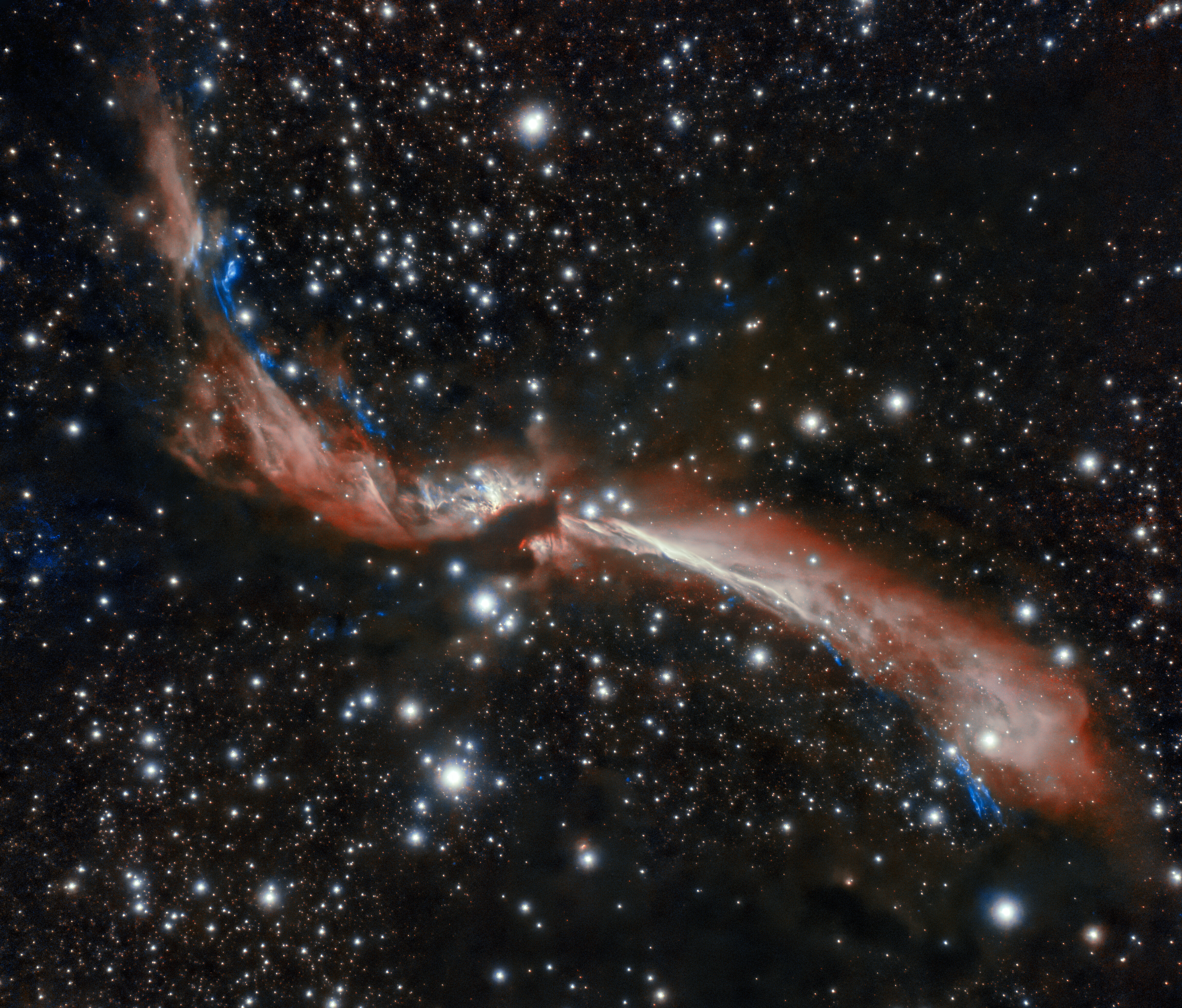
The sinuous young stellar jet, MHO 2147, meanders lazily across a field of stars in this image captured from Chile by the international Gemini Observatory, a Program of NSF's NOIRLab. The stellar jet is the outflow from a young star that is embedded in an infrared dark cloud. Astronomers suspect its sidewinding appearance is caused by the gravitational attraction of companion stars. These crystal-clear observations were made using the Gemini South telescope's adaptive optics system, which helps astronomers counteract the blurring effects of atmospheric turbulence.
Young stellar jets are a common by-product of star formation and are thought to be caused by the interplay between the magnetic fields of rotating young stars and the disks of gas surrounding them. These interactions eject twin torrents of ionized gas in opposite directions, such as those pictured in two images captured by astronomers using the Gemini South telescope on Cerro Pachón on the edge of the Chilean Andes. Gemini South is one half of the international Gemini Observatory, a Program of NSF's NOIRLab, that comprises twin 8.1-meter optical/infrared telescopes on two of the best observing sites on the planet. Its counterpart, Gemini North, is located near the summit of Maunakea in Hawai‘i.
The jet in the first image, named MHO 2147, is roughly 10,000 light-years from Earth, and lies in the galactic plane of the Milky Way, close to the boundary between the constellations Sagittarius and Ophiuchus. MHO 2147 snakes across a starry backdrop in the image – an appropriately serpentine appearance for an object close to Ophiuchus. Like many of the 88 modern astronomical constellations, Ophiuchus has mythological roots – in ancient Greece it represented a variety of gods and heroes grappling with a serpent. MHO 1502, the jet pictured in the second image, is located in the constellation of Vela, approximately 2000 light-years away.
Most stellar jets are straight but some can be wandering or knotted. The shape of the uneven jets is thought to be related to a characteristic of the object or objects that created them. In the case of the two bipolar jets MHO 2147 and MHO 1502, the stars which created them are obscured from view.
In the case of MHO 2147, this young central star, which has the catchy identifier IRAS 17527-2439, is embedded in an infrared dark cloud – a cold, dense region of gas that is opaque at the infrared wavelengths represented in this image. The sinuous shape of MHO 2147 is caused because the direction of the jet has changed over time, tracing out a gentle curve on either side of the central star. These almost unbroken curves suggest that MHO 2147 has been sculpted by continuous emission from its central source. Astronomers found that the changing direction (precession) of the jet may be due to the gravitational influence of nearby stars acting on the central star. Their observations suggest that IRAS 17527-2439 could belong to a triple star system separated by more than 300 billion kilometers (almost 200 billion miles).
MHO 1502, on the other hand, is embedded in a totally different environment – an area of star formation known as an HII region. The bipolar jet is composed of a chain of knots, suggesting that its source, thought to be two stars, has been intermittently emitting material.
These detailed image were captured by the Gemini South Adaptive Optics Imager (GSAOI), an instrument on the 8.1-meter-diameter Gemini South telescope. Gemini South is perched on the summit of Cerro Pachón, where dry air and negligible cloud cover provide one of the best observing sites on the planet. Even atop Cerro Pachón, however, atmospheric turbulence causes the stars to blur and twinkle.
GSAOI works with GeMs, the Gemini Multi-Conjugate Adaptive Optics System, to cancel out this blurring effect using a technique called adaptive optics. By monitoring the twinkling of natural and artificial guide stars up to 800 times a second, GeMs can determine how atmospheric turbulence is distorting Gemini South’s observations. A computer uses this information to minutely adjust the shape of deformable mirrors, canceling out the distortions caused by turbulence. In this case, the sharp adaptive optics images have made it possible to recognize more details in each knot of the young stellar jets than in previous studies.
Image Credit: International Gemini Observatory/NOIRLab/NSF/AURA
Acknowledgments: Image processing: T.A. Rector (University of Alaska Anchorage/NSF's NOIRLab), M. Zamani (NSF's NOIRLab) & D. de Martin (NSF's NOIRLab)
PI: L. Ferrero (Universidad Nacional de Córdoba)
Image enhancement: Jean-Baptiste Faure

Wednesday, September 29, 2021

Herbig-Haro Object HH 111

Herbig-Haro Object HH 111
Click on the image for higher resolution

This striking image features a relatively rare celestial phenomenon known as a Herbig-Haro object. This particular Herbig–Haro object is named HH 111, and was imaged by Hubble's Wide Field Camera 3 (WFC3). These spectacular objects are formed under very specific circumstances. Newly formed stars are often very active, and in some cases they expel very narrow jets of rapidly moving ionised gas – gas that is so hot that its molecules and atoms have lost their electrons, making the gas highly charged. The streams of ionised gas then collide with the clouds of gas and dust surrounding newly-formed stars at speeds of hundreds of kilometers per second. It is these energetic collisions that create Herbig-Haro objects such as HH 111.
WFC3 takes images at optical and infrared wavelengths, which means that it observes objects at a wavelength range similar to the range that human eyes are sensitive to (optical) and a range of wavelengths that are slightly too long to be detected by human eyes (infrared). Herbig-Haro objects actually release a lot of light at optical wavelengths, but they are difficult to observe because their surrounding dust and gas absorb much of the visible light. Therefore, the WFC3's ability to observe at infrared wavelengths – where observations are not as affected by gas and dust – is crucial to observing Herbo-Haro objects successfully.
Image Credit: ESA/Hubble and NASA, B. Nisini
Image enhancement: Jean-Baptiste Faure

Monday, April 26, 2021

Luminous Blue Variable Star AG Carinae

Luminous Blue Variable Star AG Carinae
Click on the image for higher resolution

In celebration of the 31st anniversary of the launching of the Hubble Space Telescope, astronomers aimed the celebrated observatory at one of the brightest stars seen in our galaxy to capture its beauty.
The giant star featured in this latest Hubble Space Telescope anniversary image is waging a tug-of-war between gravity and radiation to avoid self-destruction. The star, called AG Carinae, is surrounded by an expanding shell of gas and dust – a nebula – that is shaped by the powerful winds of the star. The nebula is about five light-years wide, which equals the distance from here to our nearest star, Alpha Centauri.
The huge structure was created from one or more giant eruptions several thousand years ago. The star's outer layers were blown into space, the expelled material amounting to roughly 10 times the mass of our Sun. These outbursts are typical in the life of a rare breed of star called a Luminous Blue Variable (LBV), a brief unstable phase in the short life of an ultra-bright, glamorous star that lives fast and dies young. These stars are among the most massive and brightest stars known. They live for only a few million years, compared to the roughly 10-billion-year lifetime of our own Sun. AG Carinae is a few million years old and resides 20 000 light-years away inside our Milky Way galaxy. The star's expected lifetime is between 5 million and 6 million years.
LBVs have a dual personality. They appear to spend years in semi-quiescent bliss and then they erupt in a petulant outburst, during which their luminosity increases – sometimes by several orders of magnitude. These behemoths are stars in the extreme, far different from normal stars like our Sun. In fact AG Carinae is estimated to be up to 70 times more massive than our Sun and shines with the blinding brilliance of 1 million suns.
Major outbursts such as the one that produced the nebula featured in this image occur a few times during a LBV's lifetime. A LBV star only casts off material when it is in danger of self-destruction. Because of their massive forms and super-hot temperatures, luminous blue variable stars like AG Carinae are in a constant battle to maintain stability. It's an arm-wrestling contest between radiation pressure from within the star pushing outward and gravity pressing inward. This arm-wrestling match results in the star's expanding and contracting. The outward pressure occasionally wins the battle, and the star expands to such an immense size that it blows off its outer layers, like a volcano erupting. But this outburst only happens when the star is on the verge of coming apart. After the star ejects the material, it contracts to its normal (large) size, settles back down, and becomes stable again.
LBV stars are rare: fewer than 50 are known among the galaxies in our local group of neighbouring galaxies. These stars spend tens of thousands of years in this phase, a blink of an eye in cosmic time. Some are expected to end their lives in titanic supernova blasts, which enrich the Universe with the heavier elements beyond iron.
Like many other LBVs, AG Carinae remains unstable. It has experienced lesser outbursts that have not been as powerful as the one that created the present nebula. Although AG Carinae is semi-quiescient now, its searing radiation and powerful stellar wind (streams of charged particles) have been shaping the ancient nebula, sculpting intricate structures as outflowing gas slams into the slower-moving outer nebula. The wind is travelling at up to 1 million kilometers per hour, about 10 times faster than the expanding nebula. Over time, the hot wind catches up with the cooler expelled material, ploughs into it, and pushes it farther away from the star. This “snowplough” effect has cleared a cavity around the star.
The red material is glowing hydrogen gas laced with nitrogen gas. The diffuse red material at upper left pinpoints where the wind has broken through a tenuous region of material and swept it into space. The most prominent features, highlighted in blue, are filamentary structures shaped like tadpoles and lopsided bubbles. These structures are dust clumps illuminated by the star's light. The tadpole-shaped features, most prominent at left and bottom, are denser dust clumps that have been sculpted by the stellar wind. Hubble's sharp vision reveals these delicate-looking structures in great detail.
The image was taken in visible and ultraviolet light. Hubble is ideally suited for observations in ultraviolet light because this wavelength range can only be viewed from space.
Image Credit: NASA, ESA and STScI
Image enhancement: Jean-Baptiste Faure

Tuesday, February 16, 2021

The Quintuplet Cluster near the Galaxy's Center

The Quintuplet Cluster near the Galaxy's Center
Click on the image for higher resolution (1.5 MB)

Although this cluster of stars gained its name due to its five brightest stars, it is home to hundreds more. The huge number of massive young stars in the cluster is clearly captured in this Hubble Space Telescope image.
The cluster is located close to the Arches Cluster and is just 100 light-years from the center of our galaxy. The cluster's proximity to the dust at the center of the galaxy means that much of its visible light is blocked, which helped to keep the cluster unknown until its discovery in 1990, when it was revealed by observations in the infrared. Infrared images of the cluster, like the one shown here, allow us to see through the obscuring dust to the hot stars in the cluster.
The Quintuplet Cluster hosts two extremely rare luminous blue variable stars: the Pistol Star and the lesser known V4650 Sgr. If you were to draw a line horizontally through the center of this image from left to right, you could see the Pistol Star hovering just above the line about one third of the way along it. The Pistol Star is one of the most luminous known stars in the Milky Way and takes its name from the shape of the Pistol Nebula that it illuminates, but which is not visible in this infrared image. The exact age and future of the Pistol Star are uncertain, but it is expected to end in a supernova or even a hypernova in one to three million years.
The cluster also contains a number of red supergiants. These stars are among the largest in the galaxy and are burning their fuel at an incredible speed, meaning they will have a very short lifetime. Their presence suggests an average cluster age of nearly four million years. At the moment these stars are on the verge of exploding as supernovae. During their spectacular deaths they will release vast amounts of energy which, in turn, will heat the material – dust and gas – between the other stars.
Image Credit: ESA/Hubble and NASA
Image enhancement: Jean-Baptiste Faure

Herbig-Haro Objects HH46 and HH47

Herbig-Haro Objects HH46 and HH47
Click on the image for higher resolution (2.1 MB)

Herbig-Haro objects are some of the rarer sights in the night sky, taking the form of thin spindly jets of matter floating amongst the surrounding gas and stars. The two Herbig-Haro objects catalogued as HH46 and HH47, seen in this image taken with the Hubble Space Telescope, were spotted in the constellation of Vela (The Sails), at a distance of over 1400 light-years from Earth. Prior to its discovery in 1977 by the American astronomer R. D. Schwartz, the exact mechanism by which these multi-coloured objects formed was unknown.
Before 1997 it was theorised by Schwartz and others that the objects could be a type of reflection nebula, or a type of shock wave formed from the gas emitted from a star interacting with the surrounding matter. The mystery was finally solved when a protostar, unseen in this image, was discovered at the centre of the long jets of matter. The outflows of matter, some 10 light-years across, were ejected from the newly born star and violently propelled outwards at speeds of over 150 kilometres per second. Upon reaching the surrounding gas, the collision created the bright shock waves seen here.
Image Credit: ESA/Hubble and NASA, B. Nisini
Image enhancement: Jean-Baptiste Faure

Saturday, August 1, 2020

Star Orbiting Supermassive Black Hole

Star Orbiting Supermassive Black Hole
Click on the image for higher resolution (1.9 MB)

Observations made with ESO's Very Large Telescope (VLT) have revealed for the first time that a star orbiting the supermassive black hole at the center of the Milky Way moves just as predicted by Einstein's theory of general relativity. Its orbit is shaped like a rosette and not like an ellipse as predicted by Newton's theory of gravity. This effect, known as Schwarzschild precession, had never before been measured for a star around a supermassive black hole. This artist's impression illustrates the precession of the star's orbit, with the effect exaggerated for easier visualisation.
Image Credit: ESO/L. Calçada

Thursday, December 26, 2019

Central Region of Milky Way

Central Region of Milky Way
Click on the image for higher resolution (4.7 MB)

ESO's Very Large Telescope (VLT) has observed the central part of the Milky Way with spectacular resolution and uncovered new details about the history of star birth in our galaxy. Thanks to the new observations, astronomers have found evidence for a dramatic event in the life of the Milky Way: a burst of star formation so intense that it resulted in over a hundred thousand supernova explosions.
Taken with the HAWK-I instrument on VLT, this stunning image shows the Milky Way's central region with an angular resolution of 0.2 arcseconds. This means the level of detail picked up by HAWK-I is roughly equivalent to seeing a football (soccer ball) in Zurich from Munich, where ESO's headquarters are located!
The image combines observations in three different wavelength bands. The team used the broadband filters J (centred at 1250 nanometers, in blue), H (centred at 1635 nanometres, in green), and Ks (centred at 2150 nanometers, in red), to cover the near infrared region of the electromagnetic spectrum. By observing in this range of wavelengths, HAWK-I can peer through the dust, allowing it to see certain stars in the central region of our galaxy that would otherwise be hidden.
Image Credit: ESO/Nogueras-Lara et al.
Image enhancement: Jean-Baptiste Faure

Wednesday, November 6, 2019

Giant Star Zeta Ophiuchi and Bow Shock

Giant Star Zeta Ophiuchi and Bow Shock
Click on the image for higher resolution

This infrared image from NASA's Spitzer Space Telescope shows the giant star Zeta Ophiuchi and the bow shock, or shock wave, in front of it. Visible only in infrared light, the bow shock is created by winds that flow from the star, making ripples in the surrounding dust. Located roughly 370 light-years from Earth, Zeta Ophiuchi dwarfs our Sun: It is about six times hotter, eight times wider, 20 times more massive and about 80,000 times as bright. Even at its great distance, it would be one of the brightest stars in the sky were it not largely obscured by dust clouds.
This massive star is travelling at a snappy pace of about 24 kilometers per second, fast enough to break the sound barrier in the surrounding interstellar material. Because of this motion, it creates a spectacular bow shock ahead of its direction of travel (to the left). The structure is analogous to the ripples that precede the bow of a ship as it moves through the water, or the sonic boom of an airplane hitting supersonic speeds. The fine filaments of dust surrounding the star glow primarily at shorter infrared wavelengths, rendered here in green. The area of the shock pops out dramatically at longer infrared wavelengths, creating the red highlights. A bright bow shock like this would normally be seen in visible light as well, but because it is hidden behind a curtain of dust, only the longer infrared wavelengths of light seen by Spitzer can reach us.
Bow shocks are commonly seen when two different regions of gas and dust slam into one another. Zeta Ophiuchi, like other massive stars, generates a strong wind of hot gas particles flowing out from its surface. This expanding wind collides with the tenuous clouds of interstellar gas and dust about half a light-year away from the star, which is almost 800 times the distance from the sun to Pluto. The speed of the winds added to the star's supersonic motion result in the spectacular collision seen here.
Image Credit: NASA/JPL-Caltech
Image enhancement: Jean-Baptiste Faure

Monday, May 6, 2019

Planetary Nebula ESO 577-24

Planetary Nebula ESO 577-24
Click on the image for higher resolution

The faint, ephemeral glow emanating from the planetary nebula ESO 577-24 persists for only a short time – around 10,000 years, a blink of an eye in astronomical terms. ESO's Very Large Telescope captured this shell of glowing ionised gas – the last breath of the dying star whose simmering remains are visible at the heart of this image. As the gaseous shell of this planetary nebula expands and grows dimmer, it will slowly disappear from sight.
This stunning planetary nebula was imaged by one of the VLT's most versatile instruments, FORS2. The instrument captured the bright, central star, Abell 36, as well as the surrounding planetary nebula. The red and blue portions of this image correspond to optical emission at red and blue wavelengths, respectively. An object much closer to home is also visible in this image – an asteroid wandering across the field of view has left a faint track below and to the left of the central star. And in the far distance behind the nebula a glittering host of background galaxies can be seen.
Image Credit: ESO
Image enhancement: Jean-Baptiste Faure

Friday, May 3, 2019

Open Cluster M11

Open Cluster M11
Click on the image for higher resolution (7.9 MB)

This star-studded image shows us a portion of M11 (Messier 11), an open star cluster in the southern constellation of Scutum (The Shield). M11 is also known as the Wild Duck Cluster, as its brightest stars form a "V" shape that somewhat resembles a flock of ducks in flight. M11 is one of the richest and most compact open clusters currently known. By investigating the brightest, hottest main sequence stars in the cluster astronomers estimate that it formed roughly 220 million years ago. Open clusters tend to contain fewer and younger stars than their more compact globular cousins, and M11 is no exception: at its center lie many blue stars, the hottest and youngest of the cluster"s few thousand stellar residents.
The lifespans of open clusters are also relatively short compared to those of globular ones; stars in open clusters are spread further apart and are thus not as strongly bound to each other by gravity, causing them to be more easily and quickly drawn away by stronger gravitational forces. As a result M11 is likely to disperse in a few million years as its members are ejected one by one, pulled away by other celestial objects in the vicinity.
Image Credit: ESA/Hubble and NASA, P. Dobbie et al.
Image enhancement: Jean-Baptiste Faure
Saturday, January 5, 2019

A view of the planet orbiting Proxima Centauri

A view of the planet orbiting Proxima Centauri
Click on the image for higher resolution (7.4 MB)

This artist's impression shows a view of the surface of the planet Proxima b orbiting the red dwarf star Proxima Centauri, the closest star to the Solar System. The double star Alpha Centauri AB also appears in the image to the upper-right of Proxima itself. Proxima b is a little more massive than the Earth and orbits in the habitable zone around Proxima Centauri, where the temperature is suitable for liquid water to exist on its surface.
Image Credit: ESO/M. Kornmesser

Sunday, September 16, 2018

Protostar IRAS 20324+4057

Protostar IRAS 20324+4057
Click on the image for higher resolution (1.0 MB)

This light-year-long knot of interstellar gas and dust resembles a caterpillar on its way to a feast. But the meat of the story is not only what this cosmic caterpillar eats for lunch, but also what's eating it. Harsh winds from extremely bright stars are blasting ultraviolet radiation at this "wanna-be" star and sculpting the gas and dust into its long shape. The culprits are 65 of the hottest, brightest known stars, classified as O-type stars, located 15 light-years away from the knot, towards the right edge of the image. These stars, along with 500 less bright, but still highly luminous, B-type stars make up what is called the Cygnus OB2 association. Collectively, the association is thought to have a mass more than 30 000 times that of our Sun.
The caterpillar-shaped knot, called IRAS 20324+4057, is a protostar in a very early evolutionary stage. It is still in the process of collecting material from an envelope of gas surrounding it. However, that envelope is being eroded by the radiation from Cygnus OB2. Protostars in this region should eventually become young stars with final masses about one to ten times that of our Sun, but if the eroding radiation from the nearby bright stars destroys the gas envelope before the protostars finish collecting mass, their final masses may be reduced. Spectroscopic observations of the central star within IRAS 20324+4057 show that it is still collecting material quite heavily from its outer envelope, hoping to bulk up. Only time will tell if the formed star will be a "heavy-weight" or a "light-weight" with respect to its mass.
This image of IRAS 20324+4057 is a composite of Hubble Advanced Camera for Surveys (ACS) data taken in green and infrared light in 2006, and ground-based hydrogen data from the Isaac Newton Telescope in 2003, as part of the IPHAS H-alpha survey. The object lies 4500 light-years away in the constellation of Cygnus (The Swan).
Image Credit: NASA, ESA, the Hubble Heritage Team (STScI/AURA), and IPHAS
Image enhancement: Jean-Baptiste Faure

Wednesday, November 16, 2016

Open Cluster NGC 299

Open Cluster NGC 299
Click on the image for higher resolution (1.9 MB)

NGC 299 is an open star cluster located within the Small Magellanic Cloud just under 200 000 light-years away. Open clusters such as this are collections of stars weakly bound by the shackles of gravity, all of which formed from the same massive molecular cloud of gas and dust. Because of this, all the stars have the same age and composition, but vary in their mass because they formed at different positions within the cloud. This unique property not only ensures a spectacular sight when viewed through a sophisticated instrument attached to a telescope such as Hubble's Advanced Camera for Surveys, but gives astronomers a cosmic laboratory in which to study the formation and evolution of stars – a process that is thought to depend strongly on a star's mass.
Image Credit: ESA/Hubble and NASA
Image enhancement: Jean-Baptiste Faure

Thursday, April 21, 2016

The galactic center as seen by Hubble

The galactic center as seen by Hubble
Click on the image for higher resolution (9.5 MB)

This infrared image from the Hubble Space Telescope shows the center of the Milky Way, 27 000 light-years away from Earth. Using the infrared capabilities of Hubble, astronomers were able to peer through the dust which normally obscures the view of this interesting region. At the center of this nuclear star cluster – and also in the center of this image – the Milky Way's supermassive black hole is located. The center of our galaxy in the constellation of Sagittarius, is a crowded place. This region is so tightly packed that it is equivalent to having one million stars crammed into the volume of space between us and Alpha Centauri, located 4.3 light-years away. At the very hub of our galaxy, this dense nuclear star cluster surrounds the Milky Way’s central supermassive black hole, known as Sagittarius A*, which alone is about four million times the mass of the Sun. Sagittarius A* is not the only mystery lurking in this part of the galaxy. The crowded center contains numerous objects that are hidden at visible wavelengths by thick clouds of dust in the galaxy's disc. In order to truly understand the central part of our galaxy astronomers used the infrared vision of Hubble to peer through this obscuring dust. To reveal the image in all its glory the scientists then assigned visible colours to the different wavelengths of infrared light, which is invisible to human eyes.
The blue stars in the image are foreground stars, which are closer to Earth than the nuclear star cluster, whilst the red stars are either behind much more intervening dust, or are embedded in dust themselves. Some extremely dense clouds of gas and dust are seen in silhouette, appearing dark against the bright background stars. These clouds are so thick that even Hubble's infrared capability cannot penetrate them. In addition to the stars hidden by the dust astronomers estimate that there are about 10 million stars in the cluster which are too faint to see, even for Hubble. Using Hubble's vantage point above the atmosphere and its high resolution, astronomers were able not only to reveal the stars in this cluster but also to measure their movements over a period of four years. Using this information, they inferred important properties of the nuclear star cluster, such as its mass and structure. The motion of the stars may also offer astronomers a glimpse into how the nuclear star cluster was formed – whether it was built up over time from globular star clusters that happened to fall into the center of the galaxy, or from gas spiralling in from the Milky Way’s disc to form stars at the core.
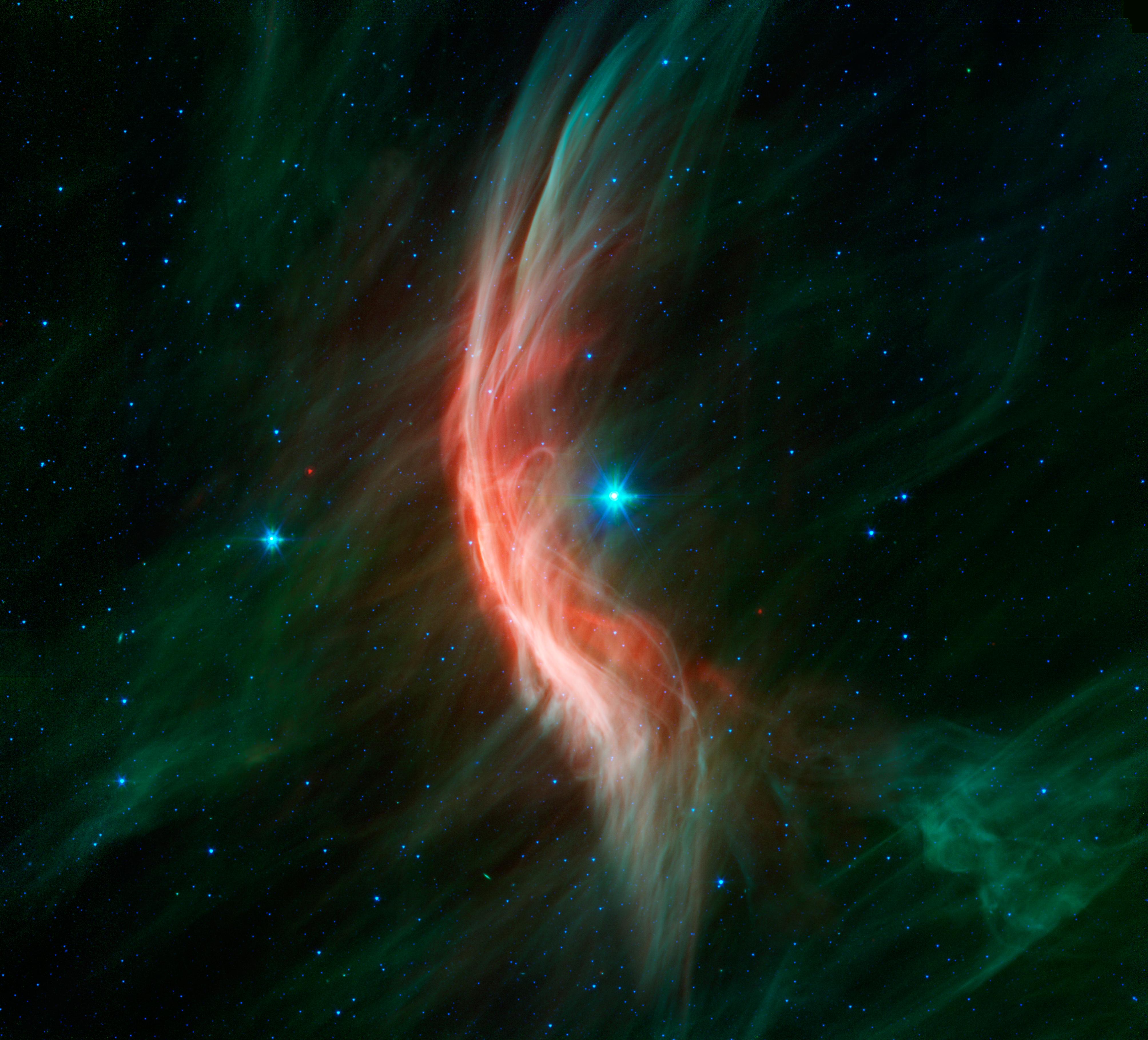
Image Credit: NASA, ESA, and the Hubble Heritage Team (STScI/AURA)
Acknowledgment: NASA, ESA, T. Do and A. Ghez (UCLA), and V. Bajaj (STScI)