Showing posts with label Supernova Remnants. Show all posts

Monday, June 17, 2024

The Crab Nebula as seen by Webb

The Crab Nebula as seen by Webb
Click the image for higher resolution (1.9 MB)

The Crab Nebula (catalogue designations M1, NGC 1952, Taurus A) is a supernova remnant and "pulsar wind nebula" in the constellation of Taurus. Charles Messier originally mistook Messier 1 (M1) for Halley's Comet, which inspired him to create his famous catalog of objects.
The James Webb Space Telescope dissected the Crab Nebula's structure, aiding astronomers as they continue to evaluate leading theories about the supernova remnant's origins. With the data collected by Webb's NIRCam (Near-Infrared Camera) and MIRI (Mid-Infrared Instrument), a team of scientists were able to closely inspect some of the Crab Nebula's major components.
For the first time ever, astronomers mapped the warm dust emission throughout this supernova remnant. Represented here as fluffy magenta material, the dust grains form a cage-like structure that is most apparent toward the lower left and upper right portions of the remnant. Filaments of dust are also threaded throughout the Crab's interior and sometimes coincide with regions of doubly ionised sulphur (sulphur III), coloured in green. Yellow-white mottled filaments, which form large loop-like structures around the supernova remnant's center, represent areas where dust and doubly ionised sulphur overlap.
The dust's cage-like structure helps constrain some, but not all of the ghostly synchrotron emission represented in blue. The emission resembles wisps of smoke, most notable toward the Crab's center. The thin blue ribbons follow the magnetic field lines created by the Crab's pulsar heart – a rapidly rotating neutron star.
Image Credit: NASA, ESA, CSA, STScI, T. Temim (Princeton University)
Image enhancement: Jean-Baptiste Faure

Saturday, March 23, 2024

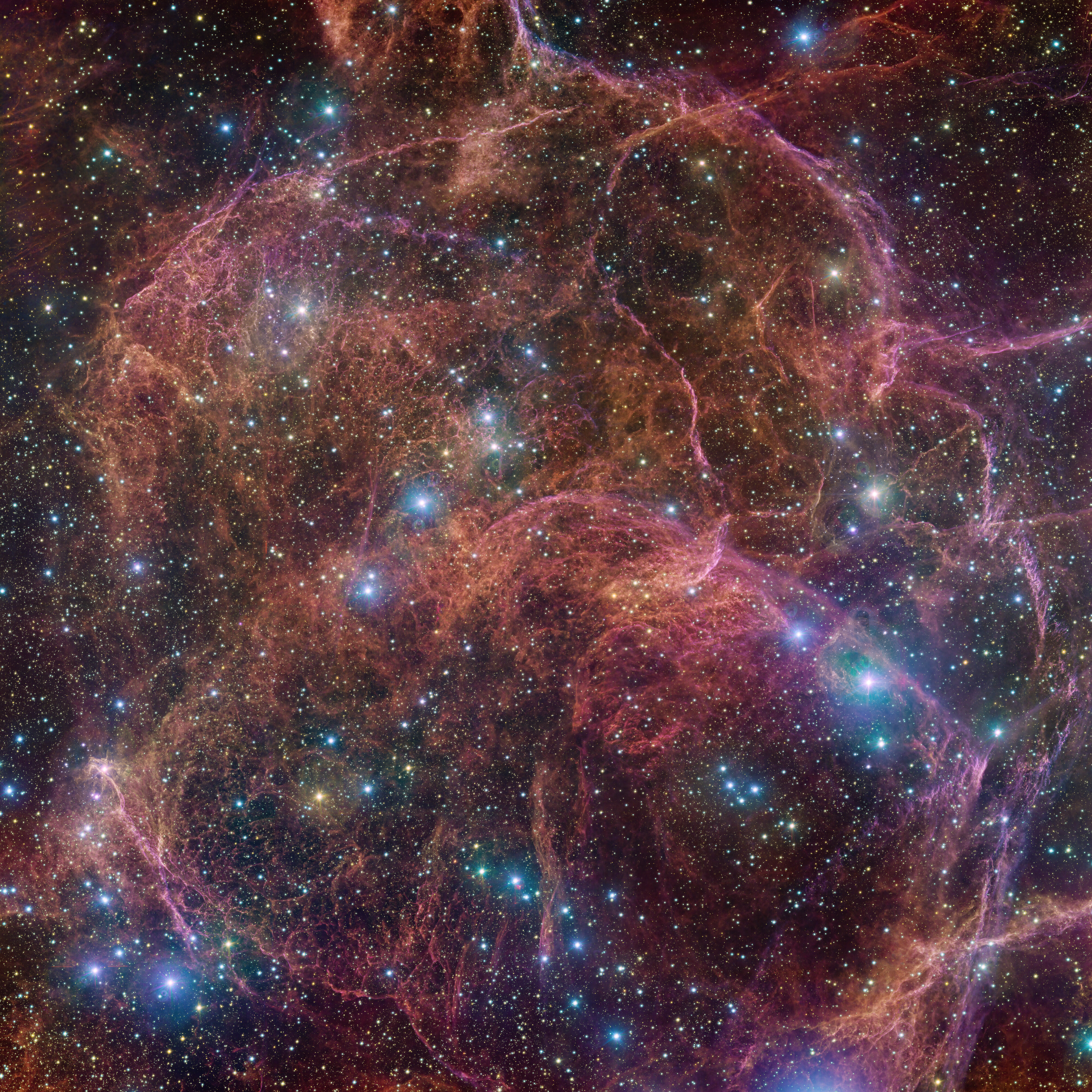
The central part of the Vela Supernova Remnant

The central part of the Vela Supernova Remnant
Click the image for higher resolution (9.2 MB)

This colorful web of wispy gas filaments is the Vela Supernova Remnant, an expanding nebula of cosmic debris left over from a massive star that exploded about 11,000 years ago. This image was taken with the Department of Energy-fabricated Dark Energy Camera (DECam), mounted on the US National Science Foundation's Víctor M. Blanco 4-meter Telescope at Cerro Tololo Inter-American Observatory in Chile, a Program of NSF's NOIRLab. 
The striking reds, yellows, and blues in this image were achieved through the use of three DECam filters that each collect a specific color of light. Separate images were taken in each filter and then stacked on top of each other to produce this high-resolution image that contains 1.3 gigapixels and showcases the intricate web-like filaments snaking throughout the expanding cloud of gas.
Image Credit: CTIO/NOIRLab/DOE/NSF/AURA
Image Processing: T.A. Rector (University of Alaska Anchorage/NSF’s NOIRLab), M. Zamani & D. de Martin (NSF's NOIRLab)

Monday, January 1, 2024

Supernova Remnant Cas A as seen by Webb

Supernova Remnant Cas A as seen by Webb
Click the image for higher resolution (3.4 MB)

A new high-definition image from the James Webb Space Telescope's NIRCam (Near-Infrared Camera) unveils intricate details of supernova remnant Cassiopeia A (Cas A), and shows the expanding shell of material slamming into the gas shed by the star before it exploded.
The most noticeable colours in Webb's newest image are clumps of bright orange and light pink that make up the inner shell of the supernova remnant. These tiny knots of gas, composed of sulphur, oxygen, argon, and neon from the star itself, are only detectable thanks to NIRCam's exquisite resolution, and give researchers a hint at how the dying star shattered like glass when it exploded.
The outskirts of the main inner shell look like smoke from a campfire. This marks where ejected material from the exploded star is ramming into surrounding circumstellar material. Researchers have concluded that this white colour is light from synchrotron radiation, which is generated by charged particles travelling at extremely high speeds and spiralling around magnetic field lines.
There are also several light echoes visible in this image, most notably in the bottom right corner. This is where light from the star's long-ago explosion has reached, and is warming, distant dust, which glows as it cools down.
Image Credit: NASA, ESA, CSA, STScI, D. Milisavljevic (Purdue University), T. Temim (Princeton University), I. De Looze (University of Gent)
Image enhancement: Jean-Baptiste Faure

Monday, October 31, 2022

The Vela Supernova Remnant as seen by the VLT-ST

The Vela Supernova Remnant as seen by the VLT-ST
Click the image for higher resolution (6.3 MB)

This image shows a spectacular view of the orange and pink clouds that make up what remains after the explosive death of a massive star – the Vela supernova remnant. This detailed image consists of 554 million pixels, and is a combined mosaic image of observations taken with the 268-million-pixel OmegaCAM camera at the VLT Survey Telescope, hosted at ESO's Paranal Observatory.
OmegaCAM can take images through several filters that each let the telescope see the light emitted in a distinct colour. To capture this image, four filters have been used, represented here by a combination of magenta, blue, green and red. The result is an extremely detailed and stunning view of both the gaseous filaments in the remnant and the foreground bright blue stars that add sparkle to the image.
Image Credit: ESO/VPHAS+ team
Acknowledgement: Cambridge Astronomical Survey Unit
Image enhancement: Jean-Baptiste Faure

Wednesday, June 22, 2022

Supernova Remnant DEM L249

Supernova Remnant DEM L249
Click on the image for higher resolution (8.1 MB)

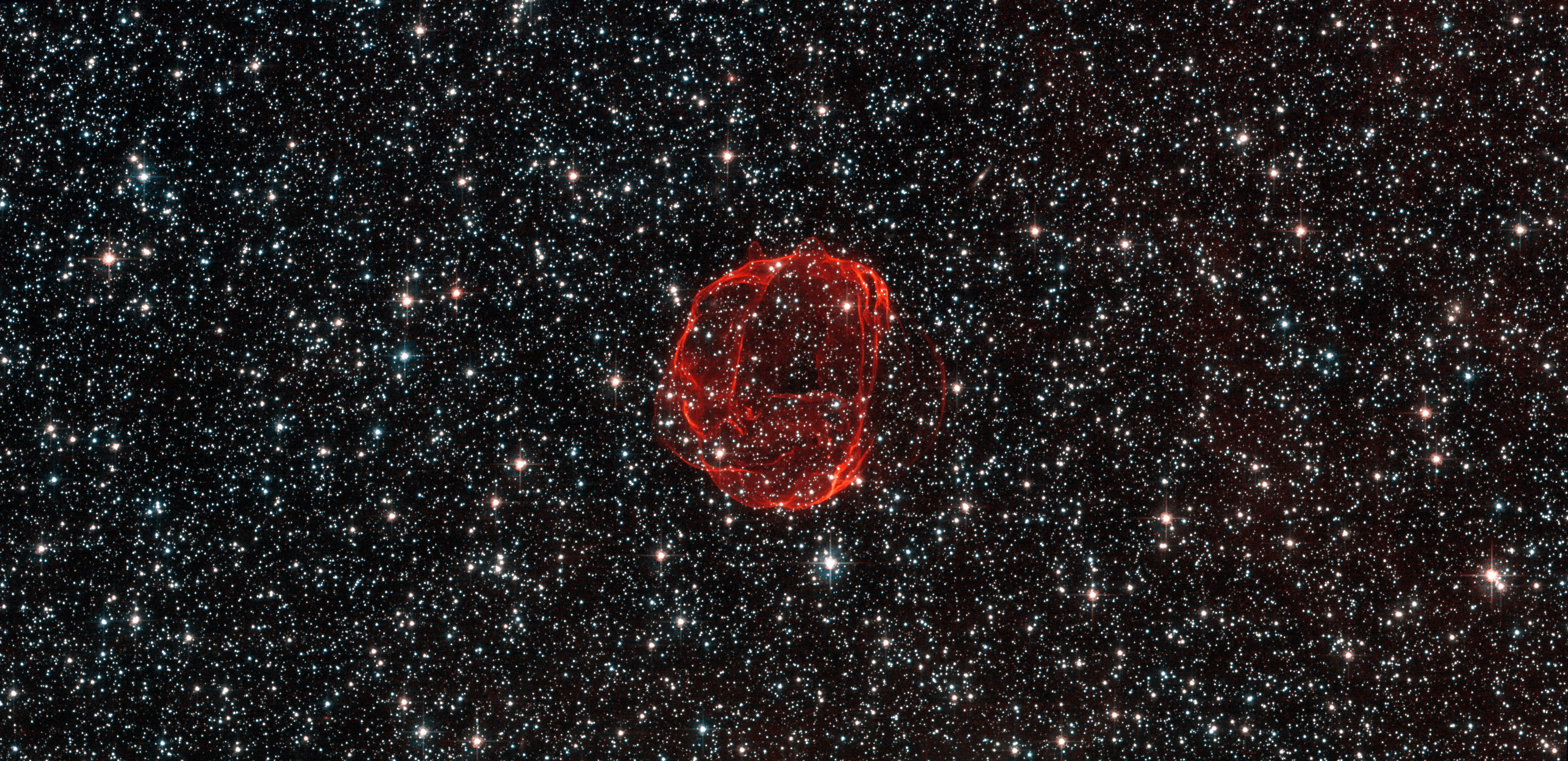
This image from the Hubble Space Telescope shows the tattered remnant of a supernova – a titanic explosion marking the end of the life of a dying star. This object – known as DEM L249 – is thought to have been created by a Type 1a supernova during the death throes of a white dwarf. While white dwarfs are usually stable, they can slowly accrue matter if they are part of a binary star system. This accretion of matter continues until the white dwarf reaches a critical mass and undergoes a catastrophic supernova explosion, ejecting a vast amount of material into space in the process.
DEM L249 lies in the constellation Mensa and is within the Large Magellanic Cloud (LMC), a small satellite galaxy of the Milky Way only 160 000 light-years from Earth. The LMC is an ideal natural laboratory where astronomers can study the births, lives, and deaths of stars, as this region is nearby, oriented towards Earth, and contains relatively little light-absorbing interstellar dust. The data in this image were gathered by Hubble’s Wide Field Camera 3 instrument, and were obtained during a systematic search of the LMC for the surviving companions of white dwarf stars which have gone supernova.
Image Credit: ESA/Hubble and NASA, Y. Chu
Image enhancement: Jean-Baptiste Faure

Wednesday, October 13, 2021

Supernova Remnant N 63A

Supernova Remnant N 63A
Click on the image for higher resolution (2.2 MB)

A violent and chaotic-looking mass of gas and dust is seen in this Hubble Space Telescope image of a nearby supernova remnant. Denoted N 63A, the object is the remains of a massive star that exploded, spewing its gaseous layers out into an already turbulent region.
The supernova remnant is part of a star-forming region in the Large Magellanic Cloud (LMC), an irregular galaxy 160,000 light-years from our own Milky Way.
Supernova remnants have long been thought to set off episodes of star formation when their expanding shock encounters nearby gas. N 63A is still young, and its ruthless shocks are destroying the ambient gas clouds, rather than coercing them to collapse and form stars.
Image Credit: NASA/ESA/HEIC and The Hubble Heritage Team (STScI/AURA)
Image enhancement: Jean-Baptiste Faure

Wednesday, September 29, 2021

Supernova Remnant SNR 0454-67.2

Supernova Remnant SNR 0454-67.2
Click on the image for higher resolution (5.2 MB)

This dark, tangled web is an object named SNR 0454-67.2. It formed in a very violent fashion – it is a supernova remnant, created after a massive star ended its life in a cataclysmic explosion and threw its constituent material out into surrounding space. This created the messy formation we see in this Hubble Space Telescope image, with threads of red snaking amidst dark, turbulent clouds.
SNR 0454-67.2 is situated in the Large Magellanic Cloud, a dwarf spiral galaxy that lies close to the Milky Way. The remnant is likely the result of a Type Ia supernova explosion; this category of supernovae is formed from the death of a white dwarf star, which grows and grows by siphoning material from a stellar companion until it reaches a critical mass and then explodes.
As they always form via a specific mechanism – when the white dwarf hits a particular mass – these explosions always have a well-known luminosity, and are thus used as markers (standard candles) for scientists to obtain and measure distances throughout the Universe.
Image Credit: ESA/Hubble, NASA
Image enhancement: Jean-Baptiste Faure
Friday, April 2, 2021

Supernova Remnant: the Veil Nebula

Supernova Remnant: the Veil Nebula
Click on the image for higher resolution (37.4 MB)

This picture revisits the Veil Nebula, a popular subject for Hubble images! This object was featured in a previous Hubble photo release, but now new processing techniques have been applied, bringing out fine details of the nebula's delicate threads and filaments of ionised gas.
To create this colourful image, observations taken by Hubble's Wide Field Camera 3 instrument through 5 different filters were used. The new post-processing methods have further enhanced details of emissions from doubly ionised oxygen (seen here in blues), ionised hydrogen and ionised nitrogen (seen here in reds).
The Veil Nebula lies around 2 100 light-years from Earth in the constellation of Cygnus (The Swan), making it a relatively close neighbour in astronomical terms. Only a small portion of the nebula was captured in this image.
The Veil Nebula is the visible portion of the nearby Cygnus Loop, a supernova remnant formed roughly 10 000 years ago by the death of a massive star. The Veil Nebula’s progenitor star – which was 20 times the mass of the Sun – lived fast and died young, ending its life in a cataclysmic release of energy. Despite this stellar violence, the shockwaves and debris from the supernova sculpted the Veil Nebula’s delicate tracery of ionised gas – creating a scene of surprising astronomical beauty.
Image Credit: ESA/Hubble and NASA, Z. Levay
Image enhancement: Jean-Baptiste Faure

Saturday, January 16, 2021

Supernova Remnant 1E 0102.2-7219

Supernova Remnant 1E 0102.2-7219
Click on the image for higher resolution

Featured in this Hubble image is an expanding, gaseous corpse – a supernova remnant – known as 1E 0102.2-7219. It is the remnant of a star that exploded long ago in the Small Magellanic Cloud, a satellite galaxy of our Milky Way located roughly 200 000 light-years away.
Because the gaseous knots in this supernova remnant are moving at different speeds and directions from the supernova explosion, those moving toward Earth are colored blue in this composition and the ones moving away are shown in red. This new Hubble image shows these ribbons of gas speeding away from the explosion site at an average speed of 3.2 million kilometers per hour. At that speed, you could travel to the Moon and back in 15 minutes.
Researchers are using Hubble's imagery of the remnant object to wind back the clock on the expanding remains of this exploded star in the hope of understanding the supernova event that caused it 1700 years ago. Because the gaseous knots in this supernova remnant are moving at different speeds and directions from the supernova explosion, those moving toward Earth are colored blue in this composition and the ones moving away are shown in red.
Researchers have studied the Hubble archive looking for visible-light images of the supernova remnant and they have analysed the data to calculate a more accurate estimate of the age and center of the supernova blast. According to their new estimates, light from this blast arrived at Earth 1700 years ago, during the decline of the Roman Empire. This supernova would only have been visible to inhabitants of Earth's southern hemisphere. Unfortunately, there are no known records of this titanic event. Earlier studies proposed explosion dates of 2000 and 1000 years ago, but this new analysis is believed to be more robust.
To pinpoint when the explosion occurred, researchers studied the tadpole-shaped, oxygen-rich clumps of ejecta flung out by this supernova blast. Ionised oxygen is an excellent tracer because it glows brightest in visible light. By using Hubble's powerful resolution to identify the 22 fastest moving ejecta clumps, or knots, the researchers determined that these targets were the least likely to have been slowed down by passage through interstellar material. They then traced the knots' motion backward until the ejecta coalesced at one point, identifying the explosion site. Once that was known, they could calculate how long it took the speedy knots to travel from the explosion centre to their current location.
Image Credit: NASA, ESA, and J. Banovetz and D. Milisavljevic (Purdue University)
Image enhancement: Jean-Baptiste Faure

Tuesday, August 25, 2020

Supernova Remnant The Cygnus Loop

Supernova Remnant The Cygnus Loop
Click on the image for higher resolution

While appearing as a delicate and light veil draped across the sky, this image from the Hubble Space Telescope actually depicts a small section of the Cygnus supernova blast wave, located around 2400 light-years away. The name of the supernova remnant comes from its position in the northern constellation of Cygnus (The Swan), where it covers an area 36 times larger than the full moon.
The original supernova explosion blasted apart a dying star about 20 times more massive than our Sun between 10 000 and 20 000 years ago. Since then, the remnant has expanded 60 light-years from its center. The shockwave marks the outer edge of the supernova remnant and continues to expand at around 350 kilometers per second. The interaction of the ejected material and the low-density interstellar material swept up by the shockwave forms the distinctive veil-like structure seen in this image.
Image Credit: ESA/Hubble and NASA, W. Blair
Acknowledgement: Leo Shatz
Image enhancement: Jean-Baptiste Faure

Saturday, November 16, 2019

Supernova Remnant DEM L71

Supernova Remnant DEM L71
Click on the image for higher resolution (3.8 MB)

Several thousand years ago, a star some 160,000 light-years away from us exploded, scattering stellar shrapnel across the sky. The aftermath of this energetic detonation is shown here in this striking image from the Hubble Space Telescope's Wide Field Camera 3.
The exploding star was a white dwarf located in the Large Magellanic Cloud, one of our nearest neighbouring galaxies. Around 97% of stars within the Milky Way that are between a tenth and eight times the mass of the Sun are expected to end up as white dwarfs. These stars can face a number of different fates, one of which is to explode as supernovae, some of the brightest events ever observed in the Universe. If a white dwarf is part of a binary star system, it can siphon material from a close companion. After gobbling up more than it can handle – and swelling to approximately one and a half times the size of the Sun – the star becomes unstable and ignites as a Type Ia supernova.
This was the case for the supernova remnant pictured here, which is known as DEM L71. It formed when a white dwarf reached the end of its life and ripped itself apart, ejecting a superheated cloud of debris in the process. Slamming into the surrounding interstellar gas, this stellar shrapnel gradually diffused into the separate fiery filaments of material seen scattered across this skyscape.
Image Credit: ESA/Hubble and NASA, Y. Chu

Sunday, November 10, 2019

Supernova Remnant Abell 85

Supernova Remnant Abell 85
Click on the image for higher resolution (4.1 MB)

Abell 85 (also known as LBN 576 or CTB 1), is a large supernova remnant in the constellation Cassiopeia, which was originally catalogued by George Abell as a planetary nebula. Compared to the emission lines H-alpha, [SII] and [NII], Abell 85 emits relatively little in the [OIII] and H-beta lines, which is rather typical for supernova bubbles. It was also recognized as a radio source.
Image Credit: DeepSky Astroteam, Frank Iwaszkiewicz, Nico Geisler and Gordon Konieczek

Saturday, November 2, 2019

Supernova Remnant the Veil Nebula

Supernova Remnant the Veil Nebula
Click on the image for higher resolution (3.7 MB)

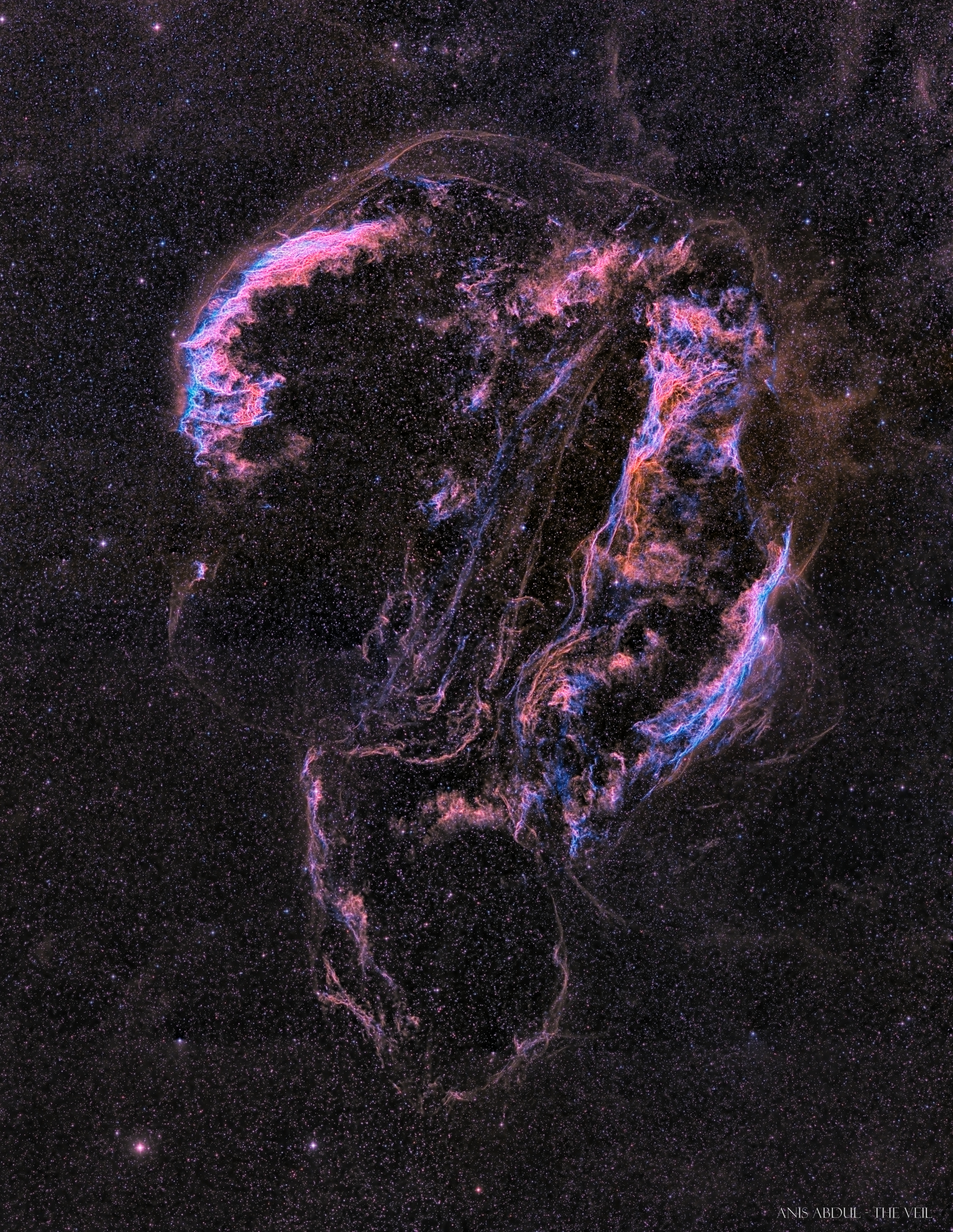
Ten thousand years ago, before the dawn of recorded human history, a new light must suddenly have appeared in the night sky and faded after a few weeks. Today we know this light was an exploding star and record the colorful expanding cloud as the Veil Nebula. The supernova remnant lies about 1,500 light-years away towards the constellation of Cygnus. This supernova remnant actually spans over 6 times the angular size of the full Moon. The bright star 52 Cygnus is visible with the unaided eye from a dark location but unrelated to the ancient supernova. The Veil Nebula is a cloud of heated and ionized gas and dust in the constellation Cygnus. It constitutes the visible portions of the Cygnus Loop (radio source W78, or Sharpless 103), a large but relatively faint supernova remnant. The source supernova exploded some 5,000 to 8,000 years ago, and the remnants have since expanded to cover an area roughly 3 degrees in diameter (about 6 times the diameter, or 36 times the area, of the full Moon). The structure is so large that several NGC numbers were assigned to various arcs of the nebula. There are three main visual components:
- The Western Veil (also known as Caldwell 34), consisting of NGC 6960 (the "Witch's Broom") near the foreground star 52 Cygni.
- The Eastern Veil (also known as Caldwell 33), whose brightest area is NGC 6992, trailing off farther south into NGC 6995 and IC 1340.
- Pickering's Triangle (or Pickering's Triangular Wisp), brightest at the north central edge of the loop, but visible in photographs continuing toward the central area of the loop.
Image Credit: Anis Abdul

Thursday, April 6, 2017

Supernova Remnant N103B

Supernova Remnant N103B
Click on the image for higher resolution (5.8 MB)

This image, taken with the Hubble Space Telescope, shows the supernova remnant SNR 0509-68.7, also known as N103B. N103B was a Type Ia supernova, located in the Large Magellanic Cloud – a neighbouring galaxy of the Milky Way. Owing to its relative proximity to Earth, astronomers observe the remnant to search for a potential stellar survivor of the explosion. The orange-red filaments visible in the image show the shock fronts of the supernova explosion. These filaments allow astronomers to calculate the original centre of the explosion. The filaments also show that the explosion is no longer expanding as a sphere, but is elliptical in shape. Astronomers assume that part of material ejected by the explosion hit a denser cloud of interstellar material, which slowed its speed. The shell of expanding material being open to one side supports this idea. The gas in the lower half of the image and the dense concentration of stars in the lower left are the outskirts of the star cluster NGC 1850, which has been observed by Hubble in the past.
Image Credit: ESA/Hubble, NASA
Image enhancement: Jean-Baptiste Faure

Sunday, September 4, 2016

Supernova Remnant DEM L71

Supernova Remnant DEM L71
Click on the image for higher resolution (3.8 MB)

Several thousand years ago, a star some 160 000 light-years away from us exploded, scattering stellar shrapnel across the sky. The aftermath of this energetic detonation is shown here in this striking image from the Hubble Space Telescope's Wide Field Camera 3. The exploding star was a white dwarf located in the Large Magellanic Cloud, one of our nearest neighbouring galaxies. Around 97% of stars within the Milky Way that are between a tenth and eight times the mass of the Sun are expected to end up as white dwarfs. These stars can face a number of different fates, one of which is to explode as supernovae, some of the brightest events ever observed in the Universe. If a white dwarf is part of a binary star system, it can siphon material from a close companion. After gobbling up more than it can handle – and swelling to approximately one and a half times the size of the Sun – the star becomes unstable and ignites as a Type Ia supernova. This was the case for the supernova remnant pictured here, which is known as DEM L71. It formed when a white dwarf reached the end of its life and ripped itself apart, ejecting a superheated cloud of debris in the process. Slamming into the surrounding interstellar gas, this stellar shrapnel gradually diffused into the separate fiery filaments of material seen scattered across this skyscape.
Image Credit: ESA/Hubble and NASA, Y. Chu
Image enhancement: Jean-Baptiste Faure

Monday, June 10, 2013

Supernova Remnant NGC 6960: Witch's Broom Nebula

Supernova Remnant NGC 6960: Witch's Broom Nebula
Click on the image for full resolution (1.5 MB)

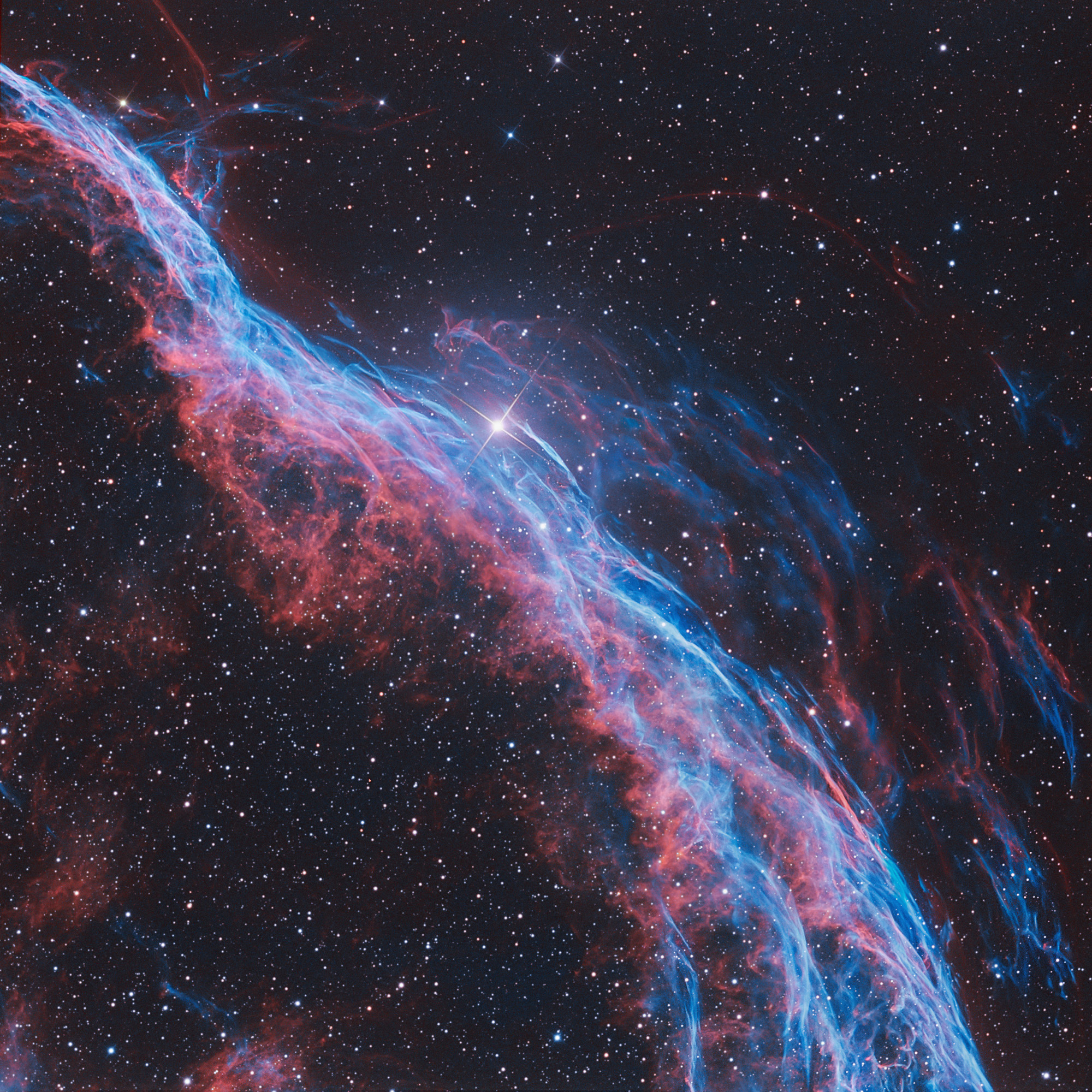
Ten thousand years ago, before the dawn of recorded human history, a new light would have suddenly have appeared in the night sky and faded after a few weeks. Today we know this light was from a supernova, or exploding star, and record the expanding debris cloud as the Veil Nebula, a supernova remnant. This sharp telescopic view is centered on a western segment of the Veil Nebula cataloged as NGC 6960 but less formally known as the Witch's Broom Nebula. Blasted out in the cataclysmic explosion, the interstellar shock wave plows through space sweeping up and exciting interstellar material. Imaged with narrow band filters, the glowing filaments are like long ripples in a sheet seen almost edge on, remarkably well separated into atomic hydrogen (red) and oxygen (blue-green) gas. The complete supernova remnant lies about 1400 light-years away towards the constellation Cygnus. This Witch's Broom actually spans about 35 light-years. The bright star in the frame is 52 Cygni, visible with the unaided eye from a dark location but unrelated to the ancient supernova remnant.
The full resolution image weighs 1.5 MB, so please be (a little) patient when downloading!
Image Credit: Martin Pugh
Image enhancement: Jean-Baptiste Faure

Monday, April 29, 2013

Supernova Remnant SNR B0519-69.0

Supernova Remnant SNR B0519-69.0
Click on the image for full resolution (6.1 MB)

These delicate wisps of gas make up an object known as SNR B0519-69.0, or SNR 0519 for short. The thin, blood-red shells are actually the remnants from when an unstable progenitor star exploded violently as a supernova around 600 years ago. There are several types of supernova, but for SNR 0519 the star that exploded is known to have been a white dwarf star - a Sun-like star in the final stages of its life. SNR 0519 is located over 150 000 light-years from Earth in the southern constellation of Dorado (The Dolphinfish), a constellation that also contains most of our neighbouring galaxy the Large Magellanic Cloud (LMC). Because of this, this region of the sky is full of intriguing and beautiful deep sky objects. The LMC orbits the Milky Way galaxy as a satellite and is the fourth largest in our group of galaxies, the Local Group. SNR 0519 is not alone in the LMC; the Hubble Space Telescope also came across a similar bauble a few years ago in SNR B0509-67.5, a supernova of the same type as SNR 0519 with a strikingly similar appearance. A version of this image was submitted to the Hubble’s Hidden Treasures Image Processing Competition by Claude Cornen, and won sixth prize.
The full resolution image weighs 6.1 MB, so please be patient when downloading!
Image Credit: ESA/Hubble and NASA
Acknowledgement: Claude Cornen
Image enhancement: Jean-Baptiste Faure

Sunday, October 21, 2012

The Cygnus Loop Supernova Remnant

The Cygnus Loop Supernova Remnant
Click on the image for full resolution (10.4 MB)

This image was obtained with the wide-field view of the Mosaic camera on the Mayall 4-meter telescope at Kitt Peak National Observatory. It shows faint filaments that are part of a large supernova remnant called the Cygnus Loop. It is located about 1,500 light-years from Earth. These filaments are the remains of a star that exploded 5,000 to 10,000 years ago. The image was generated with observations in the Oxygen [OIII] (blue), Sulphur [S II] (green) and Hydrogen-Alpha (orange) filters. In this image, North is down, East is right.
The full resolution image weighs 10.4 MB, so please be patient when downloading!
Image Credit: T.A. Rector (University of Alaska Anchorage) and H. Schweiker (WIYN and NOAO/AURA/NSF)
Image enhancement: Jean-Baptiste Faure

Saturday, September 29, 2012

NGC 2736, the Pencil Nebula

NGC 2736, the Pencil Nebula
Click on the image for full resolution (14.3 MB)

The oddly shaped Pencil Nebula aka NGC 2736 is pictured in this image from ESO's La Silla Observatory in Chile. This nebula is a small part of the Vela Supernova Remnant, a huge remnant left over after a supernova explosion that took place about 11 000 years ago. The image was produced by the Wide Field Imager on the MPG/ESO 2.2-meter telescope at ESO's La Silla Observatory. The Pencil Nebula measures about 0.75 light-years across and is moving through the interstellar medium at about 650 000 kilometers per hour. Remarkably, even at its distance of approximately 800 light-years from Earth, this means that it will noticeably change its position relative to the background stars within a human lifetime. Even after 11 000 years the supernova explosion is still changing the face of the night sky.
The full resolution image weighs 14.3 MB, so please be patient when downloading!
Credit: ESO
Image enhancement: Jean-Baptiste Faure

Friday, April 20, 2012

Emission Nebula NGC 6888, the Crescent Nebula

Supernova Remnant NGC 6888, the Crescent Nebula
Click on the image for full resolution (1.29 MB)

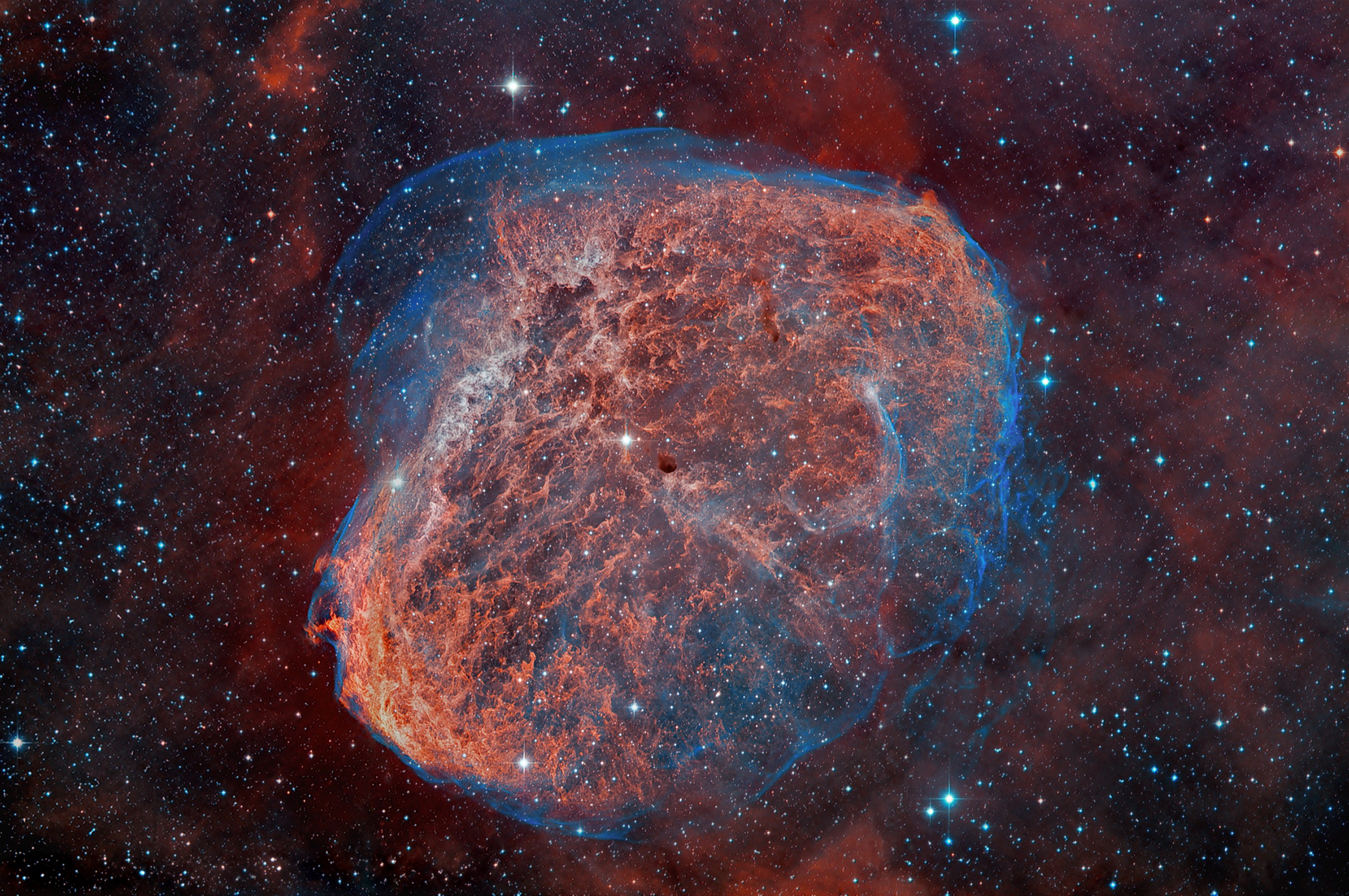
This image of the Crescent Nebula or NGC 6888 was obtained using the Wide Field Camera on the Isaac Newton Telescope. The Crescent Nebula, also known as NGC 6888, is a nebula lighted up by a central Wolf-Rayet star, WR 136 aka PPM 84423 or HD192163, whose ultraviolet radiation is responsible for heating and ionising most of the material ejected by the star during previous evolutionary phases. The strong winds blown by the central, massive star are interacting with the previously expelled material and as a result, the nebula shows a complex structure which resembles a crescent red Moon. The Crescent Nebula surrounds the Wolf-Rayet star HD192163, seen in Hydrogen-α emission. This was observed as part of the Isaac Newton Telescope/Wide Field Camera Photometric Hydrogen-α Survey (IPHAS) of the Galactic Plane. It is a three-colour composite made from data collected using filters to isolate the light emitted by hydrogen alpha (H-alpha) and doubly ionised oxygen (OIII) atoms, and coded in the image as red, green (25% H-alpha and 75% OIII) and blue.
The full resolution image weighs 1.29 MB, so please be patient when downloading!
Credit: Daniel López (IAC)
Image enhancement: Jean-Baptiste Faure