Showing posts with label Reflection Nebulae. Show all posts

Saturday, December 6, 2025

Reflection Nebula GN 04.32.8

Reflection Nebula GN 04.32.8
Click the image for higher resolution (3.4 MB)

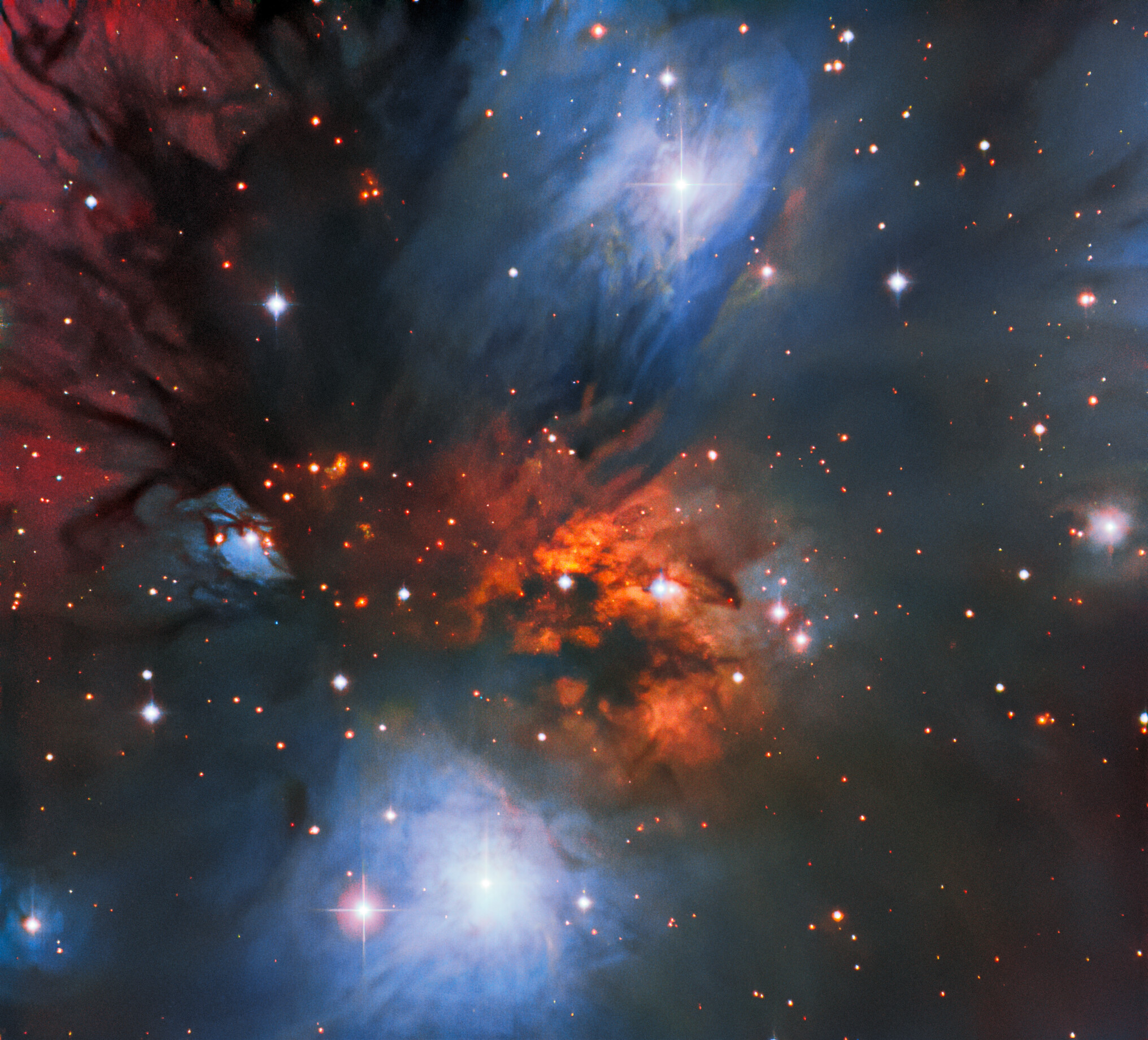
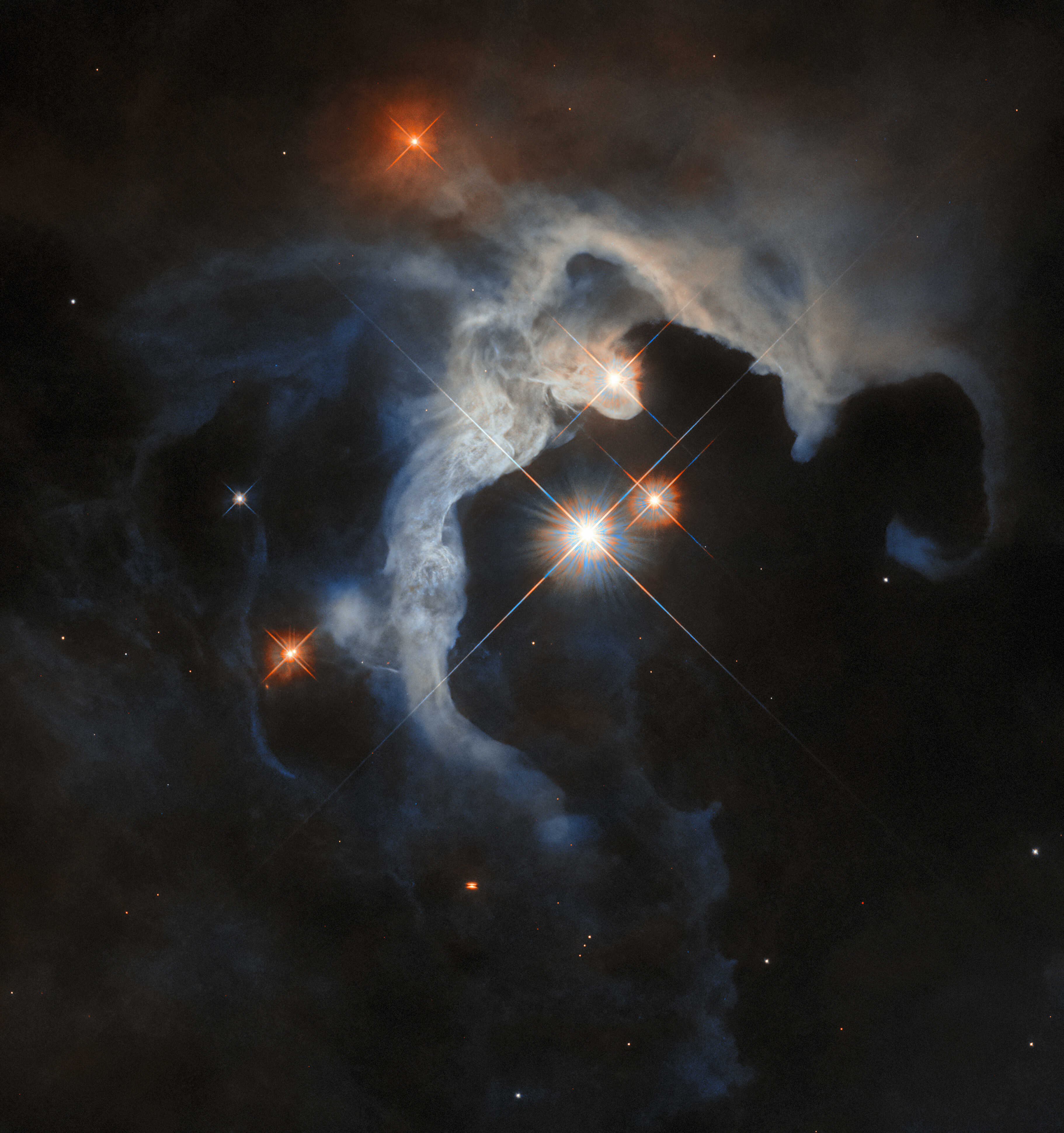
The subject of this picture is a reflection nebula, identified as GN 04.32.8. Reflection nebulae are clouds of dust in space that don't emit their own light, as other nebulae do. Instead, the light from nearby stars hits and scatters off their dust, lighting them up. Because of the way the light scatters, many reflection nebulae tend to appear blue, GN 04.32.8 included.
GN 04.32.8 is a small part of the stellar nursery known as the Taurus Molecular Cloud. At only roughly 480 light-years from Earth in the constellation Taurus, it's one of the best locations for studying newly forming stars. This reflection nebula is illuminated by the system of three bright stars in the center of this image, mainly the variable star V1025 Tauri in the very center. One of those stars overlaps with part of the nebula: this is another variable star that is named HP Tauri, but is classified as a T Tauri star, for its similarity to yet another variable star elsewhere in the Taurus Molecular Complex. T Tauri stars are very active, chaotic stars at an early stage of their evolution, so it's no surprise that they appear in a prolific stellar nursery like this one! The three stars are also named HP Tau, HP Tau G2 and HP Tau G3; they're believed to be gravitationally bound to each other, forming a triple system.
Eagle-eyed viewers might notice the small, squashed, orange spot, just left of centre below the clouds of the nebula, that's crossed by a dark line. This is a newly-formed protostar, hidden in a protoplanetary disc that obstructs some of its light. Because the disc is edge-on to us, it's an ideal candidate for study. Astronomers are using Hubble here to examine it closely, seeking to learn about the kinds of exoplanets that might be formed in discs like it.
Image Credit: ESA/Hubble and NASA, G. Duchêne
Image enhancement: Jean-Baptiste Faure

Sunday, August 10, 2025

The Trifid Nebula as seen by Rubin

The Trifid Nebula as seen by Rubin
Click the image for higher resolution (4.7 MB)

The star-forming Trifid Nebula, also known as Messier 20 (M20), as imaged by NSF–DOE Vera C. Rubin Observatory. The Trifid Nebula is an unusual combination of an open cluster of stars, an emission nebula (the pink region), a reflection nebula (the blue region), and a dark nebula (the dark regions).
Image Credit: RubinObs/NOIRLab/SLAC/NSF/DOE/AURA
Image enhancement: Jean-Baptiste Faure

Friday, August 30, 2024

Star-Forming Region NGC 1333 by Webb

Star-Forming Region NGC 1333 by Webb
Click the image for higher resolution (3.0 MB)

This stunning new mosaic of images from the James Webb Space Telescope showcases the nearby star-forming cluster, NGC 1333. The nebula is in the Perseus molecular cloud, and located approximately 960 light-years away.
Webb's superb sensitivity allows astronomers to investigate young objects with extremely low masses. Some of the faintest "stars" in the picture are in fact newly born free-floating brown dwarfs with masses comparable to those of giant planets.
The same cluster was featured as the 33rd anniversary image of the Hubble Space Telescope in April of 2023. Hubble's image just scratched the surface of this region, because clouds of dust obscure much of the star formation process. Observing with a larger aperture and in the infrared part of the spectrum, Webb is capable of peering through the dusty veil to reveal newborn stars, brown dwarfs and planetary mass objects.
The center of the image presents a deep peek into the heart of the NGC 1333 cloud. Across the image we see large patches of orange, which represent gas glowing in the infrared. These so-called Herbig-Haro objects form when ionised material ejected from young stars collides with the surrounding cloud. They are hallmarks of a very active site of star formation.
Many of the young stars in this image are surrounded by discs of gas and dust, which may eventually produce planetary systems. On the right hand side of the image, we can glimpse the shadow of one of these discs oriented edge-on – two dark cones emanating from opposite sides, seen against a bright background.
Similarly to the young stars in this mosaic, our own Sun and planets formed inside a dusty molecular cloud, 4.6 billion years ago. Our Sun didn't form in isolation but as part of a cluster, which was perhaps even more massive than NGC 1333. The cluster in the mosaic, only 1–3 million years old, presents us with an opportunity to study stars like our Sun, as well as brown dwarfs and free-floating planets, in their nascent stages.
The images were captured as part of the Webb observation programme 1202 (PI: A. Scholz) to survey a large portion of NGC 1333. These data constitute the first deep spectroscopic survey of the young cluster, and have identified brown dwarfs down to planetary masses using the observatory's Near-InfraRed Imager and Slitless Spectrograph (NIRISS). The first results from this survey have been accepted for publication in the Astronomical Journal.
Image Credit: ESA/Webb, NASA and CSA, A. Scholz, K. Muzic, A. Langeveld, R. Jayawardhana
Image enhancement: Jean-Baptiste Faure

Sunday, June 16, 2024

Star-Forming Region M42 as seen by the Subaru Telescope

Star-Forming Region M42 as seen by the Subaru Telescope
Click the image for higher resolution (11.9 MB)

The Orion Nebula, aka Messier 42 (M42), is a star-forming region in the winter constellation. It is located at a distance of 1,500 light-years from Earth and is known as one of the nearest star-forming regions. Due to its large apparent size, the Orion Nebula is easy to find with the naked eye, and many stars can be seen through an amateur telescope.
At the center of the Orion Nebula is a cluster of massive newborn stars called Trapezium that ionize surrounding hydrogen gas by their ultraviolet light. The ionized gas emits a red glow.
Image Credit: NAOJ
Image enhancement: Jean-Baptiste Faure

Star-Forming Region M78 as seen by Euclid

Star-Forming Region M78 as seen by Euclid
Click the image for higher resolution (2.54 MB)

This image is released as part of the Early Release Observations from ESA's Euclid space mission. All data from these initial observations are made public on 23 May 2024 – including a handful of unprecedented new views of the nearby Universe, this being one.
This breathtaking image features Messier 78 aka M78 (the central and brightest region), a vibrant nursery of star formation enveloped in a shroud of interstellar dust. This image is unprecedented – it is the first shot of this young star-forming region at this width and depth.
Euclid peered deep into this enshrouded nursery using its infrared camera, exposing hidden regions of star formation for the first time, mapping its complex filaments of gas and dust in unprecedented detail, and uncovering newly formed stars and planets. This is the first time we’ve been able to see these smaller, sub-stellar sized objects in Messier 78; the dark clouds of gas and dust usually hide them from view, but Euclid’s infrared "eyes" can see through these obscuring clouds to explore within.
Euclid's sensitive instruments can detect objects just a few times the mass of Jupiter, and its visible and infrared instruments – the VIS and NISP cameras – reveal over 300 000 new objects in this field of view alone. Scientists are using this data to study the amount and ratio of stars and sub-stellar objects here, which is key to understanding the dynamics of how star populations form and change over time. Sub-stellar objects like brown dwarfs and free-floating or "rogue" planets are also one possible candidate for dark matter. While our current knowledge suggests that there aren't enough of these objects to solve the mystery of dark matter in the Milky Way, it remains an open question, and one that Euclid will definitively answer by probing a significant fraction of our galaxy.
Also visible to the top of the frame is the bright nebula NGC 2071, and a third filament of star formation towards the bottom of the image (with a "traffic light"-like appearance). This lower region is a dark nebula producing lower-mass stars, all arranged along elongated filaments in space. Messier 78 lies 1300 light-years away in the constellation of Orion.
Image Credit: ESA/Euclid/Euclid Consortium/NASA
Image processing: Jean-Charles Cuillandre (CEA Paris-Saclay) and Giovanni Anselmi
Image enhancement: Jean-Baptiste Faure

Saturday, June 15, 2024

Emission and Reflection Nebula Gum 3

Emission and Reflection Nebula Gum 3
Click the image for higher resolution (3.2 MB)

This picture shows the brightly coloured Gum 3 nebula as seen with the VLT Survey Telescope (VST), hosted at ESO's Paranal Observatory in the Chilean Atacama Desert. Attentive viewers may find that part of Gum 3 resembles a Koi fish in this VST image. Equipped with the OmegaCAM instrument, an enormous 268-megapixel camera, the telescope is designed to survey large areas of the southern sky in visible light and take stunning images like this one.
Gum 3 is an interstellar cloud of gas and dust located about 3600 light-years away, between the Monoceros and Canis Major constellations. It is named after Colin Stanley Gum, an Australian astronomer who catalogued 84 nebulae in the southern sky.
When the intense ultraviolet radiation from nearby young stars hits hydrogen atoms in the cloud, they emit visible light at very specific colours, which we see as shades of red and pink in the image. At the same time, tiny particles of dust within the cloud reflect starlight, especially blue colours, similar to what makes the sky look blue here on Earth. This play of colours makes nebulae like this spectacular to look at.
This image shows not only colour, but also the lack of it. Look closely at the area just right of the brightest part of the cloud – right of the pink "Koi-smic fish". Does anything look odd to you? It's not that there really are fewer stars in this dark area; instead, there is a big clump of dust that blocks part of the visible light, hiding the stars from VST and us.
Image Credit: ESO/VPHAS+ team. Ack.: CASU
Image enhancement: Jean-Baptiste Faure

Saturday, April 20, 2024

Reflection Nebula Bernes 149 in Absorption Nebula Lupus 3

Reflection Nebula Bernes 149 in Absorption Nebula Lupus 3
Click the image for higher resolution (4.7 MB)

The massive, star-forming interstellar cloud Lupus 3 is captured with the 570-megapixel US Department of Energy-fabricated Dark Energy Camera at the National Science Foundation's NOIRLab's Cerro Tololo Inter-American Observatory in Chile. The dazzling central region of this sprawling cloud reveals a pair of infant stars bursting from their natal cocoons of dust and gas to illuminate the reflection nebula known as Bernes 149. These contrasting regions make this object a prime target of research on star formation. This star-forming nebula is located about 500 light-years from Earth in the direction of the constellation Lupus (the Wolf).
The clashing of energy and matter can lead to fantastical sites on Earth, such as glowing auroras and powerful lightning displays. The same can be said about space, where energy from bright young stars and protostars floods their surroundings, illuminating vast interstellar clouds of dust and gas to create spectacular objects known as reflection nebulae.
The two blue stars blazing in the center of the sprawling nebula, known as HR 5999 and HR 6000, illuminate nearby gas and dust, creating the bright blue reflection nebula Bernes 149. These stars grew out of the dark nebula Lupus 3, which stretches like a blanket across the background of stars. This cloud is not just a coal-black cosmic blob, however. It is home to a fleet of infant stars known as T Tauri stars, which will eventually use the material of Lupus 3 to grow into fully fledged stars.
At the relatively young age of about 1 million years, HR 5999 and HR 6000 are the oldest of the stars in the Lupus 3 region. These stars are pre-main-sequence stars, meaning that despite their brightness, they are not yet powered by nuclear fusion, like our Sun. They are instead powered by gravity, which compresses and heats up the internal matter. These sibling stars have blown away nearby gas and dust, illuminating the remnants and creating the Bernes 149 reflection nebula.
Lupus 3 is one of at least nine clouds within the massive Lupus cloud complex. Lupus 3 itself stretches across an area of the sky equivalent to about 24 Moon-diameters as seen from Earth. With a whopping 2.2-degree field of view, DECcam can capture massive objects like Lupus 3 in a single image.
Image Credit: CTIO/NOIRLab/DOE/NSF/AURA/ T.A. Rector (University of Alaska Anchorage/NSF's NOIRLab)
Image Processing: D. de Martin and M. Zamani (NSF's NOIRLab)
Image enhancement: Jean-Baptiste Faure

Saturday, January 6, 2024

Emission Nebula IC 1284

Emission Nebula IC 1284
Click the image for higher resolution (4.6 MB)

There are two different types of nebulae brought to you in this picture. Each appears with a distinct colour in the visible sky and are captured here using the wide-field camera OmegaCAM on the VLT Survey Telescope (VST), hosted at ESO's Paranal Observatory in the Chilean desert.
The large, bright emission nebula at the center, IC 1284, is a star-forming region composed primarily of hydrogen. Its rosy glow comes from electrons within the hydrogen atoms: they're excited by the radiation from young stars, but then they lose energy and emit a specific colour or wavelength of light. One of the filters on OmegaCAM lets through this particular reddish colour, hence the nebula's look. Meanwhile, another colour filter highlights the blue reflection nebulae NGC 6589 and NGC 6590 in the lower right corner. The dust in a reflection nebula preferentially scatters shorter, bluer wavelengths of light from nearby stars, which is what gives these nebulae their eerie glow. It's the same reason why the sky is blue!
The frame of this image covers an area roughly equivalent in the sky to a full Moon. This image was captured as part of a large ESO public survey, the VST Photometric H alpha Survey of the Southern Galactic Plane and Bulge (VPHAS+), which observes nebulae and stars in visible light to help astronomers understand how stars are born, live and die.
Image Credit: ESO/VPHAS+ team
Image enhancement: Jean-Baptiste Faure

Friday, September 30, 2022

Young Stellar Object IRAS 05506+2414

Young Stellar Object IRAS 05506+2414
Click the image for higher resolution

A bright young star is surrounded by a shroud of thick gas and dust in this image from the Hubble Space Telescope. Hubble's Wide Field Camera 3 inspected a young stellar object, over 9000 light years away in the constellation Taurus, to help astronomers understand the earliest stages in the lives of massive stars. This object – which is known to astronomers as IRAS 05506+2414 – is thought to be an example of an explosive event caused by the disruption of a massive young star system. If so, it would only be the second such example known.
Usually the swirling discs of material surrounding a young star are funnelled into twin outflows of gas and dust from the star. In the case of IRAS 05506+2414, however, a fan-like spray of material travelling at velocities of up to 350 kilometers per second is spreading outwards from the center of this image.
Astronomers turned to Hubble's Wide Field Camera 3 to measure the distance to IRAS 05506+2414. While it is possible to measure the velocity of material speeding outwards from the star, astronomers cannot tell how far from Earth the star actually is from a single observation. However, by measuring the distance that the outflow travels between successive images, they will be able to infer the distance to IRAS 05506+2414. This will allow astronomers to determine how bright the star is and how much energy it is emitting, and hence to estimate its mass – all vital information that will help to understand the origin of this bright young star's unusual outflow.
Image Credit: ESA/Hubble and NASA, R. Sahai
Image enhancement: Jean-Baptiste Faure

Thursday, April 15, 2021

Reflection Nebula NGC 2626

Reflection Nebula NGC 2626
Click on the image for higher resolution (1.1 MB)

This image is so beautiful that it could almost be a painting, but it is real. It has been produced using observations made at the SMARTS 0.9-meter Telescope at the Cerro Tololo Inter-American Observatory (CTIO), which is a Program of NSF's NOIRLab. It features a reflection nebula known as NGC 2626, which lies 3300 light-years from Earth.
Reflection nebulae are not luminous themselves, but they reflect light from a nearby star or stars. The light scatters off the dust particles in the nebulae, which often results in reflection nebulae having a blue tint, because blue light scatters more efficiently. This is the same phenomenon that makes the sky on Earth appear blue – the laws of physics are the same throughout our Universe! The red nebulosities are glowing hydrogen gas.
Image Credit: CTIO/NOIRLab/NSF/AURA/SMARTS Consortium
Image processing: T. A. Rector (University of Alaska Anchorage/NSF's NOIRLab), M. Zamani & D. de Martin (NSF's NOIRLab)

Saturday, February 20, 2021

Reflection Nebula NGC 2170

Reflection Nebula NGC 2170
Click on the image for higher resolution (1.0 MB)

This striking image, streaked with bright swathes of color, captures the beautiful reflection nebula NGC 2170. The diffuse clouds of interstellar dust in the nebula scatter and reflect light from nearby stars, creating this vividly colorful scene. Dust grains reflect blue light from hot stars embedded in the nebula. And warm hydrogen gas glows a deep red. Seen as dark tendrils, dust also absorbs the light from stars and gas behind it. This particular nebula lies in the constellation Monoceros (The Unicorn) – a faint constellation on the celestial equator. It was observed using the SMARTS 0.9-meter Telescope at Cerro Tololo Inter-American Observatory in Chile, a Program of NSF's NOIRLab.
Image Credit: CTIO/NOIRLab/NSF/AURA
Acknowledgments: Travis Rector (University of Alaska Anchorage), Mahdi Zamani & Davide de Martin
Image enhancement: Jean-Baptiste Faure
Saturday, February 13, 2021

Reflection Nebula vdB 152 aka Barnard 175

Reflection Nebula vdB 152 aka Barnard 175
Click on the image for higher resolution (27.5 MB)

This image was obtained with the wide-field view of the Mosaic camera on the Mayall 4-meter telescope at Kitt Peak National Observatory. Also known as Barnard 175, vdB 152 is a reflection nebula atop of a dark Bok globule. Embedded in the top right side of the nebula is the Herbig Haro object HH 450, a jet emitted from a newly forming star. The thin, red filaments in the upper-right corner of the image are the remnants of a supernova explosion. It is not yet clear whether or not the supernova remnant will collide with vdB 152. The image was generated with observations in the B (blue), V (green), I (yellow) and Hydrogen-Alpha (red) filters. In this image, North is down and East is to the right.
Image Credit: T.A. Rector (University of Alaska Anchorage) and H. Schweiker (WIYN and NOIRLab/NSF/AURA)
Image enhancement: Jean-Baptiste Faure

Reflection Nebula NGC 1788

Reflection Nebula NGC 1788
Click on the image for higher resolution (18.1 MB)


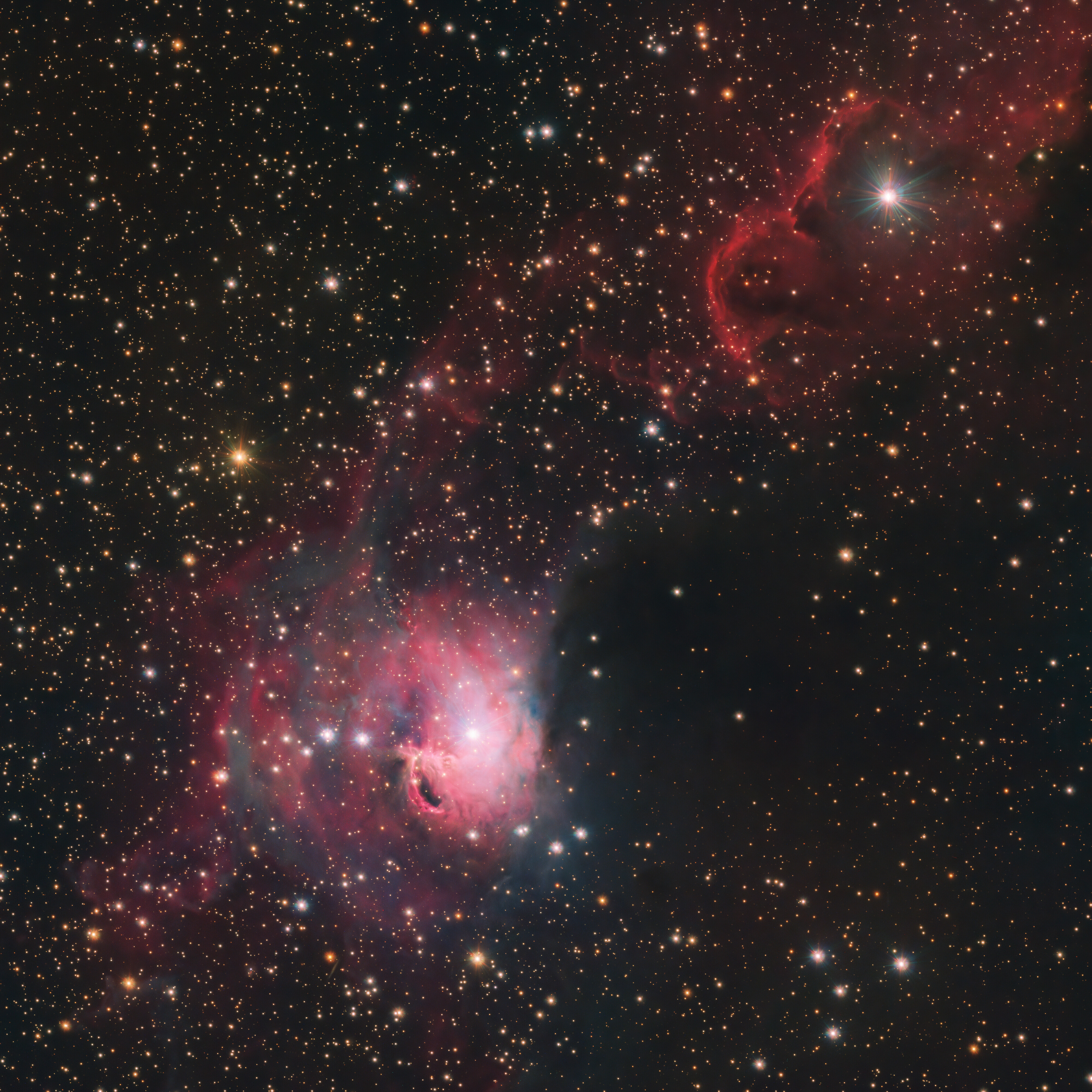
This image was obtained with the wide-field view of the Mosaic camera on the Mayall 4-meter telescope at Kitt Peak National Observatory. NGC 1788 is an unusual reflection nebula (bluish white at the center of the image) surrounded by a glowing red ring of hydrogen gas. The stars inside the nebula are only about a million years old, which is very young compared to most stars. The ring of glowing hydrogen gas is energized by nearby hot, massive stars not visible in the image. The image was generated with observations in the B (blue), I (orange) and Hydrogen-Alpha (red) filters. In this image, North is up, East is to the left.
Image Credit: T.A. Rector (University of Alaska Anchorage), H. Schweiker (WIYN and NOIRLab/NSF/AURA) & S. Pakzad (NOIRLab/NSF/AURA)
Image enhancement: Jean-Baptiste Faure
Friday, November 22, 2019

Reflection Nebula vdB 141 South

Reflection Nebula vdB 141 South
Click on the image for higher resolution (4.1 MB)

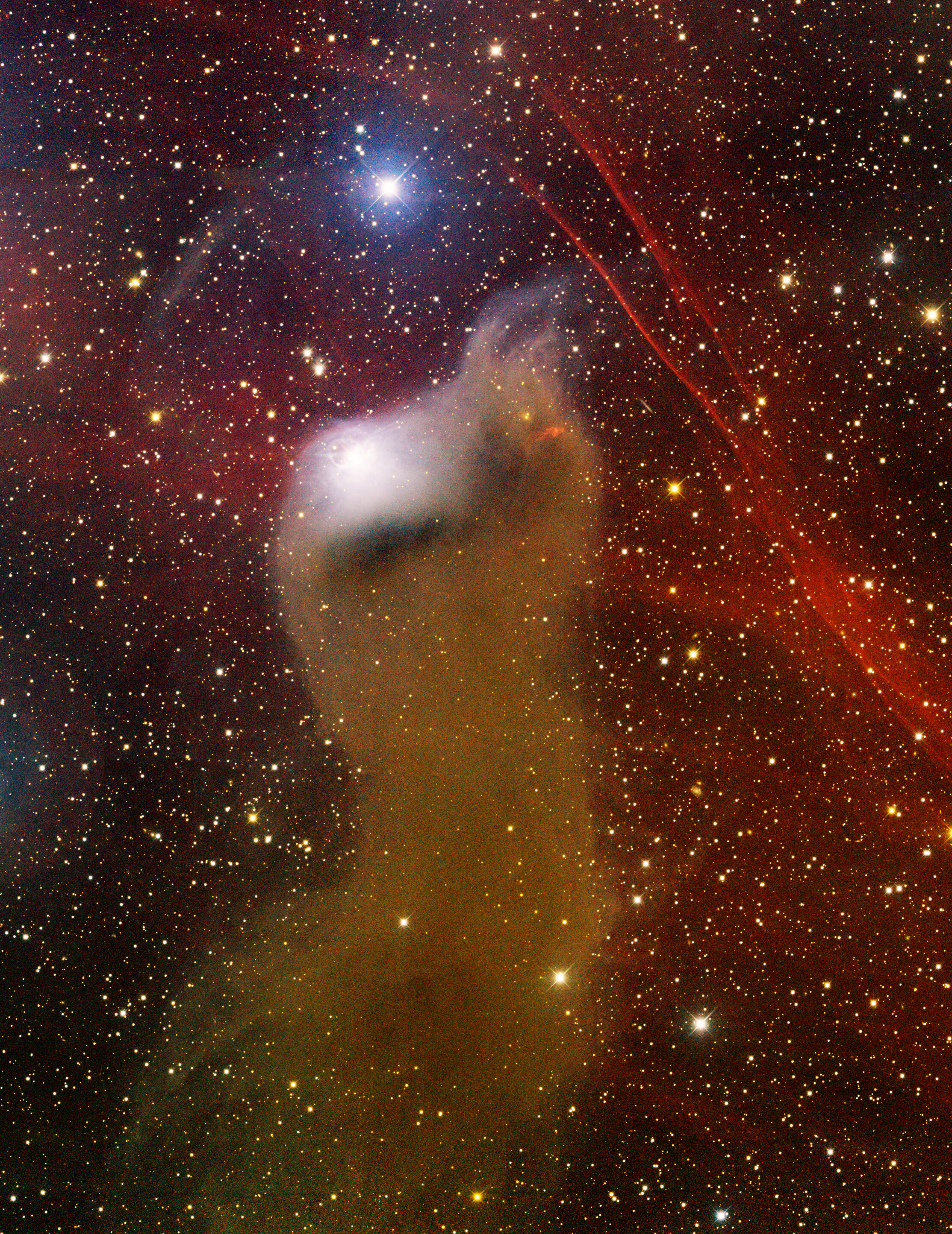
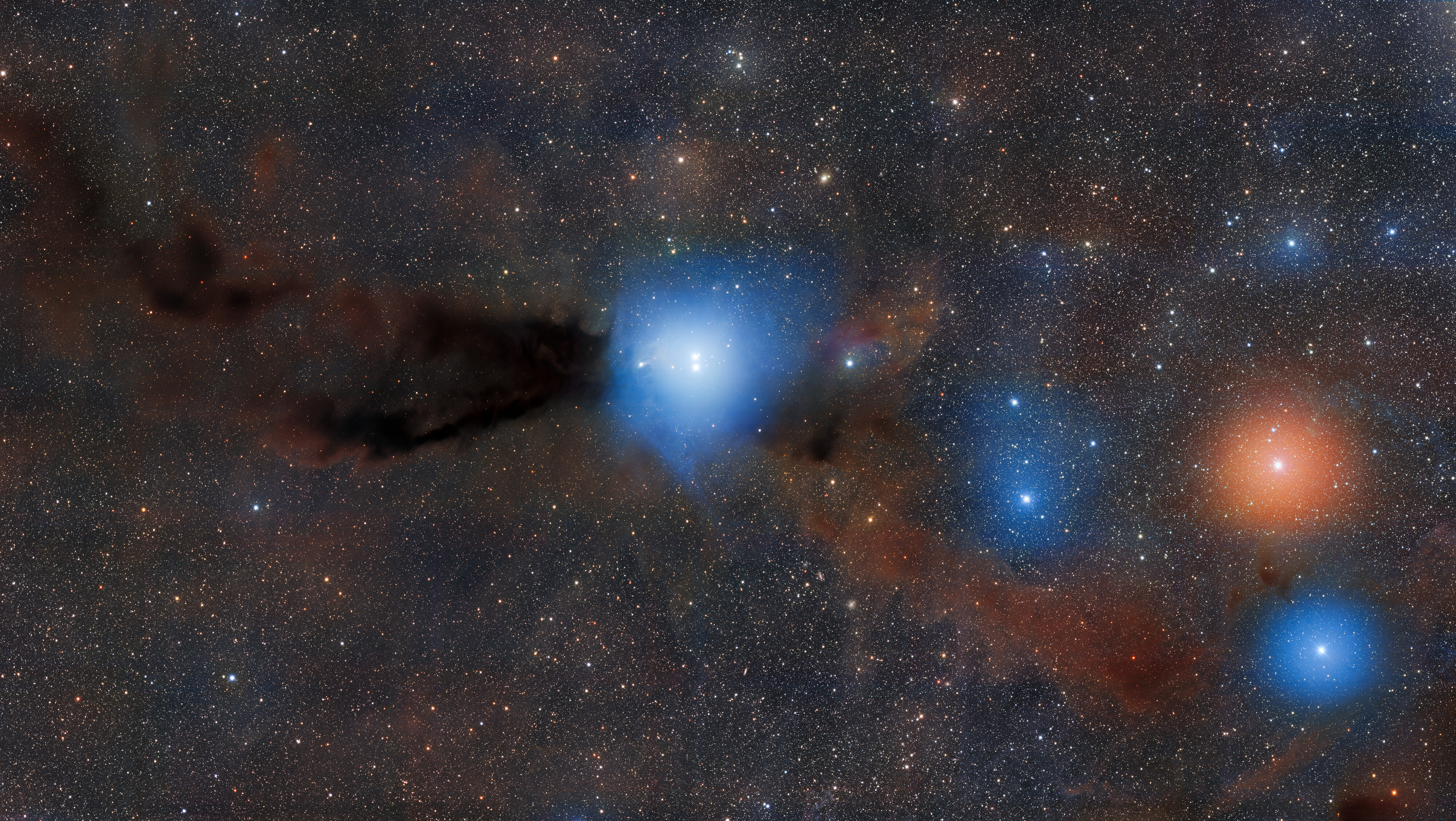
This image was obtained with the wide-field view of the Mosaic Camera on the Mayall 4-meter telescope at Kitt Peak National Observatory. This globule is located just south of vdB 141, a reflection nebula located in the constellation Cepheus. This very faint nebula looks like a bird about to take flight. North is down and East is to the right.
Image Credit: T.A. Rector/University of Alaska Anchorage, H. Schweiker/WIYN and NOAO/AURA/NSF
Image enhancement: Jean-Baptiste Faure

Monday, May 13, 2019

Reflection Nebula NGC 2023

Reflection Nebula NGC 2023
Click on the image for higher resolution

The constellation of Orion (The Hunter) is one of the most recognisable collections of stars in the night sky. We have noted Orion's prominent stars for tens of thousands of years at least, and likely far longer. Chinese astronomers called it 参宿 or Shēn, literally "three stars", for its three bright dots (which form the Hunter’s belt). The ancient Egyptians regarded it as the gods Sah and Sopdet, manifestations of Osiris and Isis, respectively, whereas Greek astronomers saw a brave hunter – the eponymous Orion – with his sword above his head, ready to strike.
Mythology aside, Orion is a fascinating patch of sky. This image, from ESO's Very Large Telescope, shows a reflection nebula nestled at the heart of the constellation – NGC 2023. Located close to the well-known Horsehead and Flame Nebulae, NGC 2023 lurks about 1500 light-years away from Earth, and is one of the largest reflection nebulae in the sky.
Reflection nebulae are clouds of interstellar dust that reflect the light from nearby or internal sources, like fog around a car headlight. NGC 2023 is illuminated by a massive young star named HD 37903. The star is extremely hot – several times hotter than the Sun – and its bright blue-white light causes NGC 2023's milky glow. Such nebulae are often the birthplaces of stars, and contain a clumpy distribution of gas that's significantly denser than the surrounding medium. Under the influence of gravity, these clumps attract one another and merge, eventually creating a new star. In a few million years time, Orion's Belt may gain a new star!
The image was taken with the VLT's FORS (FOcal Reducer and Spectrograph) instrument as part of the ESO Cosmic Gems programme. This initiative produces images of interesting and visually attractive objects using ESO telescopes, for the purposes of education and outreach. The programme makes use of telescope time that cannot be used for science observations. All data collected may also be suitable for scientific purposes, and are made available to astronomers through ESO's science archive.
Image Credit: ESO
Image enhancement: Jean-Baptiste Faure
Monday, April 29, 2019

Reflection Nebula NGC 1999

Reflection Nebula NGC 1999
Click on the image for higher resolution (2.5 MB)

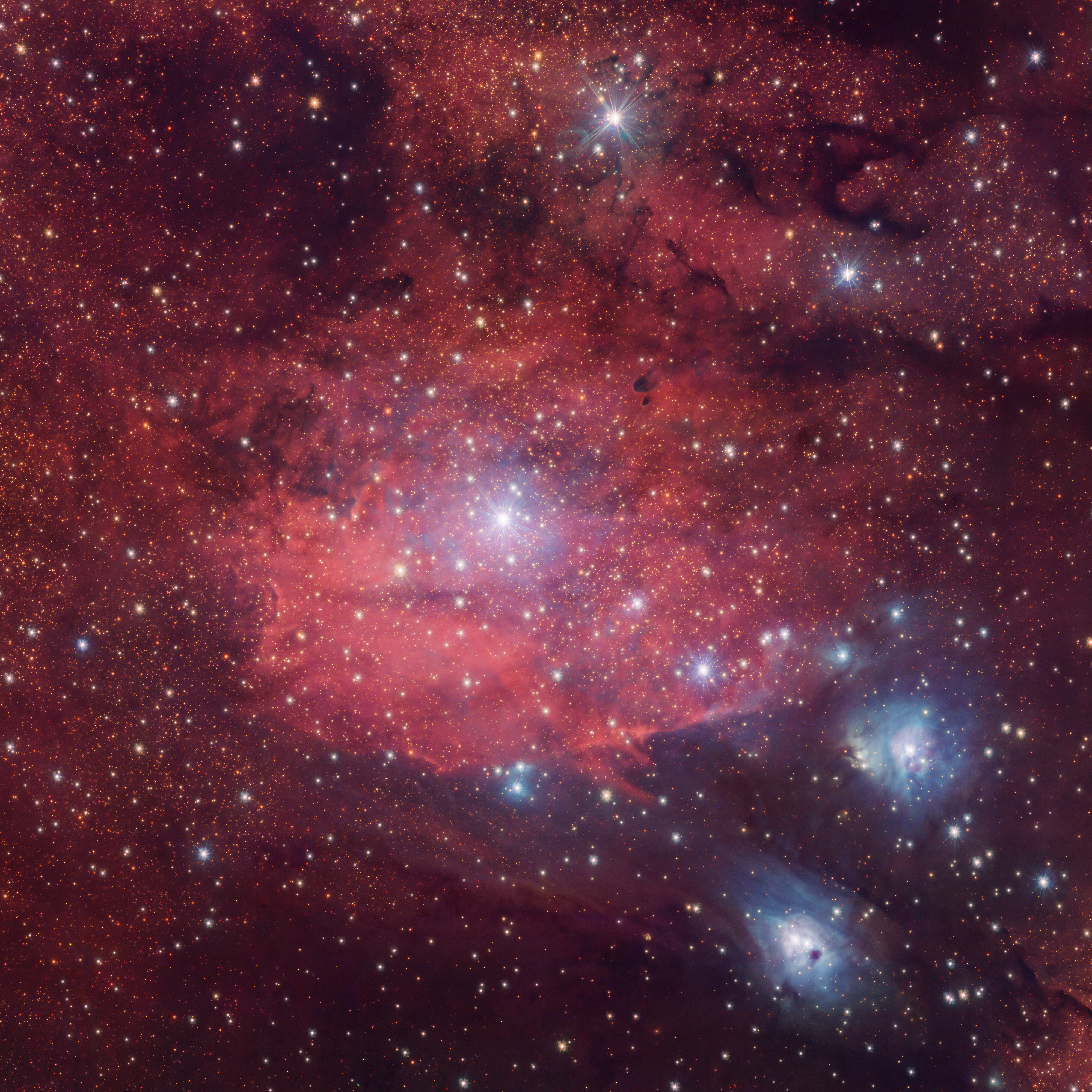
This wide-field panorama of star formation was captured with the National Science Foundation's Mayall 4-meter telescope on Kitt Peak, Arizona. Located in the constellation of Orion (the Hunter), the image show a portion of one of Orion's giant molecular clouds (known as "Orion A") where new stars are forming. The bright object in the bottom-left corner is the reflection nebula NGC 1999, which contains the young star V380 Orionis. A small, triangle shaped patch of dusty material is seen in silhouette against the reflection nebula. NGC 1999 lies at the center of a network of nebulous filaments which billow out and away like the spokes of a bicycle wheel. Powerful jets of gas are often the first visible manifestations of the birth of young stars. These jets punch holes through the opaque clouds in which the star is formed, holes through which the light of the new-born stars can escape to produce what are known as reflection nebulae. Several such nebulae are seen in this image. Outflowing jets from young stars also power luminous shock waves known as Herbig-Haro (HH) objects, which move through the surrounding gas at speeds of up to hundreds of kilometers per second (over 100,000 miles an hour). As these shock waves ram their surroundings, they heat up bow-shaped nebulae of glowing plasma. This image shows dozens of such objects. Many other smaller nebulous patches in this image mark small reflection nebulae, Herbig-Haro objects, and stellar jets. The rich detail in this image reveals one of the most fascinating areas of the night sky.
Image Credit: Z. Levay (STScI/AURA/NASA), T.A. Rector (University of Alaska Anchorage) and H. Schweiker (NOAO/AURA/NSF)
Image enhancement: Jean-Baptiste Faure

Tuesday, October 30, 2018

Emission and Reflection Nebula IC 63

Emission and Reflection Nebula IC 63
Click on the image for higher resolution (7.0 MB)

About 550 light-years away in the constellation of Cassiopeia lies IC 63, a stunning and slightly eerie nebula. Also known as the ghost of Cassiopeia, IC 63 is being shaped by radiation from a nearby unpredictably variable star, Gamma Cassiopeiae, which is slowly eroding away the ghostly cloud of dust and gas. This celestial ghost makes the perfect backdrop for the upcoming feast of All Hallow's Eve – better known as Halloween.
The remarkable Gamma Cassiopeiae is a blue-white subgiant variable star that is surrounded by a gaseous disc. This star is 19 times more massive and 65 000 times brighter than our Sun. It also rotates at the incredible speed of 1.6 million kilometers per hour – more than 200 times faster than our parent star. This frenzied rotation gives it a squashed appearance. The fast rotation causes eruptions of mass from the star into a surrounding disk. This mass loss is related to the observed brightness variations. The radiation of Gamma Cassiopeiae is so powerful that it even affects IC 63, sometimes nicknamed the Ghost Nebula, that lies several light years away from the star. IC 63 is visible in this image taken by the Hubble Space Telescope. The colours in the eerie nebula showcase how the nebula is affected by the powerful radiation from the distant star. The hydrogen within IC 63 is being bombarded with ultraviolet radiation from Gamma Cassiopeiae, causing its electrons to gain energy which they later release as hydrogen-alpha radiation – visible in red in this image.
This hydrogen-alpha radiation makes IC 63 an emission nebula, but we also see blue light in this image. This is light from Gamma Cassiopeiae that has been reflected by dust particles in the nebula, meaning that IC 63 is also a reflection nebula. This colourful and ghostly nebula is slowly dissipating under the influence of ultraviolet radiation from Gamma Cassiopeiae. However, IC 63 is not the only object under the influence of the mighty star. It is part of a much larger nebulous region surrounding Gamma Cassiopeiae that measures approximately two degrees on the sky – roughly four times as wide as the full Moon. This region is best seen from the Northern Hemisphere during autumn and winter. Though it is high in the sky and visible all year round from Europe, it is very dim, so observing it requires a fairly large telescope and dark skies.
This photo is possibly the most detailed image that has ever been taken of IC 63, and it beautifully showcases Hubble's capabilities.
Image Credit: NASA and ESA
Image enhancement: Jean-Baptiste Faure

Wednesday, April 1, 2015

Reflection Nebula NGC 7023 – The Iris Nebula

Reflection Nebula NGC 7023 – The Iris Nebula
Click on the image for full resolution (15.7 MB)

This image was obtained with the wide-field view of the Mosaic Camera on the Mayall 4-meter telescope at Kitt Peak National Observatory. NGC 7023, also known as the Iris Nebula because of its flower-like shape, is a bright reflection nebula. The bluish glow of the nebula comes from a hot, massive star at the center of the nebula, named HD 200775. Blue light from the star is scattered off dust grains in the nebula, giving it its distinctive color. The dust can also be seen on the outer portions of the nebula, where it has a faint brownish color and blocks out stars behind it. It was observed in the filters B (blue), V (green), R (orange) and Hydrogen-Alpha (red). The image is rotated 30 degrees CCW from North is up, East is to the left.
Image Credit: T.A. Rector/University of Alaska Anchorage, H. Schweiker/WIYN and NOAO/AURA/NSF
Image enhancement: Jean-Baptiste Faure

Tuesday, March 3, 2015

Young Star V1331 Cyg And Surrounding Nebula

Young Star V1331 Cyg And Surrounding Nebula
Click on the image for full resolution

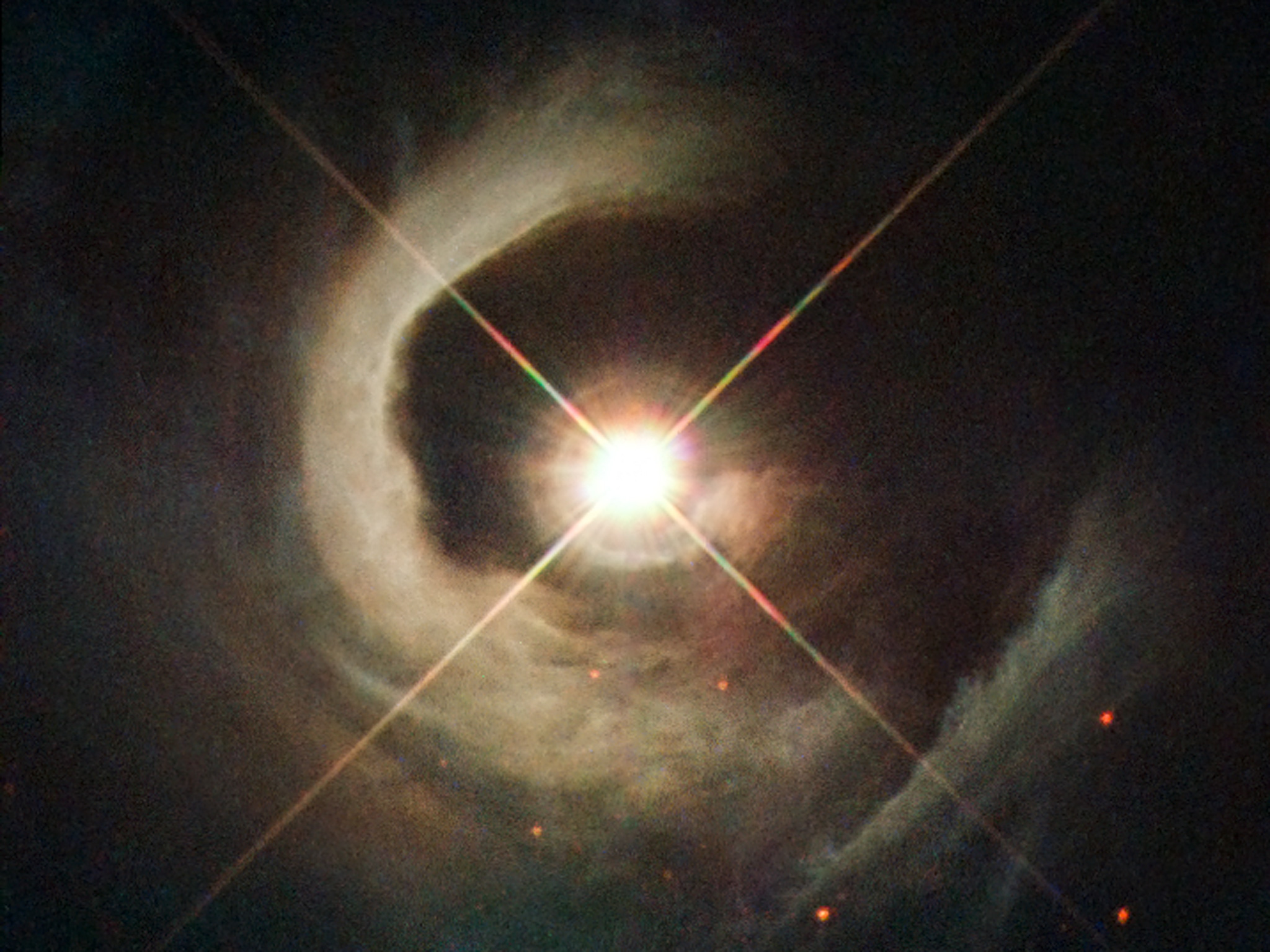
With its helical appearance resembling a snail's shell, this reflection nebula seems to spiral out from a luminous central star in this new Hubble Space Telescope image. The star in the center, known as V1331 Cyg and located in the dark cloud LDN 981 - or, more commonly, Lynds 981 - had previously been defined as a T Tauri star. A T Tauri is a young star - or Young Stellar Object - that is starting to contract to become a main sequence star similar to the Sun. What makes V1331Cyg special is the fact that we look almost exactly at one of its poles. Usually, the view of a young star is obscured by the dust from the circumstellar disc and the envelope that surround it. However, with V1331Cyg we are actually looking in the exact direction of a jet driven by the star that is clearing the dust and giving us this magnificent view. This view provides an almost undisturbed view of the star and its immediate surroundings allowing astronomers to study it in greater detail and look for features that might suggest the formation of a very low-mass object in the outer circumstellar disc.
Image Credit: ESA/Hubble, NASA, Karl Stapelfeldt (GSFC), B. Stecklum and A. Choudhary (Thüringer Landessternwarte Tautenburg, Germany)
Image enhancement: Jean-Baptiste Faure

Saturday, September 6, 2014

Young Stellar Object SSTC2D J033038.2+303212

Young Stellar Object SSTC2D J033038.2+303212
Click on the image for full resolution (6.0 MB)

This new Hubble Space Telescope image shows a variety of intriguing cosmic phenomena. Surrounded by bright stars, towards the upper middle of the frame we see a small young stellar object (YSO) known as SSTC2D J033038.2+303212. Located in the constellation of Perseus, this star is in the early stages of its life and is still forming into a fully grown star. In this view from Hubble's Advanced Camera for Surveys (ACS) it appears to have a murky chimney of material emanating outwards and downwards, framed by bright bursts of gas flowing from the star itself. This fledgling star is actually surrounded by a bright disc of material swirling around it as it forms - a disc that we see edge-on from our perspective. However, this small bright speck is dwarfed by its cosmic neighbour towards the bottom of the frame, a clump of bright, wispy gas swirling around as it appears to spew dark material out into space. The bright cloud is a reflection nebula known as [B77] 63, a cloud of interstellar gas that is reflecting light from the stars embedded within it. There are actually a number of bright stars within [B77] 63, most notably the emission-line star LkHA 326, and its very near neighbour LZK 18. These stars are lighting up the surrounding gas and sculpting it into the wispy shape seen in this image. However, the most dramatic part of the image seems to be a dark stream of smoke piling outwards from [B77] 63 and its stars - a dark nebula called Dobashi 4173. Dark nebulae are incredibly dense clouds of pitch-dark material that obscure the patches of sky behind them, seemingly creating great rips and eerily empty chunks of sky. The stars speckled on top of this extreme blackness actually lie between us and Dobashi 4173.
Image Credit: ESA/Hubble and NASA
Image enhancement: Jean-Baptiste Faure