Showing posts with label Small Bodies. Show all posts

Thursday, November 17, 2011

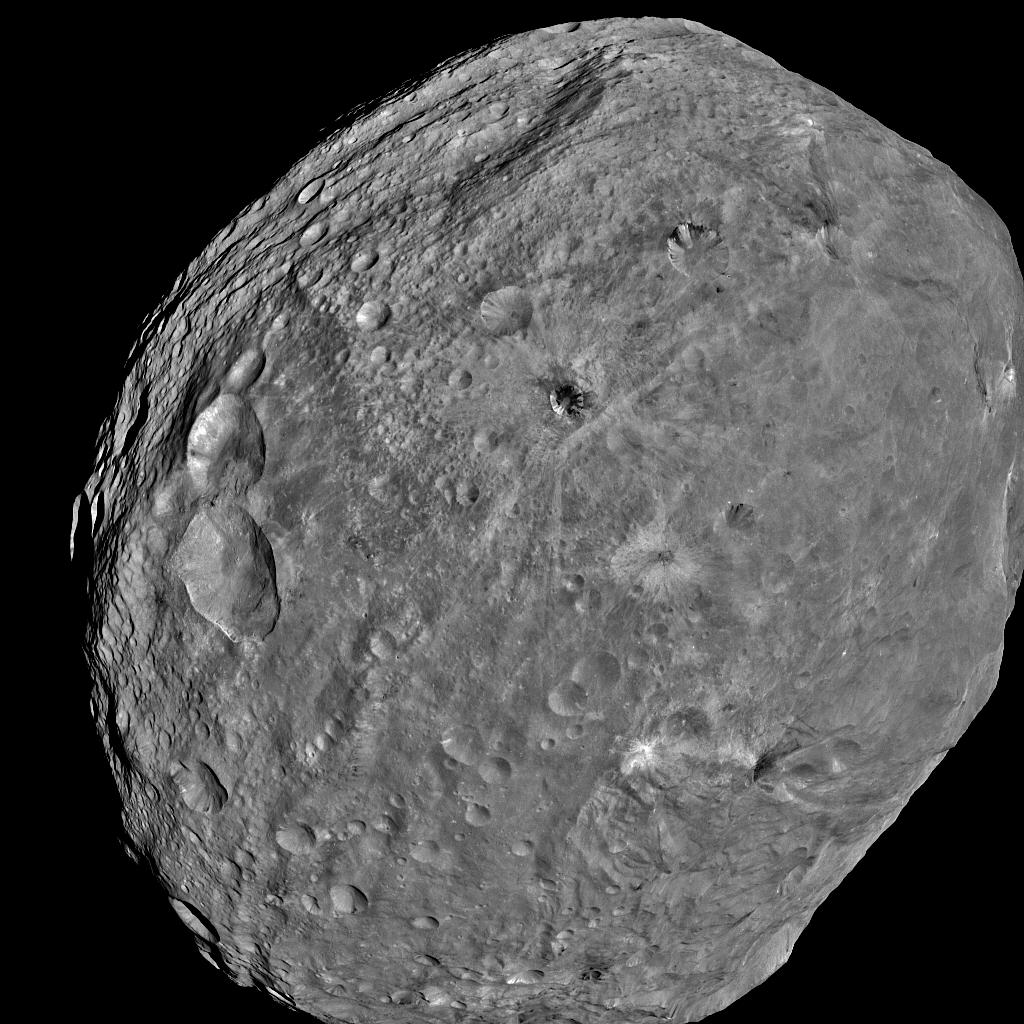
Asteroid Vesta full-frame image taken by Dawn spacecraft!

Asteroid Vesta full-frame image taken by Dawn spacecraft!
Click on the image for full resolution

NASA's Dawn spacecraft obtained this image of the giant asteroid Vesta with its framing camera on July 24, 2011. It was taken from a distance of about 5,200 kilometers (3,200 miles). Dawn entered orbit around Vesta on July 15, and will spend a year orbiting the body. After that, the next stop on its itinerary will be an encounter with the dwarf planet Ceres. The framing camera project is funded by NASA, the Max Planck Society and DLR.
Credit: NASA/JPL-Caltech/UCLA/MPS/DLR/IDA

Wednesday, November 16, 2011

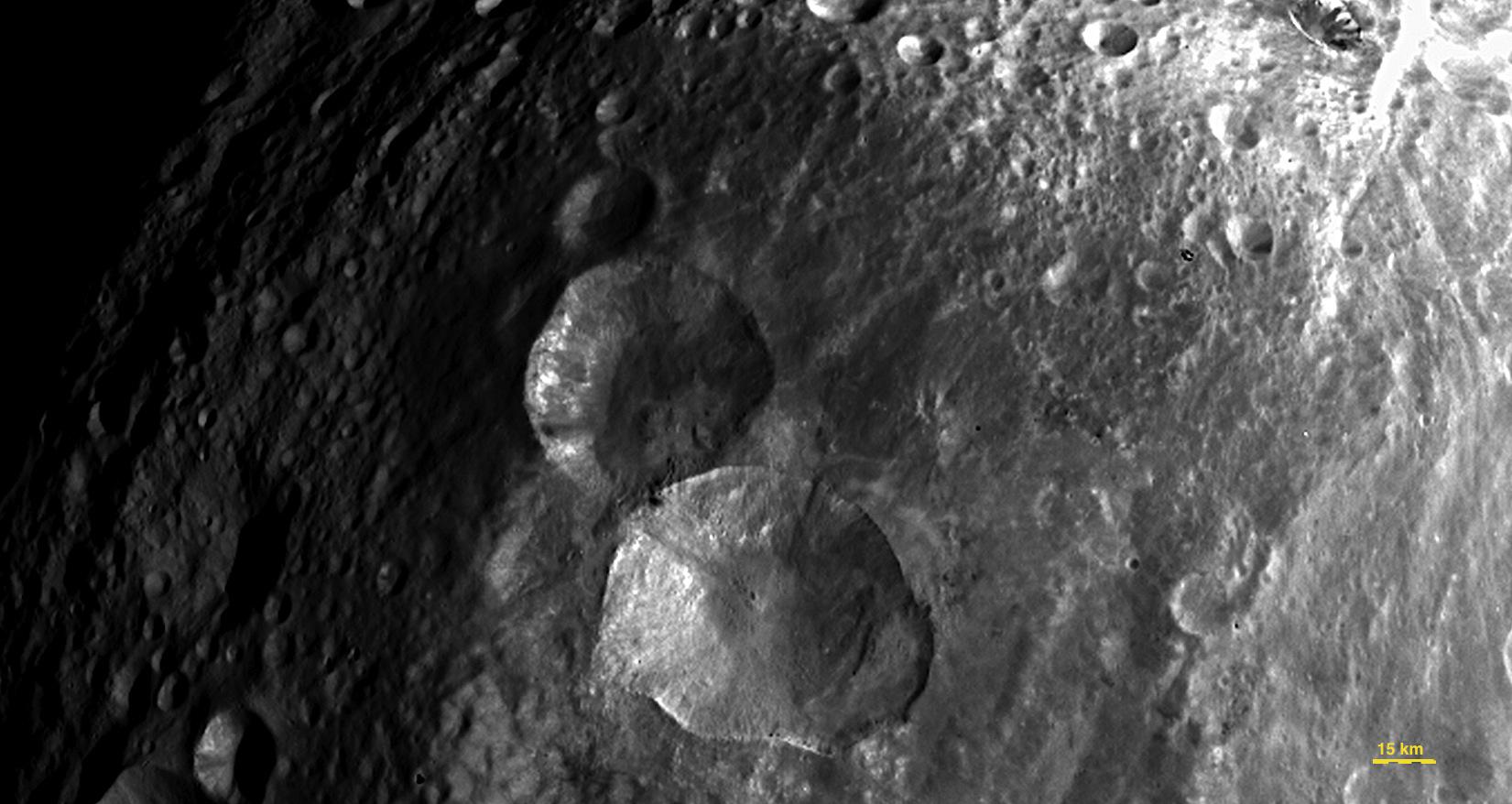
Close-up view of "Snowman" Craters on Asteroid Vesta

Close-up view of Snowman Craters on Asteroid Vesta
Click on the image for full resolution

In this image, obtained by the framing camera on NASA's Dawn spacecraft, a set of three craters, informally nicknamed "Snowman" by the camera's team members, is located in the northern hemisphere of Vesta. The image was taken on July 24, 2011, from a distance of about 5,200 kilometers (3,200 miles). The Dawn mission to Vesta and Ceres is managed by NASA's Jet Propulsion Laboratory, Pasadena, Calif., for NASA's Science Mission Directorate, Washington, D.C. It is a project of the Discovery Program, managed by NASA's Marshall Space Flight Center, Huntsville, Ala. UCLA is responsible for overall Dawn mission science. Orbital Sciences Corporation of Dulles, Va., designed and built the Dawn spacecraft.
Credit: NASA/JPL-Caltech/UCLA/MPS/DLR/IDA
Friday, November 11, 2011

Stunning color image of Asteroids Ida and Dactyl

Stunning color image of Asteroids Ida and Dactyl
Click on the image for full resolution

This color picture is made from images taken by the imaging system on the Galileo spacecraft about 14 minutes before its closest approach to asteroid 243 Ida on August 28, 1993. The range from the spacecraft was about 10,500 kilometers (6,500 miles). The images used are from the sequence in which Ida's moon was originally discovered; the moon is visible to the right of the asteroid. This picture is made from images through the 4100-angstrom (violet), 7560 A (infrared) and 9680 A (infrared) filters. The color is 'enhanced' in the sense that the CCD camera is sensitive to near infrared wavelengths of light beyond human vision; a 'natural' color picture of this asteroid would appear mostly gray. Shadings in the image indicate changes in illumination angle on the many steep slopes of this irregular body as well as subtle color variations due to differences in the physical state and composition of the soil (regolith). There are brighter areas, appearing bluish in the picture, around craters on the upper left end of Ida, around the small bright crater near the center of the asteroid, and near the upper right-hand edge (the limb). This is a combination of more reflected blue light and greater absorption of near infrared light, suggesting a difference in the abundance or composition of iron-bearing minerals in these areas. Ida's moon also has a deeper near-infrared absorption and a different color in the violet than any area on this side of Ida. The moon is not identical in spectral properties to any area of Ida in view here, though its overall similarity in reflectance and general spectral type suggests that it is made of the same rock types basically. These data, combined with study of further imaging data and more detailed spectra from the Near Infrared Mapping Spectrometer, may allow scientists to determine whether the larger parent body of which Ida, its moon, and some other asteroids are fragments was a heated, differentiated object or made of relatively unaltered primitive chondritic material. The Galileo project, whose primary mission is the exploration of the Jupiter system in 1995-97, is managed for NASA's Office of Space Science by the Jet Propulsion Laboratory.
Credit: NASA/JPL

A view of the Asteroid Lutetia from the ESA Rosetta probe

A view of the Asteroid Lutetia from the ESA Rosetta probe
Click on the image for full resolution

This image of the unusual asteroid Lutetia was taken by ESA's Rosetta probe during its closest approach in July 2010. Lutetia, which is about 100 kilometres across, seems to be a leftover fragment of the same original material that formed the Earth, Venus and Mercury. It is now part of the main asteroid belt, between the orbits of Mars and Jupiter, but its composition suggests that it was originally much closer to the Sun.
Credit: ESA 2010 MPS for OSIRIS Team MPS/UPD/LAM/IAA/RSSD/INTA/UPM/DASP/IDA

Sunday, July 31, 2011

NASA's Dawn Spacecraft views dark side of Asteroid Vesta

NASA's Dawn Spacecraft views dark side of Asteroid Vesta
Click on the image for full resolution

NASA's Dawn spacecraft took this image over Vesta's northern hemisphere after the spacecraft completed its first passage over the dark side of the giant asteroid. It is northern hemisphere winter on Vesta now, so its north pole is in deep shadow. The Dawn science team is working to determine the significance of the distinct features in this image, which include large grooves or ridges extending for great distances around Vesta. This image was taken by Dawn's framing camera on July 23, from a distance of 3,200 miles (5,200 kilometers).The Dawn mission to Vesta and Ceres is managed by NASA's Jet Propulsion Laboratory, a division of the California Institute of Technology in Pasadena, for NASA. The University of California, Los Angeles, is responsible for overall Dawn mission science. The Dawn framing cameras have been developed and built under the leadership of the Max Planck Institute for Solar System Research, Katlenburg-Lindau, Germany, with significant contributions by DLR German Aerospace Center, Institute of Planetary Research, Berlin, and in coordination with the Institute of Computer and Communication Network Engineering, Braunschweig. The Framing Camera project is funded by the Max Planck Society, DLR, and NASA/JPL.
Credit: NASA/JPL-Caltech/UCLA/MPS/DLR/IDA

Saturday, May 7, 2011

Image of Comet Wild 2 taken by NASA's Stardust spacecraft

Image of Comet Wild 2 taken by NASA's Stardust spacecraft
Click on the image to enlarge

This composite image shows comet Wild 2 as imaged by NASA's Stardust spacecraft. Comet Wild 2 was visited by the spacecraft on Jan. 2, 2004. Asteroid Annefrank was used as a dress rehearsal of procedures the spacecraft would use for its upcoming encounter with its primary science target, comet Wild 2. Stardust passed within about 3,300 kilometers (2,050 miles) of the asteroid. During the comet Wild 2 encounter, Stardust flew within about 230 kilometers (143 miles) of the comet, catching samples of comet particles and scoring detailed pictures of Wild 2's pockmarked surface. The collected particles were stowed in a sample return capsule onboard Stardust. The samples were returned to Earth for in-depth analysis on January 15, 2006, when the spacecraft's sample return capsule made a soft landing at the U.S. Air Force Utah Test and Training Range.
Credit: NASA/JPL-Caltech/University of Maryland/Cornell

Thursday, April 21, 2011

Shot of Comet Tempel 1 taken by Deep Impact's flyby Spacecraft

Shot of Comet Tempel 1 taken by Deep Impact's flyby Spacecraft
Click on the image to enlarge

This spectacular image of comet Tempel 1 was taken 67 seconds after it obliterated Deep Impact's impactor spacecraft. The image was taken by the high-resolution camera on the mission's flyby craft. Scattered light from the collision saturated the camera's detector, creating the bright splash seen here. Linear spokes of light radiate away from the impact site, while reflected sunlight illuminates most of the comet surface. The image reveals topographic features, including ridges, scalloped edges and possibly impact craters formed long ago.
Credit: NASA/JPL-Caltech/UMD
Image enhancement: Jean-Baptiste Faure

Sunday, April 17, 2011

Asteroid Eros as seen by the orbiting NASA's NEAR spacecraft!

Asteroid Eros as seen by the orbiting NASA's NEAR spacecraft!
Click on the image to enlarge

This picture of Eros, the first of an asteroid taken from an orbiting spacecraft, is a mosaic of four images obtained by NASA's NEAR mission immediately after the spacecraft's insertion into orbit. We are looking down over the north pole of Eros at one of the largest craters on the surface, which measures 4 miles (6 kilometers) across.
Inside the crater walls are subtle variations in brightness that hint at some layering of the rock in which the crater formed. Narrow grooves that run parallel to the long axis of Eros cut through the southeastern part of the crater rim. A house-sized boulder is present near the floor of the crater; it appears to have rolled down the bowl-shaped crater wall. A large number of boulders are also present on other parts of the asteroid's surface. The surface of the asteroid is heavily cratered, indicating that Eros is relatively old.
Credit: NASA/JPL/JHUAPL

Comet Hartley 2 detailed close-up by NASA's EPOXI Mission

Comet Hartley 2 detailed close-up by NASA's EPOXI Mission
Click on the image to enlarge

Comet Hartley 2 can be seen in glorious detail in this image from NASA's EPOXI mission. It was taken as the spacecraft flew by, from a distance of about 700 kilometers (435 miles). The comet's nucleus, or main body, is approximately 2 kilometers (1.2 miles) long and .4 kilometers (.25 miles) at the "neck," or most narrow portion. Jets can be seen streaming out of the nucleus. The mission's Medium-Resolution Instrument was used to capture this view. The sun is to the right.
Credit: NASA/JPL-Caltech/UMD