Showing posts with label Nebulae. Show all posts

Saturday, July 18, 2026

Planetary Nebula NGC 1514 by Gemini North

Planetary Nebula NGC 1514 by Gemini North
Click the image for higher resolution

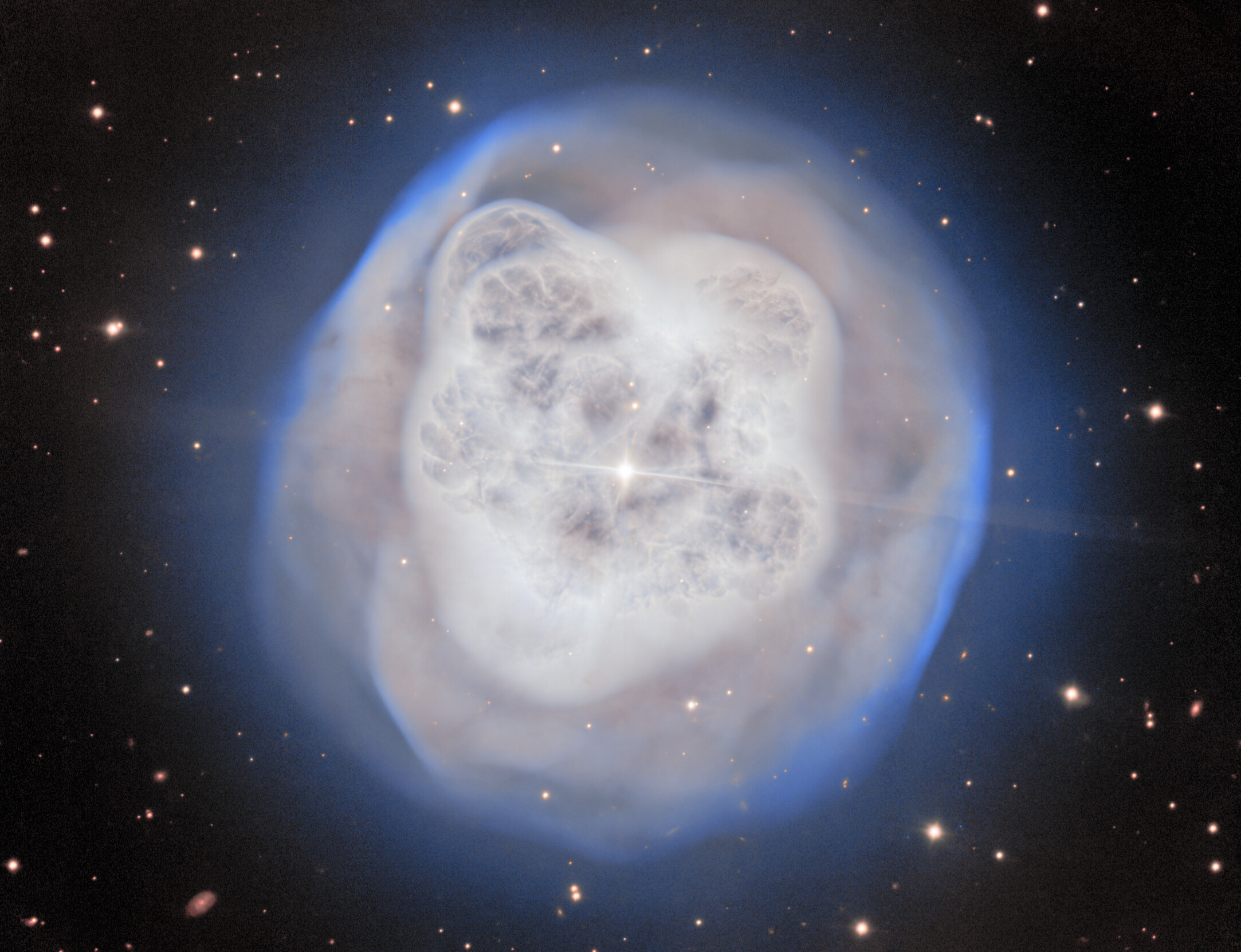
NGC 1514, nicknamed the Crystal Ball Nebula, is showcased in this enchanting image captured by Gemini Multi-Object Spectrograph (GMOS) on the Gemini North telescope, located on Maunakea in Hawai'i. Gemini North is one half of the International Gemini Observatory, partly funded by the U.S. National Science Foundation (NSF) and operated by NSF NOIRLab.
German–British astronomer William Herschel discovered the Crystal Ball Nebula in 1790. It's located in the constellation Taurus, near the border of Perseus. While, culturally, crystal balls are known for divining the future, the Crystal Ball Nebula provides us with a snapshot of the final stages of a star's life from long ago. It sits around 1500 light-years from Earth. This means the light captured in this image left its source around 1500 years ago, traveling across the Universe before finally reaching Gemini North.
The Crystal Ball Nebula is categorized as a planetary nebula, a nomenclature first presented by the nebula's discoverer, William Herschel. He coined the term in the 1700s after spotting the spherical shape of these objects, which reminded him of planets. In reality, planets and planetary nebulae are unrelated.
Planetary nebulae form when a low- or intermediate-mass star ejects its outer layers near the end of its life, forming a somewhat spherical cloud of gas. They typically have smoother, spherical shapes, making the Crystal Ball Nebula unique for its bumpy shells of gas. As the central star casts away this gas, its inner core is exposed. Radiation from the core energizes the gas, giving it a scorching temperature and chromatic glow. The Crystal Ball Nebula, for example, has an estimated temperature of 15,000 K.
Herschel found this object fascinating, amazed by its faintly illuminated shell. Prior to its discovery, he believed that nebulae were collections of stars that were too far away to individually resolve. The distinct bright point at the heart of the gaseous shell shattered this theory. He wrote in 1791, "Our judgment I may venture to say, will be, that the nebulosity about the star is not of a starry nature." He believed the illumination of the Crystal Ball Nebula came from a single star, not a far-off grouping.
While it may appear in this image as if there is a single shining light source at the heart of the Crystal Ball Nebula, as Herschel saw, it actually contains two stars. These two stars orbit each other with a period of around nine years – the longest known for any binary pair within a planetary nebula. Scientists believe that one of these stars, which was once several times more massive than our Sun, released its outer layers while in the throes of death. As the progenitor star and its binary companion orbit each other, they mold the expanding shell of gas with their strong, asymmetrical winds, forming the lumpy layers we see today.
Image Credit: International Gemini Observatory/NOIRLab/NSF/AURA
Image Processing: J. Miller and M. Rodriguez (International Gemini Observatory/NSF NOIRLab), T.A. Rector (University of Alaska Anchorage/NSF NOIRLab), D. de Martin and M. Zamani (NSF NOIRLab)
Image enhancement: Jean-Baptiste Faure

The Pillars of Creation as seen by Webb

The Pillars of Creation as seen by Webb
Click the image for higher resolution (9.8 MB)

By combining images of the iconic Pillars of Creation from two cameras aboard the James Webb Space Telescope, the Universe has been framed in its infrared glory. Webb's near-infrared image was fused with its mid-infrared image, setting this star-forming region ablaze with new details.
Myriad stars are spread throughout the scene. The stars primarily show up in near-infrared light, marking a contribution of Webb's Near-Infrared Camera (NIRCam). Near-infrared light also reveals thousands of newly formed stars – look for bright orange spheres that lie just outside the dusty pillars.
In mid-infrared light, the dust is on full display. The contributions from Webb's Mid-Infrared Instrument (MIRI) are most apparent in the layers of diffuse, orange dust that drape the top of the image, relaxing into a V. The densest regions of dust are cast in deep indigo hues, obscuring our view of the activities inside the dense pillars.
Dust also makes up the spire-like pillars that extend from the bottom left to the top right. This is one of the reasons why the region is overflowing with stars – dust is a major ingredient of star formation. When knots of gas and dust with sufficient mass form in the pillars, they begin to collapse under their own gravitational attraction, slowly heat up, and eventually form new stars. Newly formed stars are especially apparent at the edges of the top two pillars – they are practically bursting onto the scene.
At the top edge of the second pillar, undulating detail in red hints at even more embedded stars. These are even younger, and are quite active as they form. The lava-like regions capture their periodic ejections. As stars form, they periodically send out supersonic jets that can interact within clouds of material, like these thick pillars of gas and dust. These young stars are estimated to be only a few hundred thousand years old, and will continue to form for millions of years.
Almost everything you see in this scene is local. The distant universe is largely blocked from our view both by the interstellar medium, which is made up of sparse gas and dust located between the stars, and a thick dust lane in our Milky Way galaxy. As a result, the stars take center stage in Webb’s view of the Pillars of Creation.
The Pillars of Creation is a small region within the vast Eagle Nebula, which lies 6,500 light-years away.
MIRI was contributed by ESA and NASA, with the instrument designed and built by a consortium of nationally funded European Institutes (The MIRI European Consortium) in partnership with JPL and the University of Arizona.
Webb's NIRCam was built by a team at the University of Arizona and Lockheed Martin's Advanced Technology Center.
Image Credit: NASA, ESA, CSA, STScI, J. DePasquale (STScI), A. Pagan (STScI), A. M. Koekemoer (STScI)
Image enhancement: Jean-Baptiste Faure

Sunday, July 12, 2026

Deep Field in the Constellation Lupus by Rubin

Deep Field in the Constellation Lupus by Rubin
Click the image for higher resolution (7.1 MB)

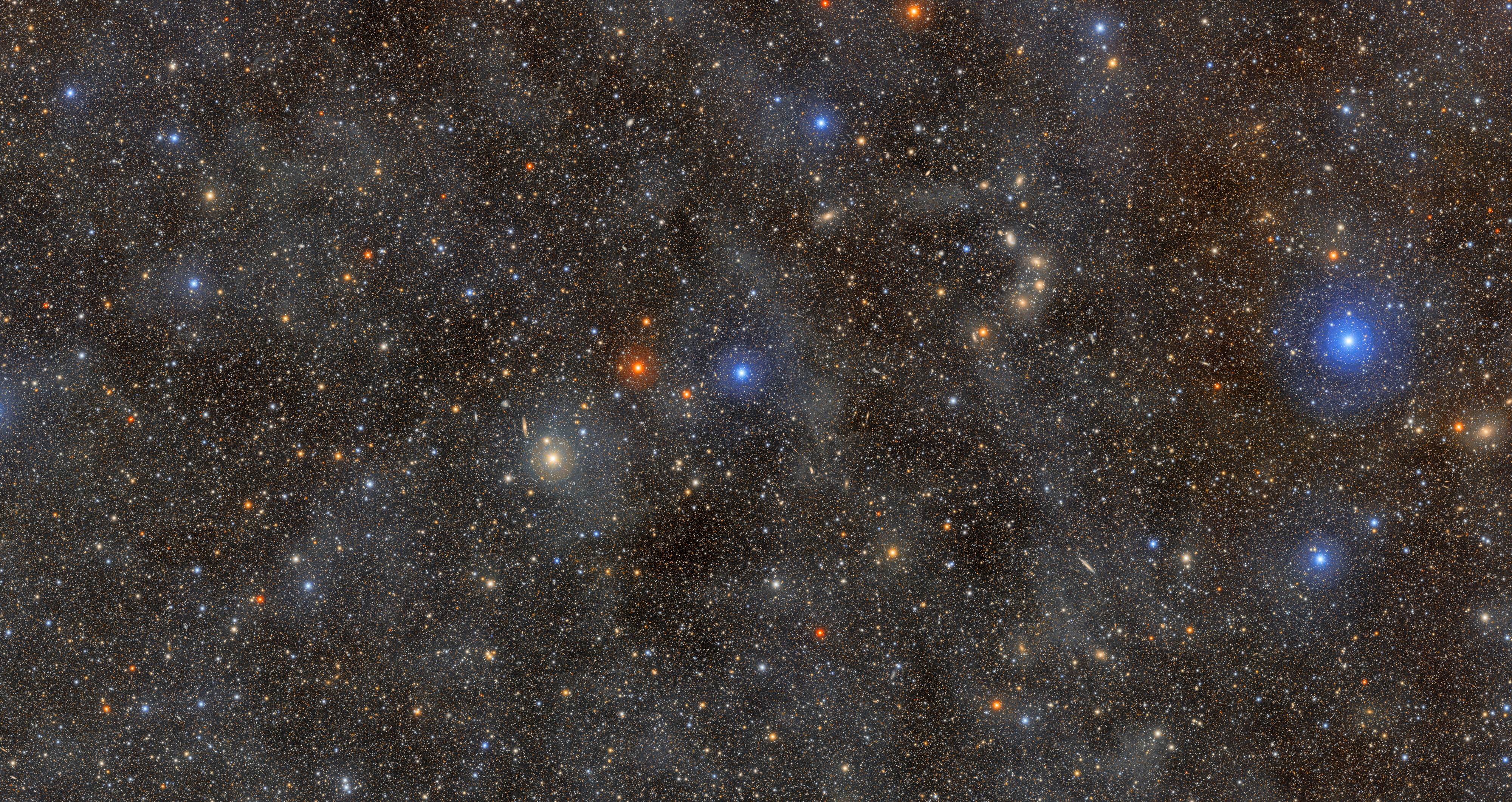
This 1.7-gigapixel image of a field of stars in the constellation Lupus showcases the unprecedented view of the Universe that NSF–DOE Vera C. Rubin Observatory gives us. Equipped with the LSST Camera – the largest digital camera in the world – Rubin combines a wide view of the sky with the ability to detect extremely faint objects. With this capability, Rubin can reveal details of the cosmos across an enormous range of scales, from distant galaxies, to individual stars, to the wispy clouds of dust spread throughout our galaxy.
The faint, glowing clouds spread across this image are galactic cirrus: clouds of interstellar gas and dust that can be seen in the foreground of the Milky Way. Rubin's ability to capture scenes like this in unmatched detail will open new windows into the structure of our galaxy and the Universe beyond it.
Imaqge Credit: NSF–DOE Vera C. Rubin Observatory/NOIRLab/SLAC/AURA
Image enhancement: Jean-Baptiste Faure

Saturday, May 2, 2026

Star-Forming Region N11 in the LMC

Star-Forming Region N11 in the LMC
Click the image for higher resolution (1.5 MB)

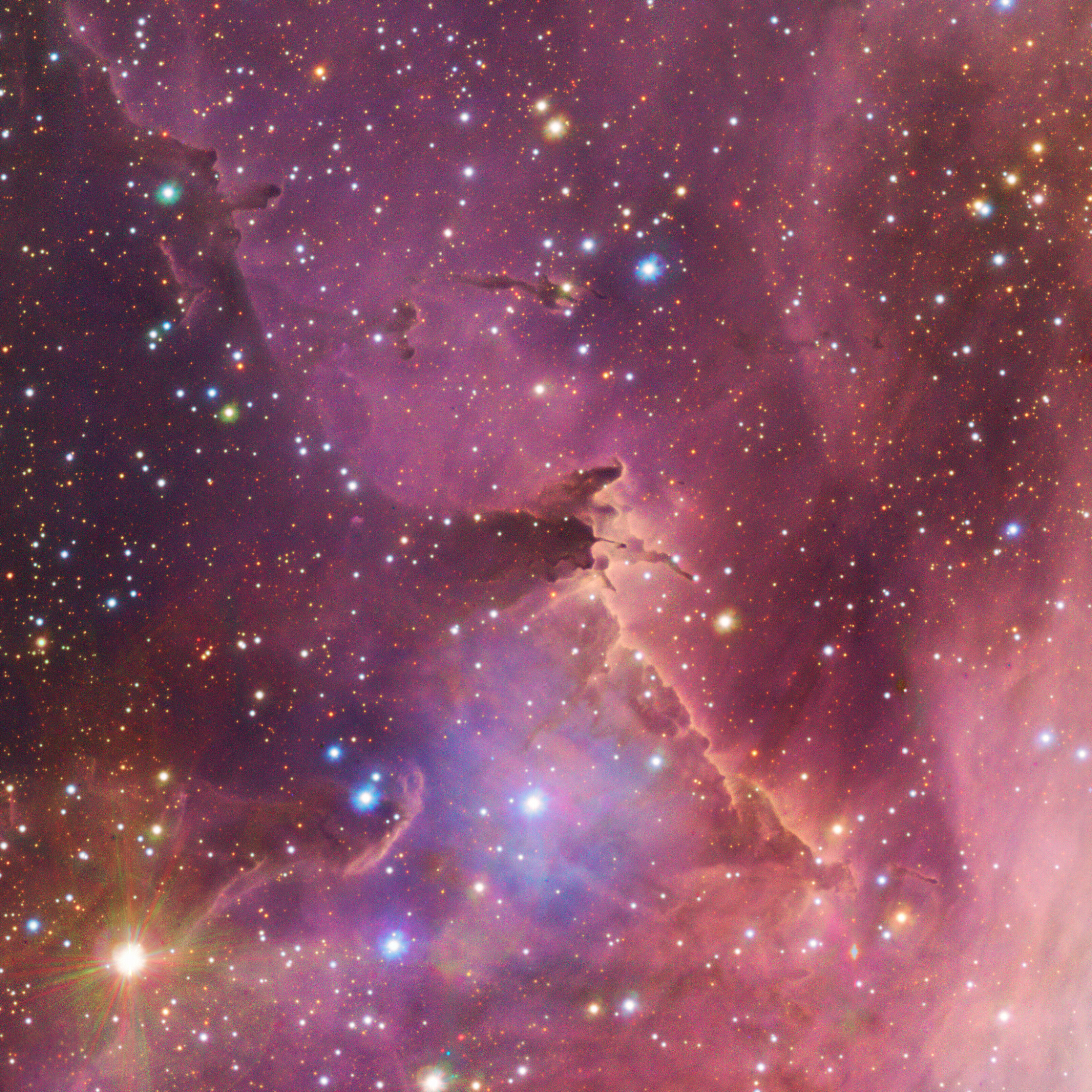
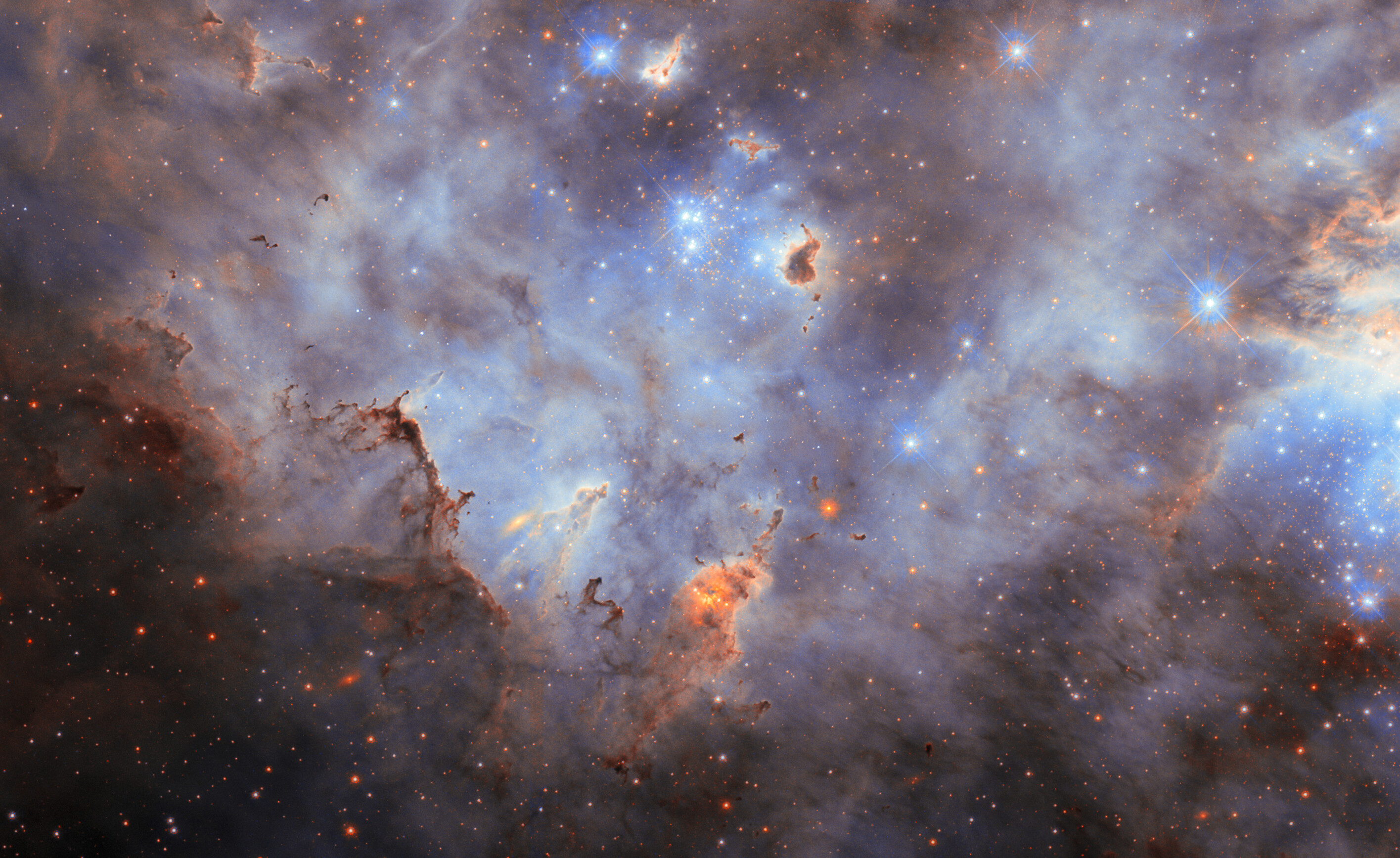
This Hubble Space Telescope picture features a cloudy starscape from an impressive star cluster. This scene is located in the Large Magellanic Cloud, a dwarf galaxy situated about 160 000 light-years away in the constellations Dorado and Mensa. With a mass equal to 10–20% of the mass of the Milky Way, the Large Magellanic Cloud is the largest of the dozens of small galaxies that orbit our galaxy.
The Large Magellanic Cloud is home to several massive stellar nurseries where gas clouds, like those strewn across this image, coalesce into new stars. This image depicts a portion of the galaxy's second-largest star-forming region, which is called N11. (The most massive and prolific star-forming region in the Large Magellanic Cloud, the Tarantula Nebula, is a frequent target for Hubble.) We see bright, young stars lighting up the gas clouds and sculpting clumps of dust with powerful ultraviolet radiation.
This image marries observations made roughly 20 years apart, a testament to Hubble's longevity. The first set of observations, which were carried out in 2002–2003, capitalised on the exquisite sensitivity and resolution of the then-newly-installed Advanced Camera for Surveys. Astronomers turned Hubble toward the N11 star cluster to do something that had never been done before at the time: catalogue all the stars in a young cluster with masses between 10% of the Sun's mass and 100 times the Sun's mass.
The second set of observations came from Hubble's newest camera, the Wide Field Camera 3. These images focused on the dusty clouds that suffuse the cluster, bringing a new perspective on cosmic dust.
Image Credit: ESA/Hubble and NASA, C. Murray, J. Maíz Apellániz
Image enhancement: Jean-Baptiste Faure
Sunday, March 1, 2026

Planetary Nebula PMR 1 as seen by Webb

Planetary Nebula PMR 1 as seen by Webb
Click the image for higher resolution (6.2 MB)

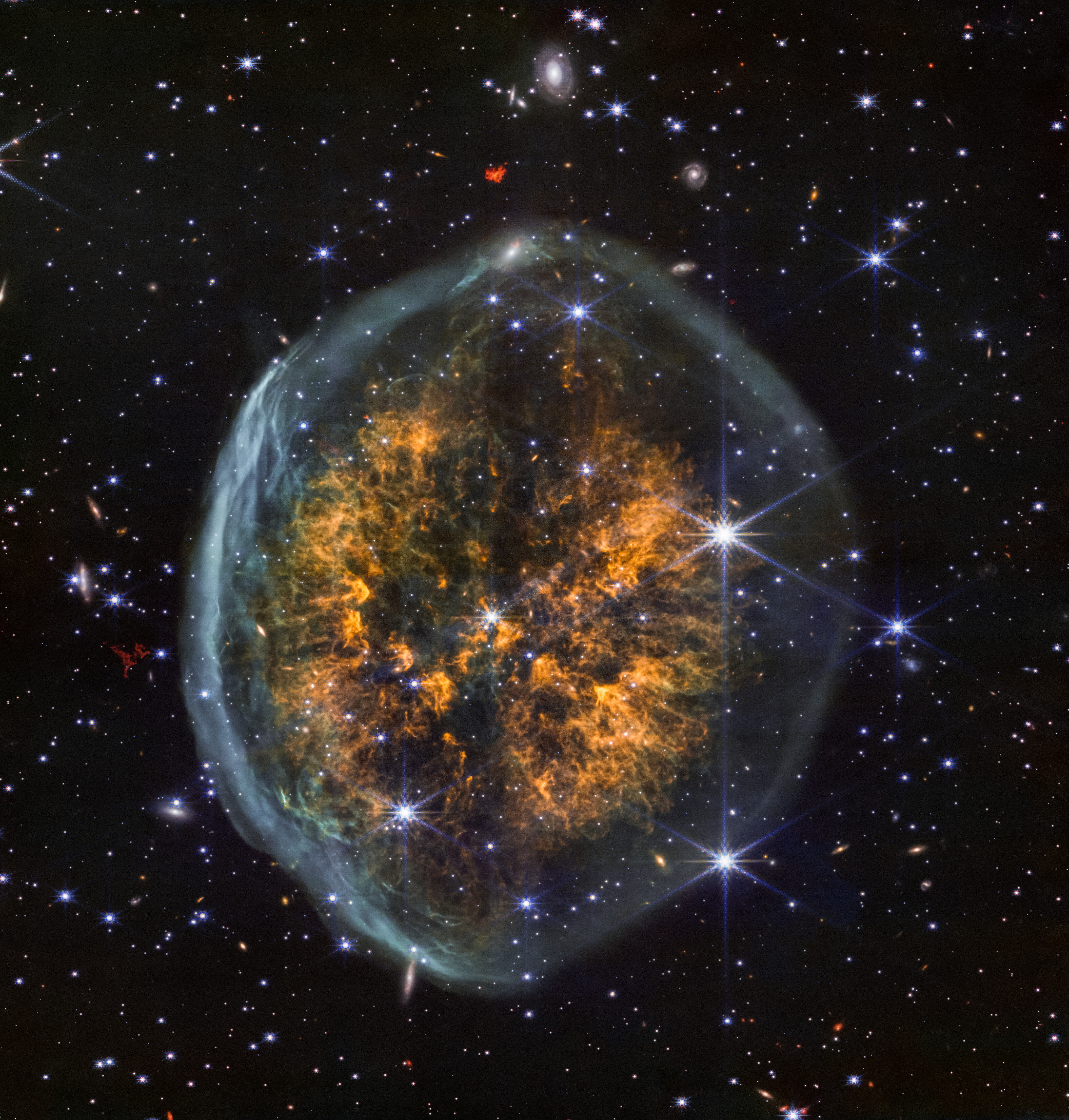
Two heads are better than one in the latest images from NASA's James Webb Space Telescope, which reveal new detail in a mysterious, little-studied nebula surrounding a dying star.
Nebula PMR 1 is a cloud of gas and dust that bears an uncanny resemblance to a brain in a transparent skull, inspiring its nickname, the "Exposed Cranium" nebula. Webb captured its unusual features in both near- and mid-infrared light. The nebula was first revealed in infrared light by a predecessor to Webb, NASA's now-retired Spitzer Space Telescope, more than a decade ago. Webb's advanced instruments show detail that enhances the nebula's brain-like appearance.
The nebula appears to have distinct regions that capture different phases of its evolution – an outer shell of gas that was blown off first and consists mostly of hydrogen, and an inner cloud with more structure that contains a mix of different gases. Both Webb's NIRCam (Near-Infrared Camera) and MIRI (Mid-Infrared Instrument) show a distinctive dark lane running vertically through the middle of the nebula that defines its brain-like look of left and right hemispheres. Webb's resolution shows that this lane could be related to an outburst or outflow from the central star, which typically occurs as twin jets burst out in opposite directions. Evidence for this is particularly notable at the top of the nebula in Webb’s MIRI image, where it looks like the inner gas is being ejected outward.
While there is still much to be understood about this nebula, it's clear that it is being created by a star near the end of its fuel-burning "life". In their end stages, stars expel their outer layers. It's a dynamic and fairly fast process, in cosmic terms. Webb has captured a moment in this star's decline. What ultimately happens will depend on the mass of the star, which is yet to be determined. If it's massive enough, it will explode in a supernova. A less massive Sun-like star will continue to shed layers until only its core remains as a dense white dwarf, which will cool off over eons.
Image Credit: NASA, ESA, CSA, STScI, Image Processing: Joseph DePasquale (STScI)
Image enhancement: Jean-Baptiste Faure

Monday, January 12, 2026

Star-Forming Region Sagittarius B2 by Webb

Star-Forming Region Sagittarius B2 by Webb
Click the image for higher resolution (4.8 MB)

Stars, gas and cosmic dust in the Sagittarius B2 molecular cloud glow in near-infrared light, captured by Webb's NIRCam (Near-Infrared Camera). In this light, astronomers see more of the region's diverse, colourful stars, but less of its gas and dust structure. Webb's instruments each provide astronomers with important information that help build a more complete picture of what is happening in this intriguing portion of the centre of our galaxy.
Sagittarius B2 is the Milky Way galaxy's most massive and active star forming cloud, producing half of the stars created in the galactic center region despite having only 10 percent of the area's star-making material. Now, Webb has revealed stunning new views of the region, using both its near-infrared and mid-infrared instruments, to capture both its colourful stars and gaseous stellar nurseries in unprecedented detail.
Sagittarius B2 is located only a few hundred light-years from the supermassive black hole at the heart of the galaxy called Sagittarius A, a region densely packed with stars, star-forming clouds, and complex magnetic fields. The infrared light that Webb detects is able to pass through some of the area's thick clouds to reveal young stars and the warm dust surrounding them. Astronomers think that analysis of Webb's data will help unravel enduring mysteries of the star formation process, and why Sagittarius B2 is forming so many more stars than the rest of the galactic center.
However, one of the most notable aspects of Webb's images of Sagittarius B2 are the portions that remain dark. These ironically empty-looking areas of space are actually so dense with gas and dust that even Webb cannot see through them. These thick clouds are the raw material of future stars and a cocoon for those still too young to shine.
Image Credit: NASA, ESA, CSA, STScI, A. Ginsburg (University of Florida); Image Processing: A. Pagan (STScI)
Image enhancement: Jean-Baptiste Faure
Saturday, December 27, 2025

Planetary Nebula NGC 6537 as seen by Webb

Planetary Nebula NGC 6537 as seen by Webb
Click the image for higher resolution (9.8 MB)

This new James Webb Space Telescope picture features a cosmic creepy-crawly called NGC 6537 – the Red Spider Nebula. Using its Near-InfraRed Camera (NIRCam), Webb has revealed never-before-seen details in this picturesque planetary nebula with a rich backdrop of thousands of stars.
Planetary nebulae like the Red Spider Nebula form when ordinary stars like the Sun reach the end of their lives. After ballooning into cool red giants, these stars shed their outer layers and cast them into space, exposing their white-hot cores. Ultraviolet light from the central star ionises the cast-off material, causing it to glow. The planetary nebula phase of a star's life is as fleeting as it is beautiful, lasting only a few tens of thousands of years.
The central star of the Red Spider Nebula is visible in this image, glowing just brighter than the webs of dusty gas that surround it. The surprising nature of the nebula's tremendously hot and luminous central star has been revealed by Webb's NIRCam. In optical-wavelength images, such as from the Hubble Space Telescope, the star appears faint and blue. But in the NIRCam images, it shows up as red: thanks to its sensitive near-infrared capabilities, Webb has revealed a shroud of hot dust surrounding the central star. This hot dust likely orbits the central star, in a disc structure.
Though only a single star is visible in the Red Spider's heart, a hidden companion star may lurk there as well. A stellar companion could explain the nebula's shape, including its characteristic narrow waist and wide outflows. This hourglass shape is seen in other planetary nebulae such as the Butterfly Nebula, which Webb also recently observed.
Webb's new view of the Red Spider Nebula reveals for the first time the full extent of the nebula's outstretched lobes, which form the "legs" of the spider. These lobes, shown in blue, are traced by light emitted from H2 molecules, which contain two hydrogen atoms bonded together. Stretching over the entirety of NIRCam's field of view, these lobes are shown to be closed, bubble-like structures that each extend about 3 light-years. Outflowing gas from the centre of the nebula has inflated these massive bubbles over thousands of years.
Gas is also actively jetting out from the nebula's center, as these new Webb observations show. An elongated purple "S" shape centred on the heart of the nebula follows the light from ionised iron atoms. This feature marks where a fast-moving jet has emerged from near the nebula's central star and collided with material that was previously cast away by the star, sculpting the rippling structure of the nebula seen today.
The observations used to create this image come from Webb GO programme #4571 (PI: J. Kastner) as part of a joint Chandra-JWST observing programme, which aims to understand how bipolar planetary nebulae like the Red Spider Nebula are shaped by the outflows and jets that emerge from the stars at their cores.
Image Credit: ESA/Webb, NASA and CSA, J. H. Kastner (Rochester Institute of Technology)
Image enhancement: Jean-Baptiste Faure

Saturday, December 20, 2025

Open Cluster Westerlund 2 as seen by Webb

Open Cluster Westerlund 2 as seen by Webb
Click the image for higher resolution (5.0 MB)

This star cluster, known as Westerlund 2, resides in a stellar breeding ground known as Gum 29, located 20,000 light-years away from Earth in the constellation Carina (the Keel).
This image of Westerlund 2 uses data from Webb's Near-InfraRed Camera (NIRCam) and Mid-InfraRed Instrument (MIRI). The cluster measures between 6 light-years and 13 light-years across, and is host to some of our Milky Way galaxy's hottest, brightest, and most massive stars. It was also the feature of Hubble's 25th anniversary image in 2015.
This new Webb image captures the bright, brilliant cluster near the top that is packed with young, massive stars whose intense light shapes the entire scene. Below and around them, swirls of orange and red gas form sculpted walls and tangled clouds – material that is being pushed, eroded, and illuminated by the cluster's powerful radiation. Threaded throughout the view are countless tiny stars just beginning to shine, some still surrounded by the gas and dust from which they formed. The soft blues and pinks are wisps of thinner material drifting between the denser clouds. Scattered across the field are also many bright stars much closer to us, whose sharp, star-shaped patterns are created by Webb's optics. The result is a vivid portrait of a stellar nursery in action, where intense energy from newborn stars carves dramatic shapes into the surrounding nebula and drives the ongoing cycle of star formation.
These new Webb observations of Westerlund 2 have revealed, for the first time, the full population of brown dwarfs in this extremely massive young star cluster, including objects as small as about 10 times the mass of Jupiter. This data is allowing astronomers to find several hundred stars with discs in various evolutionary states to facilitate our understanding of how discs evolve and how planets form in such massive young clusters. This image was developed using data from Webb's programme #3523 (M. Guarcello) as part of the Extended Westerlund 1 and 2 Open Clusters Survey (EWOCS).
Image Credit: ESA/Webb, NASA and CSA, V. Almendros-Abad, M. Guarcello, K. Monsch, and the EWOCS team.
Image enhancement: Jean-Baptiste Faure
Saturday, December 6, 2025

Reflection Nebula GN 04.32.8

Reflection Nebula GN 04.32.8
Click the image for higher resolution (3.4 MB)

The subject of this picture is a reflection nebula, identified as GN 04.32.8. Reflection nebulae are clouds of dust in space that don't emit their own light, as other nebulae do. Instead, the light from nearby stars hits and scatters off their dust, lighting them up. Because of the way the light scatters, many reflection nebulae tend to appear blue, GN 04.32.8 included.
GN 04.32.8 is a small part of the stellar nursery known as the Taurus Molecular Cloud. At only roughly 480 light-years from Earth in the constellation Taurus, it's one of the best locations for studying newly forming stars. This reflection nebula is illuminated by the system of three bright stars in the center of this image, mainly the variable star V1025 Tauri in the very center. One of those stars overlaps with part of the nebula: this is another variable star that is named HP Tauri, but is classified as a T Tauri star, for its similarity to yet another variable star elsewhere in the Taurus Molecular Complex. T Tauri stars are very active, chaotic stars at an early stage of their evolution, so it's no surprise that they appear in a prolific stellar nursery like this one! The three stars are also named HP Tau, HP Tau G2 and HP Tau G3; they're believed to be gravitationally bound to each other, forming a triple system.
Eagle-eyed viewers might notice the small, squashed, orange spot, just left of centre below the clouds of the nebula, that's crossed by a dark line. This is a newly-formed protostar, hidden in a protoplanetary disc that obstructs some of its light. Because the disc is edge-on to us, it's an ideal candidate for study. Astronomers are using Hubble here to examine it closely, seeking to learn about the kinds of exoplanets that might be formed in discs like it.
Image Credit: ESA/Hubble and NASA, G. Duchêne
Image enhancement: Jean-Baptiste Faure

Saturday, June 28, 2025

Trifid and Lagoon Nebulae as seen by Rubin

Trifid and Lagoon Nebulae as seen by Rubin
Click the image for higher resolution (7.1 MB)

In this immense image NSF-DOE Vera C. Rubin Observatory offers a brand new view of two old friends: the Trifid and Lagoon Nebulae. The image provides a demonstration of what makes Rubin unique: its combination of an extremely wide field of view and the speed that allows it to take lots of big images in a very short time. Combining images reveals subtle details in the clouds of gas and dust. The more images we can combine, the more detail we see!
This almost 5-gigapixel image combines 678 exposures taken in just 7.2 hours of observing time, and was composed from about two trillion pixels of data in total. No other observatory is capable of producing an image of such a wide area so quickly and with this much depth.
The Trifid Nebula (also referred to as Messier 20) is a standout in the sky. It's a bright, colorful cloud of gas and dust about 5,000 light-years away in the constellation Sagittarius. What makes it especially striking is the combination of features packed into one place: a glowing pink emission nebula, a cool blue reflection nebula, and dark dust lanes that split it into three sections – hence the name "Trifid". Inside, new stars are forming and blasting out strong winds and radiation, carving up the gas around them. It gives us a dramatic glimpse at how massive stars shape their surroundings even as they're being born.
Below the Trifid Nebula in this image is the Lagoon Nebula (or Messier 8), another vibrant stellar nursery glowing about 4,000 light-years away. You can actually spot the Lagoon with just a pair of binoculars or a small telescope. At its heart is a cluster of young, massive stars – their intense radiation lights up the surrounding gas and shapes the swirling clouds into intricate patterns. The Lagoon nebula provides scientists with a great place to study the earliest stages of star formation – how giant clouds collapse, how star clusters take shape, and how newborn stars start to reshape their environment.
This expansive image of Trifid and Lagoon together exposes an intricate web of dust lanes and star clusters that make this part of the Milky Way come alive with cosmic activity. The exquisite detail in the structure of the nebulosity shown here demonstrates the exceptional quality of Rubin's entire system – from its light-collecting power, to its sensitive camera, to its efficient data transfer and processing system. Over ten years, Rubin Observatory will take millions of images and will image each place in the sky, including this one, about 800 times.
Every time we look at the Universe in a new way, we discover new things we never could have predicted – and with Rubin we will see more than we ever have before.
The image was captured by Rubin Observatory using the 3200-megapixel LSST Camera – the largest digital camera in the world.
Image Credit: RubinObs/NOIRLab/SLAC/NSF/DOE/AURA
Image enhancement: Jean-Baptiste Faure
Sunday, October 20, 2024

Emission Nebula and Open Cluster IC 2948

Emission Nebula and Open Cluster IC 2948
Click the image for higher resolution (6.2 MB)

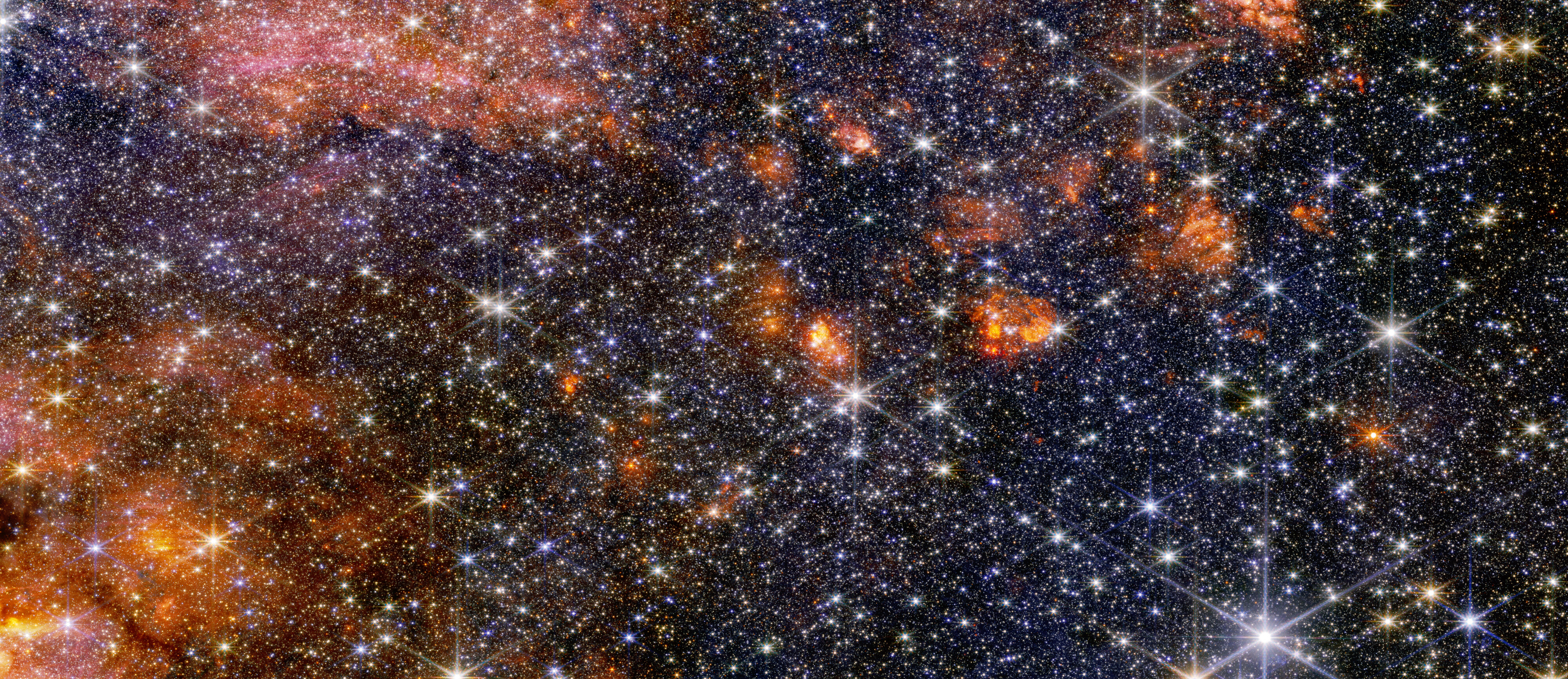
Exploring the gas cloud known as IC 2948 means finding your way across countless nascent stars born in this enormous stellar nursery. And yet, this is just a snippet of a much larger object: the Running Chicken Nebula. This nebula spans an area on the night sky close to 25 full moons, and yet, the area you see here is not even a third of a full moon. Obtaining such a detailed snippet of the nebula was possible thanks to a 1.5-billion-pixel image taken by the VLT Survey Telescope (VST), hosted and operated by ESO.
Located in the constellation of the Centaur (Centaurus), the Running Chicken Nebula is a labyrinth of gas, dust and young stars whose highly intense radiation erodes away the surrounding material. The gas cloud IC 2948 is the brightest region of the nebula. Here, we find creeping dark clouds, shaped like open hands about to grab their surrounding blooming stars.
First discovered more than a century ago, this gas cloud is helping us understand how stars form and behave during their infancy. To spot IC 2948 within the much larger Running Chicken Nebula, locate the chicken’s rear end (or its head, as some people claim). In your search, you may come across other areas like the stunning GUM 41 nebula.
Image Credit: ESO/VPHAS+ team. Acknowledgement: CASU
Image enhancement: Jean-Baptiste Faure

Sunday, October 13, 2024

Rosette Nebula NGC 2237 and Open Cluster NGC 2244

Rosette Nebula NGC 2237 and Open Cluster NGC 2244
Click the image for higher resolution (3.7 MB)

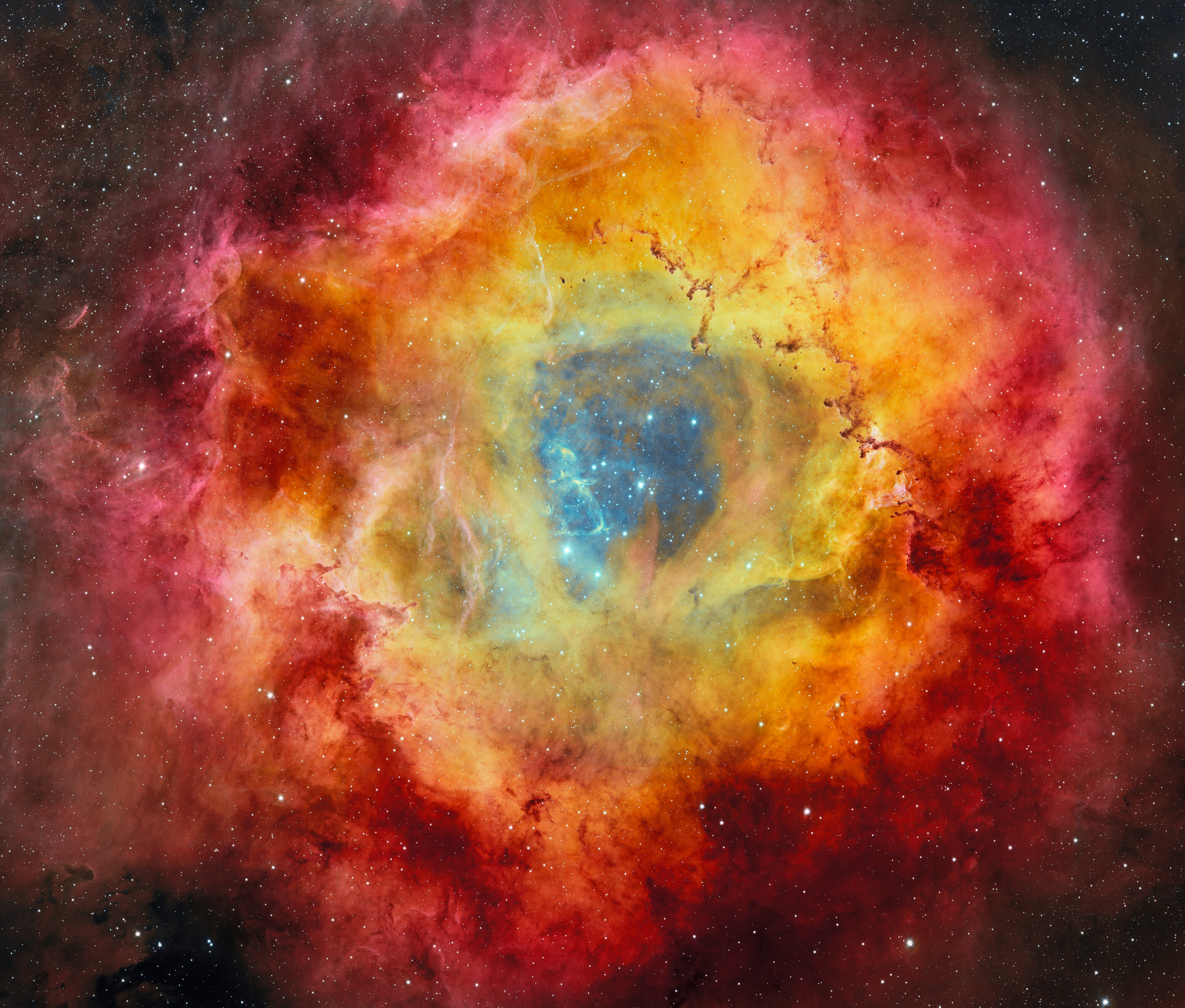
Cradled within the fiery petals of the Rosette Nebula (NGC 2237) is NGC 2244, the young star cluster which it nurtured. The cluster's stars light up the nebula in vibrant hues of red, gold and purple, and opaque towers of dust rise from the billowing clouds around its excavated core. This image, captured by 570-megapixel Department of Energy-fabricated Dark Energy Camera (DECam), mounted on the U.S. National Science Foundation Víctor M. Blanco 4-meter Telescope at Cerro Tololo Inter-American Observatory, a Program of NSF NOIRLab, is being released in celebration of NOIRLab's fifth anniversary.
Image Credit: CTIO/NOIRLab/DOE/NSF/AURA
Image Processing: T.A. Rector (University of Alaska Anchorage/NSF NOIRLab), D. de Martin and M. Zamani (NSF NOIRLab)

Friday, August 30, 2024

Star-Forming Region NGC 1333 by Webb

Star-Forming Region NGC 1333 by Webb
Click the image for higher resolution (3.0 MB)

This stunning new mosaic of images from the James Webb Space Telescope showcases the nearby star-forming cluster, NGC 1333. The nebula is in the Perseus molecular cloud, and located approximately 960 light-years away.
Webb's superb sensitivity allows astronomers to investigate young objects with extremely low masses. Some of the faintest "stars" in the picture are in fact newly born free-floating brown dwarfs with masses comparable to those of giant planets.
The same cluster was featured as the 33rd anniversary image of the Hubble Space Telescope in April of 2023. Hubble's image just scratched the surface of this region, because clouds of dust obscure much of the star formation process. Observing with a larger aperture and in the infrared part of the spectrum, Webb is capable of peering through the dusty veil to reveal newborn stars, brown dwarfs and planetary mass objects.
The center of the image presents a deep peek into the heart of the NGC 1333 cloud. Across the image we see large patches of orange, which represent gas glowing in the infrared. These so-called Herbig-Haro objects form when ionised material ejected from young stars collides with the surrounding cloud. They are hallmarks of a very active site of star formation.
Many of the young stars in this image are surrounded by discs of gas and dust, which may eventually produce planetary systems. On the right hand side of the image, we can glimpse the shadow of one of these discs oriented edge-on – two dark cones emanating from opposite sides, seen against a bright background.
Similarly to the young stars in this mosaic, our own Sun and planets formed inside a dusty molecular cloud, 4.6 billion years ago. Our Sun didn't form in isolation but as part of a cluster, which was perhaps even more massive than NGC 1333. The cluster in the mosaic, only 1–3 million years old, presents us with an opportunity to study stars like our Sun, as well as brown dwarfs and free-floating planets, in their nascent stages.
The images were captured as part of the Webb observation programme 1202 (PI: A. Scholz) to survey a large portion of NGC 1333. These data constitute the first deep spectroscopic survey of the young cluster, and have identified brown dwarfs down to planetary masses using the observatory's Near-InfraRed Imager and Slitless Spectrograph (NIRISS). The first results from this survey have been accepted for publication in the Astronomical Journal.
Image Credit: ESA/Webb, NASA and CSA, A. Scholz, K. Muzic, A. Langeveld, R. Jayawardhana
Image enhancement: Jean-Baptiste Faure
Monday, June 17, 2024

The Crab Nebula as seen by Webb

The Crab Nebula as seen by Webb
Click the image for higher resolution (1.9 MB)

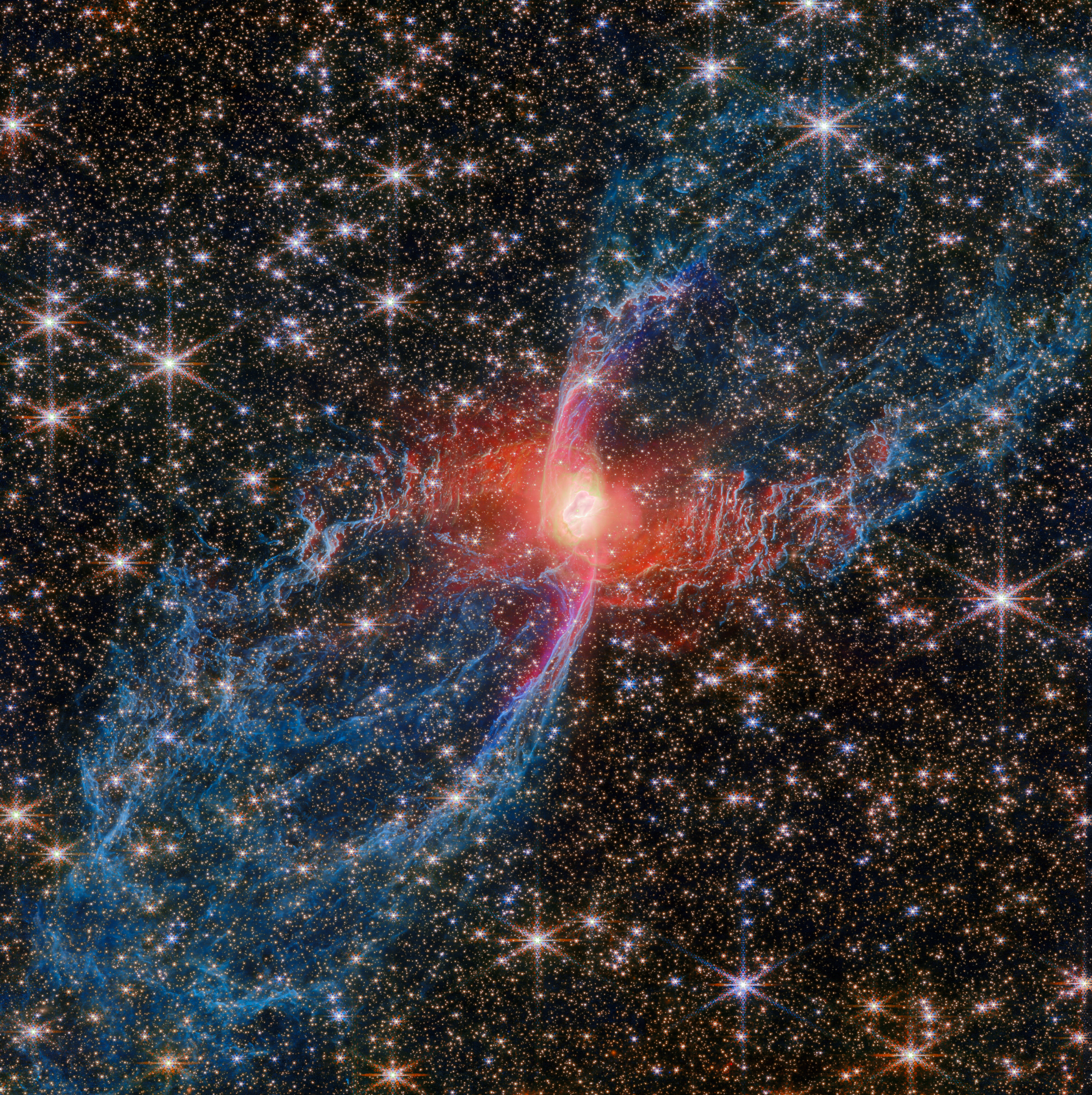
The Crab Nebula (catalogue designations M1, NGC 1952, Taurus A) is a supernova remnant and "pulsar wind nebula" in the constellation of Taurus. Charles Messier originally mistook Messier 1 (M1) for Halley's Comet, which inspired him to create his famous catalog of objects.
The James Webb Space Telescope dissected the Crab Nebula's structure, aiding astronomers as they continue to evaluate leading theories about the supernova remnant's origins. With the data collected by Webb's NIRCam (Near-Infrared Camera) and MIRI (Mid-Infrared Instrument), a team of scientists were able to closely inspect some of the Crab Nebula's major components.
For the first time ever, astronomers mapped the warm dust emission throughout this supernova remnant. Represented here as fluffy magenta material, the dust grains form a cage-like structure that is most apparent toward the lower left and upper right portions of the remnant. Filaments of dust are also threaded throughout the Crab's interior and sometimes coincide with regions of doubly ionised sulphur (sulphur III), coloured in green. Yellow-white mottled filaments, which form large loop-like structures around the supernova remnant's center, represent areas where dust and doubly ionised sulphur overlap.
The dust's cage-like structure helps constrain some, but not all of the ghostly synchrotron emission represented in blue. The emission resembles wisps of smoke, most notable toward the Crab's center. The thin blue ribbons follow the magnetic field lines created by the Crab's pulsar heart – a rapidly rotating neutron star.
Image Credit: NASA, ESA, CSA, STScI, T. Temim (Princeton University)
Image enhancement: Jean-Baptiste Faure

Emission Nebula RCW 7

Emission Nebula RCW 7
Click the image for higher resolution

A visually striking collection of interstellar gas and dust is the focus of this Hubble picture. Named RCW 7, the nebula is located just over 5300 light-years from Earth in the constellation Puppis.
Nebulae are areas of space that are rich in the raw material needed to form new stars. Under the influence of gravity, parts of these molecular clouds collapse until they coalesce into protostars, surrounded by spinning discs of leftover gas and dust. In the case of RCW 7, the protostars forming here are particularly massive, giving off strongly ionising radiation and fierce stellar winds that have transformed it into what is known as a H II region.
H II regions are filled with hydrogen ions – where H I refers to a normal hydrogen atom, H II is hydrogen that has lost its electron. The ultraviolet radiation from the massive protostars excites the hydrogen, causing it to emit light and giving this nebula its soft pinkish glow. Here Hubble is studying a particular massive protostellar binary named IRAS 07299-1651, still in its glowing cocoon of gas in the curling clouds towards the top of the nebula. To expose this star and its siblings, this image was captured using the Wide Field Camera 3 in near-infrared light. The massive protostars here are brightest in ultraviolet light, but they emit plenty of infrared light which can pass through much of the gas and dust around them and be seen by Hubble. Many of the other, larger-looking stars in this image are not part of the nebula, but sit between it and our Solar System.
The creation of an H II region marks the beginning of the end for a molecular cloud. Over only a few million years, the radiation and winds from the massive stars gradually disperse the gas – even more so as the most massive stars come to the end of their lives in supernova explosions. Only a fraction of the gas will be incorporated into new stars in this nebula, with the rest being spread throughout the galaxy to eventually form new molecular clouds.
Image Credit: ESA/Hubble and NASA, J. Tan (Chalmers University and University of Virginia), R. Fedriani (Institute for Astrophysics of Andalusia)
Image enhancement: Jean-Baptiste Faure
Sunday, June 16, 2024

Star-Forming Region M42 as seen by the Subaru Telescope

Star-Forming Region M42 as seen by the Subaru Telescope
Click the image for higher resolution (11.9 MB)

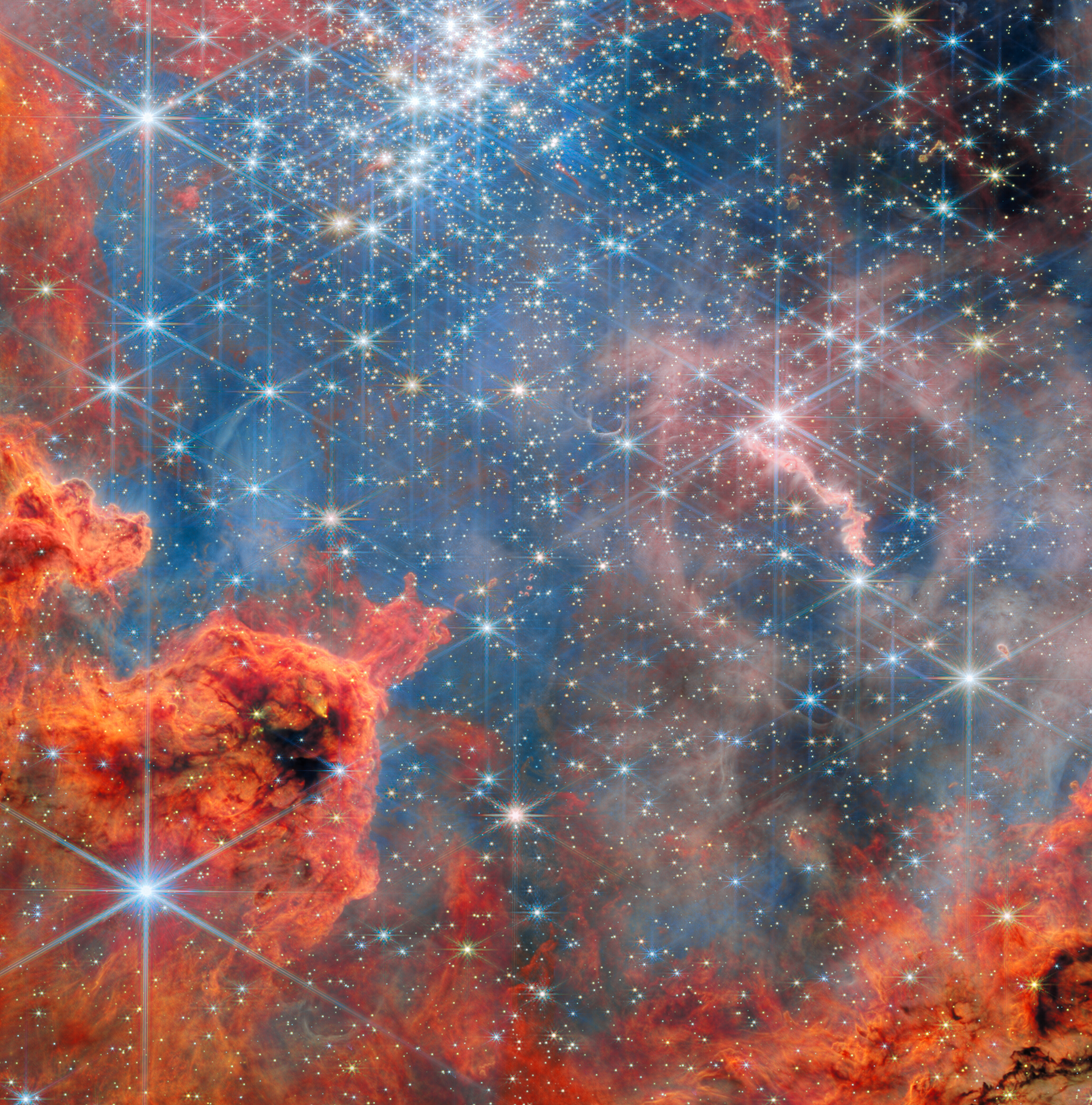
The Orion Nebula, aka Messier 42 (M42), is a star-forming region in the winter constellation. It is located at a distance of 1,500 light-years from Earth and is known as one of the nearest star-forming regions. Due to its large apparent size, the Orion Nebula is easy to find with the naked eye, and many stars can be seen through an amateur telescope.
At the center of the Orion Nebula is a cluster of massive newborn stars called Trapezium that ionize surrounding hydrogen gas by their ultraviolet light. The ionized gas emits a red glow.
Image Credit: NAOJ
Image enhancement: Jean-Baptiste Faure

Star-Forming Region M78 as seen by Euclid

Star-Forming Region M78 as seen by Euclid
Click the image for higher resolution (2.54 MB)

This image is released as part of the Early Release Observations from ESA's Euclid space mission. All data from these initial observations are made public on 23 May 2024 – including a handful of unprecedented new views of the nearby Universe, this being one.
This breathtaking image features Messier 78 aka M78 (the central and brightest region), a vibrant nursery of star formation enveloped in a shroud of interstellar dust. This image is unprecedented – it is the first shot of this young star-forming region at this width and depth.
Euclid peered deep into this enshrouded nursery using its infrared camera, exposing hidden regions of star formation for the first time, mapping its complex filaments of gas and dust in unprecedented detail, and uncovering newly formed stars and planets. This is the first time we’ve been able to see these smaller, sub-stellar sized objects in Messier 78; the dark clouds of gas and dust usually hide them from view, but Euclid’s infrared "eyes" can see through these obscuring clouds to explore within.
Euclid's sensitive instruments can detect objects just a few times the mass of Jupiter, and its visible and infrared instruments – the VIS and NISP cameras – reveal over 300 000 new objects in this field of view alone. Scientists are using this data to study the amount and ratio of stars and sub-stellar objects here, which is key to understanding the dynamics of how star populations form and change over time. Sub-stellar objects like brown dwarfs and free-floating or "rogue" planets are also one possible candidate for dark matter. While our current knowledge suggests that there aren't enough of these objects to solve the mystery of dark matter in the Milky Way, it remains an open question, and one that Euclid will definitively answer by probing a significant fraction of our galaxy.
Also visible to the top of the frame is the bright nebula NGC 2071, and a third filament of star formation towards the bottom of the image (with a "traffic light"-like appearance). This lower region is a dark nebula producing lower-mass stars, all arranged along elongated filaments in space. Messier 78 lies 1300 light-years away in the constellation of Orion.
Image Credit: ESA/Euclid/Euclid Consortium/NASA
Image processing: Jean-Charles Cuillandre (CEA Paris-Saclay) and Giovanni Anselmi
Image enhancement: Jean-Baptiste Faure
Saturday, June 15, 2024

Emission and Reflection Nebula Gum 3

Emission and Reflection Nebula Gum 3
Click the image for higher resolution (3.2 MB)

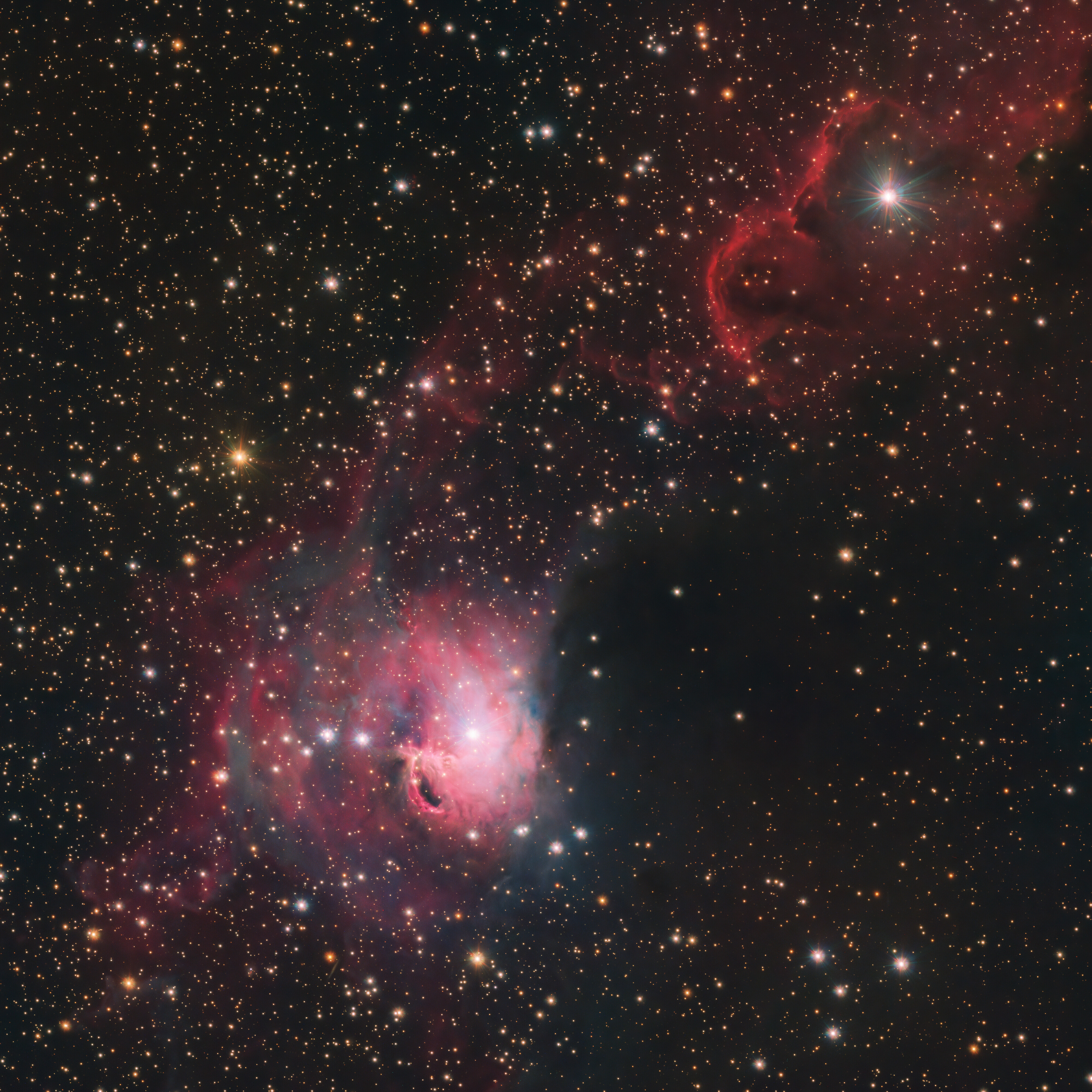
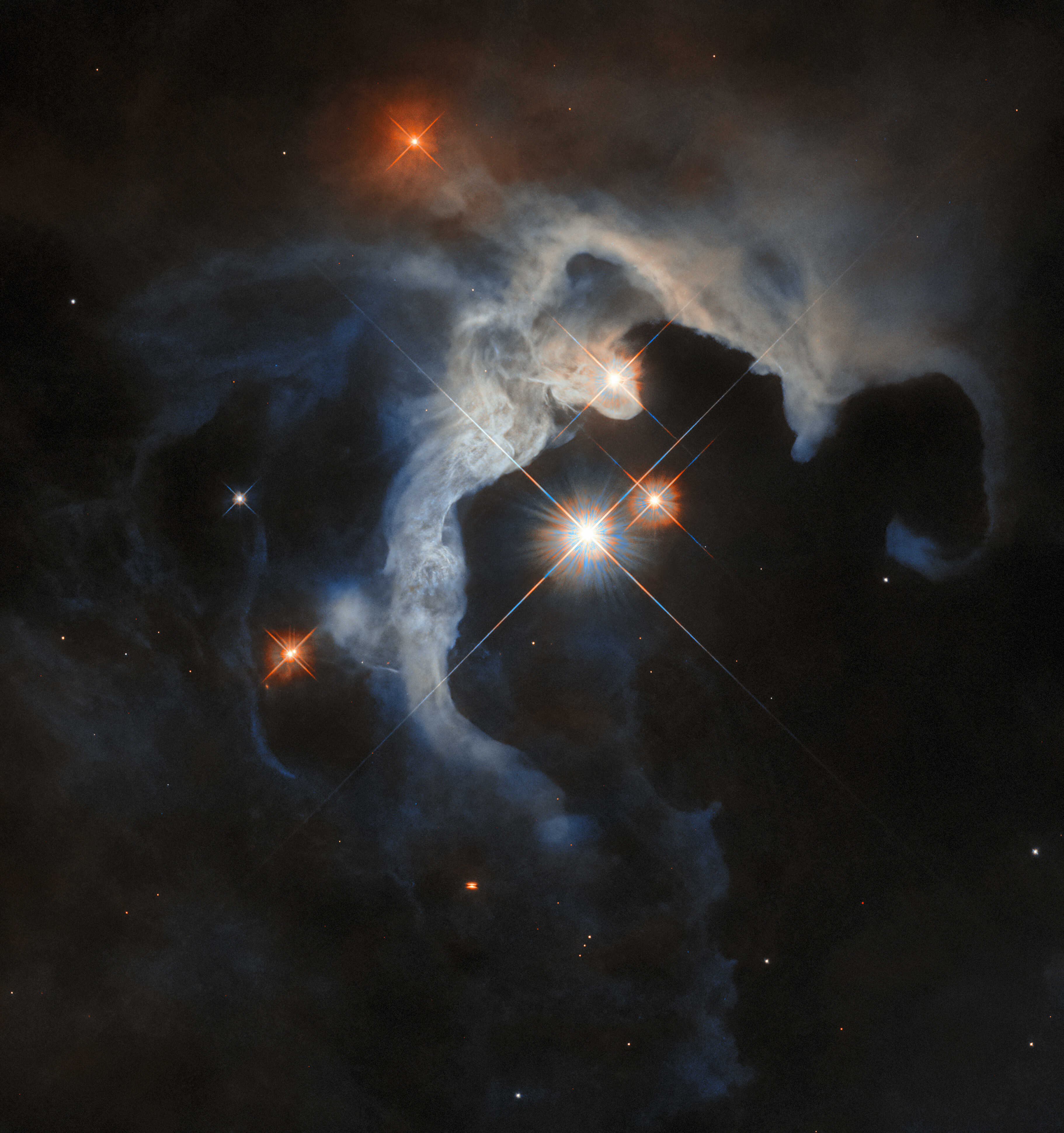
This picture shows the brightly coloured Gum 3 nebula as seen with the VLT Survey Telescope (VST), hosted at ESO's Paranal Observatory in the Chilean Atacama Desert. Attentive viewers may find that part of Gum 3 resembles a Koi fish in this VST image. Equipped with the OmegaCAM instrument, an enormous 268-megapixel camera, the telescope is designed to survey large areas of the southern sky in visible light and take stunning images like this one.
Gum 3 is an interstellar cloud of gas and dust located about 3600 light-years away, between the Monoceros and Canis Major constellations. It is named after Colin Stanley Gum, an Australian astronomer who catalogued 84 nebulae in the southern sky.
When the intense ultraviolet radiation from nearby young stars hits hydrogen atoms in the cloud, they emit visible light at very specific colours, which we see as shades of red and pink in the image. At the same time, tiny particles of dust within the cloud reflect starlight, especially blue colours, similar to what makes the sky look blue here on Earth. This play of colours makes nebulae like this spectacular to look at.
This image shows not only colour, but also the lack of it. Look closely at the area just right of the brightest part of the cloud – right of the pink "Koi-smic fish". Does anything look odd to you? It's not that there really are fewer stars in this dark area; instead, there is a big clump of dust that blocks part of the visible light, hiding the stars from VST and us.
Image Credit: ESO/VPHAS+ team. Ack.: CASU
Image enhancement: Jean-Baptiste Faure

Sunday, May 26, 2024

Cometary Globule CG 4

Cometary Globule CG 4
Click the image for higher resolution (4.5 MB)

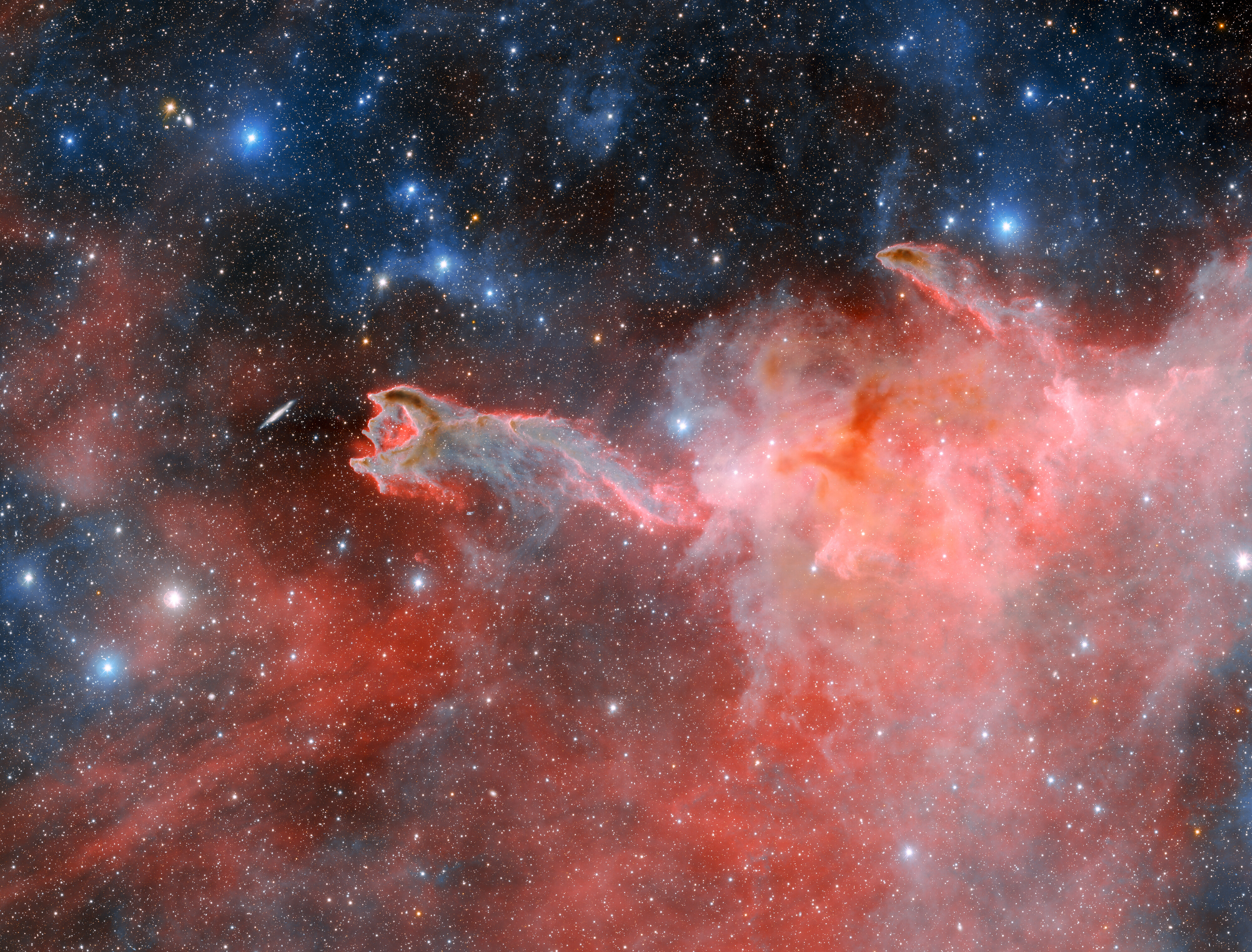
This cloudy, ominous structure is CG 4, a cometary globule nicknamed "God's Hand". CG 4 is one of many cometary globules present within the Milky Way, and how these objects get their distinct form is still a matter of debate among astronomers. This image was captured by the Department of Energy-fabricated Dark Energy Camera on the U.S. National Science Foundation Víctor M. Blanco 4-meter Telescope at Cerro Tololo Inter-American Observatory, a Program of NSF NOIRLab. In it, the features that classify CG 4 as a cometary globule are hard to miss. Its dusty head and long, faint tail vaguely resemble the appearance of a comet, though they have nothing in common. Astronomers theorize that cometary globules get their structure from the stellar winds of nearby hot, massive stars.
Image Credit: CTIO/NOIRLab/DOE/NSF/AURA
Image Processing: T.A. Rector (University of Alaska Anchorage/NSF's NOIRLab), D. de Martin & M. Zamani (NSF's NOIRLab)
Image enhancement: Jean-Baptiste Faure

Wednesday, May 8, 2024

Planetary Nebula M76

Planetary Nebula M76
Click the image for higher resolution (4.2 MB)

In celebration of the 34th anniversary of the launch of the legendary Hubble Space Telescope, astronomers took a snapshot of the Little Dumbbell Nebula (also known as Messier 76, M76, or NGC 650/651) located 3400 light-years away in the northern circumpolar constellation Perseus. The photogenic nebula is a favourite target of amateur astronomers.
M76 is classified as a planetary nebula. This is a misnomer because it is unrelated to planets. But its round shape suggested it was a planet to astronomers who first viewed it through low-power telescopes. In reality, a planetary nebula is an expanding shell of glowing gases that were ejected from a dying red giant star. The star eventually collapses to an ultra-dense, hot white dwarf.
M76 is composed of a ring, seen edge-on as the central bar structure, and two lobes on either opening of the ring. Before the star burned out, it ejected the ring of gas and dust. The ring was probably sculpted by the effects of the star that once had a binary companion star. This sloughed-off material created a thick disc of dust and gas along the plane of the companion's orbit. The hypothetical companion star isn't seen in the Hubble image, and so it could have been later swallowed by the central star. The disc would be forensic evidence for that stellar cannibalism.
The primary star is collapsing to form a white dwarf. It is one of the hottest stellar remnants known at a scorching 120 000 degrees Celsius, 24 times our Sun's surface temperature. The sizzling white dwarf can be seen as a pinpoint in the centre of the nebula. A star visible in projection beneath it is not part of the nebula.
Pinched off by the disc, two lobes of hot gas are escaping from the top and bottom of the "belt" along the star's rotation axis that is perpendicular to the disc. They are being propelled by the hurricane-like outflow of material from the dying star, tearing across space at two million miles per hour. That's fast enough to travel from Earth to the Moon in a little over seven minutes! This torrential "stellar wind" is ploughing into cooler, slower-moving gas that was ejected at an earlier stage in the star's life, when it was a red giant. Ferocious ultraviolet radiation from the super-hot star is causing the gases to glow. The red colour is from nitrogen, and blue is from oxygen.
The entire nebula is a flash in the pan by cosmological timekeeping. It will vanish in about 15 000 years.
Image Credit: NASA, ESA, STScI, A. Pagan (STScI)
Image enhancement: Jean-Baptiste Faure