



Click the image for higher resolution (4.8 MB)
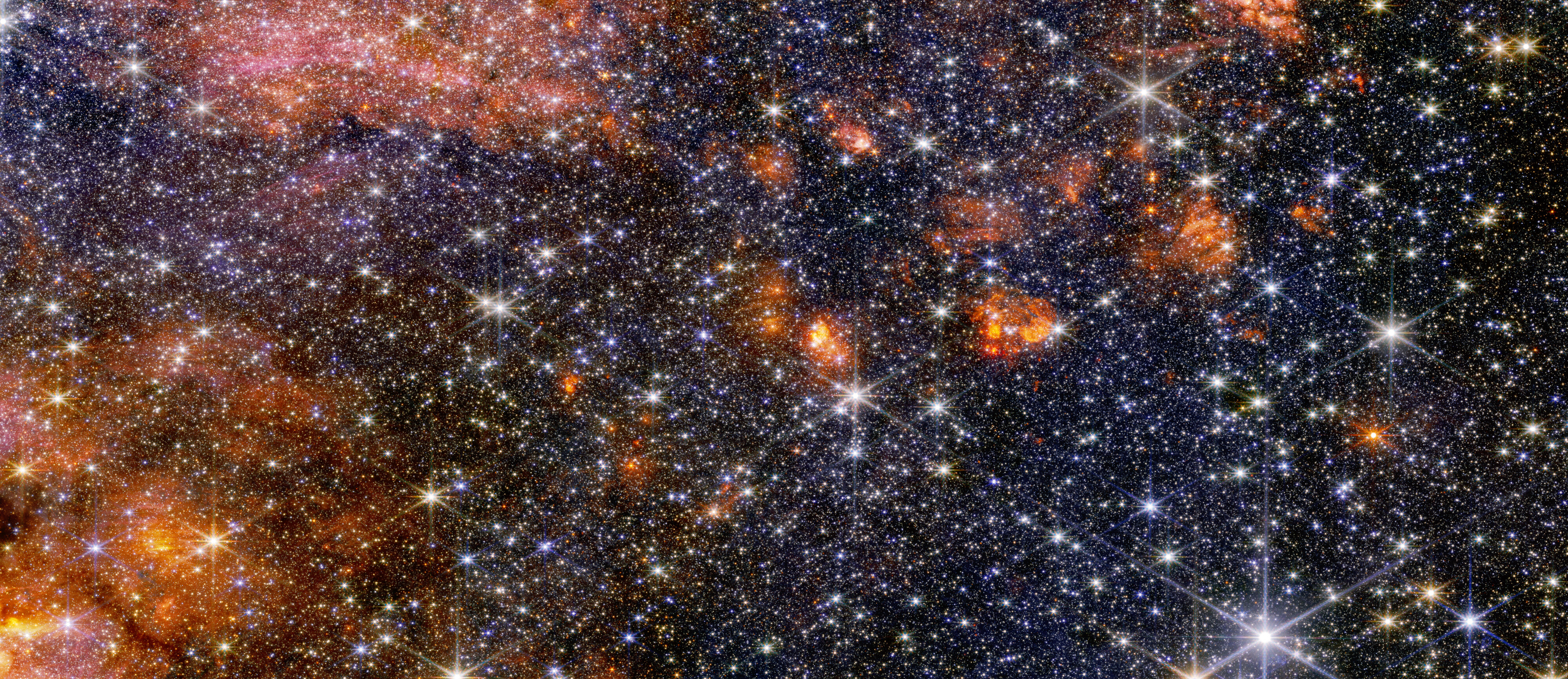
Stars, gas and cosmic dust in the Sagittarius B2 molecular cloud glow in near-infrared light, captured by Webb's NIRCam (Near-Infrared Camera). In this light, astronomers see more of the region's diverse, colourful stars, but less of its gas and dust structure. Webb's instruments each provide astronomers with important information that help build a more complete picture of what is happening in this intriguing portion of the centre of our galaxy.
Sagittarius B2 is the Milky Way galaxy's most massive and active star forming cloud, producing half of the stars created in the galactic center region despite having only 10 percent of the area's star-making material. Now, Webb has revealed stunning new views of the region, using both its near-infrared and mid-infrared instruments, to capture both its colourful stars and gaseous stellar nurseries in unprecedented detail.
Sagittarius B2 is located only a few hundred light-years from the supermassive black hole at the heart of the galaxy called Sagittarius A, a region densely packed with stars, star-forming clouds, and complex magnetic fields. The infrared light that Webb detects is able to pass through some of the area's thick clouds to reveal young stars and the warm dust surrounding them. Astronomers think that analysis of Webb's data will help unravel enduring mysteries of the star formation process, and why Sagittarius B2 is forming so many more stars than the rest of the galactic center.
However, one of the most notable aspects of Webb's images of Sagittarius B2 are the portions that remain dark. These ironically empty-looking areas of space are actually so dense with gas and dust that even Webb cannot see through them. These thick clouds are the raw material of future stars and a cocoon for those still too young to shine.
Image Credit: NASA, ESA, CSA, STScI, A. Ginsburg (University of Florida); Image Processing: A. Pagan (STScI)
Image enhancement: Jean-Baptiste Faure


0 comment(s):
Post a Comment