Showing posts with label Astronautics. Show all posts

Saturday, March 9, 2024

March 9: Birth Anniversary of Yuri Gagarin

March 9: Birth Anniversary of Yuri Gagarin
Click the image for higher resolution

Celebrating the first human to journey into outer space.
Yuri Gagarin was born in Klushino, near Smolensk on March 9, 1934. The adjacent town of Gzhatsk was renamed Gagarin in 1968 in his honour. His parents, Alexey Ivanovich Gagarin and Anna Timofeyevna Gagarina, worked on a collective farm, his father as a carpenter and his mother as a dairy farmer. Both were laborers but both were well read and fairly educated. Yuri was the third of four children and the family suffered privations when the German Army occupied their home. The Gagarins literally built a mud hut and lived in it while Germans operated out of their home during the war.
After the war he entered the Soviet Air Forces, after he learned to fly as a hobby. He was later trained to fly the MiG-15 fighter. In the late 1950s, he was selected for the cosmonaut program and on April 12, 1961, Yuri Alekseyevich Gagarin became the first man to fly into space. He ascended and orbited the Earth for 1 hour and 48 minutes in the Vostok 1 spacecraft.
He died on March 27, 1968, testing a MiG-15.
Image restoration: Jean-Baptiste Faure

Thursday, November 14, 2019

NASA’s X-59 QueSST Airplane

NASA’s X-59 QueSST Airplane
Click on the image for higher resolution (2.8 MB)

In the high desert of California, some of the most important aircraft in aviation history have been built and flown. NASA's X-59 QueSST (short for Quiet SuperSonic Technology) is an experimental piloted aircraft designed to fly faster than sound without producing the annoying – if not alarming – sonic booms of previous supersonic aircraft. It is the latest craft to take shape at Skunk Works, a renowned Lockheed Martin division that for the past 76 years has used a unique approach to design and manufacturing that has produced the US's most advanced airplanes.
This artist's concept of NASA's QueSST jet reflects the airplane's final configuration following years of research and design engineering. The jet is now under construction by Lockheed Martin at the company's Skunk Works facility in Palmdale, California.
Image Credit: Lockheed Martin

Saturday, July 21, 2012

Apollo 11 - Earthrise over the Moon

Apollo 11 - Earthrise over the Moon
Click on the image for full resolution (2.73 MB)

Earthrise over the Moon taken by the Apollo 11 crew.
The full resolution image weighs 2.73 MB, so please be patient when downloading!
Credit: NASA-Johnson Space Center
Image enhancement: Jean-Baptiste Faure

Tuesday, June 28, 2011

Microgravity Combustion Research as Art!

Microgravity Combustion Research as Art!
Click on the image for full resolution

Fire acts differently in space than on Earth. Sandra Olson, an aerospace engineer at NASA's Glenn Research Center, demonstrates just how differently in her art. This artwork is comprised of multiple overlays of three separate microgravity flame images. Each image is of flame spread over cellulose paper in a spacecraft ventilation flow in microgravity. The different colors represent different chemical reactions within the flame. The blue areas are caused by chemiluminescence (light produced by a chemical reaction.) The white, yellow and orange regions are due to glowing soot within the flame zone.
Microgravity combustion research at Glenn not only provides insights into spacecraft fire safety, but it has also been used to create award-winning art images. This image won first place in the 2011 Combustion Art Competition, held at the 7th U.S. National Combustion Meeting.
Credit: NASA

Wednesday, June 8, 2011

First portrait of Shuttle and ISS taken from a Soyuz spacecraft

First portrait of Shuttle and ISS taken from a Soyuz spacecraft
Click on the image for full resolution

Newly released portraits show the International Space Station together with the space shuttle Endeavour, the vehicle that helped build the complex during the last decade. The pictures are the first taken of a shuttle docked to the station from the perspective of a Russian Soyuz spacecraft. On May 23, the Soyuz was carrying Russian cosmonaut Dmitry Kondratyev, NASA astronaut Cady Coleman and European Space Agency astronaut Paolo Nespoli back to Earth. Once their vehicle was about 600 feet from the station, Mission Control Moscow, outside the Russian capital, commanded the orbiting laboratory to rotate 130 degrees. This move allowed Nespoli to capture digital photographs and high definition video of shuttle Endeavour docked to the station.
Credit: NASA

Tuesday, May 31, 2011

Starry Sky off Space Shuttle Endeavour on STS-134 Mission

Starry Sky off Space Shuttle Endeavour on STS-134 Mission
Click on the image for full resolution

Earth's atmosphere and a starry sky just off the port wing of the docked space shuttle Endeavour are the subject of this image photographed by the Expedition 28 crew, while the shuttle was docked with space station on the STS-134 mission. Endeavour and the STS-134 crew undocked from the station on Monday, May 30, and landing is slated for 2:35 a.m. EDT Wednesday, June 1 at the Kennedy Space Center.
Credit: NASA

Sunday, May 29, 2011

The MPCV being assembled and tested at Lockheed Martin

The MPCV being assembled and tested at Lockheed Martin
Click on the image for full resolution

The Multi-Purpose Crew Vehicle (MPCV) being assembled and tested at Lockheed Martin's Vertical Testing Facility in Colorado.
Credit: Lockheed Martin

Artist's rendering of the MPCV on a Manned Mission to Mars

Artist's rendering of the MPCV on a Manned Mission to Mars
Click on the image to enlarge

Artist's rendering of the Multi-Purpose Crew Vehicle on a deep space manned mission to Mars.
The Multi-Purpose Crew Vehicle (MPCV) is based on the Orion design requirements for traveling beyond Low Earth Orbit (LEO). The MPCV will serve as the exploration vehicle that will carry the crew to space, provide emergency abort capability, sustain the crew during the space travel, and provide safe re-entry from deep space return velocities.
- Spacecraft to serve as the primary crew vehicle for missions beyond LEO, like Moon or Mars Manned missions.
- Capable of conducting regular in-space operations (rendezvous, docking, extravehicular activity) in conjunction with payloads delivered by SLS for missions beyond LEO.
- Capability to be a backup system for ISS cargo and crew delivery.
Drawing from more than 50 years of spaceflight research and development, the Multi-Purpose Crew Vehicle (MPCV) is designed to meet the evolving needs of our nation's space program for decades to come.
As the flagship of our nation's next-generation space fleet, the MPCV will push the envelope of human spaceflight far beyond low Earth orbit. The MPCV may resemble its Apollo-era predecessors, but its technology and capability are light years apart. The MPCV features dozens of technology advancements and innovations that have been incorporated into the spacecraft's subsystem and component design. To support long-duration deep space missions of up to six months, NASA engineers are developing a state-of-the-art spacecraft. The MPCV's unique life support, propulsion, thermal protection and avionics systems will enable integration of new technical innovations in the future. Building upon the best of human spaceflight design and experience, the MPCV spacecraft includes both crew and service modules, a spacecraft adaptor, and a revolutionary launch abort system that will significantly increase crew safety. The MPCV's crew module is much larger than Apollo's and can support more crew members for short or long-duration spaceflight missions. The service module is the powerhouse that fuels and propels the spacecraft as well as the storehouse for the life-sustaining air and water astronauts need during their space travels. The service module's structure will also provide places to mount scientific experiments and cargo. The MPCV is capable of transporting astronauts on a variety of expeditions beyond low Earth orbit - ushering in a new era of space exploration.
Credit: NASA
Image Credit: John Frassanito & Associates

Saturday, May 21, 2011

The 50th Launch of Ariane 5 at 6:01 pm EDT on May 21, 2010

The 50th Launch of Ariane 5 at 6:01 pm EDT on May 21, 2010
Click on the image to enlarge

The 50th launch of a ESA Ariane 5 rocket successfully launched dual satellites, ASTRA 3B and COMSATBw-2, at 6:01 pm EDT on May 21, 2010. Arianespace delivered another dual-satellite payload into orbit today with a milestone flight that utilized the 50th Ariane 5 launch vehicle. Lifting off from the Spaceport in French Guiana, this Ariane 5 ECA version successfully orbited the ASTRA 3B commercial telecommunications satellite for Luxembourg-based SES ASTRA, along with the COMSATBw-2 secure military relay spacecraft for Astrium GmbH on behalf of the German Bundeswehr (armed forces). Arianespaces workhorse heavy-lift launch vehicle has lofted payloads weighing a combined total of more than 300,000 kg. since its maiden liftoff in 1996. During the past 50 flights, Ariane 5s have carried commercial telecommunications satellites; military relay, reconnaissance and early warning spacecraft; Earth observation platforms and meteorological satellites; scientific space probes, experimental and developmental payloads, and the first Automated Transfer Vehicle for servicing of the International Space Station. This evenings mission with ASTRA 3B and COMSATBw-2 was the 194th flight of an Ariane family launcher since 1979. Payload lift performance for the launch was approximately 9,115 kg. which included 7,970 kg. for the two satellites, plus the associated integration hardware and the launchers SYLDA 5 dual-payload dispenser system. The on-time liftoff occurred at the start of a launch window that opened at 7:01 p.m. local time in French Guiana. Ariane 5 provided another high-precision delivery, with the following provisional parameters at the injection of the vehicles cryogenic upper stage:
- Perigee: 248.5 km. for a target of 248.4 km.
- Apogee: 35,970 km. for a target of 35,969 km.
- Inclination: 3.00 deg. for a target of 3.00 deg.
ASTRA 3B was released first into geostationary transfer orbit, being separated from the upper passenger position of Ariane 5s dual payload stack at approximately 27 minutes into the flight. The satellite was produced for SES ASTRA by EADS Astrium, and it had an estimated liftoff mass of 5,470 kg. Configured with 60 Ku-band transponders and four Ka-band transponders, ASTRA 3B was the 10th satellite orbited by Arianespace for SES ASTRA, and the 33rd for the SES group one of the worlds leading providers of satellite transmission capacity. ASTRA 3B will be located at 23.5 degrees East, which is ASTRA's orbital position for delivering Direct-to-Home (DTH) broadcast services to Benelux and Eastern European countries, and this location also will serve public and private satellite communication networks across Europe and the Middle East. The COMSATBw-2 lower passenger on Ariane 5 was deployed at approximately 33 min. into the flight. This 2,440-kg. satellite was designed, integrated and tested by Thales Alenia Space on behalf of EADS Astrium the programs space segment prime contractor and it was the 34th military satellite orbited by Arianespace. COMSATBw-2 operates from an orbital position of 13.2 deg. East, providing secure broadband network for uninterrupted communications between the German government, military authorities and armed forces deployed around the world. It is equipped with four SHF-band transponders and five UHF-band transponders, and will join COMSATBw-1 orbited last October by another Ariane 5.
Credit: ESA/CNES/Arianespace - Photo vidé0 CSG

Friday, May 20, 2011

Endeavour at the International Space Station on May 19, 2011

Endeavour at the International Space Station on May 19, 2011
Click on the image for full resolution

This image of space shuttle Endeavour, taken by STS-134 mission specialist Ron Garan on May 19, shows the craft docked at the International Space Station. Thus far during the 14-day mission, the Endeavour crew has installed the Alpha Magnetic Spectrometer, delivered spare parts and is conducting the mission's first spacewalk. This is the 36th shuttle mission to the International Space Station.
Credit: NASA

Thursday, May 5, 2011

Alan Shepard, May 5, 1961: the First American in Space

Alan Shepard, May 5, 1961: the First American in Space
Click on the image to enlarge

Alan Shepard waiting for launch into space on May 5, 1961.
On May 5, 1961, Shepard piloted the Freedom 7 mission and became the second person, and the first American, to travel into space. Alan Shepard was launched by a Redstone rocket, and unlike Gagarin's 108 minute orbital flight, Shepard stayed on a ballistic trajectory suborbital flight - a flight which carried him to an altitude of 116 statute miles (187 km) and to a landing point 302 statute miles (486 km) down the Atlantic Missile Range. Unlike Gagarin, whose flight was strictly automatic, Shepard had some control of Freedom 7, spacecraft attitude in particular. Alan Shepard became the first astronaut to safely return to Earth inside his vehicle. In the Vostok 1 mission, pilot Yuri Gagarin parachuted from his vehicle prior to landing. The Mercury-Redstone 3 was a U.S. Mercury program manned space mission using a Redstone rocket, from Launch Complex 5 (LC-5) at Cape Canaveral, Florida. The launch, return from space and subsequent collection by helicopter were seen live on television by millions.
Credit: NASA

Friday, April 29, 2011

Space Shuttle Endeavour's Final Roll: the End of an Odyssey

Space Shuttle Endeavour's Final Roll: the End of an Odyssey
Click on the image for full resolution

Bathed in xenon lights, space shuttle Endeavour moves along the crawlerway from the Vehicle Assembly Building to Launch Pad 39A at NASA's Kennedy Space Center in Florida. Riding atop a crawler-transporter attached to its external fuel tank and solid rocket boosters, Endeavour's last scheduled 3.4-mile trek to the pad, known as "rollout," took just less than eight hours.
Credit: NASA/Terry Zaperach

Friday, February 25, 2011

Space shuttle Discovery lifts off on Feb. 24, 2011 at 4:53 p.m. EST

Space shuttle Discovery lifts off on Feb. 24, 2011 at 4:53 p.m. EST
Click on the image to enlarge

Space shuttle Discovery lifted off from Kennedy Space Center's Launch Pad 39A on Feb. 24, 2011 at 4:53 p.m. EST. It's the final spaceflight for Discovery, NASA's oldest orbiter, which is ferrying hardware and supplies to the International Space Station on the 11-day STS-133 mission.
Credit: NASA TV

Thursday, February 24, 2011

Shuttle Discovery at launch pad 39A on Wednesday, Feb. 23, 2011

Shuttle Discovery at launch pad 39A on Wednesday, Feb. 23, 2011
Click on the image for full resolution

The space shuttle Discovery is seen shortly after the Rotating Service Structure was rolled back at launch pad 39A, at the Kennedy Space Center in Cape Canaveral, Florida, on Wednesday, Feb. 23, 2011. Discovery, on its 39th and final flight, will carry the Italian-built Permanent Multipurpose Module, Express Logistics Carrier 4 and Robonaut 2, the first humanoid robot in space, to the International Space Station.
Credit: NASA/Bill Ingalls

Discovery ready for launch to the ISS on the STS-133 mission

Discovery ready for launch to the ISS on the STS-133 mission
Click on the image to enlarge

Dawn broke over the Atlantic Ocean near Launch Pad 39A at NASA's Kennedy Space Center in Florida to reveal space shuttle Discovery newly arrived for its upcoming launch in this image taken on Feb. 1, 2011.
Discovery began its 3.4-mile trip from the Vehicle Assembly Building at 7:58 p.m. EST Jan. 31, and was secured on the pad a little before 3 a.m. Feb. 1. Discovery is set to launch to the International Space Station on the STS-133 mission on Thursday, Feb. 24.
Credit: NASA/Kim Shiflett

Monday, February 7, 2011

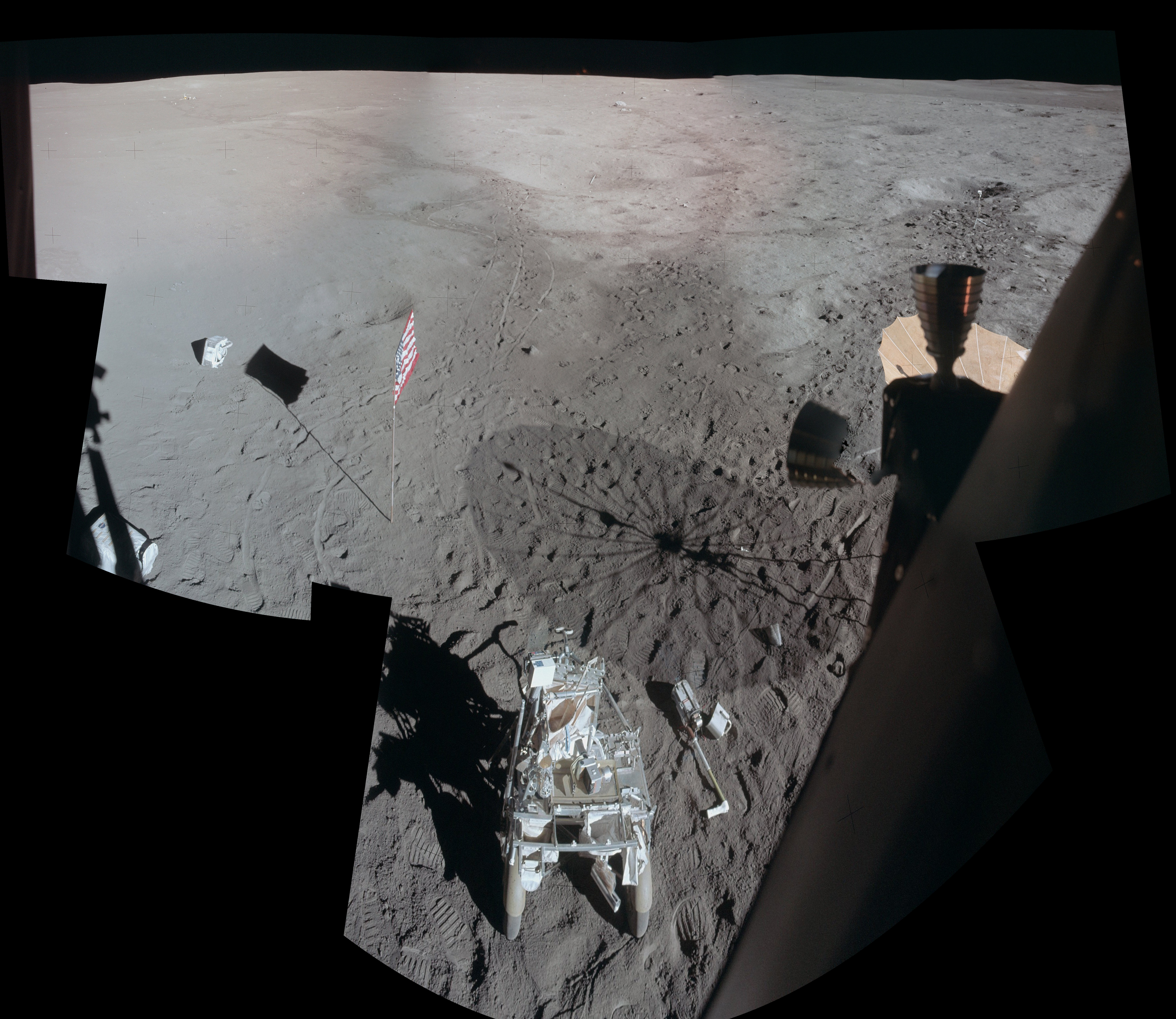
Apollo 14: astronaut Ed Mitchell's view from Lunar Module Antares

Apollo 14: astronaut Ed Mitchell's view from Lunar Module Antares
Click on the image for full resolution (4.5 MB)

Forty years ago, while looking out the window of Apollo 14's Lunar Module Antares, astronaut Ed Mitchell snapped a series of photos of the lunar surface, assembled into this detailed mosaic by Apollo Lunar Surface Journal editor Eric Jones. The view looks across the Fra Mauro highlands to the northwest of the landing site after the Apollo 14 astronauts had completed their second and final walk on the Moon. Prominent in the foreground is their Modular Equipment Transporter (MET), a two-wheeled, rickshaw-like device used to carry tools and samples. Near the horizon at top center is a 1.5 meter wide boulder dubbed Turtle rock. In the shallow crater below Turtle rock is the long white handle of a sampling instrument, thrown there javelin-style by Mitchell. Mitchell's fellow moonwalker and first American in space, Alan Shepard, also used a makeshift six iron to hit two golf balls. One of Shepard's golf balls is just visible as a white spot below Mitchell's javelin.
The full resolution image weighs 4.5 MB, so please be patient when downloading!
Credit: Edgar Mitchell, Apollo 14, NASA; Mosaic - Eric M. Jones

Friday, January 14, 2011

Space shuttle Buran on launchpad 110/37 in November 1988

Space shuttle Buran on launchpad 110/37 in November 1988
Click on the image to enlarge

Soviet space shuttle Buran on launchpad 110/37 at Baikonur Cosmodrome in November 1988.
Credit: Roscosmos

Tuesday, January 11, 2011

A Delta IV Heavy rocket lifts off with classified payload NROL-26

A Delta IV Heavy rocket lifts off with classified payload NROL-26
Click on the image to enlarge

A United Launch Alliance Delta IV Heavy rocket lifts off from Cape Canaveral on January 18, 2009. This was the first Delta IV Heavy mission for the NRO, carrying a classified intelligence-gathering satellite, designated NROL-26, aka USA-202. This was the third Delta IV Heavy launch in Delta program history. A Delta IV Heavy demonstration flight occurred in December 2004, and the first Air Force operational mission was launched in November 2007.
The ULA Delta IV Heavy vehicle featured a center common booster core with two strap-on common booster cores. Each common booster core was powered by the RS-68 cryogenic engine. An RL10B-2 cryogenic engine powered the second stage. Both engines are built by Pratt & Whitney Rocketdyne. The payload was encased by a 5-meter diameter (16.7-foot diameter) aluminum, tri-sector payload fairing. ULA constructed the Delta IV Heavy launch vehicle in Decatur, Ala.
The payload for this mission was highly classified and the NRO is providing few details about the spacecraft. However, Aviation Week & Space Technology and the website GlobalSecurity.org have reported that NROL-26 is a 12,000 pound signal intelligance satellite with an antenna as wide as 350 feet.
From its geostationary perch, the satellite provides key intelligence on the communications of hostile parties such as Iran and al Qeada for the White House, NSA and the Pentagon.
Credit: Pat Coprkery / ULA

Monday, January 10, 2011

Space Shuttle Enterprise First Historical Appearance: May 1, 1979

Space Shuttle Enterprise First Historical Appearance: May 1, 1979
Click on the image to enlarge

Space shuttle Enterprise made its first appearance mated to supportive propellant containers/boosters cluster, as it was rolled from the Vehicle Assembly Building at Kennedy Space Center en route to the launch pad, some 3.5 miles away, on May 1, 1979. Enterprise underwent several weeks of fit and function checks on the pad in preparation for STS-1, on which its sister craft Columbia took astronauts John Young and Robert Crippen into space for a 54-hour test mission.
Credit: NASA

Saturday, January 8, 2011

NASA's vision of manned Mars exploration: more than a dream?

NASA's vision of manned Mars exploration: more than a dream?
Click on the image for full resolution (6.6 MB)

In this artist's concept of a future Mars mission, two explorers stop to inspect a robotic lander and its small rover after driving a short distance from their landing site. This stop also allows the crew to check out the life support systems of their rover and space suits within walking distance of the base.
The Vision for Space Exploration calls for NASA to return to the Moon and eventually explore Mars and beyond.
The full resolution image weighs 6.6 MB, so please be patient when downloading!
Credit: NASA/Pat Rawlings, SAIC