Showing posts with label Planetary Nebulae. Show all posts

Sunday, March 1, 2026

Planetary Nebula PMR 1 as seen by Webb

Planetary Nebula PMR 1 as seen by Webb
Click the image for higher resolution (6.2 MB)

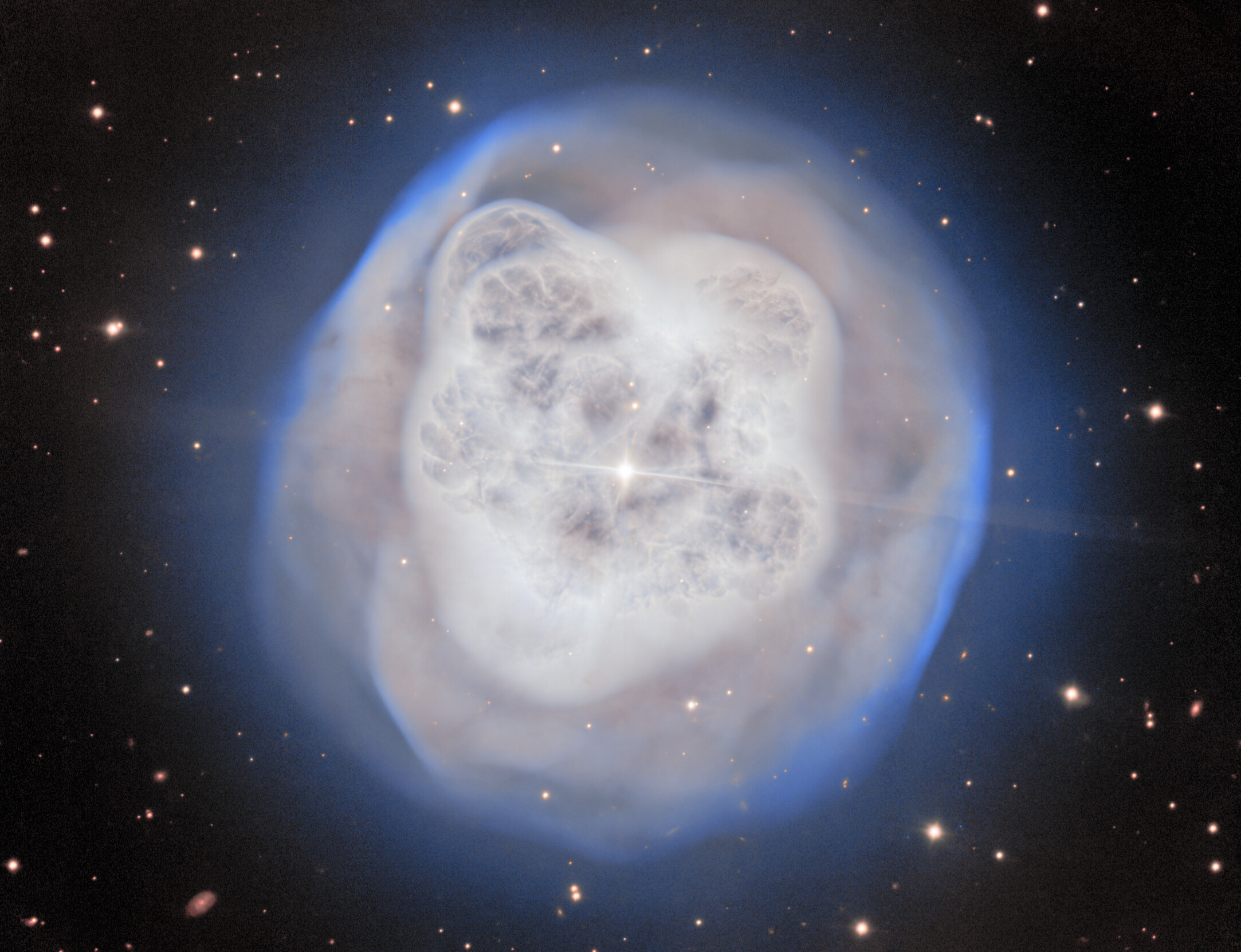
Two heads are better than one in the latest images from NASA's James Webb Space Telescope, which reveal new detail in a mysterious, little-studied nebula surrounding a dying star.
Nebula PMR 1 is a cloud of gas and dust that bears an uncanny resemblance to a brain in a transparent skull, inspiring its nickname, the "Exposed Cranium" nebula. Webb captured its unusual features in both near- and mid-infrared light. The nebula was first revealed in infrared light by a predecessor to Webb, NASA's now-retired Spitzer Space Telescope, more than a decade ago. Webb's advanced instruments show detail that enhances the nebula's brain-like appearance.
The nebula appears to have distinct regions that capture different phases of its evolution – an outer shell of gas that was blown off first and consists mostly of hydrogen, and an inner cloud with more structure that contains a mix of different gases. Both Webb's NIRCam (Near-Infrared Camera) and MIRI (Mid-Infrared Instrument) show a distinctive dark lane running vertically through the middle of the nebula that defines its brain-like look of left and right hemispheres. Webb's resolution shows that this lane could be related to an outburst or outflow from the central star, which typically occurs as twin jets burst out in opposite directions. Evidence for this is particularly notable at the top of the nebula in Webb’s MIRI image, where it looks like the inner gas is being ejected outward.
While there is still much to be understood about this nebula, it's clear that it is being created by a star near the end of its fuel-burning "life". In their end stages, stars expel their outer layers. It's a dynamic and fairly fast process, in cosmic terms. Webb has captured a moment in this star's decline. What ultimately happens will depend on the mass of the star, which is yet to be determined. If it's massive enough, it will explode in a supernova. A less massive Sun-like star will continue to shed layers until only its core remains as a dense white dwarf, which will cool off over eons.
Image Credit: NASA, ESA, CSA, STScI, Image Processing: Joseph DePasquale (STScI)
Image enhancement: Jean-Baptiste Faure

Saturday, December 27, 2025

Planetary Nebula NGC 6537 as seen by Webb

Planetary Nebula NGC 6537 as seen by Webb
Click the image for higher resolution (9.8 MB)

This new James Webb Space Telescope picture features a cosmic creepy-crawly called NGC 6537 – the Red Spider Nebula. Using its Near-InfraRed Camera (NIRCam), Webb has revealed never-before-seen details in this picturesque planetary nebula with a rich backdrop of thousands of stars.
Planetary nebulae like the Red Spider Nebula form when ordinary stars like the Sun reach the end of their lives. After ballooning into cool red giants, these stars shed their outer layers and cast them into space, exposing their white-hot cores. Ultraviolet light from the central star ionises the cast-off material, causing it to glow. The planetary nebula phase of a star's life is as fleeting as it is beautiful, lasting only a few tens of thousands of years.
The central star of the Red Spider Nebula is visible in this image, glowing just brighter than the webs of dusty gas that surround it. The surprising nature of the nebula's tremendously hot and luminous central star has been revealed by Webb's NIRCam. In optical-wavelength images, such as from the Hubble Space Telescope, the star appears faint and blue. But in the NIRCam images, it shows up as red: thanks to its sensitive near-infrared capabilities, Webb has revealed a shroud of hot dust surrounding the central star. This hot dust likely orbits the central star, in a disc structure.
Though only a single star is visible in the Red Spider's heart, a hidden companion star may lurk there as well. A stellar companion could explain the nebula's shape, including its characteristic narrow waist and wide outflows. This hourglass shape is seen in other planetary nebulae such as the Butterfly Nebula, which Webb also recently observed.
Webb's new view of the Red Spider Nebula reveals for the first time the full extent of the nebula's outstretched lobes, which form the "legs" of the spider. These lobes, shown in blue, are traced by light emitted from H2 molecules, which contain two hydrogen atoms bonded together. Stretching over the entirety of NIRCam's field of view, these lobes are shown to be closed, bubble-like structures that each extend about 3 light-years. Outflowing gas from the centre of the nebula has inflated these massive bubbles over thousands of years.
Gas is also actively jetting out from the nebula's center, as these new Webb observations show. An elongated purple "S" shape centred on the heart of the nebula follows the light from ionised iron atoms. This feature marks where a fast-moving jet has emerged from near the nebula's central star and collided with material that was previously cast away by the star, sculpting the rippling structure of the nebula seen today.
The observations used to create this image come from Webb GO programme #4571 (PI: J. Kastner) as part of a joint Chandra-JWST observing programme, which aims to understand how bipolar planetary nebulae like the Red Spider Nebula are shaped by the outflows and jets that emerge from the stars at their cores.
Image Credit: ESA/Webb, NASA and CSA, J. H. Kastner (Rochester Institute of Technology)
Image enhancement: Jean-Baptiste Faure

Wednesday, May 8, 2024

Planetary Nebula M76

Planetary Nebula M76
Click the image for higher resolution (4.2 MB)

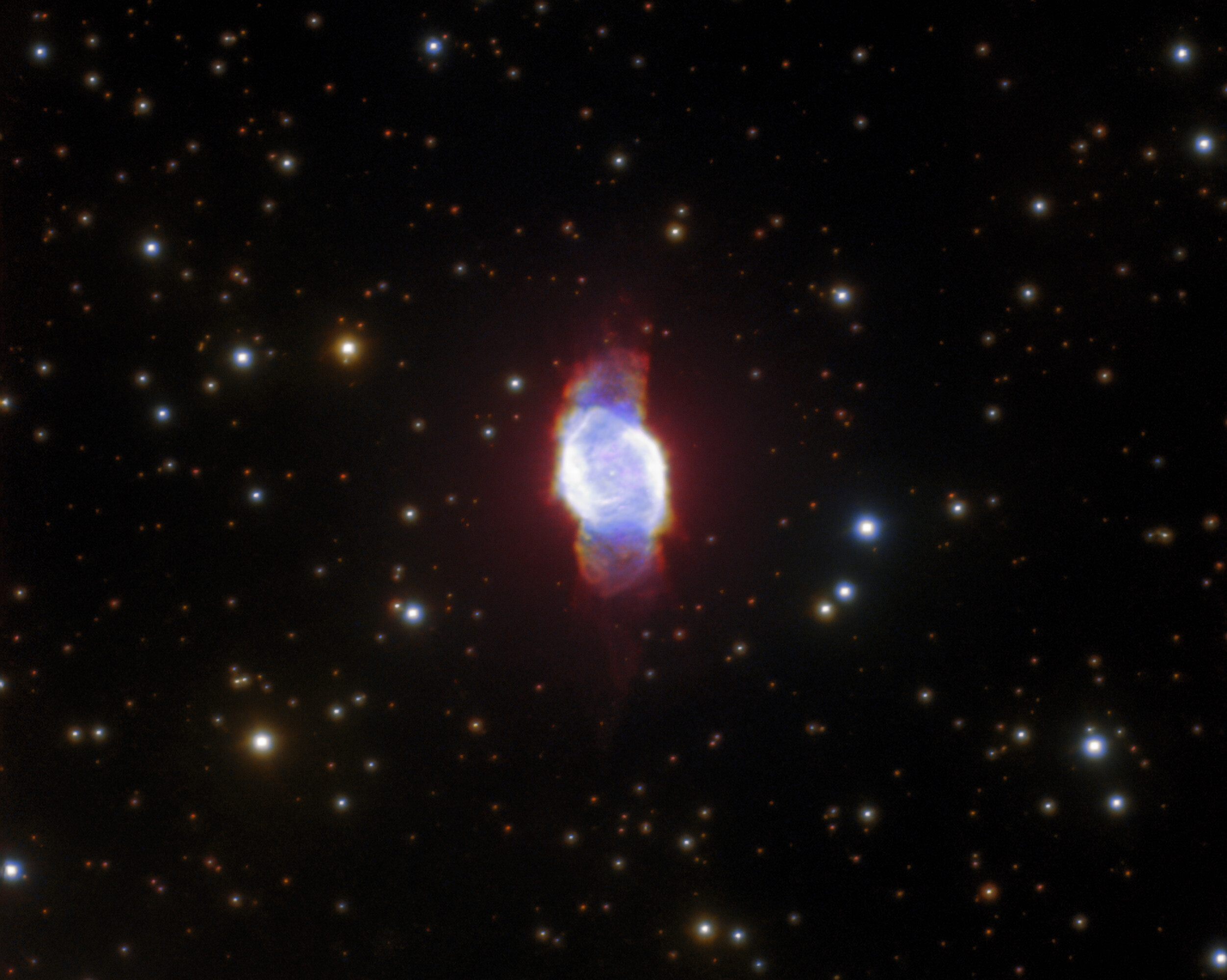
In celebration of the 34th anniversary of the launch of the legendary Hubble Space Telescope, astronomers took a snapshot of the Little Dumbbell Nebula (also known as Messier 76, M76, or NGC 650/651) located 3400 light-years away in the northern circumpolar constellation Perseus. The photogenic nebula is a favourite target of amateur astronomers.
M76 is classified as a planetary nebula. This is a misnomer because it is unrelated to planets. But its round shape suggested it was a planet to astronomers who first viewed it through low-power telescopes. In reality, a planetary nebula is an expanding shell of glowing gases that were ejected from a dying red giant star. The star eventually collapses to an ultra-dense, hot white dwarf.
M76 is composed of a ring, seen edge-on as the central bar structure, and two lobes on either opening of the ring. Before the star burned out, it ejected the ring of gas and dust. The ring was probably sculpted by the effects of the star that once had a binary companion star. This sloughed-off material created a thick disc of dust and gas along the plane of the companion's orbit. The hypothetical companion star isn't seen in the Hubble image, and so it could have been later swallowed by the central star. The disc would be forensic evidence for that stellar cannibalism.
The primary star is collapsing to form a white dwarf. It is one of the hottest stellar remnants known at a scorching 120 000 degrees Celsius, 24 times our Sun's surface temperature. The sizzling white dwarf can be seen as a pinpoint in the centre of the nebula. A star visible in projection beneath it is not part of the nebula.
Pinched off by the disc, two lobes of hot gas are escaping from the top and bottom of the "belt" along the star's rotation axis that is perpendicular to the disc. They are being propelled by the hurricane-like outflow of material from the dying star, tearing across space at two million miles per hour. That's fast enough to travel from Earth to the Moon in a little over seven minutes! This torrential "stellar wind" is ploughing into cooler, slower-moving gas that was ejected at an earlier stage in the star's life, when it was a red giant. Ferocious ultraviolet radiation from the super-hot star is causing the gases to glow. The red colour is from nitrogen, and blue is from oxygen.
The entire nebula is a flash in the pan by cosmological timekeeping. It will vanish in about 15 000 years.
Image Credit: NASA, ESA, STScI, A. Pagan (STScI)
Image enhancement: Jean-Baptiste Faure
Thursday, November 30, 2023

Planetary Nebula IC 5148

Planetary Nebula IC 5148
Click the image for higher resolution (1.1 MB)

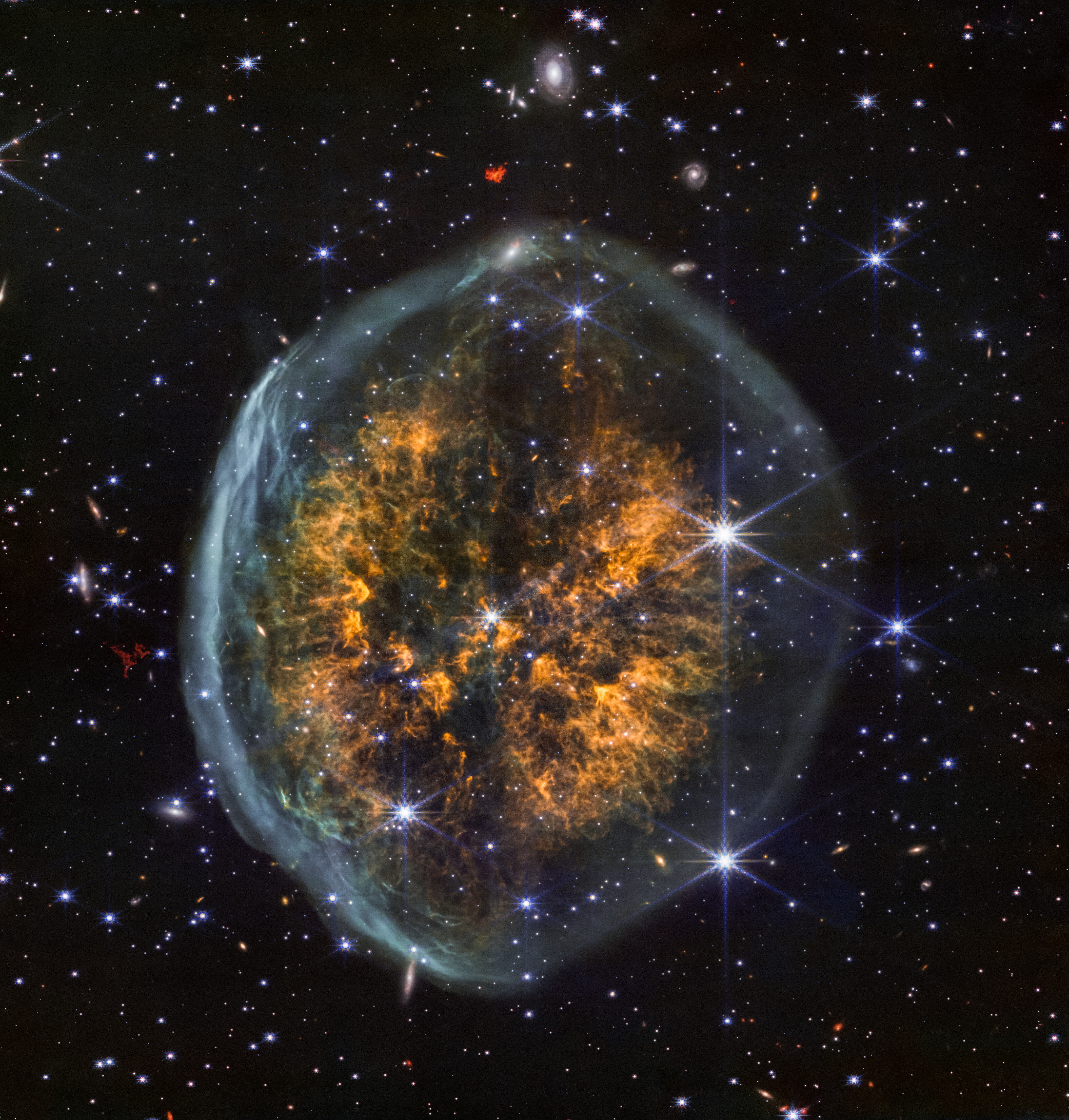
IC 5148, nicknamed the Spare Tyre Nebula, is a beautiful planetary nebula located about 3000 light-years away near the "neck" of the southern constellation Grus (The Crane). This image, captured with the Gemini South telescope, one half of the International Gemini Observatory operated by NSF's NOIRLab, showcases the looming cloud of gas of IC 1548 and the central stellar remnant from which the gas radiates. It's one of the fastest expanding planetary nebulae, pushing out into space at 180,000 kilometers per hour (112,000 miles per hour).
With small telescopes, this nebula looks like a bright central star with an outer ring. The mesmerizing layers of gas are faint. They are almost undetectable without the use of larger telescopes, and not with the clarity captured in this image using the Gemini Multi-Object Spectrograph (GMOS) on Gemini South. Around the time IC 5148 was discovered by astronomers in 1894, researchers coined the term planetary nebula to refer to these giant gaseous balls that looked like giant planets. Today we know that these balls are in fact stellar remnants.
At the center of IC 5148 is a white dwarf, the hot core of the dying star, surrounded by asymmetrical gaseous "blooms" and a faint halo ring. The predecessor of the white dwarf was likely a star of a similar mass to our Sun. At the end of that star's life, the internal pressure imbalance resulted in the star swelling up into a red giant. As it grew, the outer layers of the gas and stellar material were pushed into space to form the nebula we see today. The central hole – the dark patch surrounding the star – is due to the pressure of the radiation from the star that pushes the surrounding gas away from the core and leaves a vacant space. The formation of the ring and the bow-like structures of gas are marks of the evolutionary history of IC 5148 – but the mechanisms that created them remain a mystery to astronomers.
Image Credit: International Gemini Observatory/NOIRLab/NSF/AURA
Image processing: T.A. Rector (University of Alaska Anchorage/NSF's NOIRLab), J. Miller (Gemini Observatory/NSF's NOIRLab), M. Rodriguez (Gemini Observatory/NSF's NOIRLab), and M. Zamani (NSF's NOIRLab)
Image enhancement: Jean-Baptiste Faure

Tuesday, September 26, 2023

Planetary Nebula M57 as seen by Webb

Planetary Nebula M57 as seen by Webb
Click the image for higher resolution (3.7 MB)

The James Webb Space Telescope has observed the well-known Ring Nebula with unprecedented detail. Formed by a star throwing off its outer layers as it runs out of fuel, the Ring Nebula is an archetypal planetary nebula. Also known as M57 and NGC 6720, it is both relatively close to Earth at roughly 2,500 light-years away.
This new image provides unprecedented spatial resolution and spectral sensitivity. For example, the intricate details of the filament structure of the inner ring are particularly visible in this dataset.
There are some 20,000 dense globules in the nebula, which are rich in molecular hydrogen. In contrast, the inner region shows very hot gas. The main shell contains a thin ring of enhanced emission from carbon-based molecules known as polycyclic aromatic hydrocarbons (PAHs). Roughly ten concentric arcs are located just beyond the outer edge of the main ring. The arcs are thought to originate from the interaction of the central star with a low-mass companion orbiting at a distance comparable to that between the Earth and the dwarf planet Pluto. In this way, nebulae like the Ring Nebula reveal a kind of astronomical archaeology, as astronomers study the nebula to learn about the star that created it.
This image of the Ring Nebula appears as a distorted doughnut. The nebula's inner cavity hosts shades of blue and green, while the detailed ring transitions through shades of orange in the inner regions and pink in the outer region. The ring's inner region has distinct filament elements.
Image Credit: ESA/Webb, NASA, CSA, M. Barlow, N. Cox, R. Wesson
Image enhancement: Jean-Baptiste Faure
Thursday, July 14, 2022

Planetary Nebula NGC 3132 imaged by the JWST

Planetary Nebula NGC 3132 imaged by the JWST
Click the image for full resolution (21.3 MB)

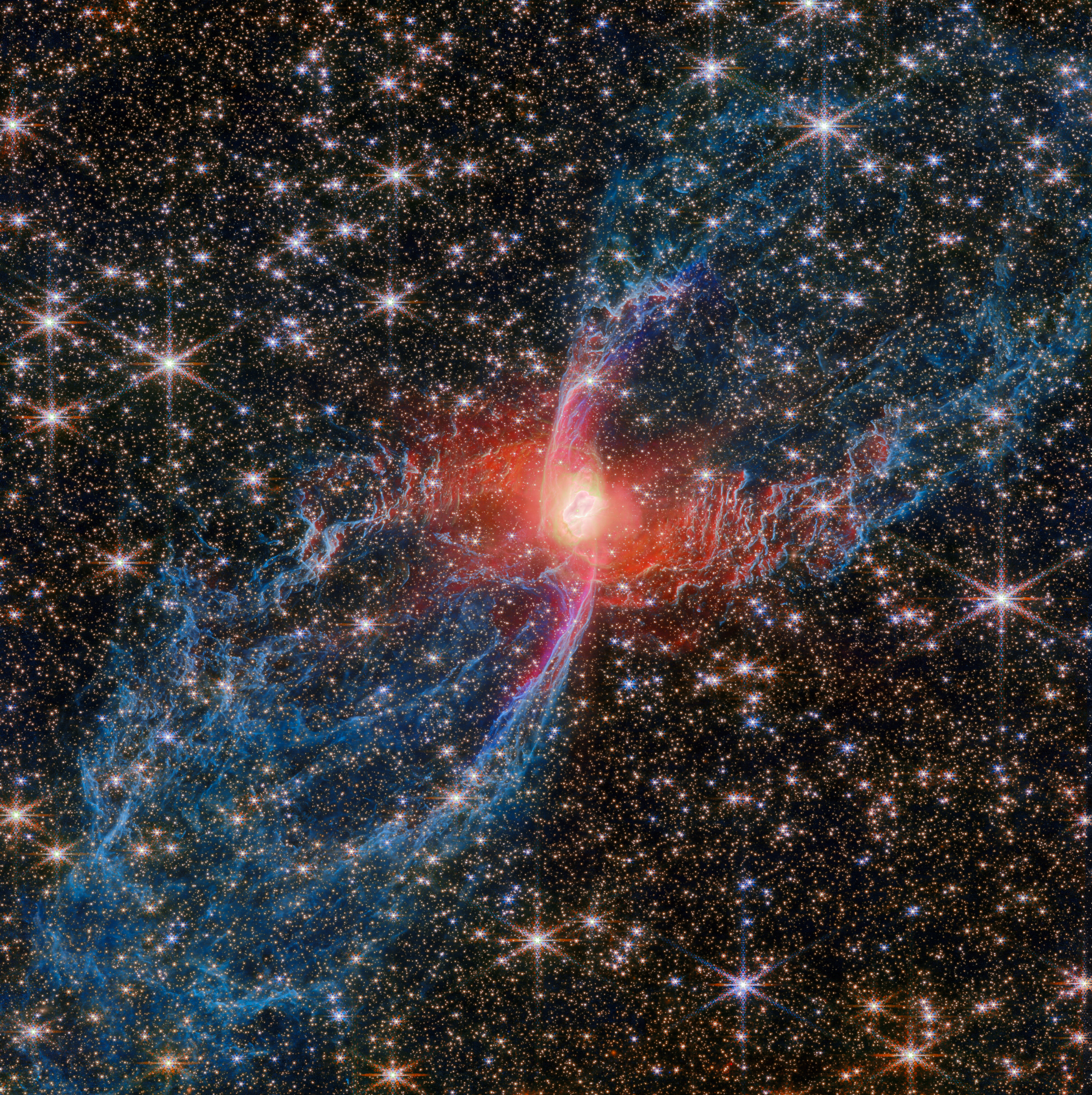
The bright star at the center of NGC 3132, while prominent when viewed by NASA's Webb Telescope in near-infrared light, plays a supporting role in sculpting the surrounding nebula. A second star, barely visible at lower left along one of the bright star’s diffraction spikes, is the nebula's source. It has ejected at least eight layers of gas and dust over thousands of years. But the bright central star visible here has helped “stir” the pot, changing the shape of this planetary nebula's highly intricate rings by creating turbulence. The pair of stars are locked in a tight orbit, which leads the dimmer star to spray ejected material in a range of directions as they orbit one another, resulting in these jagged rings.
Hundreds of straight, brightly-lit lines pierce through the rings of gas and dust. These “spotlights” emanate from the bright star and stream through holes in the nebula like sunlight through gaps in a cloud. But not all of the starlight can escape. The density of the central region, set off in teal, is reflected by how transparent or opaque it is. Areas that are a deeper teal indicate that the gas and dust are denser – and light is unable to break free.
Data from Webb's Near-Infrared Camera (NIRCam) were used to make this extremely detailed image. It is teeming with scientific information – and research will begin following its release. This is not only a crisp image of a planetary nebula – it also shows us objects in the vast distances of space behind it. The transparent red sections of the planetary nebula – and all the areas outside it – are filled with distant galaxies.
Look for the bright angled line at the upper left. It is not starlight – it is a faraway galaxy seen edge-on. Distant spirals, of many shapes and colors, also dot the scene. Those that are farthest away – or very dusty – are small and red.
Since planetary nebulae exist for tens of thousands of years, observing the nebula is like watching a movie in exceptionally slow motion. Each shell the star puffed off gives researchers the ability to precisely measure the gas and dust that are present within it. As the star ejects shells of material, dust and molecules form within them – changing the landscape even as the star continues to expel material. This dust will eventually enrich the areas around it, expanding into what's known as the interstellar medium. And since it's very long-lived, the dust may end up traveling through space for billions of years and become incorporated into a new star or planet. In thousands of years, these delicate layers of gas and dust will dissipate into surrounding space.
Image Credit: NASA, ESA, CSA, and STScI

Sunday, May 15, 2022

Planetary Nebula EGB 6

Planetary Nebula EGB 6
Click on the image for higher resolution (4.5 MB)

This image, which looks a little like an enormous bubble in space, features a planetary nebula known as EGB 6. It was imaged by the Nicholas U. Mayall 4-meter Telescope at Kitt Peak National Observatory (KPNO), a Program of NSF's NOIRLab. Planetary nebulae, notoriously, have nothing to do with planets. They form during the dying millennia of intermediate-mass stars, stars with masses between one and eight times the mass of the Sun.
"Dying millennia" might sound like a very long time, but compared to the overall lifespan of a star, planetary nebulae are extremely short-lived. Towards the end of their life cycle, intermediate-mass stars enter the red giant phase, during which fusion reactions temporarily reignite in a dying star's core. Layers of gas, shed or ejected during the red giant phase, absorb vast amounts of energy and create the gorgeous phenomena known as planetary nebulae. The dying millenia only last about 20,000 years, a mere blink of an eye when you consider that intermediate-mass stars shine steadily for between 30 million to 10 billion years (depending on their mass) before they die.
Image Credit: KPNO/NOIRLab/NSF/AURA
Image processing: T.A. Rector (University of Alaska Anchorage/NSF's NOIRLab), M. Zamani (NSF's NOIRLab) & D. de Martin (NSF's NOIRLab)
Image enhancement: Jean-Baptiste Faure

Wednesday, September 29, 2021

Planetary Nebula CVMP 1

Planetary Nebula CVMP 1
Click on the image for higher resolution (1.4 MB)

The international Gemini Observatory composite color image of the planetary nebula CVMP 1 imaged by the Gemini Multi-Object Spectrograph on the Gemini South telescope on Cerro Pachón in Chile.
Image Credit: International Gemini Observatory/NOIRLab/NSF/AURA
Image enhancement: Jean-Baptiste Faure

Wednesday, June 2, 2021

Planetary Nebula Sh2-42

Planetary Nebula Sh2-42
Click on the image for higher resolution (2.9 MB)

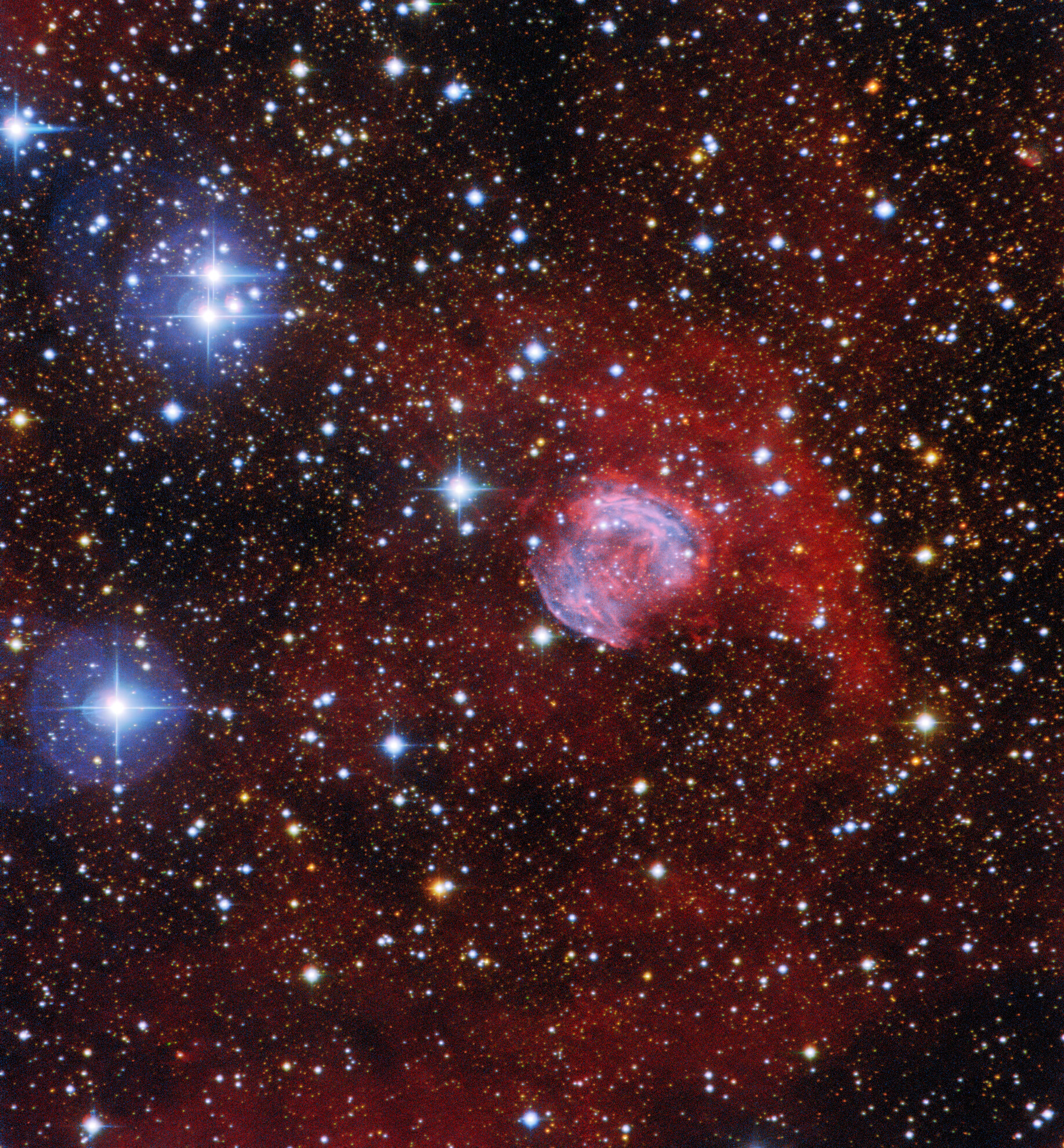
This image shows the planetary nebula Sh2-42 in the constellation Sagittarius, and was captured by using the SMARTS 0.9-meter Telescope at Cerro Tololo Inter-American Observatory, a Program of NSF's NOIRLab. Despite the name, planetary nebulae have nothing to do with planets – they are spectacular funeral pyres formed by red giant stars at the end of their lives. As these giant stars expand and throw their outer gaseous layers into space, the hot exposed core of the star ionizes the surrounding material, causing it to glow in a range of vivid colours. As it reaches the end of its life, our own Sun is expected to form a planetary nebula – but not for another 5 billion years!
Image Credit: CTIO/NOIRLab/NSF/AURA
Acknowledgment: Image processing: T. A. Rector (University of Alaska Anchorage/NSF's NOIRLab), M. Zamani & D. de Martin (NSF's NOIRLab)
Image enhancement: Jean-Baptiste Faure

Sunday, April 4, 2021

Planetary Nebula PN M 2-53

Planetary Nebula PN M 2-53
Click on the image for higher resolution

This gorgeous image resembles an inky patch of space that has been smudged by a giant celestial thumbprint. Actually the object is a planetary nebula named PN M 2-53. It was imaged using the Gemini North telescope of the international Gemini Observatory, a Program of NSF's NOIRLab.
Planetary nebulae have a wildly misleading name, as they have nothing to do with planets – or even exoplanets. The misnomer originates from the late 1700s, when astronomers thought that the gaseous structures resembled planets. Planetary nebulae are actually formed by some dying stars, right at the end of their lives. The layers of gas and dust shed by the dying stars are lit by their remaining cores, creating a planetary nebula. Despite its inaccuracy, the name has stuck!
Image Credit: International Gemini Observatory/NOIRLab/NSF/AURA
Acknowledgements: PI: Rafael Andrés Pignata (Universidad Nacional de Córdoba)
Image processing: T. A. Rector (University of Alaska Anchorage/NSF's NOIRLab), J. Miller (Gemini Observatory/NSF's NOIRLab), M. Zamani & D. de Martin (NSF's NOIRLab)
Image enhancement: Jean-Baptiste Faure
Tuesday, March 16, 2021

Planetary Nebula Abell 78

Planetary Nebula Abell 78
Click on the image for higher resolution (2.9 MB)

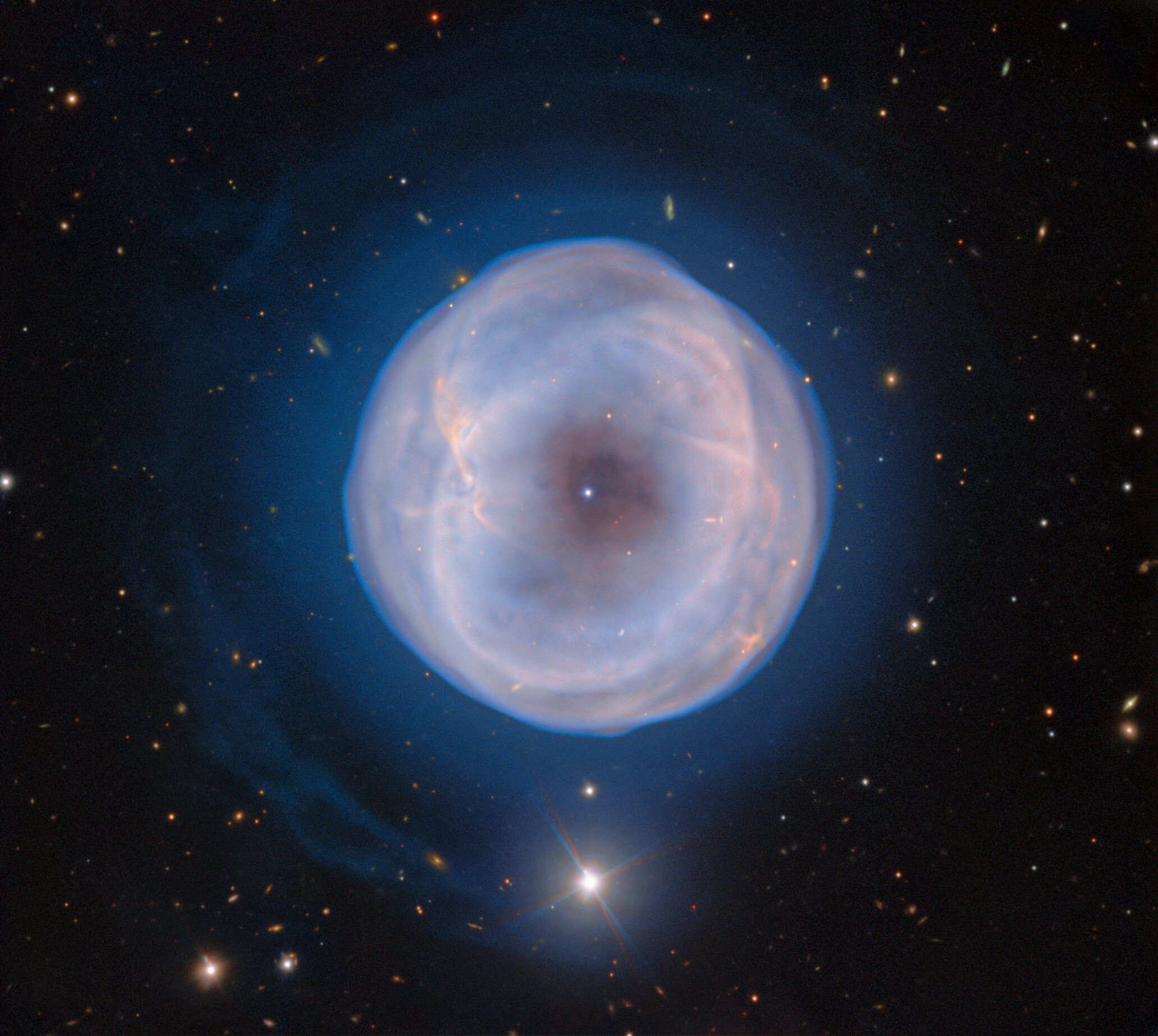
Located around 5 000 light-years away in the constellation of Cygnus (The Swan), Abell 78 is an unusual type of planetary nebula.
After exhausting the nuclear fuel in their cores, stars with a mass of around 0.8 to 8 times the mass of our Sun collapse to form dense and hot white dwarf stars. As this process occurs, the dying star will throw off its outer layers of material, forming an elaborate cloud of gas and dust known as a planetary nebula. This phenomenon is not uncommon, and planetary nebulae are a popular focus for astrophotographers because of their often beautiful and complex shapes. However, a few like Abell 78 are the result of a so-called "born again" star.
Although the core of the star has stopped burning hydrogen and helium, a thermonuclear runaway at its surface ejects material at high speeds. This ejecta shocks and sweeps up the material of the old nebula, producing the filaments and irregular shell around the central star seen in this Picture of the Week, which features data from Hubble's Wide Field Camera 3 and PANSTARSS.
Image Credit: ESA/Hubble and NASA, M. Guerrero
Acknowledgement: Judy Schmidt
Image enhancement: Jean-Baptiste Faure

Thursday, February 18, 2021

Planetary Nebula PN G75.5+1.7: the Soap Bubble Nebula

Planetary Nebula PN G75.5+1.7: the Soap Bubble Nebula
Click on the image for higher resolution (6.0 MB)

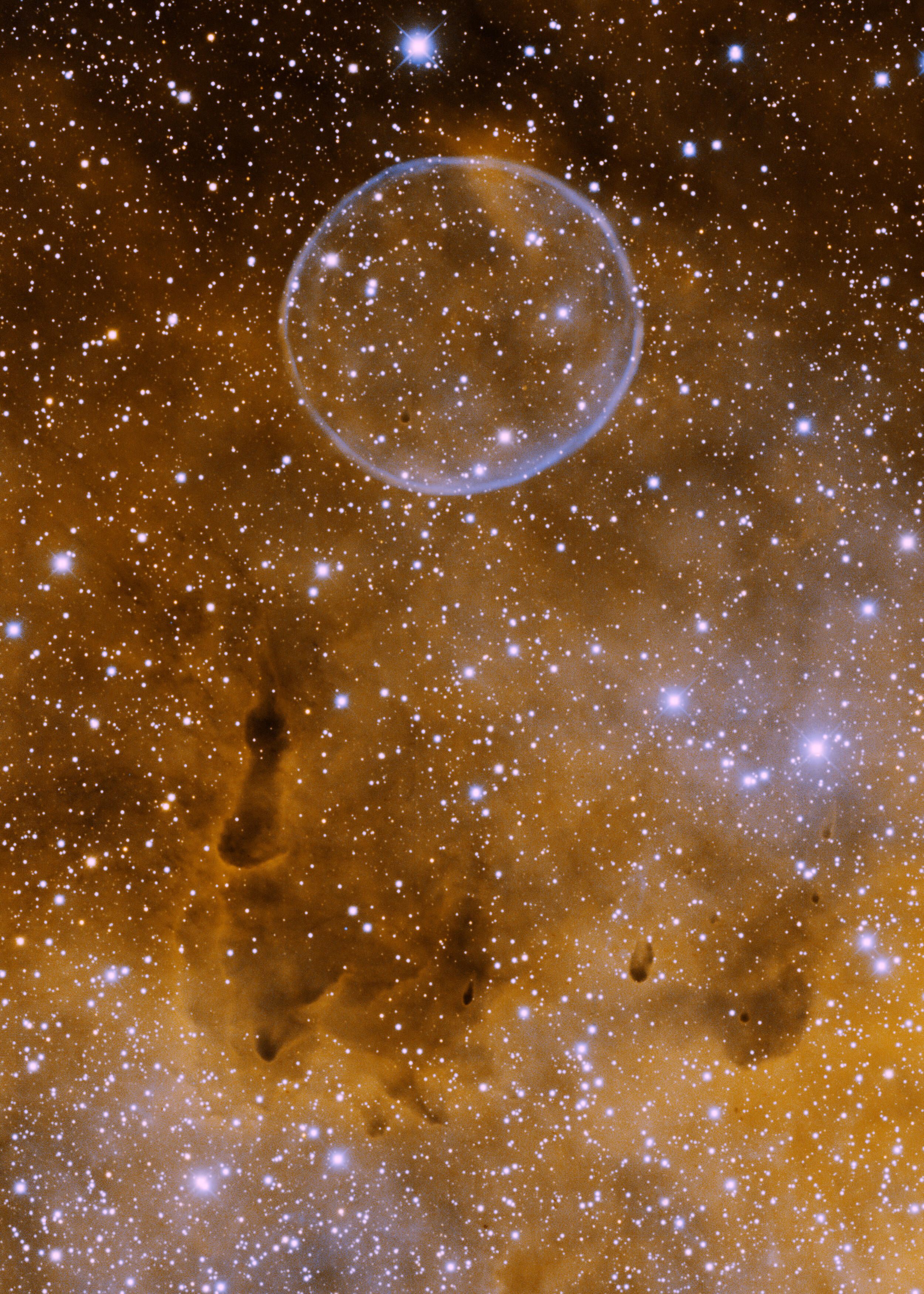
Informally known as the "Soap Bubble Nebula", this planetary nebula (officially known as PN G75.5+1.7) was discovered by amateur astronomer Dave Jurasevich on July 6th, 2008. It was noted and reported by Keith Quattrocchi and Mel Helm on July 17th, 2008. This image was obtained with the Kitt Peak Mayall 4-meter telescope in the H-alpha (orange) and [OIII] (blue) narrowband filters.
In this image, north is to the left and east is down. PN G75.5+1.7 is located in the constellation of Cygnus, not far from the Crescent Nebula (NGC 6888). It is embedded in a diffuse nebula which, in conjunction with its faintness, is the reason it was not discovered until recently. The spherical symmetry of the shell is remarkable, making it very similar to Abell 39.
Image Credit: T. A. Rector/University of Alaska Anchorage, H. Schweiker/WIYN and NOIRLab/NSF/AURA
Image enhancement: Jean-Baptiste Faure
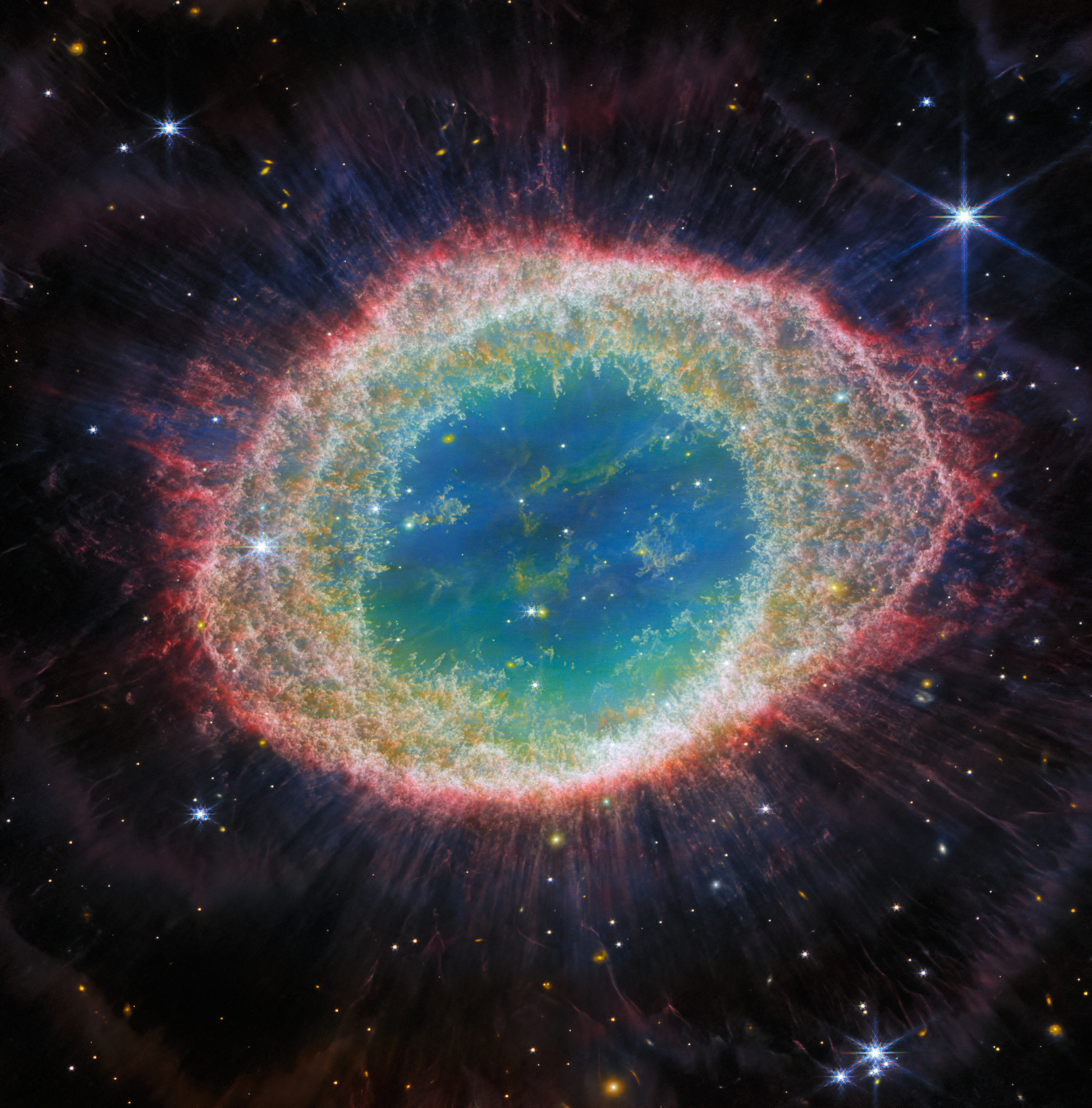
Tuesday, February 9, 2021

Planetary Nebula PN G054.2-03.4: the Necklace Nebula

Planetary Nebula PN G054.2-03.4: the Necklace Nebula
Click on the image for higher resolution (3.5 MB)

A giant cosmic necklace glows brightly in this Hubble Space Telescope image. The object, aptly named the Necklace Nebula, is a recently discovered planetary nebula, the glowing remains of an ordinary, Sun-like star. The nebula consists of a bright ring, measuring about two light-years across, dotted with dense, bright knots of gas that resemble diamonds in a necklace. The knots glow brightly due to absorption of ultraviolet light from the central stars.
A pair of tightly orbiting stars produced the nebula, also called PN G054.2-03.4. About 10 000 years ago one of the aging stars ballooned to the point where it engulfed its companion star. The smaller star continued orbiting inside its larger companion, increasing the giant's rotation rate, so that the bloated star span so fast that a large part of its gaseous envelope expanded into space. Most of the gas escaped along the star's equator, producing a ring. The bright knots are dense gas clumps in the ring.
The pair is so close, only a few million kilometers apart, that they appear as one bright dot in the center of this image. The stars are furiously whirling around each other, completing an orbit in a little more than a day. For comparison, Mercury, the innermost planet of our Solar System, orbits the Sun in 88 days.
The Necklace Nebula is located 15 000 light-years away in the constellation of Sagitta (The Arrow). In this composite image, Hubble's Wide Field Camera 3 captured the glow of hydrogen (blue), oxygen (green), and nitrogen (red).
Image Credit: NASA, ESA and the Hubble Heritage Team (STScI/AURA)
Image enhancement: Jean-Baptiste Faure

Sunday, February 7, 2021

Planetary Nebula IC 418: the Spirograph Nebula

Planetary Nebula IC 418: the Spirograph Nebula
Click on the image for higher resolution

Glowing like a multi-faceted jewel, the planetary nebula IC 418 lies about 2000 light-years from Earth in the constellation Lepus. In this picture, the Hubble telescope reveals some remarkable textures weaving through the nebula. Their origin, however, is still uncertain.
Image Credit: NASA/ESA and The Hubble Heritage Team (STScI/AURA)
Image enhancement: Jean-Baptiste Faure

Friday, October 30, 2020

Planetary Nebula NGC 246: the Skull Nebula

Planetary Nebula NGC 246: the Skull Nebula
Click on the image for higher resolution

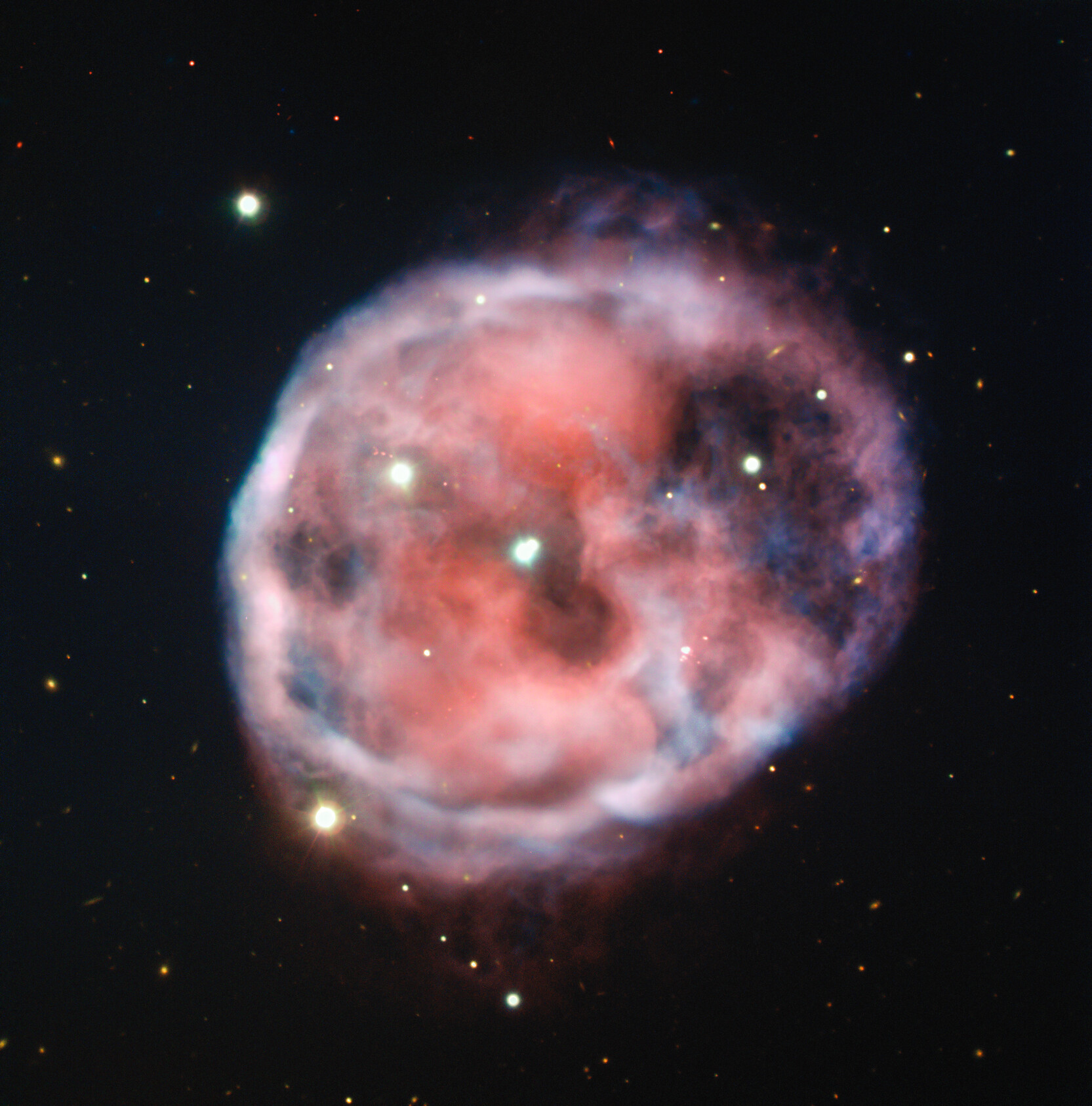
This ethereal remnant of a long dead star, nestled in the belly of The Whale, bears an uneasy resemblance to a skull floating through space. Captured in astounding detail by ESO's Very Large Telescope (VLT), the eerie Skull Nebula is showcased in this new image in beautiful bloodshot colours. This planetary nebula is the first known to be associated with a pair of closely bound stars orbited by a third outer star.
Also known as NGC 246, the Skull Nebula lies about 1600 light-years away from Earth in the southern constellation of Cetus (The Whale). It formed when a Sun-like star expelled its outer layers in its old age, leaving behind its naked core – a white dwarf – one of two stars that can be seen at the very center of NGC 246.
Even though this nebula has been known for centuries, only in 2014 did astronomers discover, using ESO's VLT, that the white dwarf and its companion are concealing a third star situated at the heart of the Skull Nebula. This star, which is not visible in this image, is a dim red dwarf that sits close to the white dwarf at about 500 times the distance between Earth and the Sun. The red and white dwarf stars orbit each other as a pair, and the outer star orbits the two dwarfs at a distance of around 1900 times the Earth-Sun separation. Collectively, these three stars establish NGC 246 as the first known planetary nebula with a hierarchical triple stellar system at its center.
Taken by the FORS 2 instrument on ESO's VLT in the Chilean Atacama Desert, this new image of the Skull Nebula intentionally captures light emitted in some narrow ranges of wavelengths – those associated with hydrogen and oxygen gas. Observations of light emitted by particular elements help reveal a wealth of information about an object's chemical and structural compositions. This new image of the Skull Nebula highlights where NGC 246 is rich or poor in hydrogen (shown in red) and oxygen (depicted in light blue).
This image was selected as part of the ESO Cosmic Gems programme, an outreach initiative to produce images of interesting, intriguing or visually attractive objects using ESO telescopes, for the purposes of education and public outreach. The programme makes use of telescope time that cannot be used for science observations. All data collected may also be suitable for scientific purposes, and are made available to astronomers through ESO's science archive.
Image Credit: ESO
Image enhancement: Jean-Baptiste Faure

Saturday, August 1, 2020

Planetary Nebula NGC 6302: the Butterfly Nebula

Planetary Nebula NGC 6302: the Butterfly Nebula
Click on the image for higher resolution (2.5 MB)

This image from the Hubble Space Telescope depicts NGC 6302, commonly known as the Butterfly Nebula. NGC 6302 lies within our Milky Way galaxy, roughly 3800 light-years away in the constellation of Scorpius. The glowing gas was once the star's outer layers, but has been expelled over about 2200 years. The butterfly shape stretches for more than two light-years, which is about half the distance from the Sun to the nearest star, Proxima Centauri.
New observations of the object have found unprecedented levels of complexity and rapid changes in the jets and gas bubbles blasting off of the star at the centre of the nebula.
Image Credit: NASA, ESA, and J. Kastner (RIT)
Image enhancement: Jean-Baptiste Faure
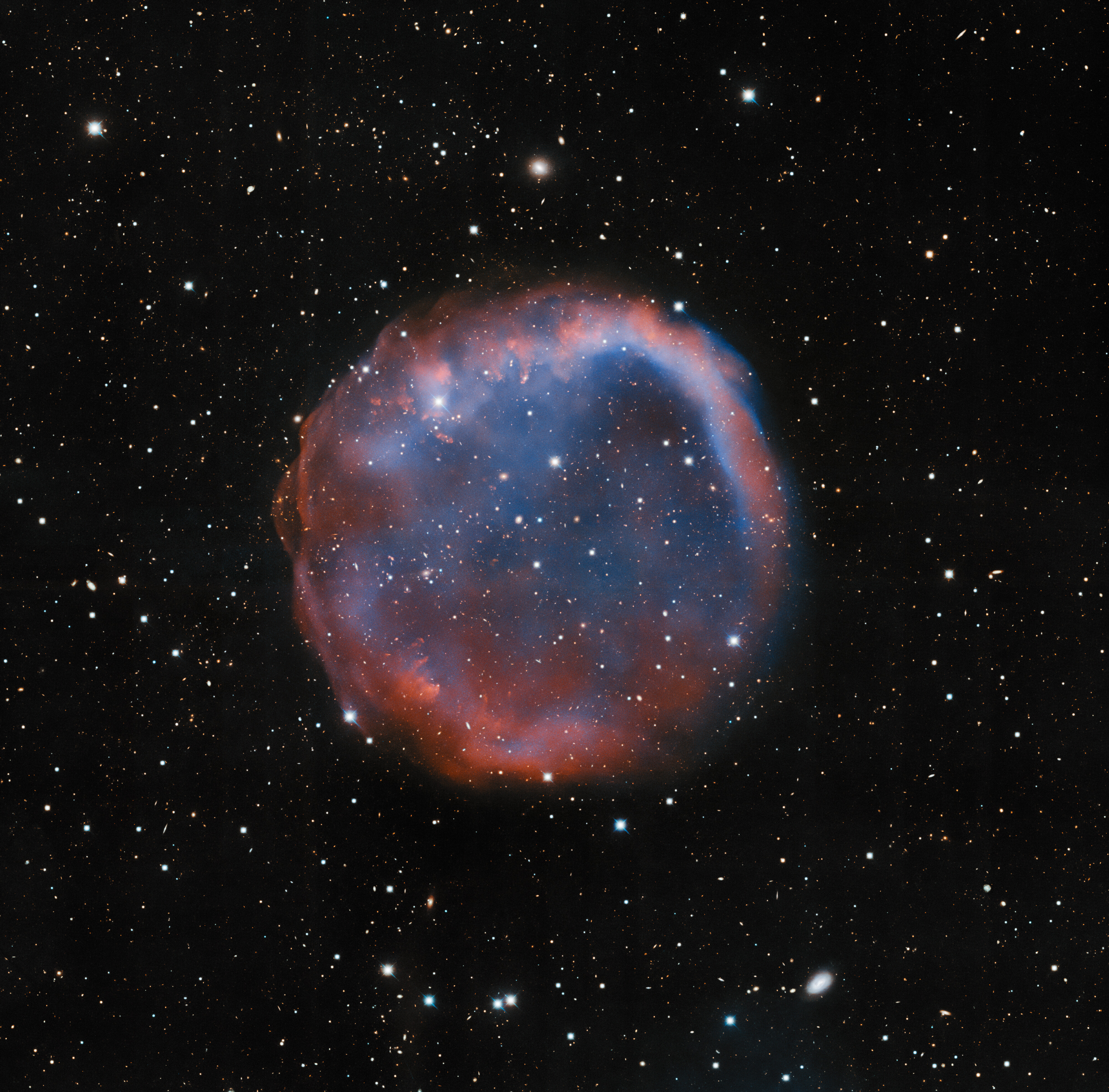
Planetary Nebula NGC 7027: the Jewel Bug Nebula

Planetary Nebula NGC 7027: the Jewel Bug Nebula
Click on the image for higher resolution

This image from the Hubble Space Telescope depicts NGC 7027, or the "Jewel Bug" nebula. The object had been slowly puffing away its mass in quiet, spherically symmetric or perhaps spiral patterns for centuries – until relatively recently when it produced a new cloverleaf pattern.
New observations of the object have found unprecedented levels of complexity and rapid changes in the jets and gas bubbles blasting off of the star at the centre of the nebula.
Image Credit: NASA, ESA, and J. Kastner (RIT)
Image enhancement: Jean-Baptiste Faure

Sunday, November 3, 2019

Planetary Nebula NGC 2022

Planetary Nebula NGC 2022
Click on the image for higher resolution

Although it looks more like an entity seen through a microscope than a telescope, this rounded object, named NGC 2022, is certainly no alga or tiny, blobby jellyfish. Instead, it is a vast orb of gas in space, cast off by an ageing star. The star is visible in the orb's center, shining through the gases it formerly held onto for most of its stellar life.
When stars like the Sun grow advanced in age, they expand and glow red. These so-called red giants then begin to lose their outer layers of material into space. More than half of such a star's mass can be shed in this manner, forming a shell of surrounding gas. At the same time, the star's core shrinks and grows hotter, emitting ultraviolet light that causes the expelled gases to glow. This type of object is called, somewhat confusingly, a planetary nebula, though it has nothing to do with planets. The name derives from the rounded, planet-like appearance of these objects in early telescopes. NGC 2022 is located in the constellation of Orion (The Hunter).
Image Credit: ESA/Hubble and NASA, R. Wade
Image enhancement: Jean-Baptiste Faure
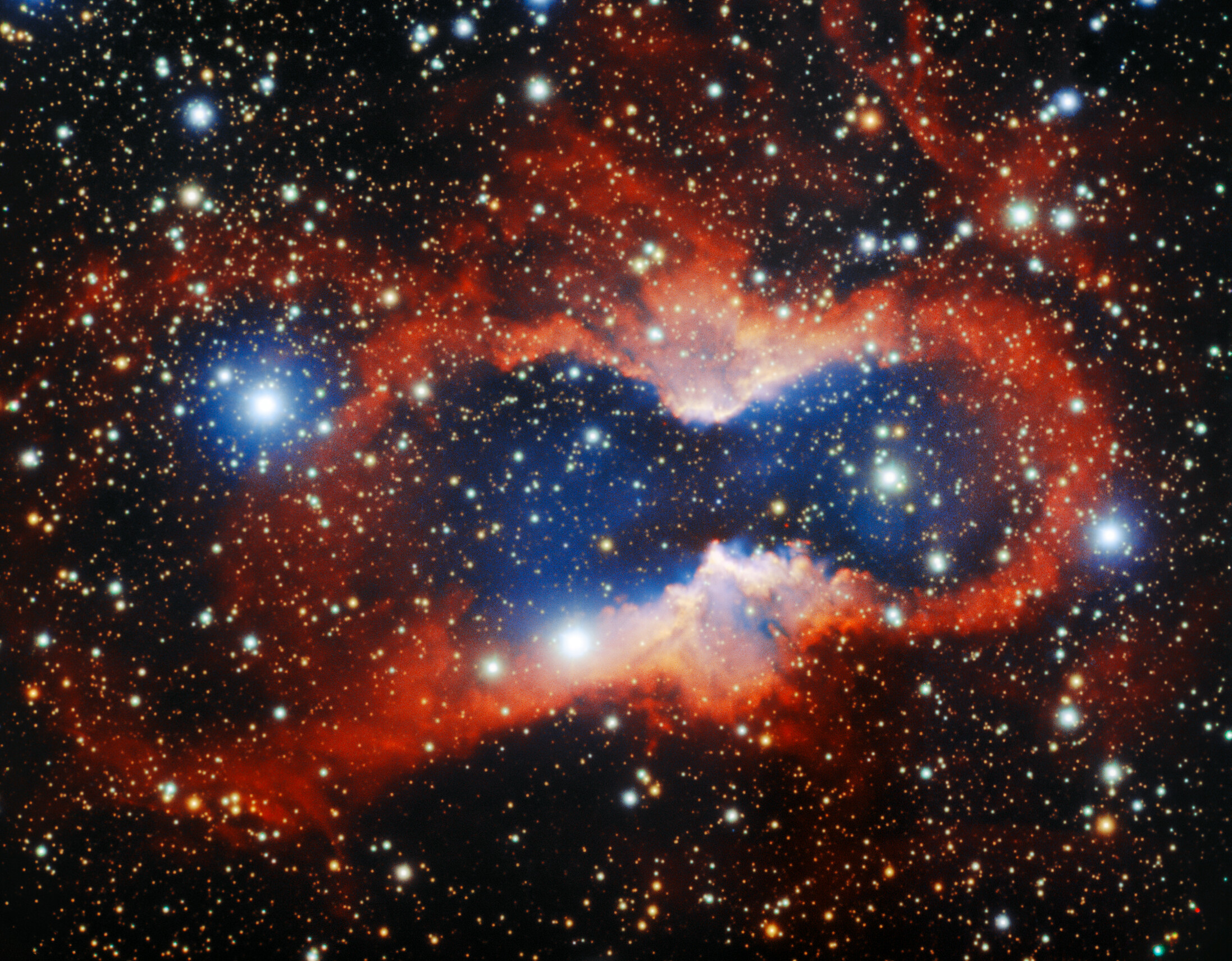
Monday, May 6, 2019

Planetary Nebula ESO 577-24

Planetary Nebula ESO 577-24
Click on the image for higher resolution

The faint, ephemeral glow emanating from the planetary nebula ESO 577-24 persists for only a short time – around 10,000 years, a blink of an eye in astronomical terms. ESO's Very Large Telescope captured this shell of glowing ionised gas – the last breath of the dying star whose simmering remains are visible at the heart of this image. As the gaseous shell of this planetary nebula expands and grows dimmer, it will slowly disappear from sight.
This stunning planetary nebula was imaged by one of the VLT's most versatile instruments, FORS2. The instrument captured the bright, central star, Abell 36, as well as the surrounding planetary nebula. The red and blue portions of this image correspond to optical emission at red and blue wavelengths, respectively. An object much closer to home is also visible in this image – an asteroid wandering across the field of view has left a faint track below and to the left of the central star. And in the far distance behind the nebula a glittering host of background galaxies can be seen.
Image Credit: ESO
Image enhancement: Jean-Baptiste Faure

Thursday, April 25, 2019

Planetary Nebula Sh2-68

Planetary Nebula Sh2-68
Click on the image for higher resolution (2.9 MB)

This image was obtained with the wide-field view of the Mosaic camera on the Mayall 4-meter telescope at Kitt Peak National Observatory. Sh2-68 is an ancient planetary nebula that is estimated to be at least 45,000 years old. The diffuse orange emission to the upper right is the result of the planetary nebula's motion through the disk of our galaxy. The bluish interior is from energized oxygen atoms. The progenitor star is the very blue star at the center of the bluish gas. The image was generated with observations in the Hydrogen alpha (red) and Oxygen [OIII] (blue) filters. In this image, North is right, East is up.
Image Credit: T.A. Rector (University of Alaska Anchorage) and H. Schweiker (WIYN and NOAO/AURA/NSF)
Image enhancement: Jean-Baptiste Faure