Showing posts with label Black Holes. Show all posts

Thursday, September 10, 2026

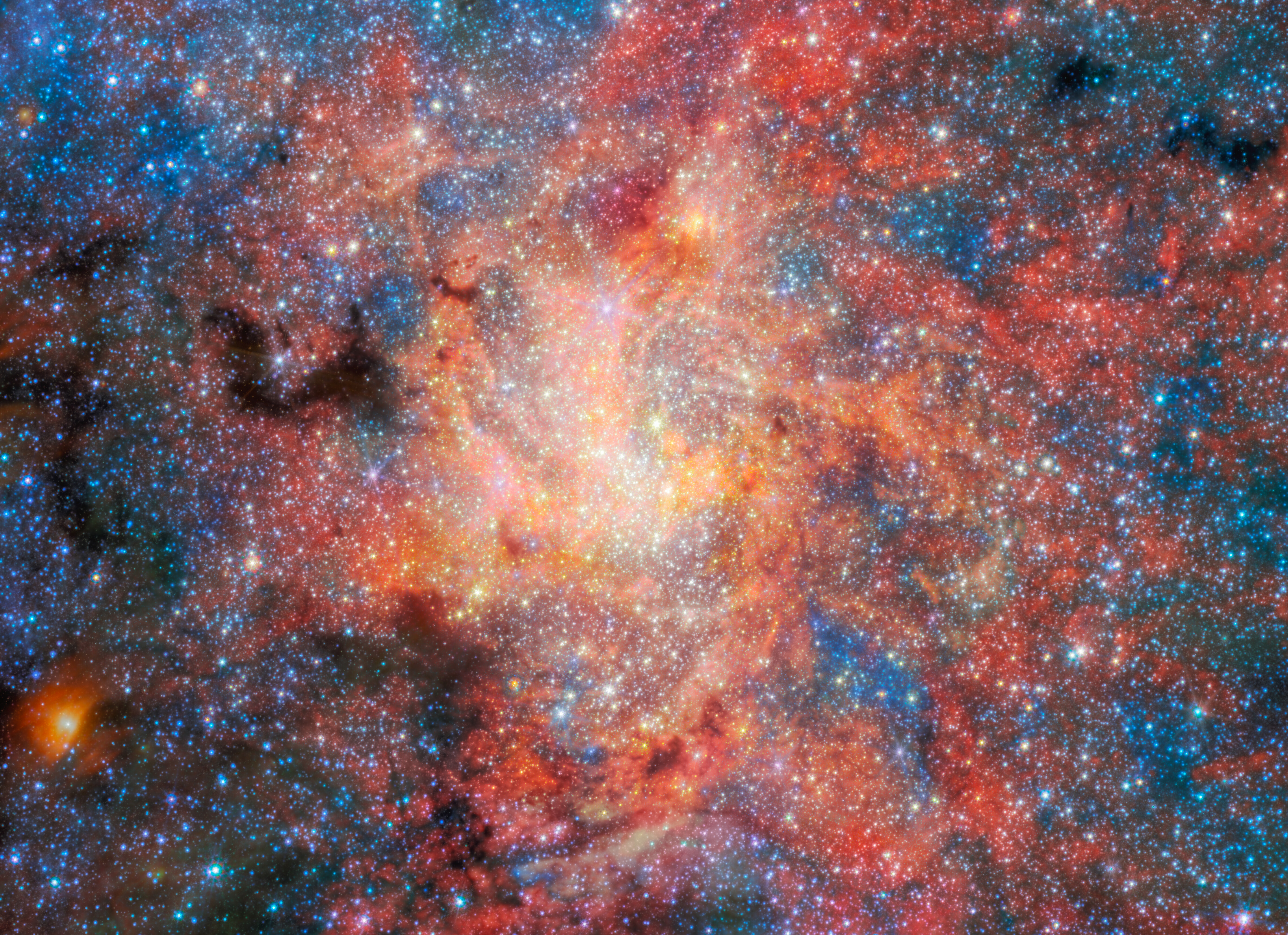
The Milky Way Galaxy's center as seen by Webb

The Milky Way Galaxy's center as seen by Webb
Click the image for higher resolution (5.1 MB)

A dense star field fills the entire image, with countless stars scattered across a backdrop of glowing clouds in shades of red, orange, pink, white, and blue. At the center, a brilliant concentration of stars creates a bright, almost white core surrounded by intricate filaments and wisps of illuminated gas and dust that radiate outward. Dark, irregular patches of opaque dust interrupt the glowing clouds, particularly toward the left side of the image, where they appear as silhouetted shapes against the brighter background. The surrounding stellar population varies in brightness and colour, with cool blue stars and warmer orange and red stars distributed throughout the scene.
This image features data from Webb's NIRCam (Near Infrared Camera) and MIRI (Mid Infrared Instrument) to capture the most detailed mid-infrared view yet of the field that hosts the highly evolved star IRS 3, which is located just 0.55 light-years from Sagittarius A, the Milky Way galaxy's central supermassive black hole.
An international team of astronomers have discovered that dust and water can form and survive surprisingly close to this supermassive black hole. The observations reveal that the evolved star IRS 3 continues to enrich its surroundings with newly formed material despite the intense radiation environment around Sagittarius A.
Image Credit: ESA/Webb, NASA and CSA, F. Peißker, J. Lu, F. Yusef-Zadeh, N. B. Sabha, C. Chan
Image enhancement: Jean-Baptiste Faure

Saturday, December 6, 2025

Galaxy Cluster MACS J1149.5+2223 as seen by Webb

Click the image for higher resolution (4.9 MB)

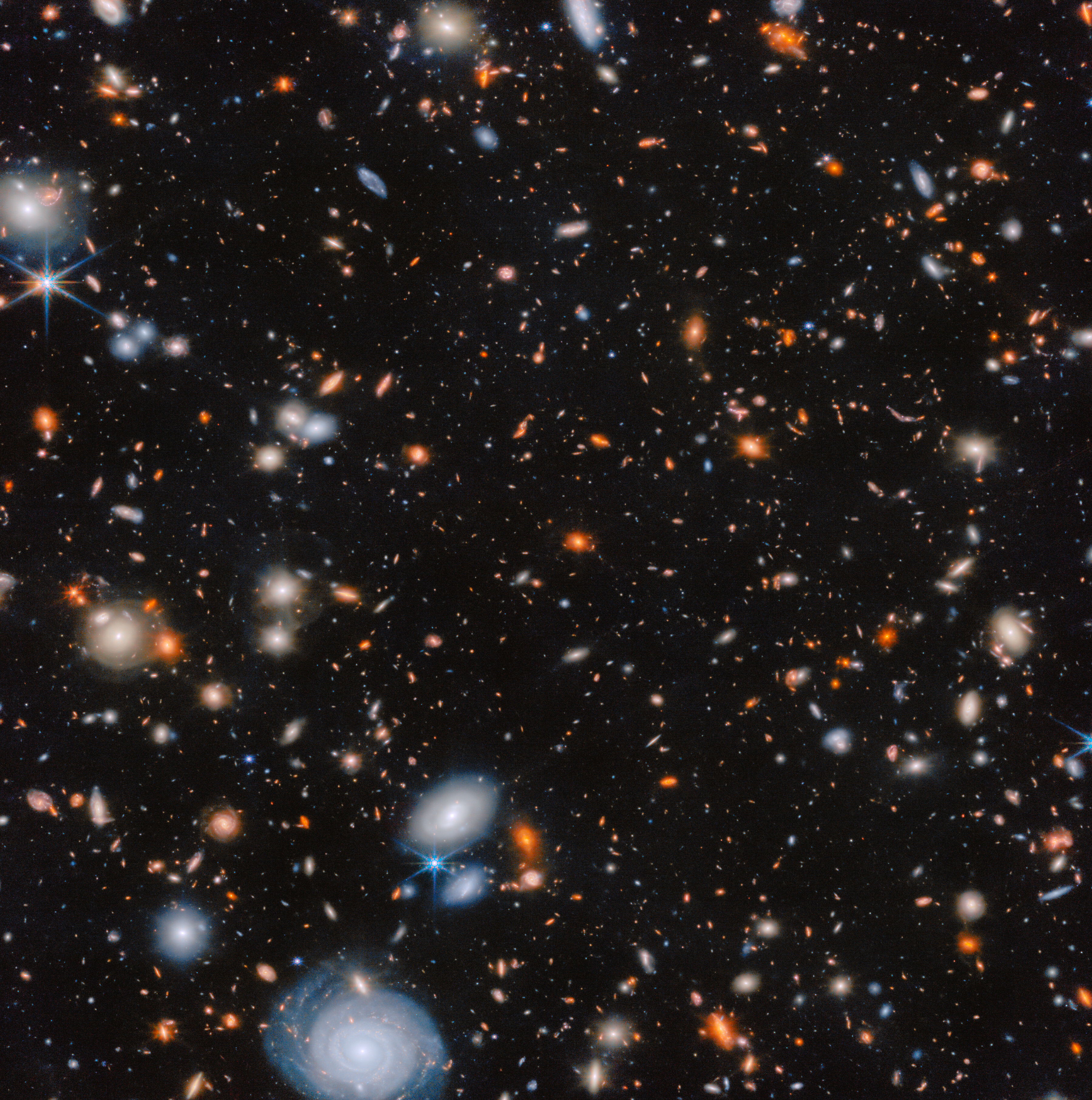
This image shows a portion of the galaxy cluster MACS J1149.5+2223, as seen by Webb's Near-Infrared Camera (NIRCam). With Webb's excellent sensitivity to infrared light and the hours of exposure time combined in this image, distant galaxies (red colours) are brought out of the darkness. Other galaxies glow strongly from the abundance of light they radiate.
These observations come from the CANUCS survey (#1208, PI: C. J. Willott). The survey employed Webb's advanced instruments, including NIRCam, NIRISS and NIRSpec, to capture detailed images and spectra of massive galaxy clusters in infrared light. Astronomers could then study low-mass galaxies in these early clusters at early stages of evolution. Because of how Webb's instruments work, for each cluster the survey targeted both the cluster's center, where the brightest and largest galaxies are gathered, and a "parallel field" of a neighbouring area within the cluster. This image features one of these parallel fields.
Researchers studying the data from the CANUCS survey uncovered a distant galaxy, named CANUCS-LRD-z8.6, in this parallel field. The galaxy is extremely distant (seen only 570 million years after the Big Bang) and the team’s research revealed that it hosts a supermassive black hole that is unusually large for such an early stage in the Universe. This result challenges existing theories about the formation of galaxies and black holes in the early Universe.
Image Credit: ESA/Webb, NASA and CSA, G. Rihtaršič (University of Ljubljana, FMF), R. Tripodi (University of Ljubljana, FMF)
Image enhancement: Jean-Baptiste Faure
Monday, November 23, 2020

Seyfert Galaxy IC 5063

Seyfert Galaxy IC 5063
Click on the image for higher resolution

Some of the most stunning views of our sky occur at sunset, when sunlight pierces the clouds, creating a mixture of bright and dark rays formed by the clouds' shadows and the beams of light scattered by the atmosphere. Astronomers studying the nearby galaxy IC 5063 are tantalized by a similar effect in this new image from the Hubble Space Telescope. In this case, a collection of narrow bright rays and dark shadows is seen beaming out of the blazingly bright center of the active galaxy, shooting across at least 36,000 light-years.
Astronomers have traced the rays back to the galaxy's core, the location of an active supermassive black hole. The black hole is feeding on infalling material, producing a powerful gusher of light from superheated gas near it. Although the researchers have developed several plausible theories for the lightshow, the most intriguing idea suggests that the shadows are being cast into space by an inner tube-shaped ring, or torus, of dusty material surrounding the black hole. IC 5063 resides 156 million light-years from Earth.
Image Credit: NASA, ESA, and W.P. Maksym (CfA)
Image enhancement: Jean-Baptiste Faure

Saturday, August 1, 2020

Star Orbiting Supermassive Black Hole

Star Orbiting Supermassive Black Hole
Click on the image for higher resolution (1.9 MB)

Observations made with ESO's Very Large Telescope (VLT) have revealed for the first time that a star orbiting the supermassive black hole at the center of the Milky Way moves just as predicted by Einstein's theory of general relativity. Its orbit is shaped like a rosette and not like an ellipse as predicted by Newton's theory of gravity. This effect, known as Schwarzschild precession, had never before been measured for a star around a supermassive black hole. This artist's impression illustrates the precession of the star's orbit, with the effect exaggerated for easier visualisation.
Image Credit: ESO/L. Calçada

Saturday, November 23, 2019

Elliptical Galaxy M87 with Black-Hole-Powered Jet

Elliptical Galaxy M87 with Black-Hole-Powered Jet
Click on the image for higher resolution (2.2 MB)

The monstrous elliptical galaxy M87 is the home of several trillion stars, a supermassive black hole, and family of 13,000 globular star clusters. M87 is the dominant galaxy at the center of the neighbouring Virgo Cluster of galaxies, which contains some 2,000 galaxies. Amid the smooth yellow population of older stars, the two features that stand out most in this Hubble Space Telescope image of M87 are its soft blue jet and the myriad of starlike globular clusters scattered throughout the image.
The jet is a black-hole-powered stream of material that is being ejected from the core of the galaxy. As gaseous material from the center of the galaxy accretes onto the black hole, the resultant energy released produces a fire-hose stream of subatomic particles that are accelerated to velocities near the speed of light. Being in the center of the Virgo Cluster of galaxies, M87 may have accumulated some of its globular clusters by gravitationally pulling them from nearby dwarf galaxies that seem to be devoid of globulars today. The 120,000-light-year-diameter galaxy lies at a distance of 54 million light-years from the Sun in the spring constellation Virgo.
This image, which was made with Hubble's Advanced Camera for Surveys, is a composite of individual filtered data that cover the visible and infrared portions of the spectrum.
Image Credit: NASA, ESA, and the Hubble Heritage Team (STScI/AURA) Acknowledgment: P. Cote (Herzberg Institute of Astrophysics) and E. Baltz (Stanford University)
Image enhancement: Jean-Baptiste Faure

Wednesday, May 8, 2019

Active Galaxy Markarian 817

Active Galaxy Markarian 817
Click on the image for higher resolution (1.3 MB)

Rings of brilliant blue stars encircle the bright, active core of this spiral galaxy, whose monster black hole is blasting material into space at over 14 million kilometers per hour. Viewed nearly face-on, the galaxy, called Markarian 817, shows intense star-forming regions and dark bands of interstellar dust along its spiral arms.
Observations by the new Cosmic Origins Spectrograph (COS) aboard the Hubble Space Telescope captured the powerful outflow of material from this galaxy. The COS spectrum of Markarian 817 highlights the outflow's dynamic nature. A gas cloud containing hydrogen that was detected in Hubble data taken in 1997 does not appear in the COS observation because the cloud has apparently been driven out by an outflow of material from the galaxy. This discharge is being powered by a huge disc of matter encircling the supermassive black hole, which is 40 million times more massive than our Sun. The disc is driving the material out of the galaxy through powerful winds, produced by streams of charged particles. Some of the outflow rains back onto the galaxy. The rest settles into the intergalactic gas.
Astronomers want to know how much of the outflow lands in the galaxy and how much escapes into intergalactic space. To achieve this, they need high-quality spectroscopic observations to detect the signatures of the outflowing material, which includes carbon, nitrogen and oxygen. This will allow them to determine the composition, location and dynamics of the winds that distribute the material.
Markarian 817 is 430 million light-years away in the northern constellation of Draco. COS observed the galaxy using its far-ultraviolet detector to distinguish the outflow from the galaxy's core. NASA astronauts installed COS during Servicing Mission 4.
The Hubble image was taken with the Wide Field Camera 3. The composite image was made by using filters that isolate light from the blue, green and infrared portions of the spectrum, as well as emission from glowing hydrogen. The Hubble observations are part of the Hubble Servicing Mission 4 Early Release Observations.
Image Credit: NASA, ESA and the Hubble SM4 ERO Team
Image enhancement: Jean-Baptiste Faure

Thursday, April 21, 2016

The galactic center as seen by Hubble

The galactic center as seen by Hubble
Click on the image for higher resolution (9.5 MB)

This infrared image from the Hubble Space Telescope shows the center of the Milky Way, 27 000 light-years away from Earth. Using the infrared capabilities of Hubble, astronomers were able to peer through the dust which normally obscures the view of this interesting region. At the center of this nuclear star cluster – and also in the center of this image – the Milky Way's supermassive black hole is located. The center of our galaxy in the constellation of Sagittarius, is a crowded place. This region is so tightly packed that it is equivalent to having one million stars crammed into the volume of space between us and Alpha Centauri, located 4.3 light-years away. At the very hub of our galaxy, this dense nuclear star cluster surrounds the Milky Way’s central supermassive black hole, known as Sagittarius A*, which alone is about four million times the mass of the Sun. Sagittarius A* is not the only mystery lurking in this part of the galaxy. The crowded center contains numerous objects that are hidden at visible wavelengths by thick clouds of dust in the galaxy's disc. In order to truly understand the central part of our galaxy astronomers used the infrared vision of Hubble to peer through this obscuring dust. To reveal the image in all its glory the scientists then assigned visible colours to the different wavelengths of infrared light, which is invisible to human eyes.
The blue stars in the image are foreground stars, which are closer to Earth than the nuclear star cluster, whilst the red stars are either behind much more intervening dust, or are embedded in dust themselves. Some extremely dense clouds of gas and dust are seen in silhouette, appearing dark against the bright background stars. These clouds are so thick that even Hubble's infrared capability cannot penetrate them. In addition to the stars hidden by the dust astronomers estimate that there are about 10 million stars in the cluster which are too faint to see, even for Hubble. Using Hubble's vantage point above the atmosphere and its high resolution, astronomers were able not only to reveal the stars in this cluster but also to measure their movements over a period of four years. Using this information, they inferred important properties of the nuclear star cluster, such as its mass and structure. The motion of the stars may also offer astronomers a glimpse into how the nuclear star cluster was formed – whether it was built up over time from globular star clusters that happened to fall into the center of the galaxy, or from gas spiralling in from the Milky Way’s disc to form stars at the core.
Image Credit: NASA, ESA, and the Hubble Heritage Team (STScI/AURA)
Acknowledgment: NASA, ESA, T. Do and A. Ghez (UCLA), and V. Bajaj (STScI)

Tuesday, March 18, 2014

Spiral Seyfert Galaxy NGC 5793

Spiral Seyfert Galaxy NGC 5793
Click on the image for full resolution (2.6 MB)

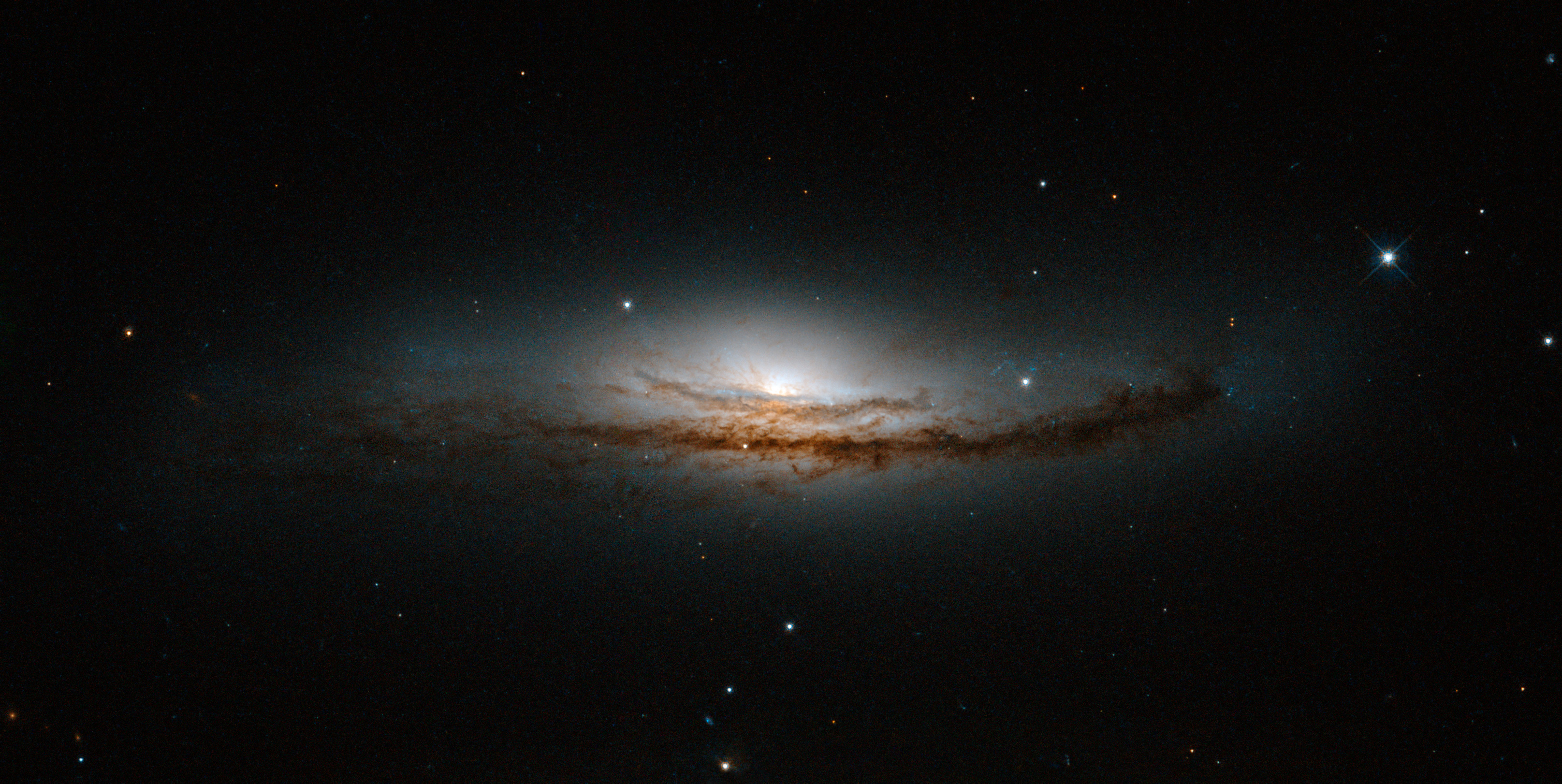
This new Hubble image is centred on NGC 5793, a spiral galaxy over 150 million light-years away in the constellation of Libra. This galaxy has two particularly striking features: a beautiful dust lane and an intensely bright center - much brighter than that of our own galaxy, or indeed those of most spiral galaxies we observe. NGC 5793 is a Seyfert galaxy. These galaxies have incredibly luminous centers that are thought to be caused by hungry supermassive black holes - black holes that can be billions of times the size of the Sun - that pull in and devour gas and dust from their surroundings. This galaxy is of great interest to astronomers for many reasons. For one, it appears to house objects known as masers. Whereas lasers emit visible light, masers emit microwave radiation. Naturally occurring masers, like those observed in NGC 5793, can tell us a lot about their environment; we see these kinds of masers in areas where stars are forming. In NGC 5793 there are also intense mega-masers, which are thousands of times more luminous than the Sun. A version of this image was submitted to the Hubble’s Hidden Treasures image processing competition by contestant Judy Schmidt.
Image Credit: NASA, ESA, and E. Perlman (Florida Institute of Technology)
Acknowledgement: Judy Schmidt
Image enhancement: Jean-Baptiste Faure

Wednesday, February 15, 2012

Galaxy ESO 243-49 and Black Hole HLX-1

Galaxy ESO 243-49 and Black Hole HLX-1
Click on the image for full resolution

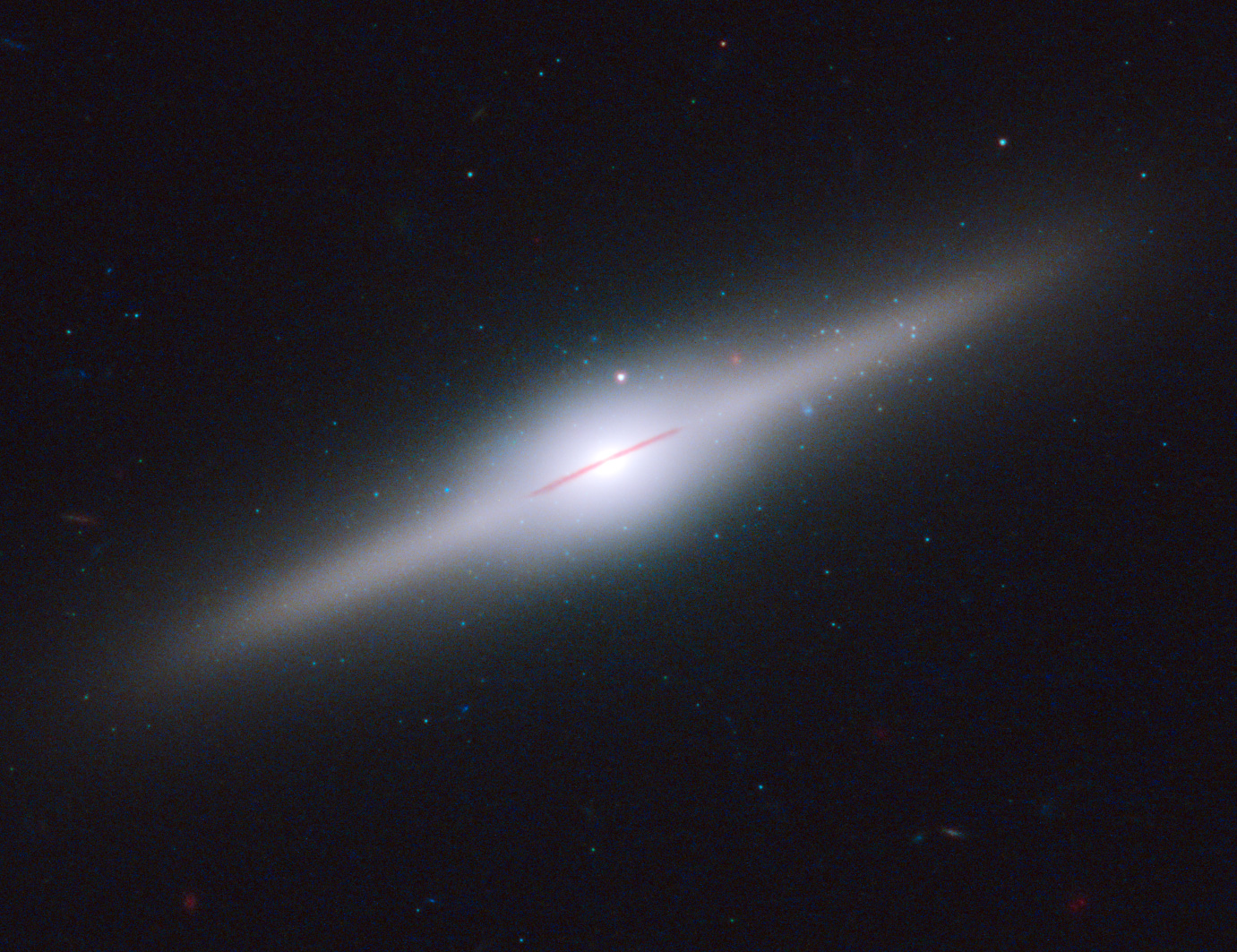
This spectacular edge-on galaxy, called ESO 243-49, is home to an intermediate-mass black hole known as HLX-1 that may have been purloined from a cannibalised dwarf galaxy. The black hole, with an estimated mass of 50 million Suns, lies above the galactic plane. This is an unlikely place for such a massive back hole to exist, unless it belonged to a small galaxy that was gravitationally torn apart by ESO 243-49.
Credit: NASA, ESA, and S. Farrell (University of Sydney, Australia and University of Leicester, UK)

Monday, January 16, 2012

Core of Spiral Galaxy M100 in Super High Resolution!

Core of Spiral Galaxy M100 in Super High Resolution!
Click on the image for full resolution (2.15 MB)

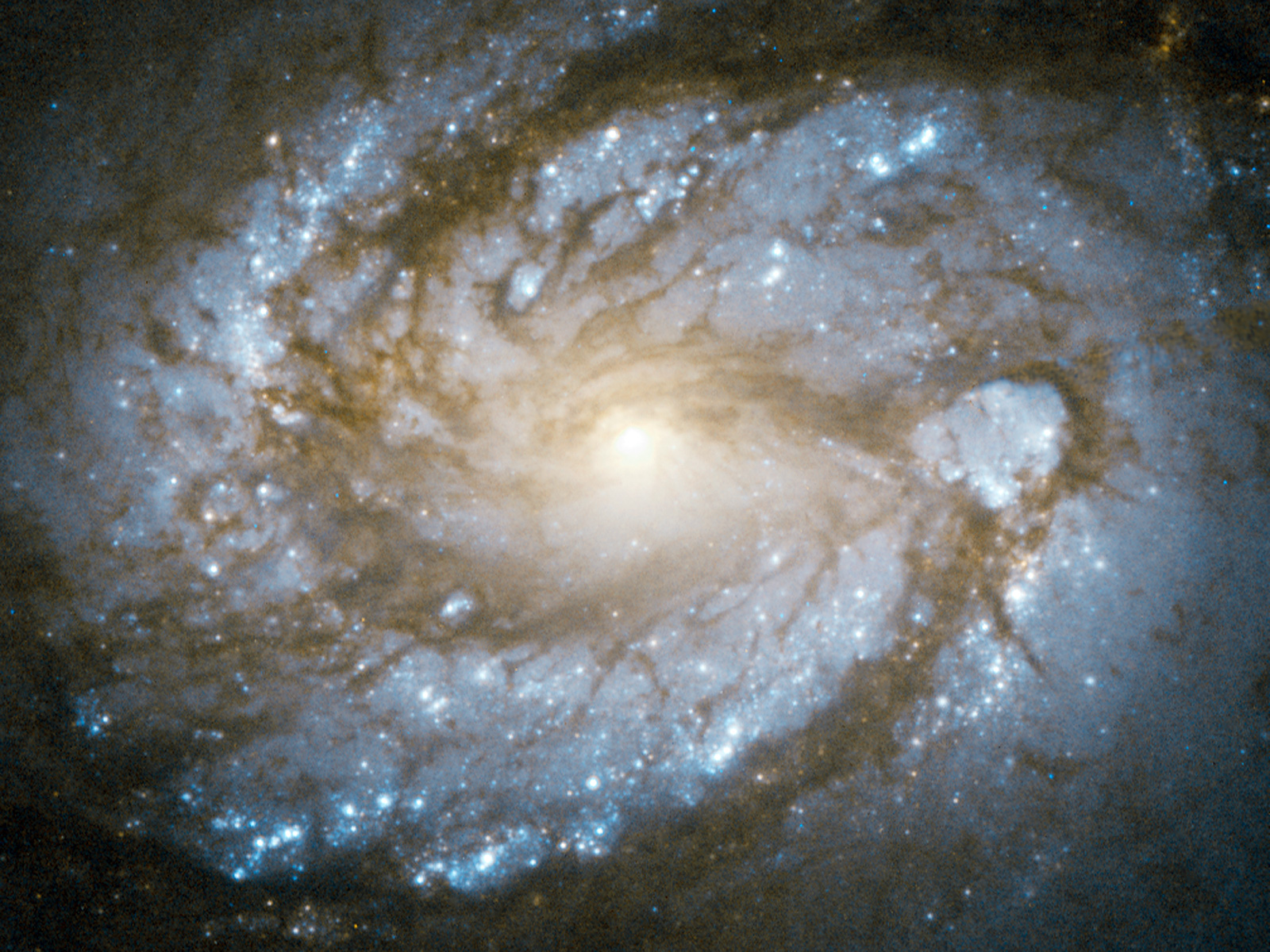
M100 (Messier 100) is a perfect example of a grand design spiral galaxy, a type of galaxy with prominent and very well-defined spiral arms. These dusty structures swirl around the galaxy's nucleus, and are marked by a flurry of star formation activity that dots Messier 100 with bright blue, high-mass stars. This image from the NASA/ESA Hubble Space Telescope, the most detailed made to date, shows the bright core of the galaxy and the innermost parts of its spiral arms. Messier 100 has an active galactic nucleus - a bright region at the galaxy's core caused by a supermassive black hole that is actively swallowing material, which radiates brightly as it falls inwards. The galaxy's spiral arms also host smaller black holes, including the youngest ever observed in our cosmic neighbourhood, the result of a supernova observed in 1979. M100 is located in the direction of the constellation of Coma Berenices, about 50 million light-years distant. The galaxy became famous in the early 1990s with the release of two images of the object taken with Hubble before and after a major repair to the telescope, which illustrated the dramatic improvement in Hubble's observations. This image, taken with the high resolution channel of Hubble's Advanced Camera for Surveys demonstrates the continued evolution of Hubble's capabilities over two decades in orbit. This image, like all high resolution channel images, has a relatively small field of view: only around 25 by 25 arcseconds.
The full resolution image weighs 2.15 MB, so please be patient when downloading!
Credit: ESA/Hubble and NASA

Tuesday, January 10, 2012

Barred Spiral Galaxy NGC 3259 spotted by Hubble

Barred Spiral Galaxy NGC 3259 spotted by Hubble
Click on the image for full resolution (3.3 MB)

This classic shot of a galaxy in the constellation of Ursa Major was taken by the NASA/ESA Hubble Space Telescope. NGC 3259 is a bright barred spiral galaxy located approximately 110 million light-years from Earth. Being a fully-formed active galaxy, its bright central bulge hosts a supermassive black hole, whose huge appetite for matter explains the high luminosity of the galaxy’s core: as it devours its surroundings, the black hole emits intense radiation across the whole electromagnetic spectrum, including in visible light. The beautiful spiral arms of the galaxy are not left out either as they contain dark lanes of dust and gas, ideal spawning grounds for stars. These bright, young, hot stars appear in rich clusters in the galaxy's arms and are what gives the galaxy its blueish hue. Interestingly, the galaxy has a small companion (visible to the left of the image), a much smaller galaxy that may be orbiting NGC 3259. In the background, numerous distant galaxies can be seen, easily identifiable by their elliptical shapes. They are visible here mainly in infrared light, which is shown in red in this image.
The full resolution image weighs 3.3 MB, so please be patient when downloading!
Credit: ESA/Hubble and NASA

Tuesday, November 29, 2011

Spiral Galaxy NGC 3621 has three Central Black Holes!

Spiral Galaxy NGC 3621 has three Central Black Holes!
Click on the image for full resolution (2.9 MB)

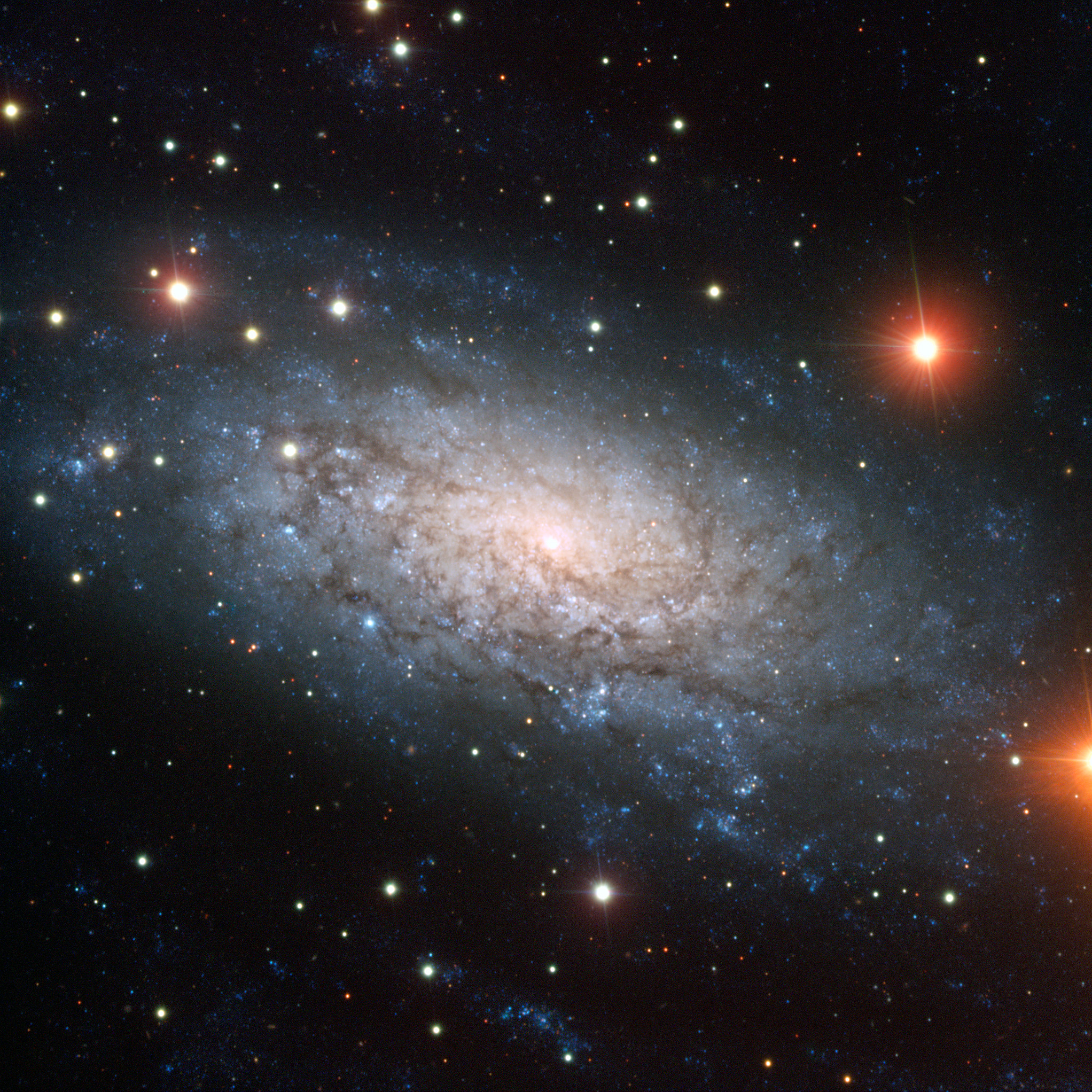
This image, from ESO's Very Large Telescope (VLT), shows a truly remarkable galaxy known as NGC 3621. To begin with, it is a pure-disc galaxy. Like other spirals, it has a flat disc permeated by dark lanes of material and with prominent spiral arms where young stars are forming in clusters (the blue dots seen in the image). But while most spiral galaxies have a central bulge - a large group of old stars packed in a compact, spheroidal region - NGC 3621 doesn't. In this image, it is clear that there is simply a brightening to the centre, but no actual bulge like the one in NGC 6744, for example. NGC 3621 is also interesting as it is believed to have an active supermassive black hole at its centre that is engulfing matter and producing radiation. This is somewhat unusual because most of these so-called active galactic nuclei exist in galaxies with prominent bulges. In this particular case, the supermassive black hole is thought to have a relatively small mass, of around 20 000 times that of the Sun. Another interesting feature is that there are also thought to be two smaller black holes, with masses of a few thousand times that of the Sun, near the nucleus of the galaxy. Therefore, NGC 3621 is an extremely interesting object which, despite not having a central bulge, has a system of three black holes in its central region. This galaxy is located in the constellation of Hydra (The Sea Snake) and can be seen with a moderate-sized telescope. This image, taken using B, V, and I filters with the FORS1 instrument on the powerful VLT, shows striking detail in this odd object and also reveals a multitude of background galaxies. A number of bright foreground stars that belong to our own Milky Way are also visible.
The full resolution image weighs 2.9 MB, so please be patient when downloading!
Credit: ESO

Sunday, November 27, 2011

Ring of Star Formation around NGC 1097 Central Black Hole

Ring of Star Formation around NGC 1097 Central Black Hole
Click on the image for full resolution (1.24 MB)

NGC 1097 (also known as Caldwell 67) is a barred spiral galaxy about 45 million light-years away in the constellation Fornax. This Hubble image shows the central ring of star formation in NGC 1097. NGC 1097 is also a Seyfert galaxy. Deep photographs revealed four narrow optical jets that appear to emanate from the nucleus. Arp interpreted these as manifestations of the (currently weak) active nucleus. Subsequent analysis of the brightest jet's radio-to-X-ray spectral energy distribution by Carter, Allen & Malin (1984), Wehrle, Keel, & Jones (1997) and Higdon & Wallin (2003) were able to rule out synchrotron and thermal free-free emission. The jets are in fact composed of stars. The failure to detect atomic hydrogen gas in the jets (under the assumption that they were an example of tidal tails) using deep 21 cm HI imaging with the Very Large Array radio telescope and numerical simulations led to the current interpretation that the jets are actually the shattered remains of a cannibalized dwarf galaxy (Higdon & Wallin 2003). Like most massive galaxies, NGC 1097 has a supermassive black hole at its center. Around the central black hole is a ring of star-forming regions with a network of gas and dust that spirals from the ring to the black hole. NGC 1097 has two satellite galaxies. Dwarf elliptical galaxy NGC 1097A is the larger of the two. It is a peculiar elliptical galaxy that orbits 42,000 light-years from the center of NGC 1097. Dwarf galaxy NGC 1097B, the outermost one, was discovered by its HI emission (5 x 10^6 solar masses; Higdon & Wallin 2003), and appears to be a typical dwarf irregular. Little else is known about it. The field of view is about 0.9 arcminutes across.
The full resolution image weighs 1.24 MB, so please be (a little) patient when downloading!
Credit: ESA and NASA

Wednesday, November 9, 2011

M31 Globular Cluster G1 harbors a Central Black Hole!

M31 Globular Cluster G1 harbors a Central Black Hole!
Click on the image for full resolution

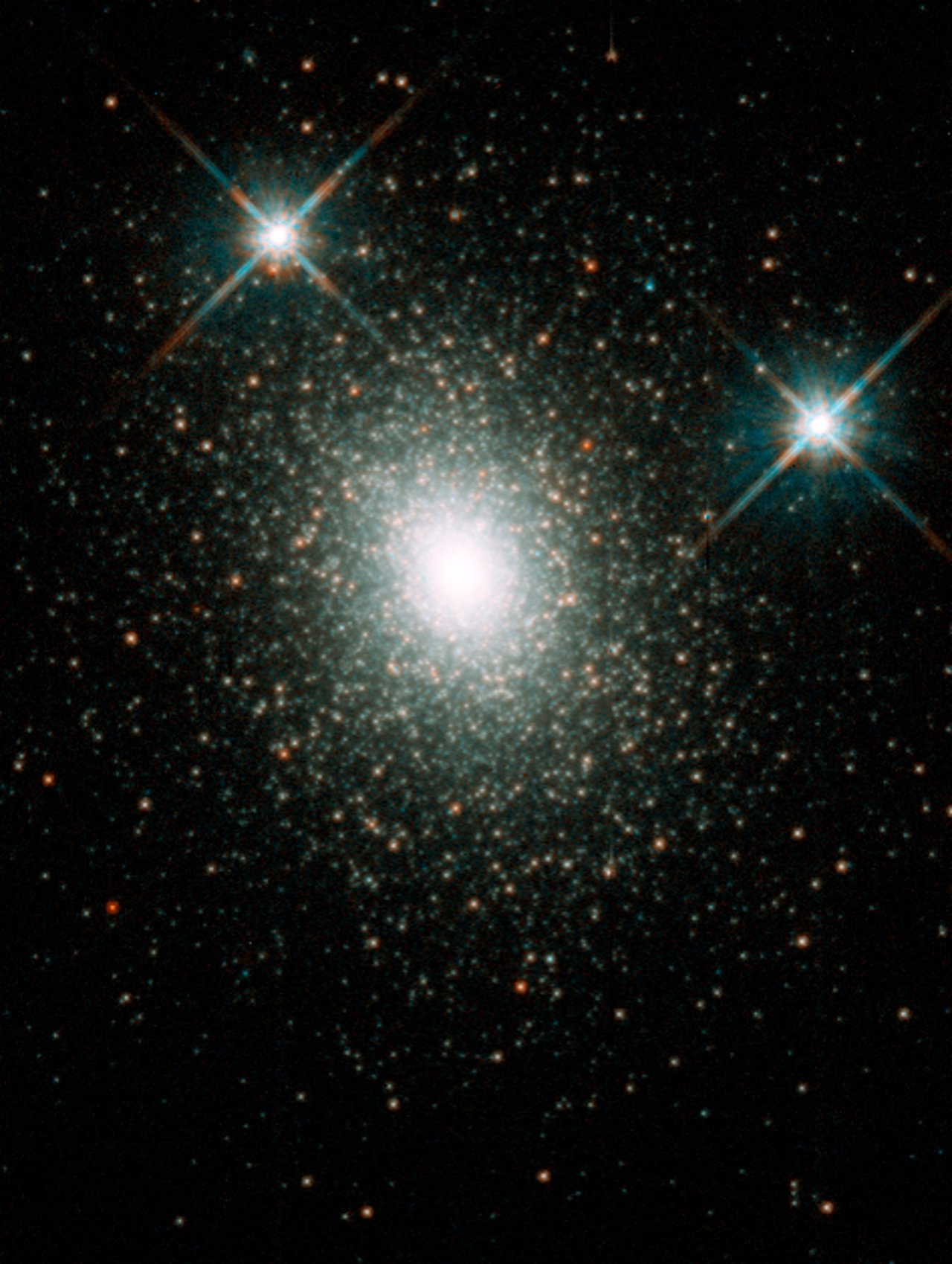
Medium-size black holes actually do exist, according to the latest findings from the NASA/ESA Hubble Space Telescope, but scientists had to look in some unexpected places to find them. The previously undiscovered black holes provide an important link that sheds light on the way in which black holes grow. Even more odd, these new black holes were found in the cores of glittering, 'beehive' swarms of stars called globular star clusters, which orbit our Milky Way and other galaxies. The globular cluster G1 aka Mayall II is located 130,000 light-years from M31 galactic core, and is the brightest globular cluster in the Local Group, having an apparent magnitude of 13.7. G1 is considered to have twice the mass of Omega Centauri. G1 harbors a central, intermediate-mass (∼ 2×10⁴ M⊙) black hole. G1 black hole is about 20,000 times more massive than our Sun!
Credit: NASA/ESA and Michael Rich (UCLA)

Saturday, November 5, 2011

Hubble directly observes the Disc around a Black Hole!

Hubble directly observes the Disc around a Black Hole!
Click on the image for full resolution

A team of scientists has used the NASA/ESA Hubble Space Telescope to observe a quasar accretion disc - a brightly glowing disc of matter that is slowly being sucked into its galaxy's central black hole. Their study makes use of a novel technique that uses gravitational lensing to give an immense boost to the power of the telescope. The incredible precision of the method has allowed astronomers to directly measure the disc's size and plot the temperature across different parts of the disc. This picture shows the quasar HE 1104-1805 that has been gravitationally lensed by a galaxy in the foreground, which can be seen as a faint shape around the two bright images of the quasar. Observations of one of the images show variations in colour over time. This is caused by stars within the lens galaxy passing through the path of the light from the quasar, magnifying the light from different parts of the quasar's accretion disc as they move. This has allowed a team of scientists to reconstruct the colour and temperature profile of the accretion disc with unprecedented precision. The level of detail involved is equivalent to being able to study individual grains of sand on the surface of the Moon while standing on Earth.
Credit: NASA, ESA and J.A. Muñoz (University of Valencia)