Showing posts with label Dark Matter. Show all posts

Wednesday, May 27, 2015

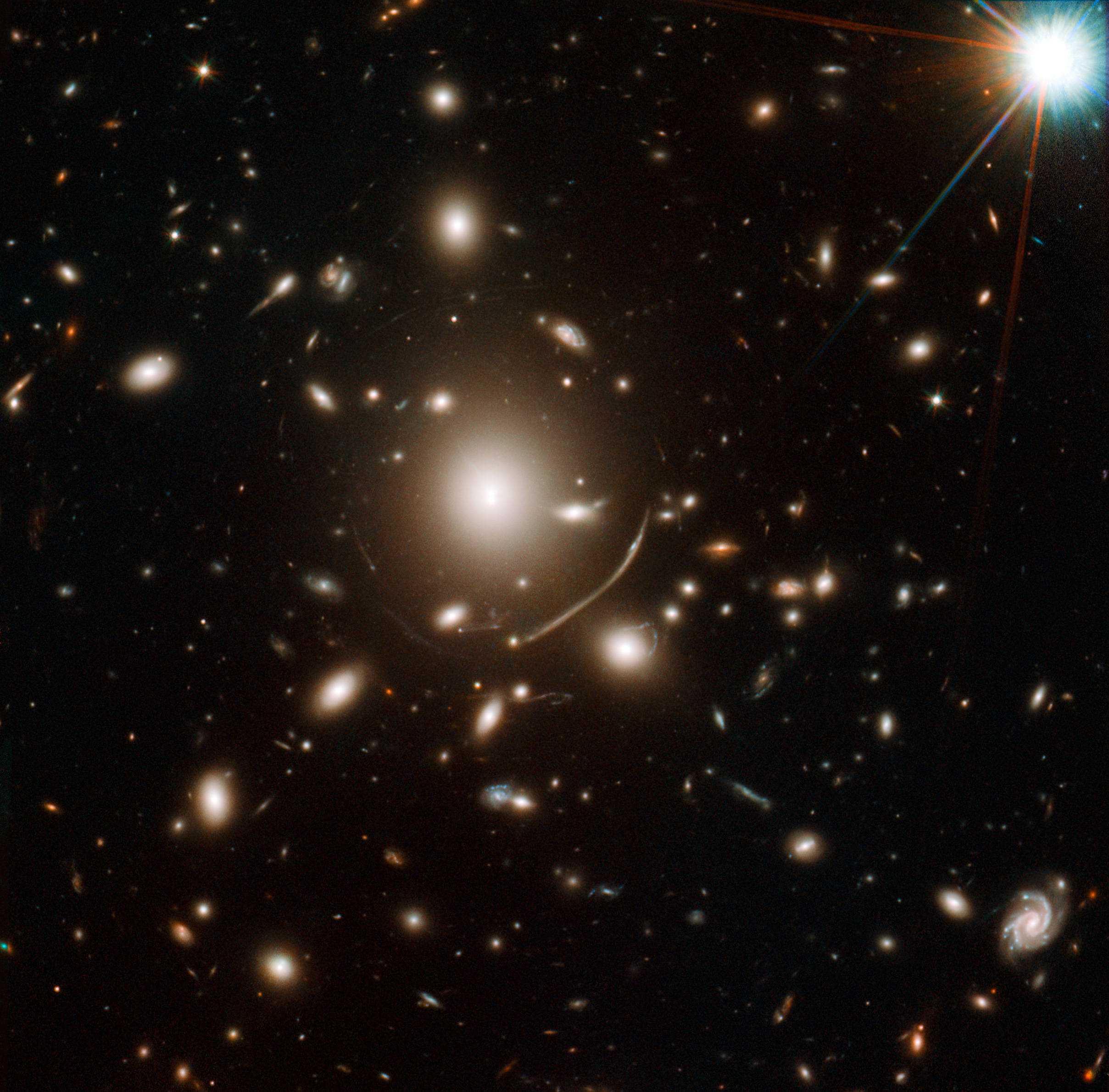
Dark Matter in Galaxy Cluster Abell 3827

Dark Matter in Galaxy Cluster Abell 3827
Click on the image for higher resolution (10.2 MB)

This image from the Hubble Space Telescope shows the rich galaxy cluster Abell 3827. The strange blue structures surrounding the central galaxies are gravitationally lensed views of a much more distant galaxy behind the cluster. Observations of the central four merging galaxies have provided hints that the dark matter around one of the galaxies is not moving with the galaxy itself, possibly implying dark matter-dark matter interactions of an unknown nature are occuring. The dark matter is currently 5,000 light-years (50,000 million million kilometers) behind the galaxy – it would take NASA's Voyager 2 spacecraft 90 million years to travel that far. Dark matter has never before been observed interacting in any way other than through the force of gravity.
Image Credit: ESO
Image enhancement: Jean-Baptiste Faure

Wednesday, July 11, 2012

Dwarf Galaxy Leo IV: a ghost filled with Dark Matter!

Dwarf Galaxy Leo IV: a ghost filled with Dark Matter!
Click on the image for full resolution (10.4 MB)

Astronomers used the Hubble Space Telescope to unmask the dim, star-starved dwarf galaxy Leo IV. This Hubble image demonstrates why astronomers had a tough time spotting this small-fry galaxy: it is practically invisible. The image shows how the handful of stars from the sparse galaxy are virtually indistinguishable from the background. Residing 500 000 light-years from Earth, Leo IV is one of more than a dozen ultra-faint dwarf galaxies found lurking around our Milky Way galaxy. These galaxies are dominated by dark matter, an invisible substance that makes up the bulk of the Universe's mass. Astronomers have puzzled over why some extremely faint dwarf galaxies spotted in our Milky Way galaxy’s backyard contain so few stars. The galaxies are thought to be some of the tiniest, oldest, and most pristine galaxies in the Universe. They have been discovered over the past decade by astronomers using automated computer techniques to search through the images of the Sloan Digital Sky Survey. But an international team of astronomers needed the Hubble Space Telescope to help solve the mystery of why these galaxies are starved of stars, and why so few of them have been found. Hubble views of three of these small galaxies, the Hercules, Leo IV and Ursa Major dwarf galaxies, reveal that they all started forming stars more than 13 billion years ago - and then abruptly stopped - all in the first billion years after the Universe was born in the Big Bang. In fact, the extreme age of their stars is similar to Messier 92, the oldest known globular cluster in the Milky Way. The relic galaxies are evidence for a transitional phase in the early Universe that shut down star-making factories in tiny galaxies. This phase seems to coincide with the time when the first stars burned off a fog of cold hydrogen, a process called reionisation. In this period, which began in the first billion years after the Big Bang, radiation from the first stars knocked electrons off primeval hydrogen atoms, ionising the Universe's cool hydrogen gas. The same radiation that sparked universal reionisation also appears to have squelched star-making activities in dwarf galaxies, such as those in Brown's study.
The small irregular galaxies were born about 100 million years before reionisation began and had just started to churn out stars at that time. Roughly 2000 light-years wide, these galaxies are the lightweight cousins of the more luminous and higher-mass star-making dwarf galaxies near our Milky Way. Unlike their higher-mass relatives, the puny galaxies were not massive enough to shield themselves from the harsh ultraviolet light. What little gas they had was stripped away as the flood of ultraviolet light rushed through them. Their gas supply depleted, the galaxies could not make new stars. The discovery could help explain the so-called "missing satellite problem", where only a few dozen dwarf galaxies have been observed around the Milky Way while the computer simulations predict that thousands should exist. One possible explanation for the low number discovered to date is that there has been very little, or even no star formation in the smallest of these dwarf galaxies, leaving them virtually invisible. The Sloan survey recently uncovered more than a dozen of these galaxies in our cosmic neighbourhood. These have very few stars - only a few hundred or thousand - but a great deal of dark matter, the underlying scaffolding upon which galaxies are built. Normal dwarf galaxies near the Milky Way contain 10 times more dark matter than the ordinary matter that makes up gas and stars, while in these so-called ultra-faint dwarf galaxies, dark matter outweighs ordinary matter by at least a factor of 100. Astronomers think the rest of the sky should contain dozens more of these ultra-faint dwarf galaxies with few stars, and the evidence for squelched star formation in the smallest of these dwarfs suggests that there may be still thousands more with essentially no stars at all.
The full resolution image weighs 10.4 MB, so please be patient when downloading!
Credit: NASA, ESA, and T. Brown (STScI)
Image enhancement: Jean-Baptiste Faure

Friday, April 20, 2012

Dark Matter around the Milky Way Galaxy!

Dark Matter around the Milky Way Galaxy!
Click on the image for full resolution (2.7 MB)

This artist's impression shows the Milky Way Galaxy. The blue halo of material surrounding the galaxy indicates the expected distribution of the mysterious dark matter, which was first introduced by astronomers to explain the rotation properties of the galaxy and is now also an essential ingredient in current theories of the formation and evolution of galaxies. New measurements show that the amount of dark matter in a large region around the Sun is far smaller than predicted and have indicated that there is no significant dark matter at all in our neighbourhood. The most accurate study so far of the motions of stars in the Milky Way has found no evidence for dark matter in a large volume around the Sun. According to widely accepted theories, the solar neighbourhood was expected to be filled with dark matter, a mysterious invisible substance that can only be detected indirectly by the gravitational force it exerts. But a new study by a team of astronomers in Chile has found that these theories just do not fit the observational facts. This may mean that attempts to directly detect dark matter particles on Earth are unlikely to be successful. A team using the MPG/ESO 2.2-meter telescope at ESO's La Silla Observatory, along with other telescopes, has mapped the motions of more than 400 stars up to 13 000 light-years from the Sun. From this new data they have calculated the mass of material in the vicinity of the Sun, in a volume four times larger than ever considered before. Dark matter is a mysterious substance that cannot be seen, but shows itself by its gravitational attraction for the material around it. This extra ingredient in the cosmos was originally suggested to explain why the outer parts of galaxies, including our own Milky Way, rotated so quickly, but dark matter now also forms an essential component of theories of how galaxies formed and evolved. Today it is widely accepted that this dark component constitutes about the 80% of the mass in the Universe, despite the fact that it has resisted all attempts to clarify its nature, which remains obscure. All attempts so far to detect dark matter in laboratories on Earth have failed. By very carefully measuring the motions of many stars, particularly those away from the plane of the Milky Way, the team could work backwards to deduce how much matter is present. The motions are a result of the mutual gravitational attraction of all the material, whether normal matter such as stars, or dark matter. Astronomers' existing models of how galaxies form and rotate suggest that the Milky Way is surrounded by a halo of dark matter. They are not able to precisely predict what shape this halo takes, but they do expect to find significant amounts in the region around the Sun. But only very unlikely shapes for the dark matter halo - such as a highly elongated form - can explain the lack of dark matter uncovered in the new study. The new results also mean that attempts to detect dark matter on Earth by trying to spot the rare interactions between dark matter particles and "normal" matter are unlikely to be successful.
The full resolution image weighs 2.7 MB, so please be patient when downloading!
Credit: ESO/L. Calçada

Tuesday, April 12, 2011

Strong Gravitational Lensing in giant Galaxy Cluster Abell 383

Strong Gravitational Lensing in giant Galaxy Cluster Abell 383
Click on the image for full resolution (2.3 MB)

The giant cluster of elliptical galaxies in the centre of this image contains so much dark matter mass that its gravity bends light. This means that for very distant galaxies in the background, the cluster's gravitational field acts as a sort of magnifying glass, bending and concentrating the distant object's light towards Hubble. These gravitational lenses are one tool astronomers can use to extend Hubble's vision beyond what it would normally be capable of observing.
Using Abell 383, a team of astronomers have identified and studied a galaxy so far away we see it as it was less than a billion years after the Big Bang. Viewing this galaxy through the gravitational lens meant that the scientists were able to discern many intriguing features that would otherwise have remained hidden, including that its stars were unexpectedly old for a galaxy this close in time to the beginning of the Universe. This has profound implications for our understanding of how and when the first galaxies formed, and how the diffuse fog of neutral hydrogen that filled the early Universe was cleared.
The full resolution image weighs 2.3 MB, so please be patient when downloading!
Credit: NASA, ESA, J. Richard (CRAL) and J.-P. Kneib (LAM). Acknowledgement: Marc Postman (STScI)

Friday, November 26, 2010

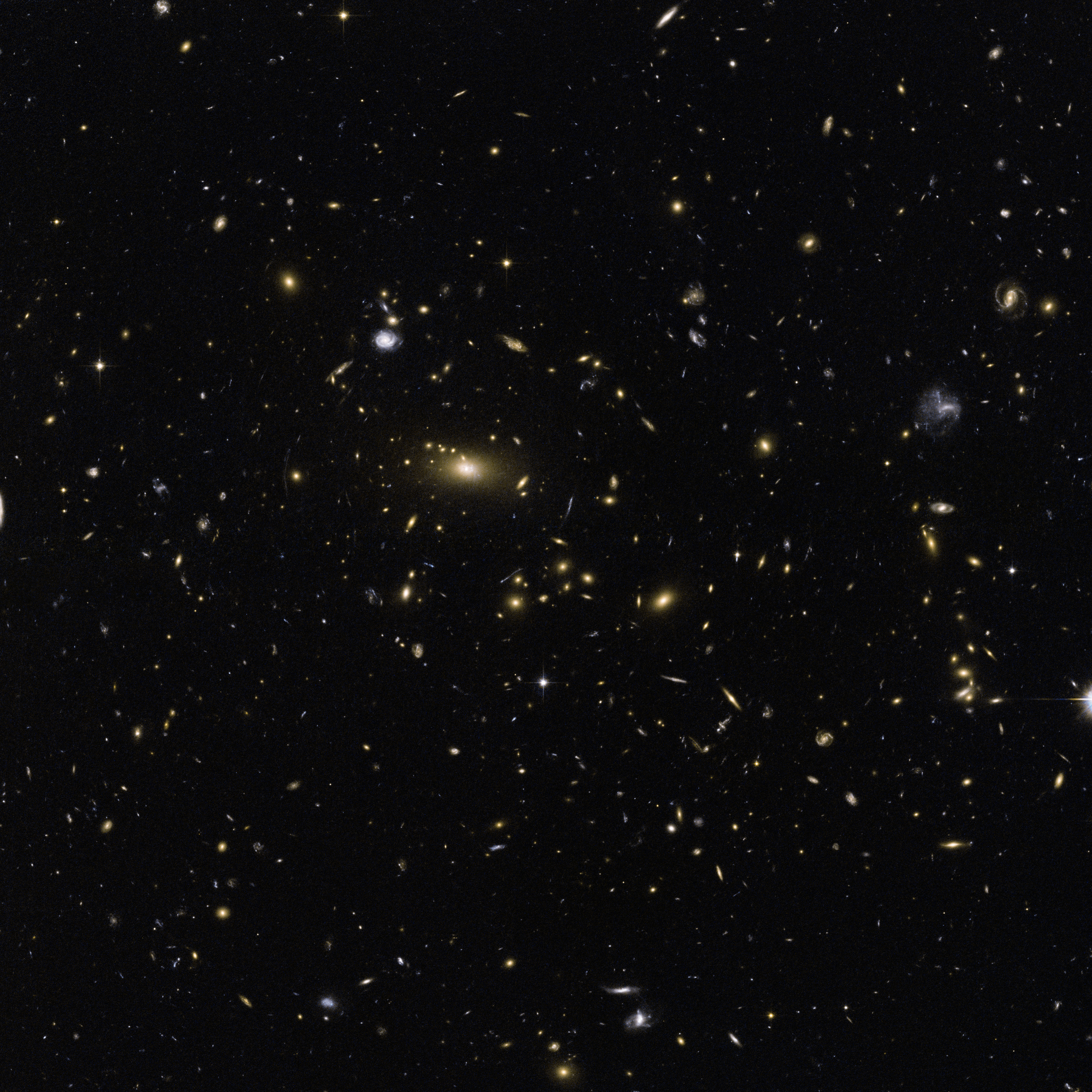
Galaxy Cluster MACSJ1423.8+2404: a Dark Matter Laboratory?

Galaxy Cluster MACSJ1423.8+2404: a Dark Matter Laboratory?
Click on the image for full resolution (8.1 MB)

Smaller, dimmer galaxies appear to flit like moths around a radiant street light in this image captured by the NASA/ESA Hubble Space Telescope. The brilliant central object is a supergiant elliptical galaxy, the dominant member of a galaxy cluster with the mouthful of a name MACSJ1423.8+2404. This great swarm of galaxies is located about five billion light-years away in the constellation Boötes (the Herdsman). MACSJ1423.8+2404 and other distant galaxy clusters offer astronomers a peek into the earlier days of our Universe when these colossal groupings were still taking shape. Over the 13.7 billion-year history of the cosmos, such galaxy clusters have emerged as the largest observed gravitationally bound structures. But there is much more than meets the eye when it comes to galaxy clusters - they also hint at the vast majority of the Universe's substance that we have not yet directly detected. Astronomers study clusters such as MACSJ1423.8+2404 to better understand the influence of dark energy, a mysterious force credited with accelerating the expansion of the Universe and accounting for some 72 percent of the mass of the Universe.
The application of what we can see and detect to the study of what we cannot does not end there with MACSJ1423.8+2404 and its ilk. Dark matter, estimated to account for about 23 percent of the mass of the Universe, exists in great quantities in galaxy clusters. The "normal" matter that comprises stars, planets and us trickles in at less than 5 percent. Astronomers observe clusters to study how this dark matter gravitationally gathers visible matter and underpins these vast cosmic metropolises. The galactic moths are drawn to the clusters not by their light, but by the vast unseen reservoir of dark matter.
This image was created from images taken using the Wide Field Channel of Hubble's Advanced Camera for Surveys. The exposures were 75 and 76 minutes respectively, through yellow (F555W) and near-infrared (F814W) filters. The field of view is 3.2 arcminutes across.
The full resolution image weighs 8.1 MB, so please be patient when downloading!
Credit: ESA/Hubble and NASA