Showing posts with label Milky Way Galaxy. Show all posts

Thursday, September 10, 2026

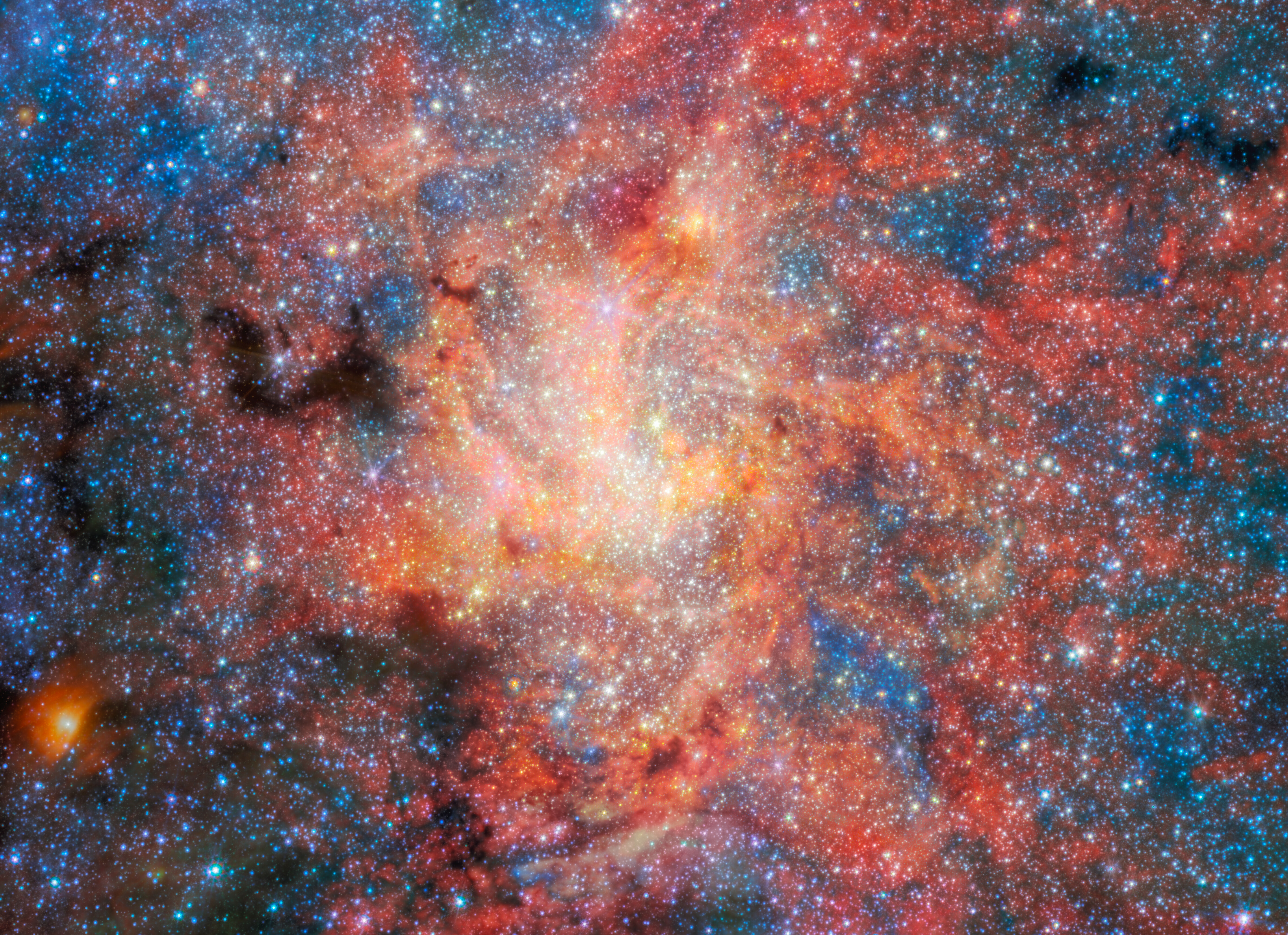
The Milky Way Galaxy's center as seen by Webb

The Milky Way Galaxy's center as seen by Webb
Click the image for higher resolution (5.1 MB)

A dense star field fills the entire image, with countless stars scattered across a backdrop of glowing clouds in shades of red, orange, pink, white, and blue. At the center, a brilliant concentration of stars creates a bright, almost white core surrounded by intricate filaments and wisps of illuminated gas and dust that radiate outward. Dark, irregular patches of opaque dust interrupt the glowing clouds, particularly toward the left side of the image, where they appear as silhouetted shapes against the brighter background. The surrounding stellar population varies in brightness and colour, with cool blue stars and warmer orange and red stars distributed throughout the scene.
This image features data from Webb's NIRCam (Near Infrared Camera) and MIRI (Mid Infrared Instrument) to capture the most detailed mid-infrared view yet of the field that hosts the highly evolved star IRS 3, which is located just 0.55 light-years from Sagittarius A, the Milky Way galaxy's central supermassive black hole.
An international team of astronomers have discovered that dust and water can form and survive surprisingly close to this supermassive black hole. The observations reveal that the evolved star IRS 3 continues to enrich its surroundings with newly formed material despite the intense radiation environment around Sagittarius A.
Image Credit: ESA/Webb, NASA and CSA, F. Peißker, J. Lu, F. Yusef-Zadeh, N. B. Sabha, C. Chan
Image enhancement: Jean-Baptiste Faure

Monday, January 1, 2024

Spiral Galaxy NGC 3338 observed by the Subaru Telescope

Spiral Galaxy NGC 3338 observed by the Subaru Telescope
Click the image for higher resolution (2.3 MB)

A group led by researchers at the National Astronomical Observatory of Japan (NAOJ) used the Subaru Telescope to take images of nine galaxies with masses similar to the Milky Way, each about 50 to 80 million light-years away. In these images, the group successfully detected 93 candidates for faint, small satellite galaxies. The number of satellites per main galaxy varied greatly but was comparable to the number of satellite galaxies around the Milky Way, indicating that the Milky Way is normal in terms of its number of satellites. Also, the satellite galaxies were evenly distributed around the main galaxies; matching predictions but not matching what we know about the Milky Way.
This result is important for understanding to what extent we can apply what we know about the local environment to the rest of the Universe. One of nine observed galaxies is NGC 3338, which is pictured here. This spiral galaxy is about 76 million light-years away with a mass similar to the Milky Way.
Image Credit: NAOJ
Image enhancement: Jean-Baptiste Faure

Tuesday, February 16, 2021

The Quintuplet Cluster near the Galaxy's Center

The Quintuplet Cluster near the Galaxy's Center
Click on the image for higher resolution (1.5 MB)

Although this cluster of stars gained its name due to its five brightest stars, it is home to hundreds more. The huge number of massive young stars in the cluster is clearly captured in this Hubble Space Telescope image.
The cluster is located close to the Arches Cluster and is just 100 light-years from the center of our galaxy. The cluster's proximity to the dust at the center of the galaxy means that much of its visible light is blocked, which helped to keep the cluster unknown until its discovery in 1990, when it was revealed by observations in the infrared. Infrared images of the cluster, like the one shown here, allow us to see through the obscuring dust to the hot stars in the cluster.
The Quintuplet Cluster hosts two extremely rare luminous blue variable stars: the Pistol Star and the lesser known V4650 Sgr. If you were to draw a line horizontally through the center of this image from left to right, you could see the Pistol Star hovering just above the line about one third of the way along it. The Pistol Star is one of the most luminous known stars in the Milky Way and takes its name from the shape of the Pistol Nebula that it illuminates, but which is not visible in this infrared image. The exact age and future of the Pistol Star are uncertain, but it is expected to end in a supernova or even a hypernova in one to three million years.
The cluster also contains a number of red supergiants. These stars are among the largest in the galaxy and are burning their fuel at an incredible speed, meaning they will have a very short lifetime. Their presence suggests an average cluster age of nearly four million years. At the moment these stars are on the verge of exploding as supernovae. During their spectacular deaths they will release vast amounts of energy which, in turn, will heat the material – dust and gas – between the other stars.
Image Credit: ESA/Hubble and NASA
Image enhancement: Jean-Baptiste Faure

Thursday, December 26, 2019

Central Region of Milky Way

Central Region of Milky Way
Click on the image for higher resolution (4.7 MB)

ESO's Very Large Telescope (VLT) has observed the central part of the Milky Way with spectacular resolution and uncovered new details about the history of star birth in our galaxy. Thanks to the new observations, astronomers have found evidence for a dramatic event in the life of the Milky Way: a burst of star formation so intense that it resulted in over a hundred thousand supernova explosions.
Taken with the HAWK-I instrument on VLT, this stunning image shows the Milky Way's central region with an angular resolution of 0.2 arcseconds. This means the level of detail picked up by HAWK-I is roughly equivalent to seeing a football (soccer ball) in Zurich from Munich, where ESO's headquarters are located!
The image combines observations in three different wavelength bands. The team used the broadband filters J (centred at 1250 nanometers, in blue), H (centred at 1635 nanometres, in green), and Ks (centred at 2150 nanometers, in red), to cover the near infrared region of the electromagnetic spectrum. By observing in this range of wavelengths, HAWK-I can peer through the dust, allowing it to see certain stars in the central region of our galaxy that would otherwise be hidden.
Image Credit: ESO/Nogueras-Lara et al.
Image enhancement: Jean-Baptiste Faure

Thursday, April 21, 2016

The galactic center as seen by Hubble

The galactic center as seen by Hubble
Click on the image for higher resolution (9.5 MB)

This infrared image from the Hubble Space Telescope shows the center of the Milky Way, 27 000 light-years away from Earth. Using the infrared capabilities of Hubble, astronomers were able to peer through the dust which normally obscures the view of this interesting region. At the center of this nuclear star cluster – and also in the center of this image – the Milky Way's supermassive black hole is located. The center of our galaxy in the constellation of Sagittarius, is a crowded place. This region is so tightly packed that it is equivalent to having one million stars crammed into the volume of space between us and Alpha Centauri, located 4.3 light-years away. At the very hub of our galaxy, this dense nuclear star cluster surrounds the Milky Way’s central supermassive black hole, known as Sagittarius A*, which alone is about four million times the mass of the Sun. Sagittarius A* is not the only mystery lurking in this part of the galaxy. The crowded center contains numerous objects that are hidden at visible wavelengths by thick clouds of dust in the galaxy's disc. In order to truly understand the central part of our galaxy astronomers used the infrared vision of Hubble to peer through this obscuring dust. To reveal the image in all its glory the scientists then assigned visible colours to the different wavelengths of infrared light, which is invisible to human eyes.
The blue stars in the image are foreground stars, which are closer to Earth than the nuclear star cluster, whilst the red stars are either behind much more intervening dust, or are embedded in dust themselves. Some extremely dense clouds of gas and dust are seen in silhouette, appearing dark against the bright background stars. These clouds are so thick that even Hubble's infrared capability cannot penetrate them. In addition to the stars hidden by the dust astronomers estimate that there are about 10 million stars in the cluster which are too faint to see, even for Hubble. Using Hubble's vantage point above the atmosphere and its high resolution, astronomers were able not only to reveal the stars in this cluster but also to measure their movements over a period of four years. Using this information, they inferred important properties of the nuclear star cluster, such as its mass and structure. The motion of the stars may also offer astronomers a glimpse into how the nuclear star cluster was formed – whether it was built up over time from globular star clusters that happened to fall into the center of the galaxy, or from gas spiralling in from the Milky Way’s disc to form stars at the core.
Image Credit: NASA, ESA, and the Hubble Heritage Team (STScI/AURA)
Acknowledgment: NASA, ESA, T. Do and A. Ghez (UCLA), and V. Bajaj (STScI)

Tuesday, March 18, 2014

HR 5171 A - The Largest Yellow Star

HR 5171 A - The Largest Yellow Star
Click on the image for full resolution (20.7 MB)

ESO's Very Large Telescope Interferometer has revealed the largest yellow star - and one of the ten largest stars found so far. This hypergiant has been found to measure more than 1300 times the diameter of the Sun, and to be part of a double star system, with the second component so close that it is in contact with the main star. Observations spanning over sixty years, some from amateur observers, also indicate that this rare and remarkable object is changing very rapidly and has been caught during a very brief phase of its life. Using ESO's Very Large Telescope Interferometer (VLTI), Olivier Chesneau (Observatoire de la Côte d'Azur, Nice, France) and an international team of collaborators have found that the yellow hypergiant star HR 5171 A is absolutely huge - 1300 times the diameter of the Sun and much bigger than was expected. This makes it the largest yellow star known. It is also in the top ten of the largest stars known - 50% larger than the famous red supergiant Betelgeuse - and about one million times brighter than the Sun. The astronomers made use of a technique called interferometry to combine the light collected from multiple individual telescopes, effectively creating a giant telescope up to 140 metres in size. The new results prompted the team to thoroughly investigate older observations of the star spanning more than sixty years, to see how it had behaved in the past. Yellow hypergiants are very rare, with only a dozen or so known in our galaxy - the best-known example being Rho Cassiopeiae. They are among the biggest and brightest stars known and are at a stage of their lives when they are unstable and changing rapidly. Due to this instability, yellow hypergiants also expel material outwards, forming a large, extended atmosphere around the star. Despite its great distance of nearly 12 000 light-years from Earth, the object can just about be seen with the naked eye by the keen-sighted. HR 5171 A has been found to be getting bigger over the last 40 years, cooling as it grows, and its evolution has now been caught in action. Only a few stars are caught in this very brief phase, where they undergo a dramatic change in temperature as they rapidly evolve. By analysing data on the star's varying brightness, using observations from other observatories, the astronomers confirmed the object to be an eclipsing binary system where the smaller component passes in front and behind the larger one as it orbits. In this case HR 5171 A is orbited by its companion star every 1300 days. The smaller companion is only slightly hotter than HR 5171 A's surface temperature of 5000 degrees Celsius.
Image Credit: ESO/Digitized Sky Survey 2
Image enhancement: Jean-Baptiste Faure

Friday, January 24, 2014

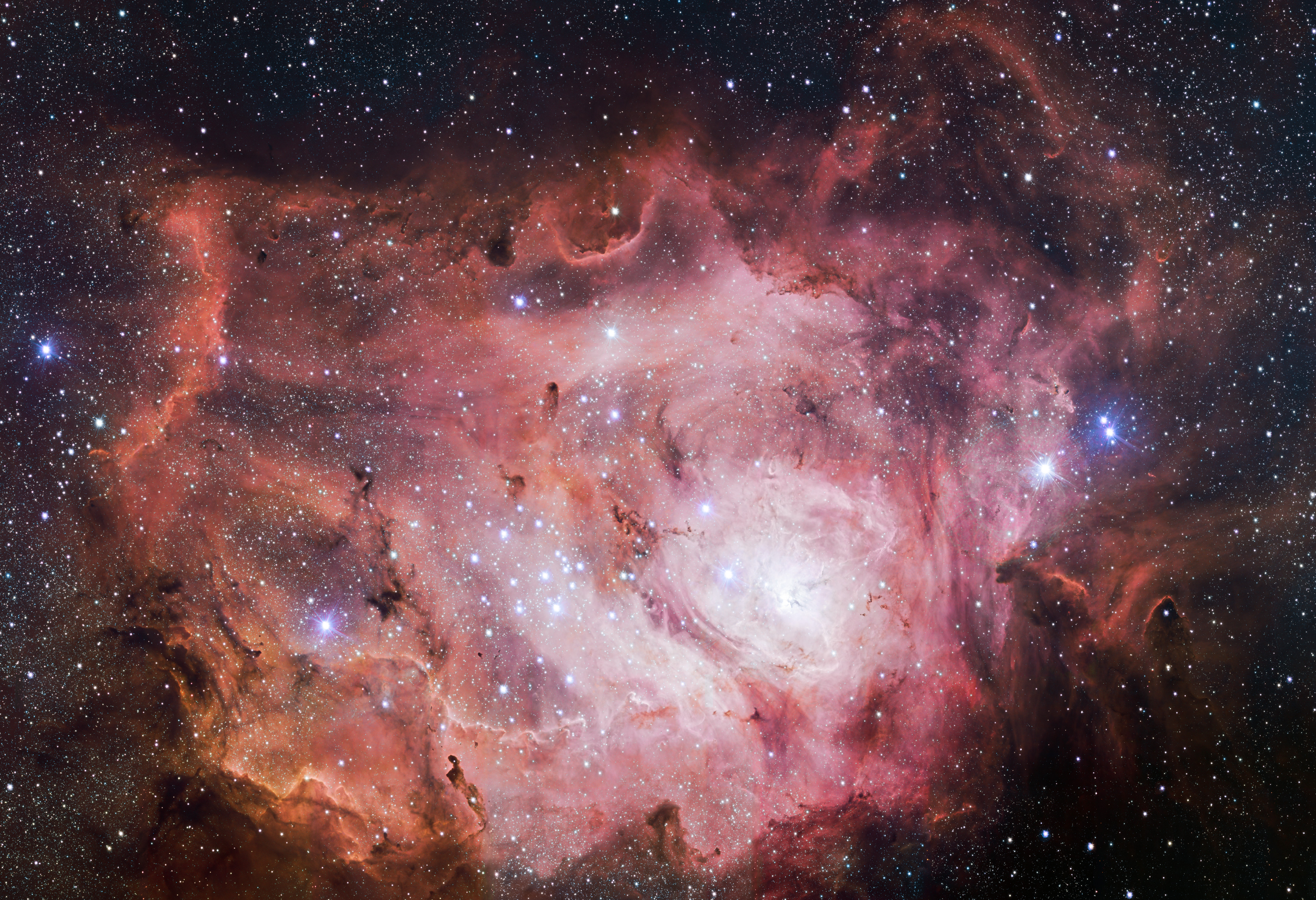
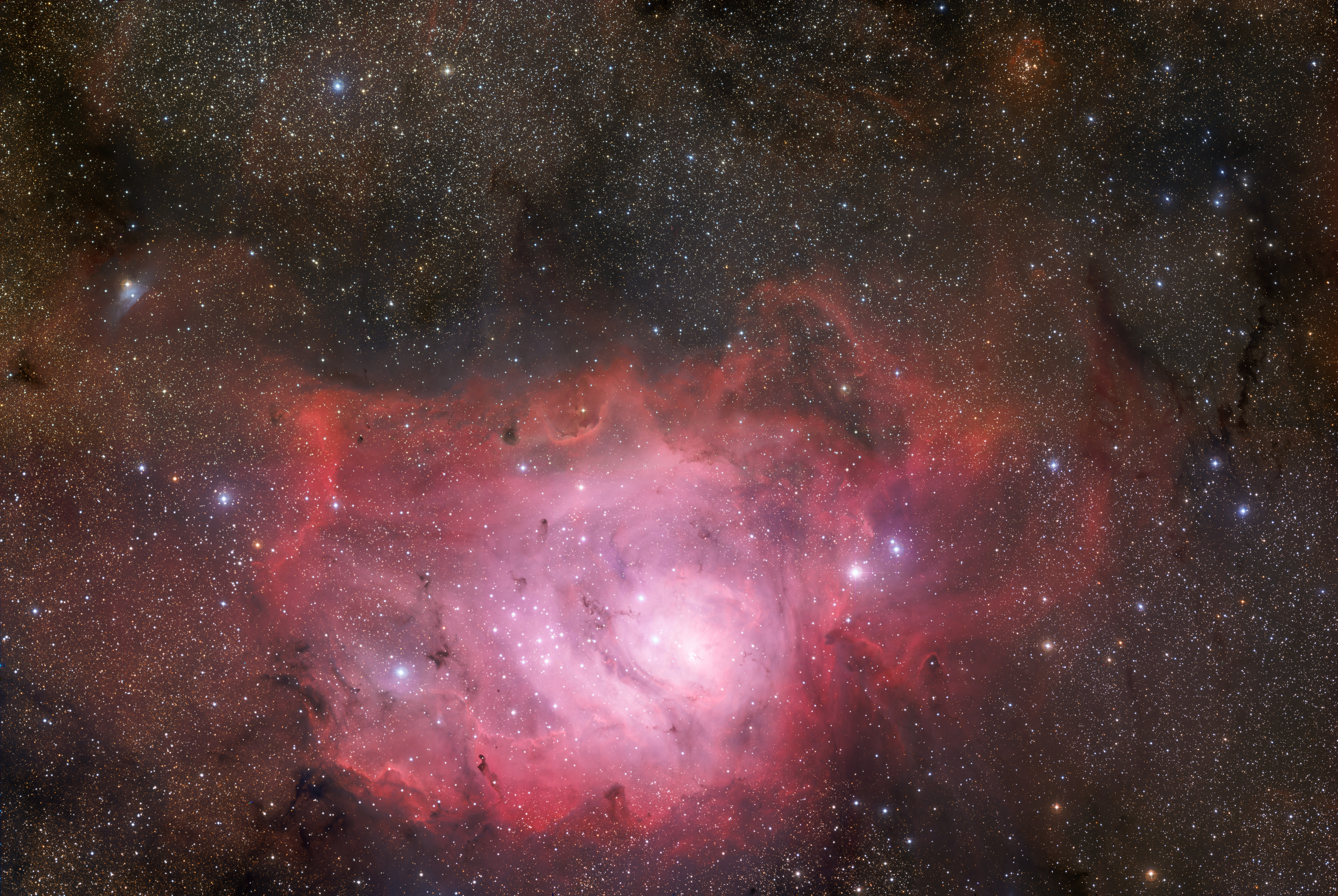
The Lagoon Nebula as seen by the VST

The Lagoon Nebula as seen by the VST
Click on the image for full resolution (7.9 MB)

The VLT Survey Telescope (VST) at ESO's Paranal Observatory in Chile has captured this richly detailed new image of the Lagoon Nebula. This giant cloud of gas and dust is creating intensely bright young stars, and is home to young stellar clusters. This image is a tiny part of just one of eleven public surveys of the sky now in progress using ESO telescopes. Together these are providing a vast legacy of publicly available data for the global astronomical community. The Lagoon Nebula is an intriguing object located around 5000 light-years from us in the constellation of Sagittarius (The Archer). Also known as Messier 8 (M8), it is a giant cloud 100 light-years across, where new stars are forming within its plumes of gas and dust. This new 16 000-pixel-wide image is from the VST, one of two dedicated survey telescopes at ESO's Paranal Observatory in northern Chile. A zoomable version of the image allows the viewers to explore the many nooks and crannies of this fascinating object. The VST was not pointed at the Lagoon deliberately, it simply was included as part of a huge imaging survey called VPHAS+ that covered a much larger region of the Milky Way. VPHAS+ is just one of three imaging surveys using visible light with the VST. These are complemented by six infrared surveys with the VISTA survey telescope. The surveys are addressing many important questions in modern astronomy. These include the nature of dark energy, searching for brilliant quasars in the early Universe, probing the structure of the Milky Way and looking for unusual and hidden objects, studying the neighbouring Magellanic Clouds in great detail, and many other topics. History shows that surveys often find things that are unexpected and these surprises are crucial for the progress of astronomical research. As well as the nine imaging surveys with VISTA and the VST there are also two additional surveys that are in progress using other ESO telescopes. One, the Gaia-ESO Survey, is using the Very Large Telescope at Paranal to map the properties of more than 100 000 stars in the Milky Way, and another (PESSTO) is following up on transient objects such as supernovae using the New Technology Telescope at La Silla.
Image Credit: ESO/VPHAS+ team
Image enhancement: Jean-Baptiste Faure

Thursday, December 19, 2013

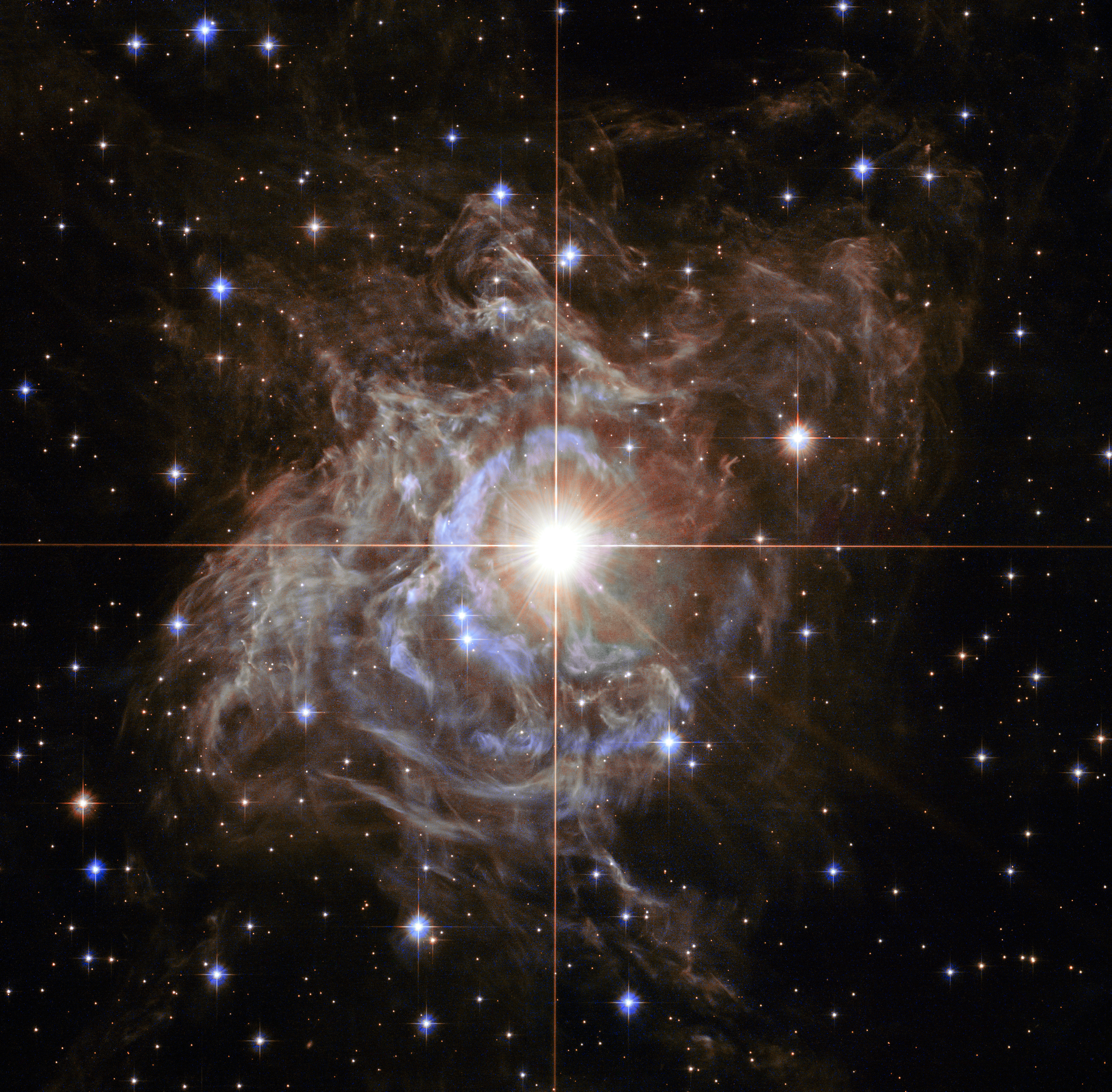
Variable Star RS Puppis

Variable Star RS Puppis
Click on the image for full resolution (9.8 MB)

This Hubble image shows RS Puppis, a type of variable star known as a Cepheid variable. As variable stars go, Cepheids have comparatively long periods - RS Puppis, for example, varies in brightness by almost a factor of five every 40 or so days. RS Puppis is unusual; this variable star is shrouded by thick, dark clouds of dust enabling a phenomenon known as a light echo to be shown with stunning clarity. These Hubble observations show the ethereal object embedded in its dusty environment, set against a dark sky filled with background galaxies. RS Puppis is unusual as it is shrouded by a nebula - thick, dark clouds of gas and dust. Hubble observed this star and its murky environment over a period of five weeks in 2010, capturing snapshots at different stages in its cycle and enabling scientists to create a time-lapse video of this ethereal object. The apparent motion shown in these Hubble observations is an example of a phenomenon known as a light echo. The dusty environment around RS Puppis enables this effect to be shown with stunning clarity. As the star expands and brightens, we see some of the light after it is reflected from progressively more distant shells of dust and gas surrounding the star, creating the illusion of gas moving outwards. This reflected light has further to travel, and so arrives at the Earth after light that travels straight from star to telescope. This is analogous to sound bouncing off surrounding objects, causing the listener to hear an audible echo. While this effect is certainly striking in itself, there is another important scientific reason to observe Cepheids like RS Puppis. The period of their pulsations is known to be directly connected to their intrinsic brightness, a property that allows astronomers to use them as cosmic distance markers. A few years ago, astronomers used the light echo around RS Puppis to measure its distance from us, obtaining the most accurate measurement of a Cepheid's distance (eso0805). Studying stars like RS Puppis helps us to measure and understand the vast scale of the Universe.
Image Credit: NASA, ESA, and the Hubble Heritage Team (STScI/AURA)- Hubble/Europe Collaboration
Acknowledgment: H. Bond (STScI and Penn State University)
Image enhancement: Jean-Baptiste Faure

Tuesday, October 29, 2013

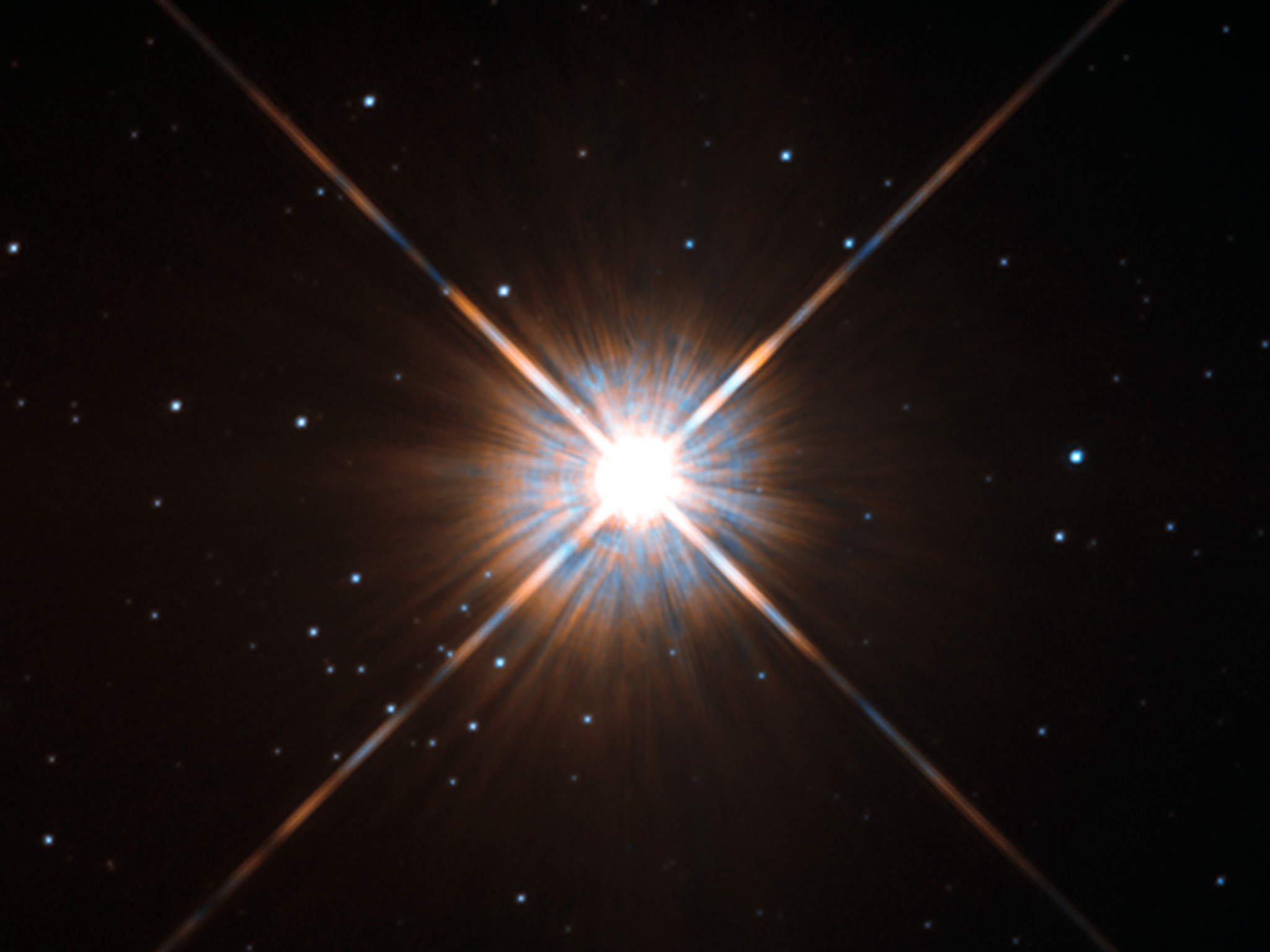
Proxima Centauri, our nearest neighbour

Proxima Centauri, our nearest neighbour
Click on the image for full resolution

Shining brightly in this Hubble image is our closest stellar neighbour: Proxima Centauri. Proxima Centauri lies in the constellation of Centaurus (The Centaur), just over four light-years from Earth. Although it looks bright through the eye of Hubble, as you might expect from the nearest star to the Solar System, Proxima Centauri is not visible to the naked eye. Its average luminosity is very low, and it is quite small compared to other stars, at only about an eighth of the mass of the Sun. However, on occasion, its brightness increases. Proxima is what is known as a "flare star", meaning that convection processes within the star's body make it prone to random and dramatic changes in brightness. The convection processes not only trigger brilliant bursts of starlight but, combined with other factors, mean that Proxima Centauri is in for a very long life. Astronomers predict that this star will remain middle-aged - or a "main sequence" star in astronomical terms - for another four trillion years, some 300 times the age of the current Universe. These observations were taken using Hubble's Wide Field and Planetary Camera 2 (WFPC2). Proxima Centauri is actually part of a triple star system - its two companions, Alpha Centauri A and B, lie out of frame. Although by cosmic standards it is a close neighbour, Proxima Centauri remains a point-like object even using Hubble's eagle-eyed vision, hinting at the vast scale of the Universe around us.
Image Credit: ESA/Hubble and NASA
Image enhancement: Jean-Baptiste Faure

Wednesday, October 17, 2012

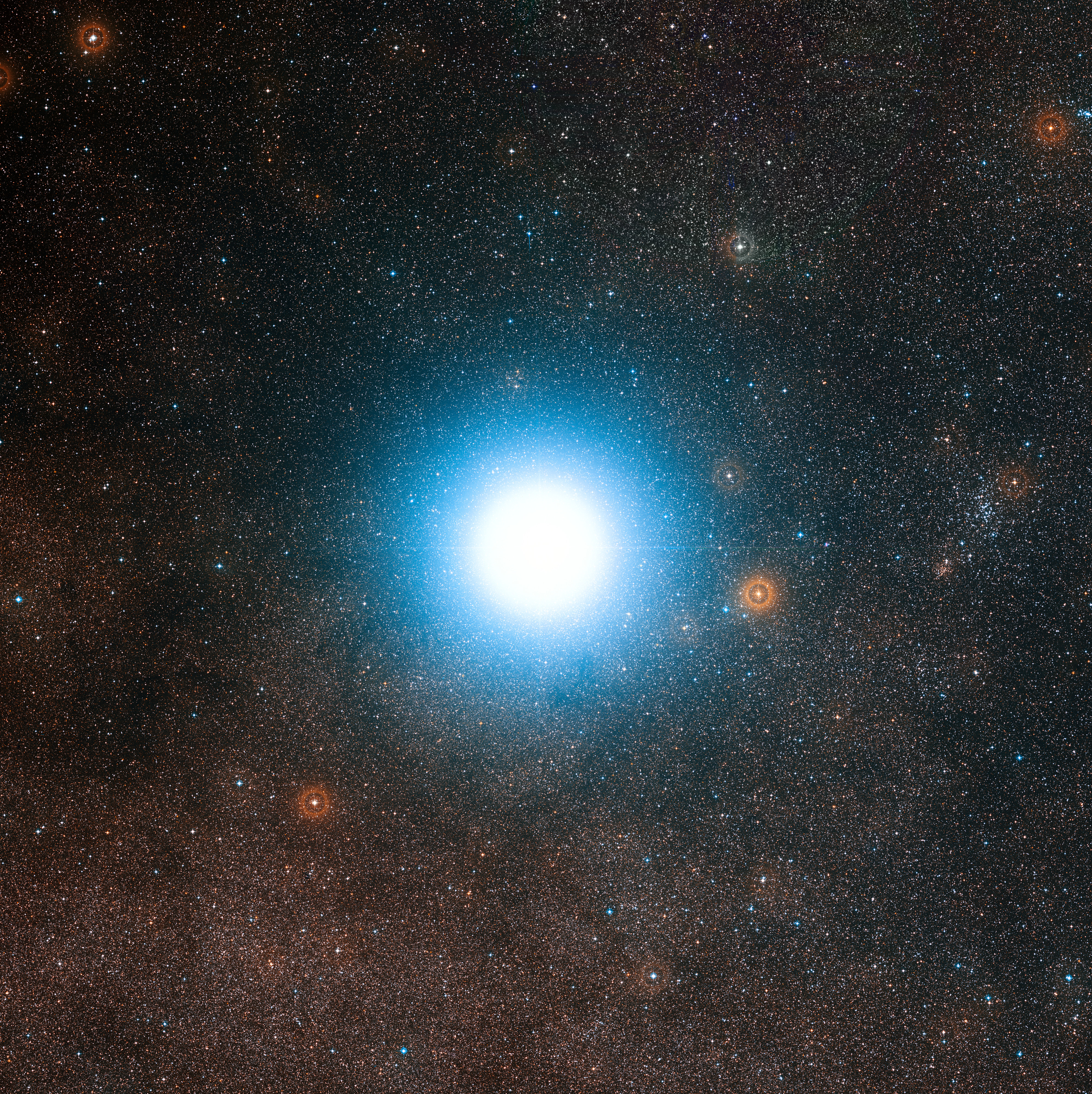
Alpha Centauri and its surroundings

Alpha Centauri and its surroundings
Click on the image for full resolution (17.1 MB)

This wide-field view of the sky around the bright star Alpha Centauri was created from photographic images forming part of the Digitized Sky Survey 2. The star appears so big just because of the scattering of light by the telescope's optics as well as in the photographic emulsion. Alpha Centauri is the closest star system to the Solar System.
The full resolution image weighs 17.1 MB, so please be patient when downloading!
Credit: ESO/Digitized Sky Survey 2
Acknowledgement: Davide De Martin

Saturday, October 13, 2012

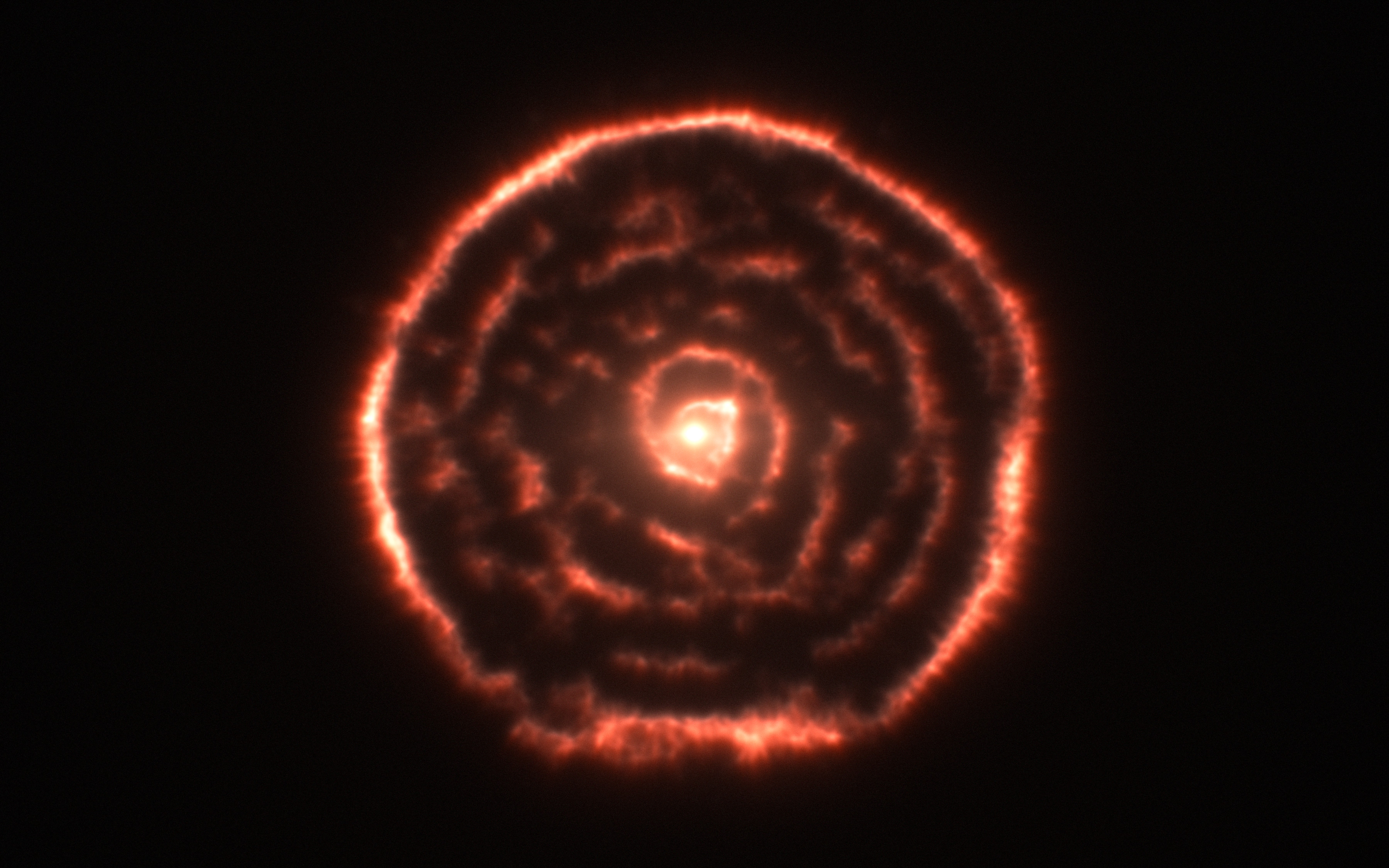
Spiral around Red Giant Star R Sculptoris

Spiral around Red Giant Star R Sculptoris
Click on the image for full resolution (2.0 MB)

Observations using the Atacama Large Millimeter/submillimeter Array (ALMA) have revealed an unexpected spiral structure in the material around the old star R Sculptoris. This feature has never been seen before and is probably caused by a hidden companion star orbiting the star. This slice through the new ALMA data reveals the shell around the star, which shows up as the outer circular ring, as well as a very clear spiral structure in the inner material. Because they blow out large amounts of material, red giants like R Sculptoris are major contributors to the dust and gas that provide the bulk of the raw materials for the formation of future generations of stars, planetary systems and subsequently for life. Even in the Early Science phase, when the new observations were made, ALMA greatly outperformed other submillimetre observatories. Earlier observations had clearly shown a spherical shell around R Sculptoris, but neither the spiral structure nor a companion was found. Late in their lives, stars with masses up to eight times that of the Sun become red giants and lose a large amount of their mass in a dense stellar wind. During the red giant stage stars also periodically undergo thermal pulses. These are short-lived phases of explosive helium burning in a shell around the stellar core. A thermal pulse leads to material being blown off the surface of the star at a much higher rate, resulting in the formation of a large shell of dust and gas around the star. After the pulse the rate at which the star loses mass falls again to its normal value. Thermal pulses occur approximately every 10 000 to 50 000 years, and last only a few hundred years. The new observations of R Sculptoris show that it suffered a thermal pulse event about 1800 years ago that lasted for about 200 years. The companion star shaped the wind from R Sculptoris into a spiral structure.
The full resolution image weighs 2.0 MB, so please be patient when downloading!
Credit: ALMA (ESO/NAOJ/NRAO)
Image enhancement: Jean-Baptiste Faure

Friday, April 20, 2012

Dark Matter around the Milky Way Galaxy!

Dark Matter around the Milky Way Galaxy!
Click on the image for full resolution (2.7 MB)

This artist's impression shows the Milky Way Galaxy. The blue halo of material surrounding the galaxy indicates the expected distribution of the mysterious dark matter, which was first introduced by astronomers to explain the rotation properties of the galaxy and is now also an essential ingredient in current theories of the formation and evolution of galaxies. New measurements show that the amount of dark matter in a large region around the Sun is far smaller than predicted and have indicated that there is no significant dark matter at all in our neighbourhood. The most accurate study so far of the motions of stars in the Milky Way has found no evidence for dark matter in a large volume around the Sun. According to widely accepted theories, the solar neighbourhood was expected to be filled with dark matter, a mysterious invisible substance that can only be detected indirectly by the gravitational force it exerts. But a new study by a team of astronomers in Chile has found that these theories just do not fit the observational facts. This may mean that attempts to directly detect dark matter particles on Earth are unlikely to be successful. A team using the MPG/ESO 2.2-meter telescope at ESO's La Silla Observatory, along with other telescopes, has mapped the motions of more than 400 stars up to 13 000 light-years from the Sun. From this new data they have calculated the mass of material in the vicinity of the Sun, in a volume four times larger than ever considered before. Dark matter is a mysterious substance that cannot be seen, but shows itself by its gravitational attraction for the material around it. This extra ingredient in the cosmos was originally suggested to explain why the outer parts of galaxies, including our own Milky Way, rotated so quickly, but dark matter now also forms an essential component of theories of how galaxies formed and evolved. Today it is widely accepted that this dark component constitutes about the 80% of the mass in the Universe, despite the fact that it has resisted all attempts to clarify its nature, which remains obscure. All attempts so far to detect dark matter in laboratories on Earth have failed. By very carefully measuring the motions of many stars, particularly those away from the plane of the Milky Way, the team could work backwards to deduce how much matter is present. The motions are a result of the mutual gravitational attraction of all the material, whether normal matter such as stars, or dark matter. Astronomers' existing models of how galaxies form and rotate suggest that the Milky Way is surrounded by a halo of dark matter. They are not able to precisely predict what shape this halo takes, but they do expect to find significant amounts in the region around the Sun. But only very unlikely shapes for the dark matter halo - such as a highly elongated form - can explain the lack of dark matter uncovered in the new study. The new results also mean that attempts to detect dark matter on Earth by trying to spot the rare interactions between dark matter particles and "normal" matter are unlikely to be successful.
The full resolution image weighs 2.7 MB, so please be patient when downloading!
Credit: ESO/L. Calçada

Tuesday, November 1, 2011

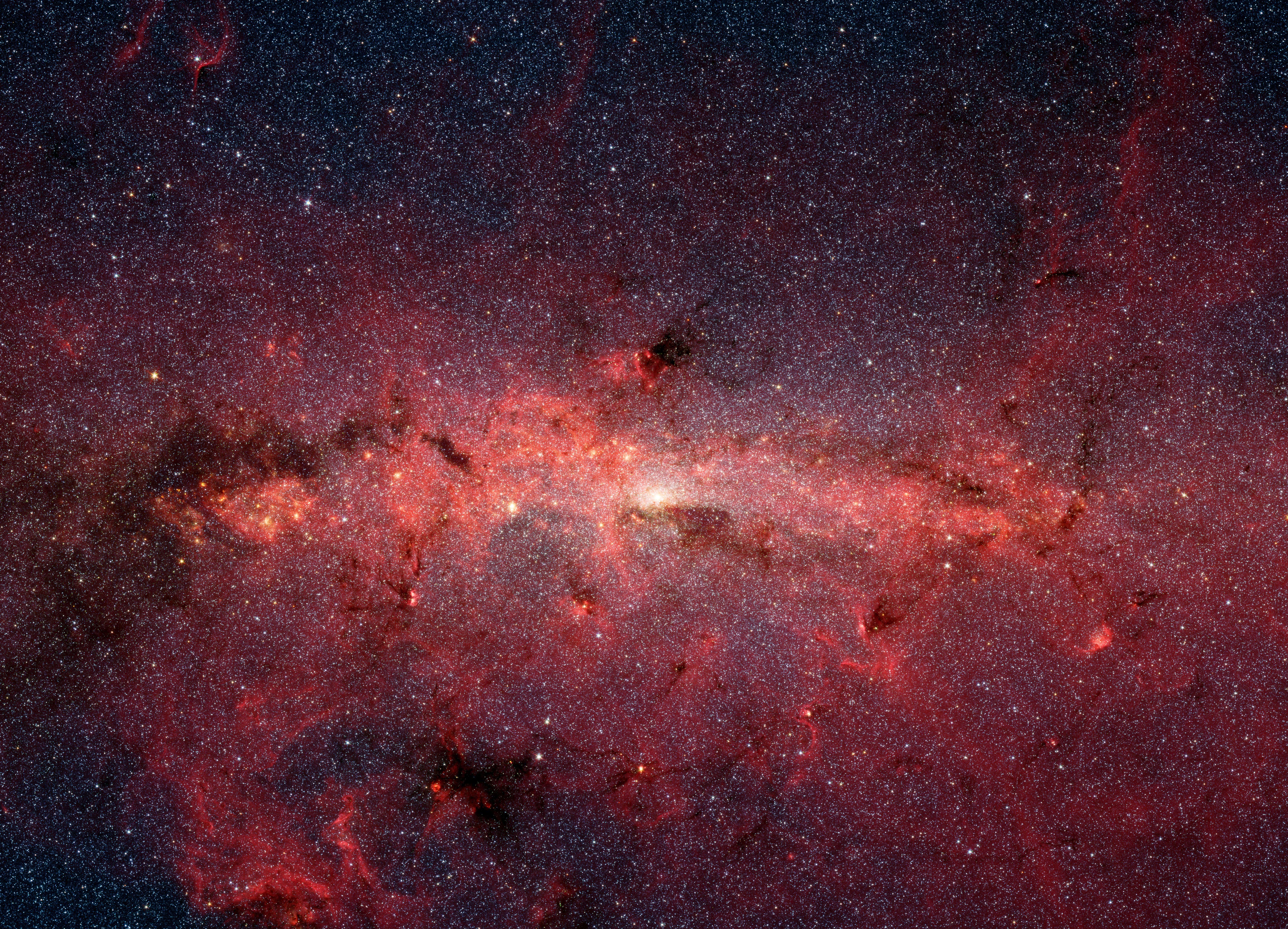
Spitzer reveals a cauldron of stars at the Milky Way's Center!

Spitzer reveals a cauldron of stars at the Milky Way's Center!
Click on the image for full resolution (7.73 MB)

This dazzling infrared image from NASA's Spitzer Space Telescope shows hundreds of thousands of stars crowded into the swirling core of our spiral Milky Way Galaxy. In visible-light pictures, this region cannot be seen at all because dust lying between Earth and the galactic center blocks our view. In this false-color picture, old and cool stars are blue, while dust features lit up by blazing hot, massive stars are shown in a reddish hue. Both bright and dark filamentary clouds can be seen, many of which harbor stellar nurseries. The plane of the Milky Way's flat disk is apparent as the main, horizontal band of clouds. The brightest white spot in the middle is the very center of the galaxy, which also marks the site of a supermassive black hole. The region pictured here is immense, with a horizontal span of 890 light-years and a vertical span of 640 light-years. Earth is located 26,000 light-years away, out in one of the Milky Way's spiral arms. Though most of the objects seen in this image are located at the galactic center, the features above and below the galactic plane tend to lie closer to Earth. Scientists are intrigued by the giant lobes of dust extending away from the plane of the galaxy. They believe the lobes may have been formed by winds from massive stars.This image is a mosaic of thousands of short exposures taken by Spitzer's infrared array camera, showing emissions from wavelengths of 3.6 microns (blue), 4.5 microns (green), 5.8 microns (orange), and 8.0 microns (red). The entire region was imaged in less than 16 hours.
The full resolution image weighs 7.73 MB, so please be patient when downloading!
Credit: NASA/JPL-Caltech

Monday, October 24, 2011

Amazing picture of nebulae in the Northern Cross in Cygnus!

Amazing picture of nebulae in the Northern Cross in Cygnus!
Click on the image for full resolution (1.7 MB)

This image emphasizes cosmic gas clouds in a 25 by 25 degree view centered on the Northern Cross, the famous asterism in the constellation Cygnus. Bright, hot, supergiant star Deneb at the top of the cross, Sadr near the center, and beautiful Albireo run diagonally through the scene. One can see on the picture the North America (NGC 7000) and Pelican (IC 5070) emission regions, the Butterfly Nebula (IC 1318), the Crescent Nebula (NGC 6888), the Tulip Nebula (Sh2-101) and Veil Nebulae (NGC 6992 and NGC 6960). Silhouetted by the glowing interstellar clouds and crowded star fields, the dark Northern Coal Sack also stands out, part of a series of obscuring dust clouds forming the Great Rift in the Milky Way. These Northern Cross nebulosities are all located about 2,000 light-years away. Along with the Sun, they lie within the Orion spiral arm of our galaxy.
The full resolution image weighs 1.7 MB, so please be (a little) patient when downloading!
Credit and Copyright: Rolf Geissinger
http://www.stern-fan.de/

Friday, October 14, 2011

Spitzer Space Telescope's new view of the Milky Way Center

Spitzer Space Telescope's new view of the Milky Way Center
Click on the image for full resolution (3.76 MB)

The region around the center of our Milky Way galaxy glows colorfully in this new version of an image taken by NASA's Spitzer Space Telescope. The data were previously released as part of a long, 120-degree view of the plane our galaxy. Now, data from the very center of that picture are being presented at a different contrast to better highlight this jam-packed region. In visible-light pictures, it is all but impossible to see the heart of our galaxy, but infrared light penetrates the shroud of dust giving us this unprecedented view. In this Spitzer image, the myriad of stars crowding the center of our galaxy creates the blue haze that brightens towards the center of the image. The green features are from carbon-rich dust molecules, called polycyclic aromatic hydrocarbons, which are illuminated by the surrounding starlight as they swirl around the galaxy's core. The yellow-red patches are the thermal glow from warm dust. The polycyclic aromatic hydrocarbons and dust are associated with bustling hubs of young stars. These materials, mixed with gas, are required for making new stars.
The brightest white feature at the center of the image is the central star cluster in our galaxy. At a distance of 26,000 light years away from Earth, it is so distant that, to Spitzer's view, most of the light from the thousands of individual stars is blurred into a single glowing blotch. Astronomers have determined that these stars are orbiting a massive black hole that lies at the very center of the galaxy. The region pictured here is immense, with a horizontal span of 2,400 light-years (5.3 degrees) and a vertical span of 1,360 light-years (3 degrees). Though most of the objects seen in this image are located near the galactic center, the features above and below the galactic plane tend to lie closer to Earth. The image is a three-color composite, showing infrared observations from two of Spitzer instruments. Blue represents 3.6-micron light and green shows 8-micron light, both captured by Spitzer's infrared array camera. Red is 24-micron light detected by Spitzer's multiband imaging photometer. The data is a combination of observations from the Galactic Legacy Infrared Mid-Plane Survey Extraordinaire (GLIMPSE) project, and the Multiband Imaging Photometer for Spitzer Galactic survey (MIPSGAL).
The full resolution image weighs 3.76 MB, so please be patient when downloading!
Credit: NASA/JPL-Caltech

Saturday, October 1, 2011

New DSS2 image of the Southern Cross and the Coalsack

New DSS2 image of the Southern Cross and the Coalsack
Click on the image for full resolution (3.1 MB)

This is a new Digital Sky Survey 2 image of the Southern Cross and the Coalsack in the southern sky. The field is 9 degrees across. The Coalsack is the most famous of the so-called "dark nebulae", or "absorption nebulae".
The full resolution image weighs 3.1 MB, so please be patient when downloading!
Credit: Caltech/DSS2/Wikisky.org
Processing: Jean-Baptiste Faure

Tuesday, September 27, 2011

A view of M8, the Lagoon Nebula, in ultra-high resolution!

A view of M8, the Lagoon Nebula, in ultra-high resolution!
Click on the image for full resolution (7.3 MB)

The third image of ESO's GigaGalaxy Zoom project is an amazing vista of M8, the Lagoon Nebula, taken with the 67-million-pixel Wide Field Imager attached to the MPG/ESO 2.2-meter telescope at the La Silla Observatory in Chile. The image covers more than one and a half square degree - an area eight times larger than that of the Full Moon - with a total of about 370 million pixels. It is based on images acquired using three different broadband filters (B, V, R) and one narrow-band filter (H-alpha).
The full resolution image weighs 7.3 MB, so please be patient when downloading!
Credit: ESO

Sunday, September 4, 2011

Stunning composite image of the core of the Milky Way Galaxy

Stunning composite image of the core of the Milky Way Galaxy
Click on the image for full resolution (3.84 MB)


NASA's Great Observatories - the Hubble Space Telescope, the Spitzer Space Telescope, and the Chandra X-ray Observatory - have produced this spectacular image using infrared light and X-ray light see through the obscuring dust and reveal the intense activity near the galactic core. This image was made using a matched trio of images of the central region of our Milky Way Galaxy. Each image shows the telescope's different wavelength view of the galactic center region, illustrating the unique science each observatory conducts. Note that the center of the galaxy is located within the bright white region to the right of and just below the middle of the image. The entire image width covers about one-half a degree, about the same angular width as the full moon. Spitzer's infrared-light observations provide a detailed and spectacular view of the galactic center region. The swirling core of our galaxy harbors hundreds of thousands of stars that cannot be seen in visible light. These stars heat the nearby gas and dust. These dusty clouds glow in infrared light and reveal their often dramatic shapes. Some of these clouds harbor stellar nurseries that are forming new generations of stars. Like the downtown of a large city, the center of our galaxy is a crowded, active, and vibrant place. Although best known for its visible-light images, Hubble also observes over a limited range of infrared light. The galactic center is marked by the bright patch in the lower right. Along the left side are large arcs of warm gas that have been heated by clusters of bright massive stars. In addition, Hubble uncovered many more massive stars across the region. Winds and radiation from these stars create the complex structures seen in the gas throughout the image.This sweeping panorama is one of the sharpest infrared pictures ever made of the galactic center region. X-rays detected by Chandra expose a wealth of exotic objects and high-energy features. In this image, pink represents lower energy X-rays and blue indicates higher energy. Hundreds of small dots show emission from material around black holes and other dense stellar objects. A supermassive black hole - some four million times more massive than the Sun - resides within the bright region in the lower right. The diffuse X-ray light comes from gas heated to millions of degrees by outflows from the supermassive black hole, winds from giant stars, and stellar explosions. This central region is the most energetic place in our galaxy.
The full resolution image weighs 3.84 MB, so please be patient when downloading!
Credit: NASA/JPL-Caltech/ESA/CXC/STScI

Thursday, June 9, 2011

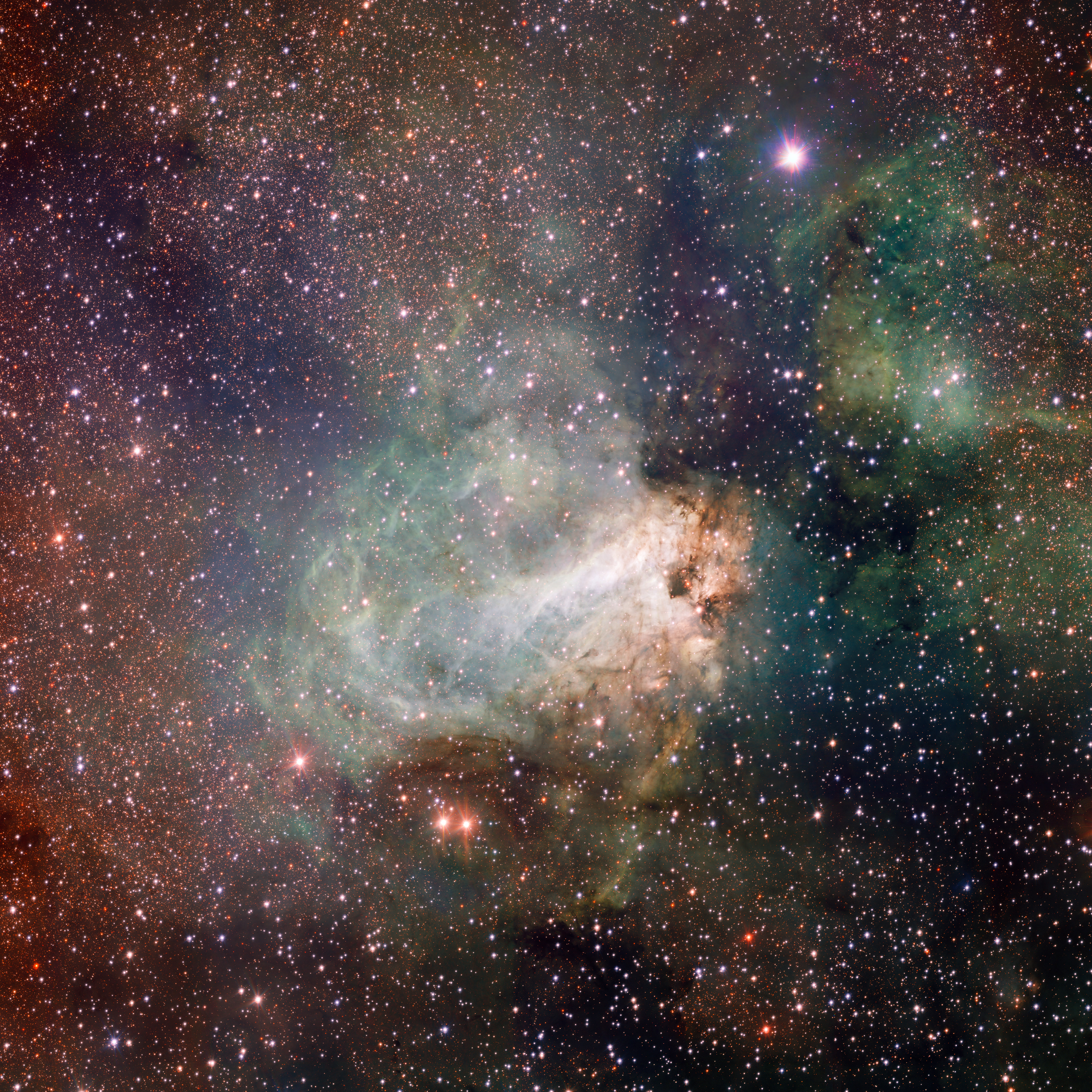
M17, the Omega Nebula, first image from ESO's new VST

M17, the Omega Nebula, first image from ESO's new VST
Click on the image for full resolution (13.6 MB)

The first released VST image shows the spectacular star-forming region Messier 17, also known as the Omega Nebula or the Swan Nebula, as it has never been seen before. This vast region of gas, dust and hot young stars lies in the heart of the Milky Way in the constellation of Sagittarius (The Archer). The VST field of view is so large that the entire nebula, including its fainter outer parts, is captured - and retains its superb sharpness across the entire image. The data were processed using the Astro-WISE software system developed by E.A. Valentijn and collaborators at Groningen and elsewhere.
The VLT Survey Telescope (VST) is the latest telescope to be added to ESO's Paranal Observatory in the Atacama Desert of northern Chile. It is housed in an enclosure immediately adjacent to the four VLT Unit Telescopes on the summit of Cerro Paranal under the pristine skies of one of the best observing sites on Earth. The VST is a wide-field survey telescope with a field of view twice as broad as the full Moon. It is the largest telescope in the world designed to exclusively survey the sky in visible light. Over the next few years the VST and its camera OmegaCAM will make several very detailed surveys of the southern sky. All survey data will be made public. The VST programme is a joint venture between the INAF–Osservatorio Astronomico di Capodimonte, Naples, Italy and ESO. INAF has designed and built the telescope with the collaboration of leading Italian industries and ESO is responsible for the enclosure and the civil engineering works at the site. OmegaCAM, the VST's camera, was designed and built by a consortium including institutes in the Netherlands, Germany and Italy with major contributions from ESO. The new facility will be operated by ESO, which will also archive and distribute data from the telescope. The VST is a state-of-the-art 2.6-meter aperture telescope with an active optics system to keep the mirrors perfectly positioned at all times. At its core, behind large lenses that ensure the best possible image quality, lies the 770 kg OmegaCAM camera, built around 32 CCD detectors, sealed in vacuum, that together create 268-megapixel images. Both the telescope and the camera have been designed to fully exploit the high quality skies at Paranal. The second released image may be the best portrait of the globular star cluster Omega Centauri ever made. This is the largest globular cluster in the sky, but the very wide field of view of VST and OmegaCAM can encompass even the faint outer regions of this spectacular object. This view, which includes about 300 000 stars, demonstrates the excellent resolution of VST.
The VST will make three public surveys over the next five years. The KIDS survey will image several regions of the sky away from the Milky Way. It will further the study of dark matter, dark energy and galaxy evolution, and find many new galaxy clusters and high-redshift quasars. The VST ATLAS survey will cover a larger area of sky and focus on understanding dark energy and supporting more detailed studies using the VLT and other telescopes. The third survey, VPHAS+, will image the central plane of the Milky Way to map the structure of the Galactic disc and its star formation history. VPHAS+ will yield a catalogue of around 500 million objects and will discover many new examples of unusual stars at all stages of their evolution. The data volume produced by OmegaCAM will be large. About 30 terabytes of raw data will be produced per year and will flow back into data centres in Europe for processing. A novel and sophisticated software system has been developed at Groningen and Naples to handle the very large data flow. The end products from the processing will be huge lists of the objects found, as well as images, and these will be made available to astronomers worldwide for scientific analysis.
The full resolution image weighs 13.6 MB, so please be patient when downloading!
Credit: ESO/INAF-VST/OmegaCAM
Acknowledgement: OmegaCen/Astro-WISE/Kapteyn Institute

Thursday, May 26, 2011

New ESO Image of Star-Forming Region R 136 in the LMC

New ESO Image of Star-Forming Region R 136 in the LMC
Click on the image for full resolution (3.36 MB)

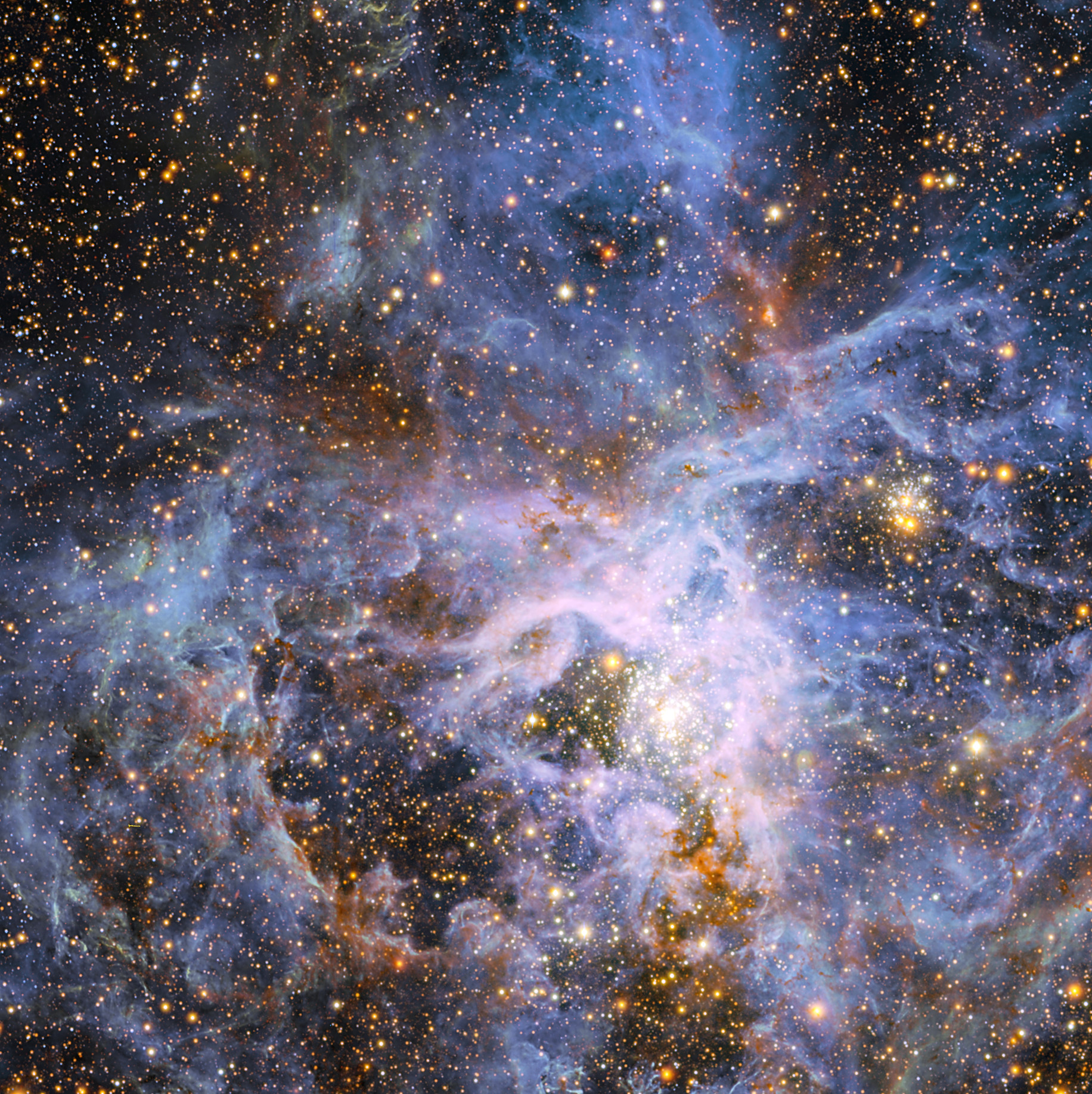
This view shows part of the very active star-forming region around the Tarantula Nebula in the Large Magellanic Cloud, a small neighbour of the Milky Way. At the exact centre lies the brilliant but isolated star VFTS 682 and to its lower right the very rich star cluster R 136. The origins of VFTS are unclear - was it ejected from R 136 or did it form on its own? The star appears yellow-red in this view, which includes both visible-light and infrared images from the Wide Field Imager at the 2.2-meter MPG/ESO telescope at La Silla and the 4.1-meter infrared VISTA telescope at Paranal, because of the effects of dust.
The full resolution image weighs 3.36 MB, so please be patient when downloading!
Credit: ESO/M.-R. Cioni/VISTA Magellanic Cloud survey
Acknowledgment: Cambridge Astronomical Survey Unit