Showing posts with label Dwarf Galaxies. Show all posts

Wednesday, December 24, 2025

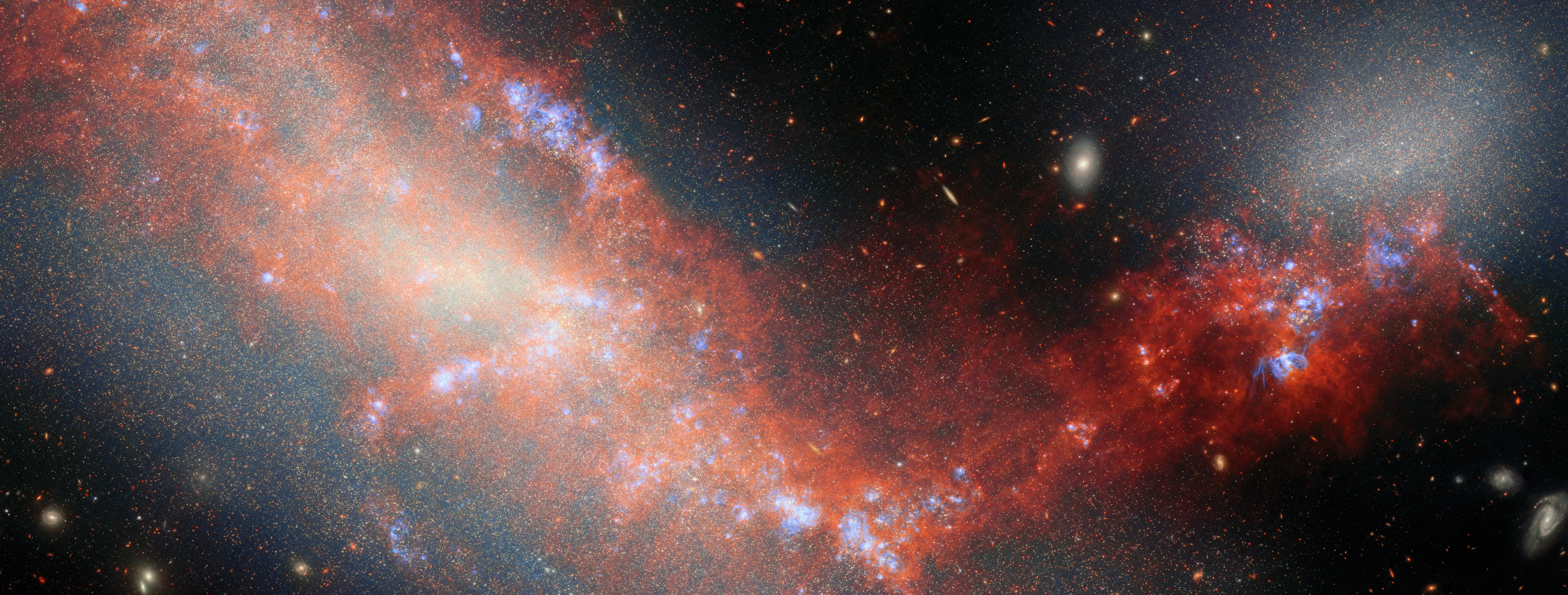
Dwarf Galaxies NGC 4490 and NGC 4485 by Webb

Dwarf Galaxies NGC 4490 and NGC 4485 by Webb
Click the image for higher resolution (12.3 MB)

For this new Webb picture, the James Webb Space Telescope has spied a pair of dwarf galaxies engaged in a gravitational dance. These two galaxies are named NGC 4490 and NGC 4485, and they're located about 24 million light-years away in the constellation Canes Venatici (The Hunting Dogs). Aside from the Milky Way's own dwarf companions (the Large and Small Magellanic Clouds), this is the closest known interacting dwarf-dwarf system where astronomers have directly observed both a gas bridge and resolved stellar populations. Together NGC 4490 and NGC 4485 form the system Arp 269, which is featured in the Atlas of Peculiar Galaxies. At such a close distance (and with Webb's impressive ability to peer through dusty cosmic clouds) these galaxies allow astronomers to witness up close the kinds of galaxy interactions that were common billions of years ago.
Dwarf galaxies likely share many similarities with young galaxies in the early Universe: they are much less massive than galaxies like the Milky Way, they typically have small amounts of metals (what astronomers call elements heavier than helium), and they contain a lot of gas and relatively few stars. When nearby dwarf galaxies collide, merge, or steal gas from one another, it can tell us how galaxies billions of years ago might have grown and evolved.
The nearby dwarf galaxies NGC 4490 and NGC 4485 form an intriguing pair. Nearly three decades ago, astronomers discovered a wispy bridge of gas connecting the two galaxies, showing that they have interacted in the past. Despite many studies with powerful telescopes like the Hubble Space Telescope, the history between NGC4490 and NGC 4485 has remained mysterious.
Recently, Webb observed this curious galactic pair as part of the Feedback in Emerging extrAgalactic Star clusTers (FEAST) programme (#1783; PI: A. Adamo). The FEAST programme used Webb's sensitive infrared eyes to reveal the formation of new stars in different types of nearby galaxies.
This image was developed using data from Webb's Near-InfraRed Camera (NIRCam) and Mid-InfraRed Instrument (MIRI), as well as a single narrow-band filter from Hubble (657N). It reveals NGC 4490 and NGC 4485 in never-before-seen detail and illuminates the bridge of gas and stars that connects them. NGC 4490 dominates the image as the larger object occupying the left side of the image, while NGC 4485 is the smaller galaxy that hosts the top-right portion of the image. By dissecting these galaxies star by star, researchers were able to map out where young, middle-aged, and old stars reside, and trace the timeline of the galaxies' interaction.
Roughly 200 million years ago, these galaxies whirled close to one another before waltzing away. The larger galaxy, NGC 4490, ensnared a stream of gas from its companion, and this gas now trails between the galaxies like dancers connected by outstretched arms. Along the newly formed bridge of gas and within the two galaxies, this interaction spurred a burst of new stars. The concentrated areas of bright blue that appear throughout the field indicate highly ionised regions of gas by the recently formed star clusters. Just 30 million years ago, these galaxies burst alight with stars once more, with new clusters coalescing where the gas of the two galaxies mixed together.
By capturing the history of the galactic dancers NGC 4490 and NGC 4485, Webb has revealed new details in how dwarf galaxies interact, giving us a glimpse of how small galaxies near and far grow and evolve.
Image Credit: ESA/Webb, NASA and CSA, A. Adamo (Stockholm University), G. Bortolini, and the FEAST JWST team
Image enhancement: Jean-Baptiste Faure

Saturday, July 6, 2024

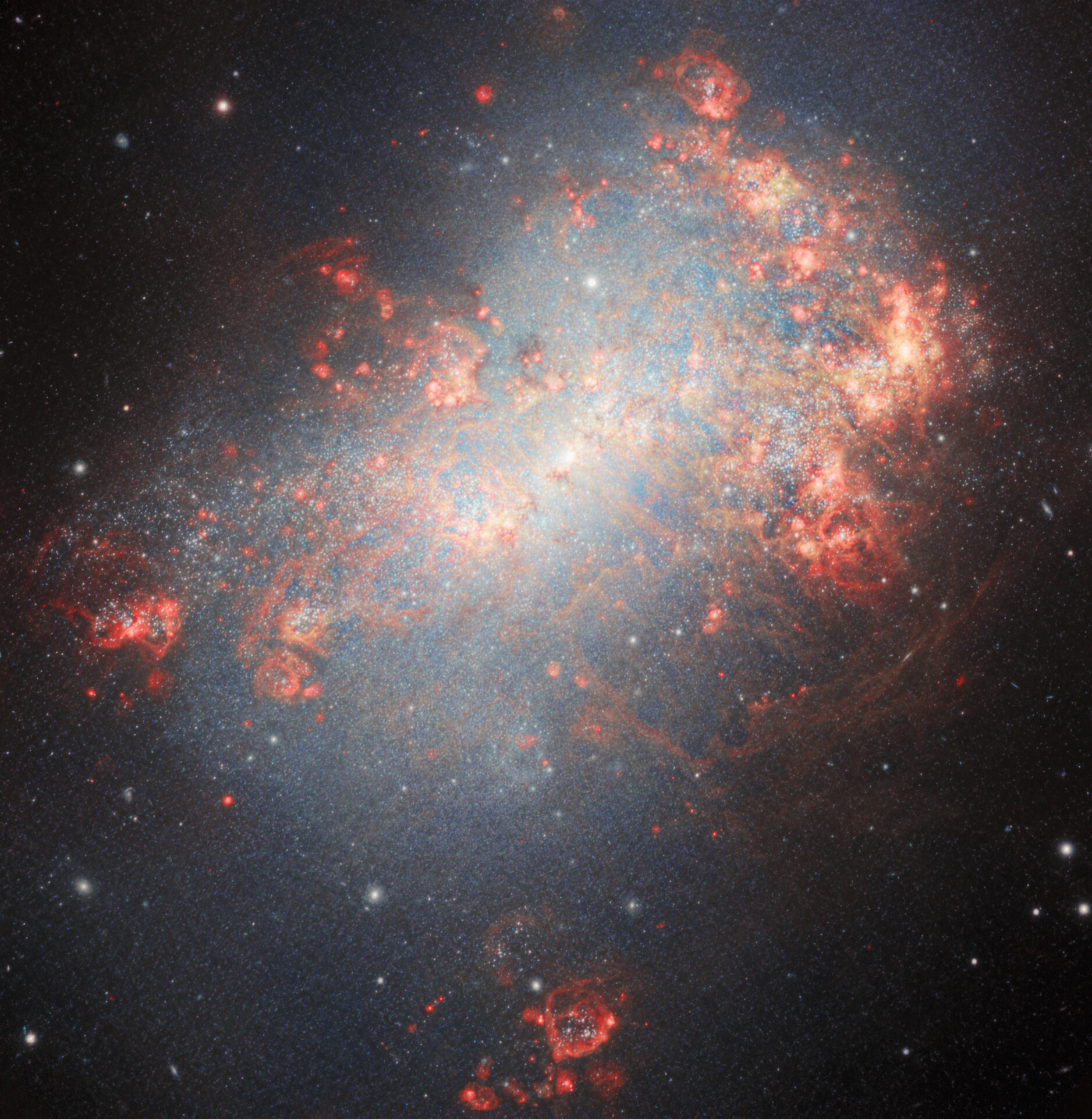
Irregular Dwarf Galaxy NGC 4449

Irregular Dwarf Galaxy NGC 4449
Click the image for higher resolution (1.2 MB)

Much of the visible matter in the Universe, the matter that makes up stars, planets – and us – is made inside stars as they complete their cycle of birth, life, and death. They are born from clouds of gas and dust, and when they die their remains are recycled back into the interstellar medium to be used as fuel for the next generation of stars. And in a not-so-distant corner of the Universe, 13 million light-years away in the constellation Canes Venatici, the beginning of this cycle is unfolding at an exceptional rate.
NGC 4449, also known as Caldwell 21, appears to be putting on a cosmic fireworks show in this image, captured with the Gemini North telescope, one half of the International Gemini Observatory, which is supported in part by the U.S. National Science Foundation and operated by NSF NOIRLab. The galaxy's billowing red clouds and sparkling blue veil are lighting up the sky with the colors of newly forming stars. It's classified as an irregular Magellanic-type galaxy, reflecting its loose spiral structure and close resemblance to the Large Magellanic Cloud – the prototype of Magellanic galaxies.
Stars have been actively forming within NGC 4449 for several billion years, but currently it is pumping out new stars at a much higher rate than in the past. This unusually explosive and intense star formation activity qualifies it as a starburst galaxy. While starbursts usually occur in the central regions of galaxies, NGC 4449's star formation is more widespread, evidenced by the fact that the youngest stars are both in the nucleus and in streams surrounding the galaxy.
This "global" starburst activity resembles the Universe's earliest star-forming galaxies, which grew by merging with and accreting smaller stellar systems. And like its galactic predecessors, NGC 4449's rapid star formation was likely ignited by interactions with neighboring galaxies. As a member of the M94 Group of galaxies – one of the closest galaxy groups to the Local Group, which hosts the Milky Way – NGC 4449 lies in close proximity to a handful of surrounding smaller galaxies. Astronomers have found evidence of interactions between NGC 4449 and at least two of these satellite galaxies.
One is a very dim dwarf galaxy that is actively being absorbed, as evidenced by a diffuse stream of stars extending to one side of NGC 4449. This "stealth" merger is nearly undetectable by visual inspection owing to its diffuse nature and low stellar mass. However, it possesses a large amount of dark matter, meaning its presence can be detected by the substantial gravitational influence it has on NGC 4449. The other object that provides hints of a past merger is a massive globular star cluster embedded within the outer halo of NGC 4449. This cluster is thought by astronomers to be the surviving nucleus of a former gas-rich satellite galaxy now in the process of being absorbed by NGC 4449.
As NGC 4449 interacts with and absorbs its smaller galactic companions, the tidal interactions between the galaxies compress and shock the gas. The glowing red regions scattered across this image showcase this process, indicating an abundance of ionized hydrogen – a telltale sign of ongoing star formation. A plethora of hot, young blue star clusters are emerging from the galactic ovens, fueled by the dark filaments of cosmic dust lacing throughout the galaxy. At the current rate, the gas supply that feeds NGC 4449's production of stars will only last for another billion years or so.
This image was released in celebration of the Gemini North telescope's 25th anniversary. On 25 June 1999 a dedication ceremony was held on Maunakea, Hawai‘i, to unveil the new world-class 8.1-meter telescope and reveal its first-light images, which at the time were some of the sharpest infrared images ever obtained by a ground-based telescope. Over the past two and a half decades Gemini North's large mirror, powerful suite of instruments and advanced adaptive optics have allowed astronomers to peer further and further into the cosmos. From capturing the first direct image of a multi-planet system to testing Einstein’s general theory of relativity – which helped astronomers earn the 2020 Nobel Prize – Gemini North has contributed greatly to humanity's understanding of the Universe.
Image Credit: International Gemini Observatory/NOIRLab/NSF/AURA
Image Processing: J. Miller (International Gemini Observatory/NSF NOIRLab), M. Rodriguez (International Gemini Observatory/NSF NOIRLab), T.A. Rector (University of Alaska Anchorage/NSF NOIRLab), M. Zamani (NSF NOIRLab)
Acknowledgements: PI: P. Frank Winkler (Middlebury College), Knox S. Long (STScI/Eureka Scientific Inc), and William P. Blair (Johns Hopkins University)
Image enhancement: Jean-Baptiste Faure
Saturday, June 15, 2024

Dwarf Barred Spiral Galaxy IC 776

Dwarf Barred Spiral Galaxy IC 776
Click the image for higher resolution (2.5 MB)

Featured in this picture is the dwarf galaxy IC 776. This swirling collection of stars new and old is located in the constellation Virgo – in fact, in the Virgo galaxy cluster – 100 million light-years from Earth. While a dwarf galaxy, it's also been classified as an SAB-type or "weakly barred" spiral, one study naming it a "complex case" in morphology. This highly detailed view from Hubble demonstrates that complexity well. IC 776 has a ragged, disturbed disc that nevertheless looks to spiral around the core, and arcs of star-forming regions.
This image is from an observation programme dedicated to the study of dwarf galaxies in the Virgo cluster, searching for sources of X-rays in such galaxies. X-rays are often emitted by accretion discs, where material that is drawn into a compact object by gravity crashes together and forms a hot, glowing disc. The compact object can be a white dwarf or neutron star in a binary pair, stealing material from its companion star, or it can be the supermassive black hole at the heart of a galaxy, devouring all around it. Dwarf galaxies like IC 776, travelling through the Virgo cluster, experience a pressure from the intergalactic gas which can both stimulate star formation and feed the central black hole in a galaxy. That can create energetic accretion discs, hot enough to emit X-rays.
While Hubble is not able to see X-rays, it can coordinate with X-ray telescopes such as NASA's Chandra, revealing the sources of this radiation in high resolution using visible light. Dwarf galaxies are thought to be very important for our understanding of cosmology and the evolution of galaxies. As with many areas of astronomy, the ability to examine these galaxies across the electromagnetic spectrum is critical to their study.
Image Credit: ESA/Hubble and NASA, M. Sun
Image enhancement: Jean-Baptiste Faure

Friday, April 5, 2024

Dwarf Irregular Galaxy I Zwicky 18

Dwarf Irregular Galaxy I Zwicky 18
Click the image for higher resolution

The James Webb Space Telescope has captured a spectacular view of the galaxy I Zwicky 18 (I Zw 18) in this new image. The galaxy was first identified by Swiss astronomer Fritz Zwicky in the 1930's and resides roughly 59 million light-years from Earth.
This galaxy has gone through several sudden bursts of star formation. This galaxy is typical of the kinds of galaxies that inhabited the early Universe and it is classified as a dwarf irregular galaxy (much smaller than our Milky Way).
Two major starburst regions are embedded in the heart of the galaxy. The wispy brown filaments surrounding the central starburst region are bubbles of gas that have been heated by stellar winds and intense ultraviolet radiation unleashed by hot, young stars. A companion galaxy resides nearby to the dwarf galaxy, which can be seen at the bottom of the wider-field image. The companion may be interacting with the dwarf galaxy and may have triggered that galaxy's recent star formation. The orange blobs surrounding the dwarf galaxy are the dim glow from ancient fully formed galaxies at much larger distances.
This image was taken as part of a Webb programme to study the life cycle of dust in I Zw 18. Scientists are now building off of previous research with Hubble obtained at optical wavelengths, studying individual dusty stars in detail with Webb's equivalent spatial resolution and sensitivity at infrared wavelengths. This galaxy is of particular interest as its content of elements heavier than helium is one of the lowest of all known galaxies in the local Universe. Such conditions are thought to be similar to those in some of the first star-forming galaxies at high redshift, so the Webb study of I Zw 18 should shed light on the life-cycle of stars and dust in the early Universe.
Although previously believed to have only just recently begun forming its first generation of stars, the Hubble Space Telescope found fainter, older red stars contained within the galaxy, suggesting its star formation started at least one billion years ago and possibly as much as 10 billion years ago. The galaxy, therefore, may have formed at the same time as most other galaxies.
The new observations from Webb have revealed the detection of a set of candidate dusty evolved stars. It also provides details about Zw 18's two dominant star-forming regions. Webb's new data suggest that the dominant bursts of star formation in these regions occurred at different times. The strongest starburst activity is now believed to have happened more recently in the northwest lobe as compared to the galaxy's southeast lobe. This is based on the relative populations of younger versus older stars found in each of the lobes.
Image Credit: ESA/Webb, NASA, CSA, A. Hirschauer, M. Meixner et al.
Image enhancement: Jean-Baptiste Faure

Tuesday, September 26, 2023

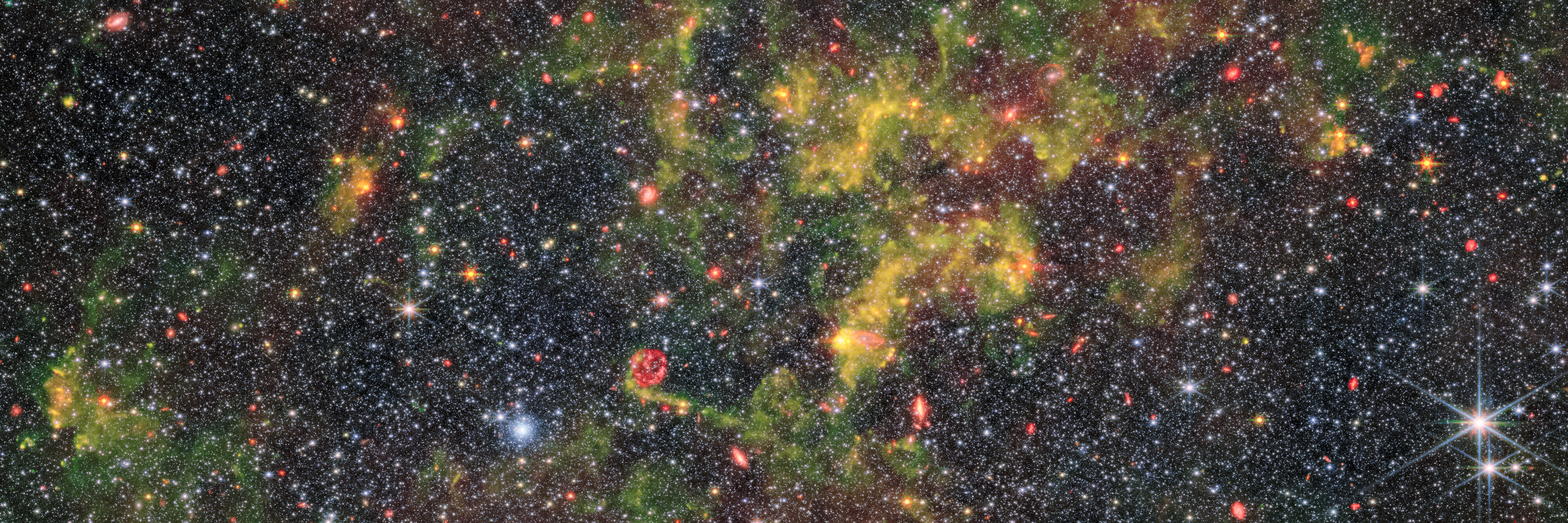
Irregular Galaxy NGC 6822 observed by Webb

Irregular Galaxy NGC 6822 observed by Webb
Click the image for higher resolution (3.4 MB)

This image shows the irregular galaxy NGC 6822, which was observed by the Near-InfraRed Camera (NIRCam) and Mid-InfraRed Instrument (MIRI) mounted on the James Webb Space Telescope. As their names suggest, NIRCam and MIRI probe different parts of the electromagnetic spectrum. This allows the instruments to observe different components of the same galaxy, with MIRI especially sensitive to its gas-rich regions (the yellow swirls in this image) and NIRCam suitable for observing its densely packed field of stars.
NGC 6822 lies about 1.5 million light-years away, and is the Milky Way's nearest galactic neighbour that is not one of its satellites. It has a low metallicity, meaning that it contains low proportions of elements that are not hydrogen and helium. Metallicity is an absolutely key concept in astronomy, in part because elements other than hydrogen and helium are largely produced by stars over their lifetimes. Therefore, in the very early Universe (before the first generation of stars had been born, lived and died) everything had very low metallicity. This makes contemporary low-metallicity objects (like NGC 6822) objects of interest for understanding how processes such as the evolution of stars and the life cycle of interstellar dust likely occurred in the early Universe. This was the motivation for these observations of NGC 6822 with Webb: to better understand how stars form and how dust evolves in low-metallicity environments.
The study of NGC 6822 has an interesting history that long predates modern investigations with Webb. It was first discovered by E. E. Barnard, who presented his discovery in a very brief paper in 1884 in The Sidereal Messenger: a short-lived but important American monthly astronomical journal that was published between 1882 and 1891. As with many astronomical objects that appeared diffuse with telescopes of the time, NGC 6822 was miscategorised as an "exceedingly faint nebula".
Over the next few years, a series of confusions arose around NGC 6822 over its apparent size, brightness, and even what kind of object it was, because astronomers at the time did not properly account for how different the same object might look with different telescopes. Edwin Hubble, namesake of the Hubble Space telescope, went on to study NGC 6822 in depth and published a far more detailed paper of his own in 1925. This work was exceptionally important for humanity’s evolving understanding of the Universe, because, in Hubble's own words: "N.G.C. 6822, [was] the first object definitely assigned to a region outside the galactic system". This paper contributed to solving the debate that was raging amongst astronomers about the extent of the Universe at the time by demonstrating that there were astronomical objects that lay beyond the Milky Way. The study of this galaxy was notably continued by Susan Kayser, who was the first woman to receive a PhD in astronomy from Caltech. Her 1966 thesis remained the most thorough investigation of this galaxy until the 2000s. Now, the study of this key local galaxy is being continued by Webb.
This image shows a dense field of stars with clouds of gas and dust billowing across it. The clouds are patchy and wispy, dense and glowing parts obscuring the center of the image. Bright galaxies with various shapes and sizes shine through the gas and stars. Some of the star images are a bit larger than the rest, with visible diffraction spikes; two foreground stars are bright in the lower-right corner.
Image Credit: ESA/Webb, NASA and CSA, M. Meixner
Image enhancement: Jean-Baptiste Faure

Friday, February 4, 2022

Dwarf Irregular Galaxy NGC 1705

Dwarf Irregular Galaxy NGC 1705
Click on the image for higher resolution (3.8 MB)

The dwarf galaxy NGC 1705 is featured in this image from the Hubble Space Telescope. This diminutive galaxy lies in the southern constellation Pictor, and is approximately 17 million light-years from Earth. NGC 1705 is a cosmic oddball – it is small, irregularly shaped, and has recently undergone a spate of star formation known as a starburst.
Despite these eccentricities, NGC 1705 and other dwarf irregular galaxies like it can provide valuable insights into the overall evolution of galaxies. Dwarf irregular galaxies tend to contain few elements other than hydrogen or helium, and are considered to be similar to the earliest galaxies that populated the Universe.
The data shown in this image come from a series of observations designed to unveil the interplay between stars, star clusters, and ionised gas in nearby star-forming galaxies. By observing a specific wavelength of light known as H-alpha with Hubble's Wide Field Camera 3, astronomers aimed to discover thousands of emission nebulae – regions created when hot, young stars bathe the clouds of gas surrounding them in ultraviolet light, causing them to glow.
This is not the first time that NGC 1705 has been imaged by Hubble – astronomers peered into the heart of the galaxy in 1999 using Hubble's workhorse camera at the time, the Wide Field Planetary Camera 2. This instrument was replaced with the Wide Field Camera 3 during the fifth and final Space Shuttle mission to Hubble in 2009, and the newer instrument has provided a richer and far more detailed portrait of NGC 1705 than the 1999 observation.
Image Credit: ESA/Hubble and NASA, R. Chandar
Image enhancement: Jean-Baptiste Faure

Wednesday, September 29, 2021

Dwarf Irregular Galaxy NGC 1427A

Dwarf Irregular Galaxy NGC 1427A
Click on the image for higher resolution (6.2 MB)

What happens when a galaxy falls in with the wrong crowd? The dwarf irregular galaxy NGC 1427A is a spectacular example of the resulting stellar rumble. Under the gravitational grasp of a large gang of galaxies, called the Fornax cluster, the small bluish galaxy is plunging headlong into the group at 600 kilometers per second or nearly 400 miles per second.
NGC 1427A, which is located some 62 million light-years away from Earth in the direction of the constellation Fornax, shows numerous hot, blue stars in this newly released image obtained by the Hubble Space Telescope. These blue stars have been formed very recently, showing that star formation is occurring extensively throughout the galaxy.
Galaxy clusters, like the Fornax cluster, contain hundreds or even thousands of individual galaxies. Within the Fornax cluster, there is a considerable amount of gas lying between the galaxies. When the gas within NGC 1427A collides with the Fornax gas, it is compressed to the point that it starts to collapse under its own gravity. This leads to formation of the myriad of new stars seen across NGC 1427A, which give the galaxy an overall arrowhead shape that appears to point in the direction of the galaxy's high-velocity motion. The tidal forces of nearby galaxies in the cluster may also play a role in triggering star formation on such a massive scale.
NGC 1427A will not survive long as an identifiable galaxy passing through the cluster. Within the next billion years, it will be completely disrupted, spilling its stars and remaining gas into intergalactic space within the Fornax cluster.
To the upper left of NGC 1427A is a background galaxy that happens to lie near Hubble's line of sight but is some 25 times further away. In contrast to the irregularly shaped NGC 1427A, the background galaxy is a magnificent spiral, somewhat similar to our own Milky Way. Stars are forming in its symmetric pinwheel-shaped spiral arms, which can be traced into the galaxy's bright nucleus. This galaxy is, however, less dominated by very young stars than NGC 1427A, giving it an overall yellower color. At even greater distances background galaxies of various shapes and colors are scattered across the Hubble image.
The Hubble Space Telescope's Advanced Camera for Surveys was used to obtain images of NGC 1427A in visible (green), red, and infrared filters. These images were then combined by the Hubble Heritage team to create the color rendition shown here. Astronomers are using the data to investigate the star-formation patterns throughout the object, to verify a prediction that there should be a relation between the ages of stars and their positions within the galaxy. This will help them understand how the gravitational influence of the cluster has affected the internal workings of this galaxy, and how this galaxy has responded to passing through the cluster environment.
The disruption of objects like NGC 1427A, and even larger galaxies like our own Milky Way, is an integral part of the formation and evolution of galaxy clusters. Such events are believed to have been very common during the early evolution of the universe, but the rate of galaxy destruction is tapering off at the present time. Thus the impending destruction of NGC 1427A provides a glimpse of an early and much more chaotic time in our universe.
Image Credit: NASA, ESA, and The Hubble Heritage Team STScI/AURA
Acknowledgment: M. Gregg (Univ. Calif.-Davis and Inst. for Geophysics and Planetary Physics, Lawrence Livermore Natl. Lab.)
Image enhancement: Jean-Baptiste Faure

Sunday, February 28, 2021

Dwarf Irregular Galaxy NGC 6822: Barnard's Galaxy

Dwarf Irregular Galaxy NGC 6822: Barnard's Galaxy
Click on the image for higher resolution (20.5 MB)

Barnard's Galaxy, a dwarf irregular galaxy neighboring the Milky Way, is revealed in this stunning image from the Víctor M. Blanco 4-m Telescope at the Cerro Tololo Inter-American Observatory, operated by NSF's NOIRLab. The image reveals regions of intense star formation and a scattering of immense cosmic bubbles.
Despite its small size, the galaxy contains some spellbinding cosmic objects. Glowing red regions of star formation are scattered throughout Barnard's Galaxy and indicate that incandescent star birth is widespread. Several other regions are well known in their own right and have been well studied since they were first detected by Edwin Hubble in 1925.
Image Credit: CTIO/NOIRLab/NSF/AURA
Acknowledgments: P. Massey (Lowell Obs.), G. Jacoby, K. Olsen, C. Smith (NOAO/AURA/NSF) and T.A. Rector (NRAO/AUI/NSF)
Image processing: Travis Rector (University of Alaska Anchorage), Mahdi Zamani and Davide de Martin

Saturday, September 5, 2020

Barred Spiral Galaxy NGC 2188

Barred Spiral Galaxy NGC 2188
Click on the image for higher resolution (5.3 MB)

The blue and orange stars of the faint galaxy named NGC 2188 sparkle in this image taken with the Hubble Space Telescope. Although NGC 2188 appears at first glance to consist solely of a narrow band of stars, it is classified by astronomers as a barred-spiral galaxy. It appears this way from our viewpoint on Earth as the centre and spiral arms of the galaxy are tilted away from us, with only the very narrow outer edge of the galaxy's disc visible to us. Astronomers liken this occurrence to turning a dinner plate in your hands so you see only its outer edge. The true shape of the galaxy was identified by studying the distribution of the stars in the inner central bulge and outer disc and by observing the stars' colors.
NGC 2188 is estimated to be just half the size of our Milky Way, at 50 000 light-years across, and it is situated in the constellation of Columba (The Dove). Named in the late 1500s after Noah's dove in biblical stories, the small constellation consists of many faint yet beautiful stars and astronomical objects.
Image Credit: ESA/Hubble and NASA, R. Tully
Image enhancement: Jean-Baptiste Faure
Monday, April 20, 2020

Dwarf Elliptical Galaxy PGC 29388

Dwarf Elliptical Galaxy PGC 29388
Click on the image for higher resolution (3.6 MB)

As beautiful as the surrounding space may be, the sparkling galaxy in the foreground of this image from the Hubble Space Telescope undeniably steals the show.
This spotlight-hogging galaxy, seen set against a backdrop of more distant galaxies of all shapes and sizes, is known as PGC 29388. Although it dominates in this image, this galaxy is a small player on the cosmic stage, and is known as a dwarf elliptical galaxy. As the "dwarf" moniker suggests, the galaxy is on the smaller side, and boasts a "mere" 100 million to a few billion stars – a very small number indeed when compared to the Milky Way's population of around 250 to 400 billion stellar residents.
Image Credit: ESA/Hubble and NASA, T. Armandroff
Image enhancement: Jean-Baptiste Faure

Saturday, November 16, 2019

Dwarf Galaxy UGC 1281

Dwarf Galaxy UGC 1281
Click on the image for higher resolution (8.9 MB)

The galaxy cutting dramatically across the frame of this Hubble Space Telescope image is a slightly warped dwarf galaxy known as UGC 1281. Seen here from an edge-on perspective, this galaxy lies roughly 18 million light-years away in the constellation of Triangulum (The Triangle). The bright companion to the lower left of UGC 1281 is the small galaxy PGC 6700, officially known as 2MASX J01493473+3234464. Other prominent stars belonging to our own galaxy, the Milky Way, and more distant galaxies can be seen scattered throughout the sky.
The side-on view we have of UGC 1281 makes it a perfect candidate for studies into how gas is distributed within galactic halos – the roughly spherical regions of diffuse gas extending outwards from a galaxy's center. Astronomers have studied this galaxy to see how its gas vertically extends out from its central plane, and found it to be a quite typical dwarf galaxy. However, it does have a slightly warped shape to its outer edges, and is forming stars at a particularly low rate. A version of this image was entered into the Hubble's Hidden Treasures image processing competition by contestant Luca Limatola.
Image Credit: ESA/Hubble and NASA
Acknowledgement: Luca Limatola
Image enhancement: Jean-Baptiste Faure

Wednesday, November 13, 2019

Dwarf Irregular Galaxy NGC 1156

Dwarf Irregular Galaxy NGC 1156
Click on the image for higher resolution (3.0 MB)

The galaxy NGC 1156 resembles a delicate cherry blossom tree flowering in springtime in this Hubble Picture of the Week. The many bright "blooms" within the galaxy are in fact stellar nurseries – regions where new stars are springing to life. Energetic light emitted by newborn stars in these regions streams outwards and encounters nearby pockets of hydrogen gas, causing it to glow with a characteristic pink hue.
NGC 1156 is located in the constellation of Aries (The Ram). It is classified as a dwarf irregular galaxy, meaning that it lacks a clear spiral or rounded shape, as other galaxies have, and is on the smaller side, albeit with a relatively large central region that is more densely packed with stars.
Some pockets of gas within NGC 1156 rotate in the opposite direction to the rest of the galaxy, suggesting that there has been a close encounter with another galaxy in NGC 1156's past. The gravity of this other galaxy – and the turbulent chaos of such an interaction – could have scrambled the likely more orderly rotation of material within NGC 1156, producing the odd behaviour we see today.
Image Credit: ESA/Hubble, NASA, R. Jansen
Image enhancement: Jean-Baptiste Faure

Saturday, April 27, 2019

Dwarf Irregular Galaxy IC 4710

Dwarf Irregular Galaxy IC 4710
Click on the image for higher resolution (6.3 MB)

Discovered in 1900 by astronomer DeLisle Stewart and here imaged by the Hubble Space Telescope, IC 4710 is an undeniably spectacular sight. The galaxy is a busy cloud of bright stars, with bright pockets – marking bursts of new star formation – scattered around its edges.
IC 4710 is a dwarf irregular galaxy. As the name suggests, such galaxies are irregular and chaotic in appearance, lacking central bulges and spiral arms – they are distinctly different from spirals or ellipticals. It is thought that irregular galaxies may once have been spirals or ellipticals, but became distorted over time through external gravitational forces during interactions or mergers with other galaxies. Dwarf irregulars in particular are important to our overall understanding of galactic evolution, as they are thought to be similar to the first galaxies that formed in the Universe.
IC 4710 lies roughly 25 million light-years away in the southern constellation of Pavo (The Peacock). This constellation is located in the southern skies and also contains the third-brightest globular cluster in the sky, NGC 6752, the spiral galaxy NGC 6744, and six known planetary systems (including HD 181433 which is host to a super-Earth). The data used to create this image were gathered by Hubble's Advanced Camera for Surveys (ACS).
Image Credit: ESA/Hubble and NASA
Acknowledgements: Judy Schmidt
Image enhancement: Jean-Baptiste Faure

Dwarf Irregular Galaxy NGC 4861

Dwarf Irregular Galaxy NGC 4861
Click on the image for higher resolution (6.2 MB)

The constellation of Canes Venatici (The Hunting Dogs), is home to a variety of deep-sky objects – including this beautiful galaxy, known as NGC 4861. Astronomers are still debating on how to classify it: While its physical properties – such as mass, size and rotational velocity – indicate it to be a spiral galaxy, its appearance looks more like a comet with its dense, luminous "head" and dimmer "tail" trailing behind. Features more fitting with a dwarf irregular galaxy.
Although small and messy, galaxies like NGC 4861 provide astronomers with interesting opportunities for study. Small galaxies have lower gravitational potentials, which simply means that it takes less energy to move stuff about inside them than it does in other galaxies. As a result, moving in, around, and through such a tiny galaxy is quite easy to do, making them far more likely to be suffused with streams and outflows of speedy charged particles known as galactic winds, which can flood such galaxies with little effort.
These galactic winds can be powered by the ongoing process of star formation, which involves huge amounts of energy. New stars are springing into life within the bright, colourful ‘head’ of NGC 4861 and ejecting streams of high-speed particles as they do so, which flood outwards to join the wider galactic wind. While NGC 4861 would be a perfect candidate to study such winds, recent studies did not find any galactic winds in it.
Image Credit: ESA/Hubble and NASA
Image enhancement: Jean-Baptiste Faure

Saturday, January 28, 2017

Dwarf Spiral Galaxy NGC 4707

Dwarf Spiral Galaxy NGC 4707
Click on the image for higher resolution (4.0 MB)

On a clear evening in April of 1789, the renowned astronomer William Herschel continued his unrelenting survey of the night sky, hunting for new cosmic objects – and found cause to celebrate! Lengthening his impressive list of cosmic discoveries yet again, the astronomer spotted this bright spiral galaxy, named NGC 4707, lurking in the constellation of Canes Venatici (The Hunting Dog). NGC 4707 lies roughly 22 million light-years from Earth. Over two centuries later, the Hubble Space Telescope is able to view the same galaxy in far greater detail than Herschel could, allowing us to appreciate the intricacies and characteristics of NGC 4707 as never before. This striking image comprises observations from Hubble's Advanced Camera for Surveys (ACS), one of a handful of high-resolution instruments currently aboard the space telescope. Herschel himself reportedly described NGC 4707 as a "small, stellar" galaxy; while it is classified as a spiral (type Sm), its overall shape, centre, and spiral arms are very loose and undefined, and its central bulge is either very small or non-existent. It instead appears as a rough sprinkling of stars and bright flashes of blue on a dark canvas, as if a pointillist painter had dotted the cosmos with small pinpricks of bright paint. The blue smudges seen across the frame highlight regions of recent or ongoing star formation, with newborn stars glowing in bright, intense shades of cyan and turquoise.
Image Credit: ESA/Hubble and NASA
Image enhancement: Jean-Baptiste Faure
Monday, August 22, 2016

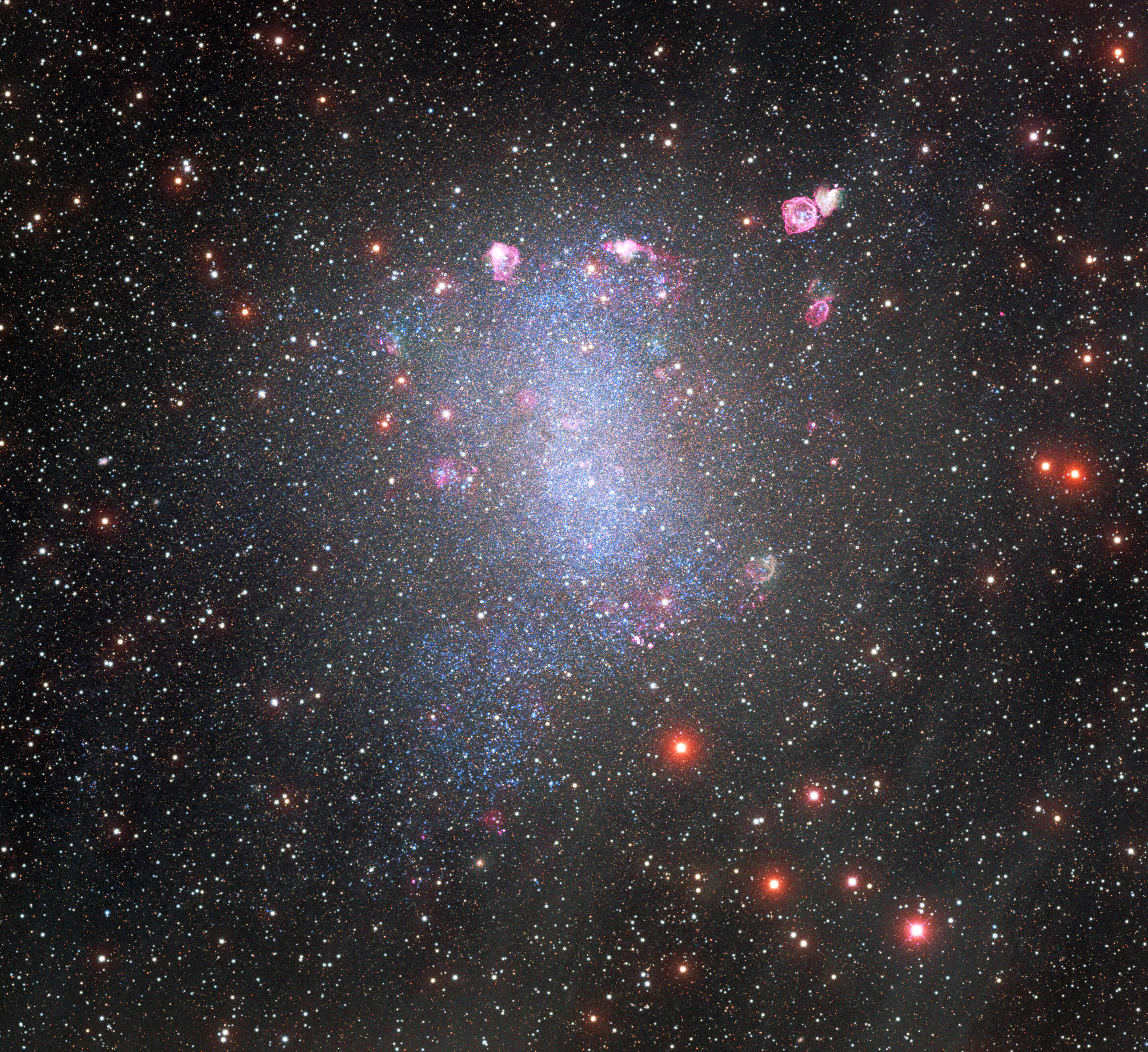
Dwarf Galaxy NGC 5264

Dwarf Galaxy NGC 5264
Click on the image for higher resolution (7.2 MB)

This image, courtesy of the Hubble Space Telescope's Advanced Camera for Surveys (ACS), captures the glow of distant stars within NGC 5264, a dwarf galaxy located just over 15 million light-years away in the constellation of Hydra (The Sea Serpent). Dwarf galaxies like NGC 5264 typically possess around a billion stars – just one per cent of the number of stars found within the Milky Way. They are usually found orbiting other, larger, galaxies such as our own, and are thought to form from the material left over from the messy formation of their larger cosmic relatives. NGC 5264 clearly possesses an irregular shape – unlike the more common spiral or elliptical galaxies – with knots of blue star formation. Astronomers believe that this is due to the gravitational interactions between NGC 5264 and other galaxies nearby. These past flirtations sparked the formation of new generations of stars, which now glow in bright shades of blue.
Image Credit: ESA/Hubble and NASA
Image enhancement: Jean-Baptiste Faure

Saturday, July 25, 2015

Dwarf Galaxy NGC 1140

Dwarf Galaxy NGC 1140
Click on the image for higher resolution

This dramatic image shows the Hubble Space Telescope's view of dwarf galaxy known as NGC 1140, which lies 60 million light-years away in the constellation of Eridanus. As can be seen in this image NGC 1140 has an irregular form, much like the Large Magellanic Cloud – a small galaxy that orbits the Milky Way. This small galaxy is undergoing what is known as a starburst. Despite being almost ten times smaller than the Milky Way it is creating stars at about the same rate, with the equivalent of one star the size of the Sun being created per year. This is clearly visible in the image, which shows the galaxy illuminated by bright, blue-white, young stars. Galaxies like NGC 1140 – small, starbursting and containing large amounts of primordial gas with way fewer elements heavier than hydrogen and helium than present in our Sun – are of particular interest to astronomers. Their composition makes them similar to the intensely star-forming galaxies in the early Universe. And these early Universe galaxies were the building blocks of present-day large galaxies like our galaxy, the Milky Way. But, as they are so far away these early Universe galaxies are harder to study so these closer starbursting galaxies are a good substitute for learning more about galaxy evolution. The vigorous star formation will have a very destructive effect on this small dwarf galaxy in its future. When the larger stars in the galaxy die, and explode as supernovae, gas is blown into space and may easily escape the gravitational pull of the galaxy. The ejection of gas from the galaxy means it is throwing out its potential for future stars as this gas is one of the building blocks of star formation. NGC 1140's starburst cannot last for long.
Image Credit: ESA/Hubble and NASA
Image enhancement: Jean-Baptiste Faure

Monday, June 15, 2015

Dwarf Spiral Galaxy NGC 6503

Dwarf Spiral Galaxy NGC 6503
Click on the image for full resolution (5.1 MB)

This Hubble Space Telescope image shows galaxy NGC 6503. The galaxy, which lies about 18 million light-years away is at the edge of a strangely empty patch of space called the Local Void. This new image shows a very rich set of colours, adding to the detail seen in previous images. This galaxy does not just offer poetic inspiration; it is also the subject of ongoing research. The Hubble Legacy ExtraGalactic UV Survey (LEGUS) is exploring a sample of nearby galaxies, including NGC 6503, to study their shape, internal structure, and the properties and behaviour of their stars. This survey uses 154 orbits of time on Hubble; by contrast, a typical Hubble observing programme lasts from a few to a few tens of orbits. The Local Void is a patch of space thought to be about 150 million light-years across that seems to be curiously devoid of galaxies. Astronomers using Hubble discovered that the emptiness of this region has quite an effect on the space around us – the Milky Way is being strongly pulled away from it by the gentle but relentless tug of other nearby galaxies. NGC 6503 lies right on the edge of this void. It has an almost non-existent central bulge surrounded by a massive halo of gas. The galaxy's central region is a good example of something known as a "low ionisation nuclear emission region", or LINER. These are less luminous than some of the brightest galaxies.
Emission from NGC 6503's heart is believed to be the result of a starved black hole that is only just being kept active, receiving a very small amount of infalling gas to keep its large appetite at bay. A previous image of NGC 6503 was released as a Hubble Picture of the Week back in 2010, taken by Hubble's Advanced Camera for Surveys. However, this new image, taken using Hubble's Wide Field Camera 3 (WFC3), shows NGC 6503 in striking detail and with a richer set of colours. Bright red patches of gas can be seen scattered through its swirling spiral arms, mixed with bright blue regions that contain newly-forming stars. Dark brown dust lanes snake across the galaxy's bright arms and center, giving it a mottled appearance. Installed in 2009 during the final Hubble servicing mission, SM4, WFC3 covers a wide range of the spectrum, from the ultraviolet all the way through to the near-infrared. Compared with its predecessor, the Wide Field and Planetary Camera 2 (WFPC2), it offers improved resolution and a wider field of view, and has led to a large number of stunning Hubble images since its installation.
Image Credit: NASA, ESA
Image enhancement: Jean-Baptiste Faure

Wednesday, June 10, 2015

Dwarf Irregular Galaxy PGC 18431

Dwarf Irregular Galaxy PGC 18431
Click on the image for full resolution (3.3 MB)

There are many galaxies in the Universe and although there is plenty of room, they tend to stick together. The Milky Way, for example, is part of a large gathering of over fifty galaxies known as the Local Group. Galaxy groups like this come together to form even larger groups called clusters which can congregate further still to create mammoth superclusters. The sphere of space surrounding our galaxy is known as the Local Volume, a region some 35 million light-years in diameter and home to several hundred known galaxies. The subject of this new Hubble Space Telescope image, a beautiful dwarf irregular galaxy known as PGC 18431, is one of these galaxies. This image shows PGC 18431 smudged across the sky, but it wasn't imaged purely for its looks. These Hubble observations were gathered in order to probe how Local Volume galaxies cluster together and move around. Hubble's high resolution allows astronomers to explore star populations within these moderately distant galaxies – specifically, stars known as tip of the red-giant branch stars – in order to get an idea of the galaxy's composition and, crucially, its distance from us. Knowing galactic distances enables us to accurately map a galaxy sample in three dimensions, a method key to understanding more about our cosmic neighbours, and to dismiss perspective and line-of-sight illusions.
Image Credit: ESA/Hubble and NASA
Image enhancement: Jean-Baptiste Faure

Tuesday, March 17, 2015

Blue Compact Dwarf Galaxy SBS 1415+437

Blue Compact Dwarf Galaxy SBS 1415+437
Click on the image for full resolution (4.5 MB)

The bright streak of glowing gas and stars in this Hubble Space Telescope image is known as PGC 51017, or SBSG 1415+437. It is type of galaxy known as a blue compact dwarf. This particular dwarf is well studied and has an interesting star formation history. Astronomers initially thought that SBS 1415+437 was a very young galaxy currently undergoing its very first burst of star formation, but more recent studies have suggested that the galaxy is in fact a little older, containing stars over 1.3 billion years old. Starbursts are an area of ongoing research for astronomers - short-lived and intense periods of star formation, during which huge amounts of gas within a galaxy are hungrily used up to form newborn stars. They have been seen in gas-rich disc galaxies, and in some lower-mass dwarfs. However, it is still unclear whether all dwarf galaxies experience starbursts as part of their evolution. It is possible that dwarf galaxies undergo a star formation cycle, with bursts occurring repeatedly over time. SBS 1415+437 is an interesting target for another reason. Dwarf galaxies like this are thought to have formed early in the Universe, producing some of the very first stars before merging together to create more massive galaxies. Dwarf galaxies which contain very few of the heavier elements formed from having several generations of stars, like SBS 1415+437, remain some of the best places to study star-forming processes similar to those thought to occur in the early Universe. However, it seems that our nearby patch of the Universe may not contain any galaxies that are currently undergoing their first burst of star formation. A version of this image was entered into the Hubble's Hidden Treasures image processing competition by contestant Nick Rose.
Image Credit: ESA/Hubble and NASA
Acknowledgement: Alessandra Aloisi (STScI) and Nick Rose
Image enhancement: Jean-Baptiste Faure