Showing posts with label Neptune. Show all posts

Monday, August 26, 2024

Star-Forming Region RCW 106

Star-Forming Region RCW 106
Click the image for higher resolution (4.2 MB)

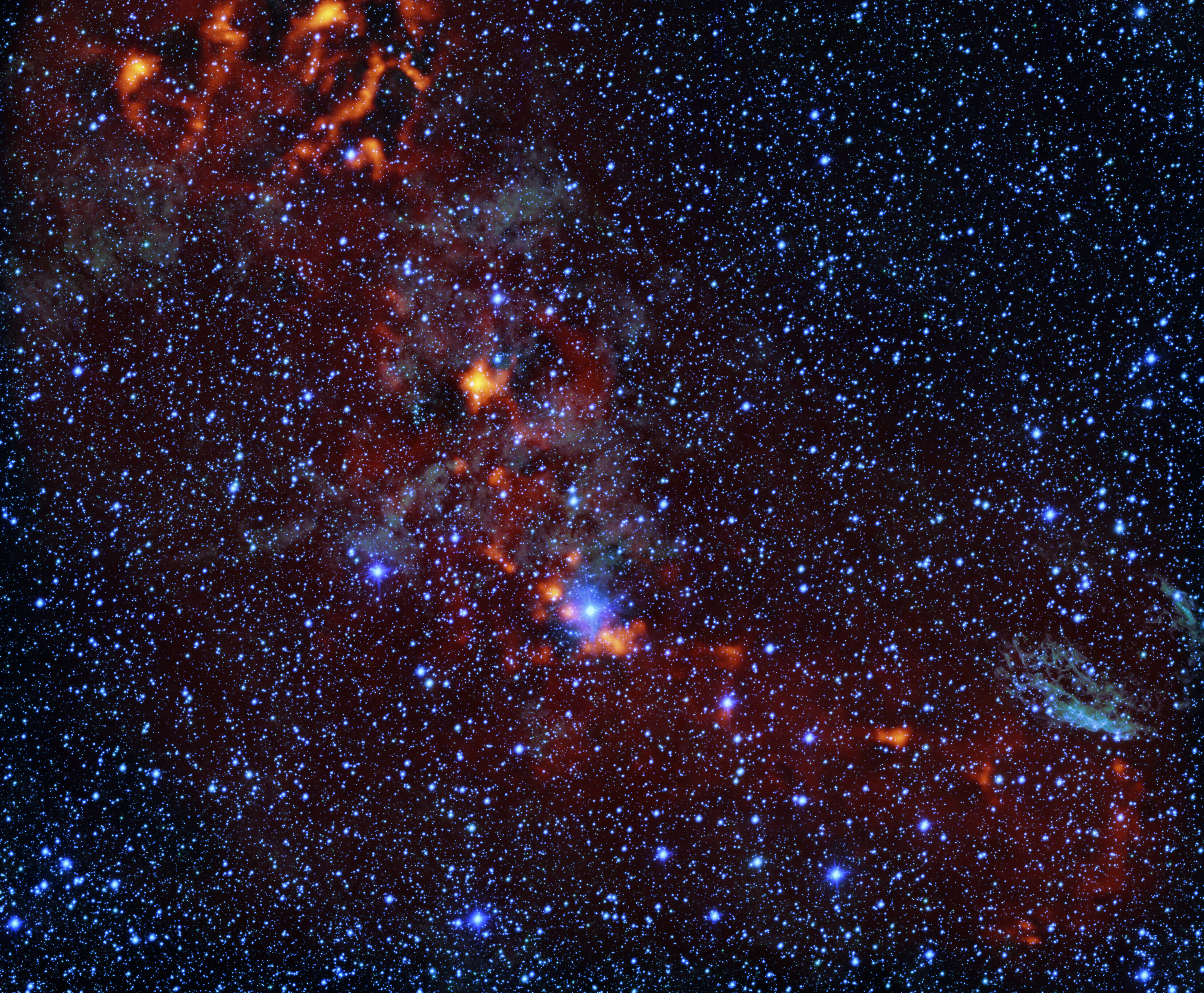
The glowing red clouds seen in this picture show dense gas regions where new stars are being born in the RCW 106 region. But only 1% of this gas will actually go on to create stars, and astronomers don’t know why this percentage is so low.
We do know that star formation takes place when regions of these huge clouds of cold gas are able to clump together and eventually collapse into newborn stars, which happens at a critical density. But once we go past that density, do even denser regions produce even more stars, and could this help to explain the 1% mystery?
New results from the Atacama Pathfinder Experiment (APEX), accepted for publication in Astronomy & Astrophysics, suggest this is not the case: denser regions are not more efficient at forming stars. This is perhaps explained by the way these denser clouds fragment into filamentary structures and cores out of which stars will form, but leaves many questions still to be answered. This Picture of the Week highlights these areas of interest. The image imposes a red map of dense gas, imaged with the ArTéMiS camera at APEX, over an optical image taken with the VLT Survey Telescope.
While APEX continues to investigate this stellar mystery, we can expect to see many more stunning images like this.
Image Credit: ESO/M. Mattern et al.
Image enhancement: Jean-Baptiste Faure

Friday, May 6, 2011

The Crescents of Neptune and Triton as imaged by Voyager 2

The Crescents of Neptune and Triton as imaged by Voyager 2
Click on the image to enlarge

This dramatic view of the crescents of Neptune and Triton was acquired by Voyager 2 approximately 3 days, 6 and one-half hours after its closest approach to Neptune (north is to the right). The spacecraft is now plunging southward at an angle of 48 degrees to the plane of the ecliptic. This direction, combined with the current season of southern summer in the Neptune system, gives this picture its unique geometry. The spacecraft was at a distance of 4.86 million kilometers (3 million miles) from Neptune when these images were shuttered so the smallest detail discernible is approximately 90 kilometers (56 miles). Color was produced using images taken through the narrow-angle camera's clear, orange and green filters. Neptune does not appear as blue from this viewpoint because the forward scattering nature of its atmosphere is more important than its absorption of red light at this high phase angle (134 degrees).
Credit: NASA/JPL

Tuesday, May 3, 2011

Awesome image of Neptune taken by the Voyager 2 Spacecraft

Awesome image of Uranus taken by the Voyager 2 Spacecraft
Click on the image for full resolution

This awesome picture of Neptune was produced from the last whole planet images taken through the green and orange filters on the Voyager 2 narrow angle camera. The images were taken at a range of 4.4 million miles from the planet, 4 days and 20 hours before closest approach. The picture shows the Great Dark Spot and its companion bright smudge; on the west limb the fast moving bright feature called Scooter and the little dark spot are visible. These clouds were seen to persist for as long as Voyager's cameras could resolve them. North of these, a bright cloud band similar to the south polar streak may be seen.
Oceans of liquid diamond, filled with solid diamond icebergs, could be floating on Neptune, according to a new report. The pressure kept dropping, but the temperature of the diamond remained the same, with more and more chunks of diamond forming. Then the diamond did something unexpected. The chunks of diamond didn't sink. They floated. Microscopic diamond ice burgs floating in a tiny sea of liquid diamond. The diamond was behaving like water. With most materials, the solid state is more dense than the liquid state. Water is an exception to that rule; when water freezes, the resulting ice is actually less dense than the surrounding water, which is why the ice floats and fish can survive a freezing winter. An ocean of diamond could help explain the orientation of the planet's magnetic field as well.
Up to 10% of Neptune is estimated to be made from carbon. A huge ocean of liquid diamond in the right place could deflect or tilt the magnetic field out of alignment with the rotation of the planet. The idea that there are oceans of liquid diamond inside Neptune is not a new idea, says Professor Tom Duffy, a planetary scientist at Princeton University. More research on the composition of Neptune is needed before a truly definitive conclusion can be made, however, and this kind of research is very difficult to conduct. Scientists can either send spacecraft to these planets, or they can try to simulate these conditions on Earth. Both options require years of preparation, expensive equipment, and are subject to some of the toughest environments in the universe.
Credit: NASA/JPL