Showing posts with label Apollo Missions. Show all posts

Saturday, July 21, 2012

Apollo 11 - Earthrise over the Moon

Apollo 11 - Earthrise over the Moon
Click on the image for full resolution (2.73 MB)

Earthrise over the Moon taken by the Apollo 11 crew.
The full resolution image weighs 2.73 MB, so please be patient when downloading!
Credit: NASA-Johnson Space Center
Image enhancement: Jean-Baptiste Faure

Monday, February 7, 2011

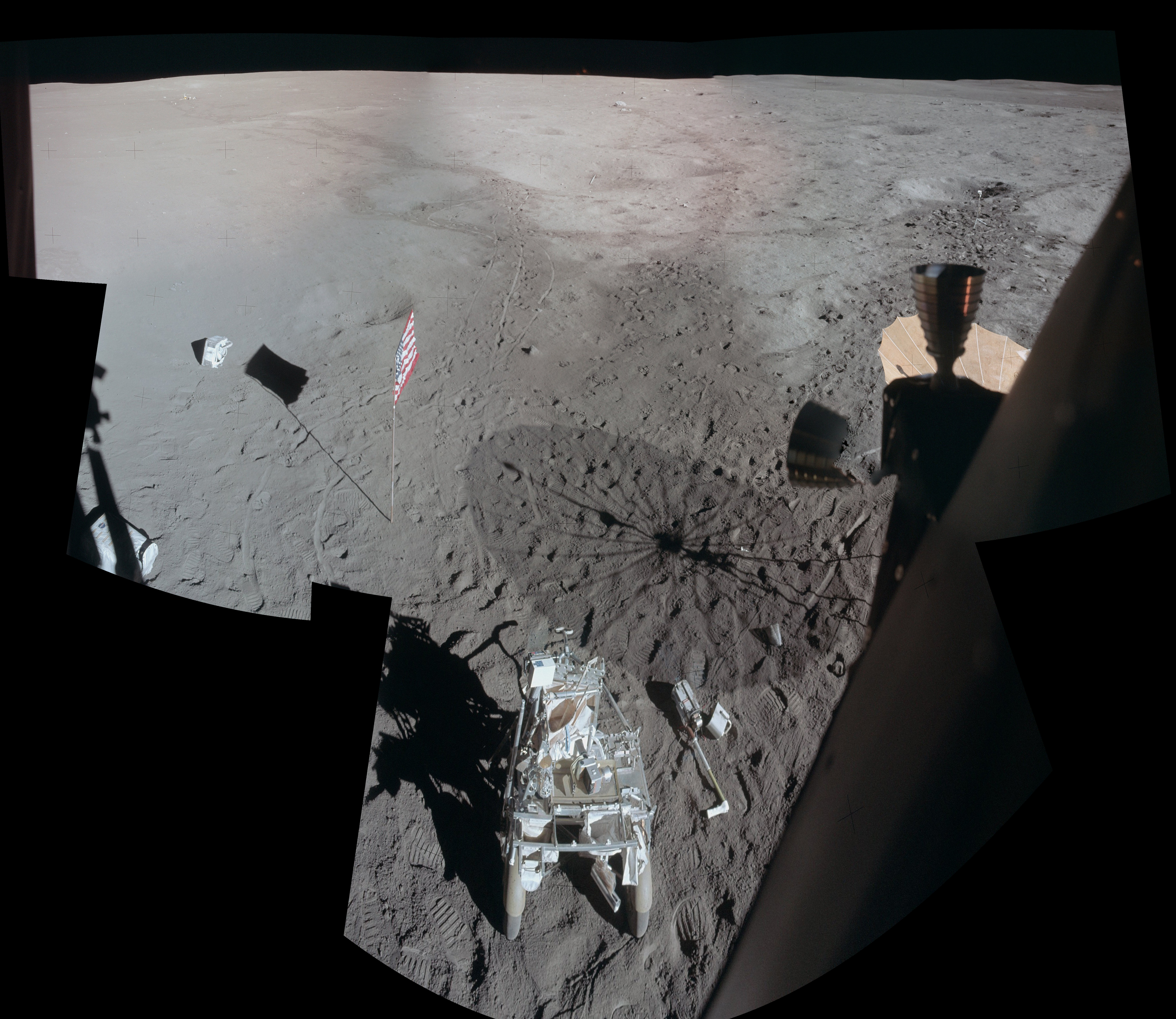
Apollo 14: astronaut Ed Mitchell's view from Lunar Module Antares

Apollo 14: astronaut Ed Mitchell's view from Lunar Module Antares
Click on the image for full resolution (4.5 MB)

Forty years ago, while looking out the window of Apollo 14's Lunar Module Antares, astronaut Ed Mitchell snapped a series of photos of the lunar surface, assembled into this detailed mosaic by Apollo Lunar Surface Journal editor Eric Jones. The view looks across the Fra Mauro highlands to the northwest of the landing site after the Apollo 14 astronauts had completed their second and final walk on the Moon. Prominent in the foreground is their Modular Equipment Transporter (MET), a two-wheeled, rickshaw-like device used to carry tools and samples. Near the horizon at top center is a 1.5 meter wide boulder dubbed Turtle rock. In the shallow crater below Turtle rock is the long white handle of a sampling instrument, thrown there javelin-style by Mitchell. Mitchell's fellow moonwalker and first American in space, Alan Shepard, also used a makeshift six iron to hit two golf balls. One of Shepard's golf balls is just visible as a white spot below Mitchell's javelin.
The full resolution image weighs 4.5 MB, so please be patient when downloading!
Credit: Edgar Mitchell, Apollo 14, NASA; Mosaic - Eric M. Jones

Wednesday, February 2, 2011

The Apollo 14 Lunar Module on the Moon's Fra Mauro Highlands

The Apollo 14 Lunar Module on the Moon's Fra Mauro Highlands
Click on the image to enlarge

This view of Antares, the Apollo 14 Lunar Module as it sat on the Moon's Fra Mauro Highlands, reflects a circular flare caused by the brilliant sun. The unusual ball of light was said by the astronauts to have a jewel-like appearance. At extreme left, the lower slope of Cone Crater can be seen.
Credit: NASA
Image restoration: Jean-Baptiste Faure

Friday, December 24, 2010

Apollo 8, the First Manned Mission to the Moon - Dec. 24, 1968

Apollo 8, the First Manned Mission to the Moon, Dec. 24, 1968
Click on the image to enlarge

Apollo 8, the first manned mission to the moon, entered lunar orbit on Christmas Eve, Dec. 24, 1968. That evening, the astronauts - Commander Frank Borman, Command Module Pilot Jim Lovell, and Lunar Module Pilot William Anders - held a live broadcast from lunar orbit, in which they showed pictures of the Earth and moon as seen from their spacecraft. Said Lovell, "The vast loneliness is awe-inspiring and it makes you realize just what you have back there on Earth." They ended the broadcast with the crew taking turns reading from the book of Genesis.
Credit: NASA
Image restoration: Jean-Baptiste Faure

Wednesday, December 15, 2010

The first Saturn V rocket on launch pad 39A

The first Saturn V rocket on launch pad 39A
Click on the image to enlarge

Early morning photo on November 9, 1967 of launch pad 39A, Kennedy Space Center, showing Saturn V (SA-501) for the Apollo 4 mission (Spacecraft 017) prior to launch later that day. This was the first test launch of the Saturn V rocket. On May 25, 1961, U.S. president John Kennedy announced the goal of landing Americans on the Moon by the end of the decade. Kennedy's ambitious speech triggered a nearly unprecedented peacetime technological mobilization and one result was the Saturn V moon rocket. Its development directed by rocket pioneer Wernher Von Braun, the three stage Saturn V stood over 36 stories tall. It had a cluster of five first stage engines fueled by liquid oxygen and kerosene which together were capable of producing 7.5 million pounds of thrust. Giant Saturn V rockets ultimately hurled nine Apollo missions to the Moon and back again with six landing on the lunar surface. The first landing, by Apollo 11, occurred on July 20, 1969 achieving Kennedy's goal. Boeing, McDonnell Douglas and North American Aviation collaborated to develop and produce the mammoth 363-foot Saturn V rocket. All 15 S-1Cs were built between 1965 and 1975. Twelve were used on the Apollo missions, and the 13th, in 1973, placed Skylab in Earth orbit. The remaining rockets were placed on display.
Credit: Boeing
Image restoration: Jean-Baptiste Faure