Showing posts with label Lenticular Galaxies. Show all posts

Sunday, July 12, 2026

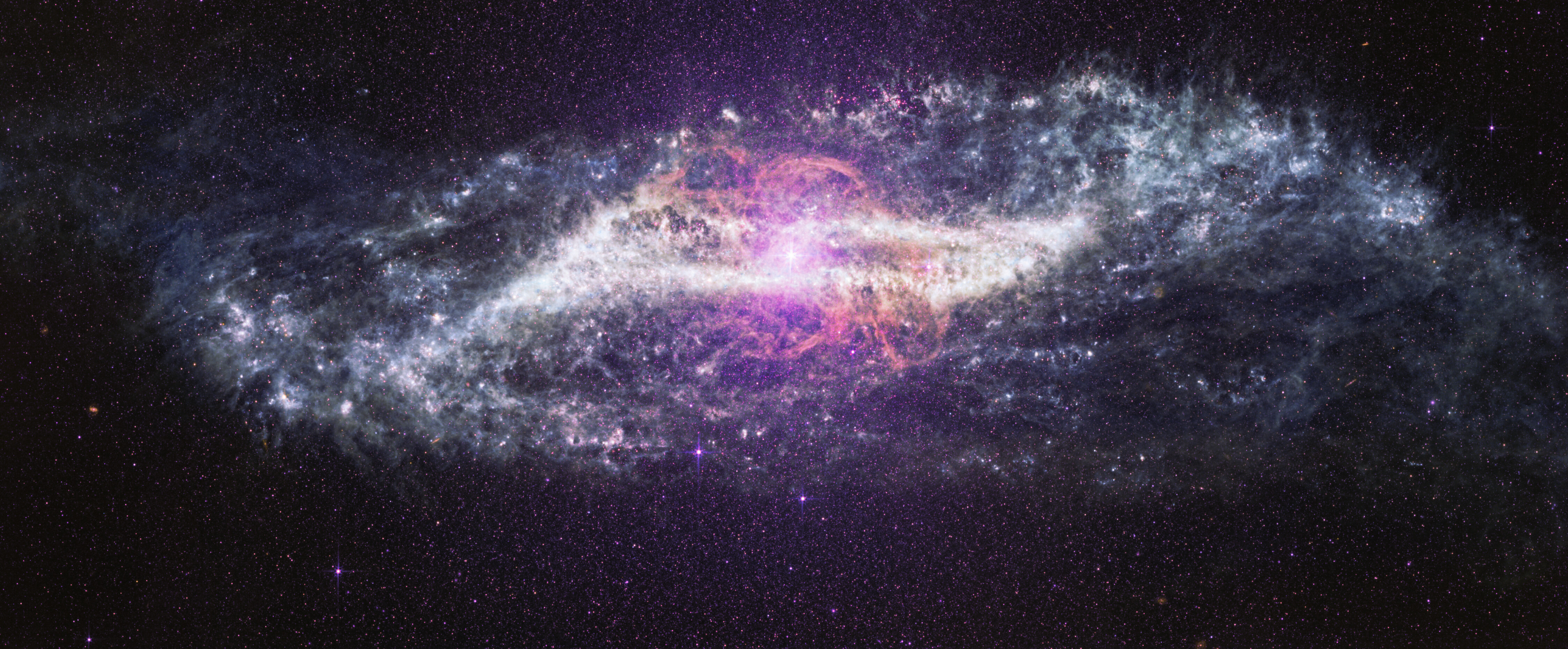
Galaxy Centaurus A as seen by Webb

Galaxy Centaurus A as seen by Webb
Click the image for higher resolution (2.6 MB)

The James Webb Space Telescope's Mid-Infrared Instrument (MIRI) reveals the nearby galaxy Centaurus A, exposing the dusty structures and hidden activity that shape this unusual system. Webb's infrared vision pierces thick lanes of dust that obscure much of the galaxy in visible light, unveiling intricate filaments, loops, and glowing clouds of warm dust stretching across its center. At the heart of the galaxy, an actively feeding supermassive black hole shines brightly, surrounded by complex structures sculpted by a past galactic collision and ongoing activity.
This image of the galaxy Centaurus A stretches across a black background filled with thousands of tiny purple, pink, and white points of light. The galaxy is brightest at its center, where a brilliant white and pale pink glow radiates outward. Eight diffraction spikes extend from the central glow. Delicate loops and wispy ribbons of pink and lavender arc above and below the center of the image in the shape of an "S". A band of gray and white dust in the shape of a parallelogram cuts across the middle of the galaxy. Mottled patches and bright knots are scattered throughout the dusty band. The galaxy's outer edges fade into soft, cloud-like plumes with feathery textures that stretch toward the left and right sides of the image. Against the surrounding darkness, a few bright foreground stars shine with Webb's distinctive diffraction spikes, while countless fainter stars create a speckled backdrop.
Image Credit: NASA, ESA, CSA, STScI
Image Processing: A. Pagan (STScI), J. Depasquale (STScI), M. Garcia Marin (ESA Office at STScI)
Image enhancement: Jean-Baptiste Faure

Sunday, March 29, 2026

Lenticular Galaxy NGC 7722

Lenticular Galaxy NGC 7722
Click the image for higher resolution (2.5 MB)

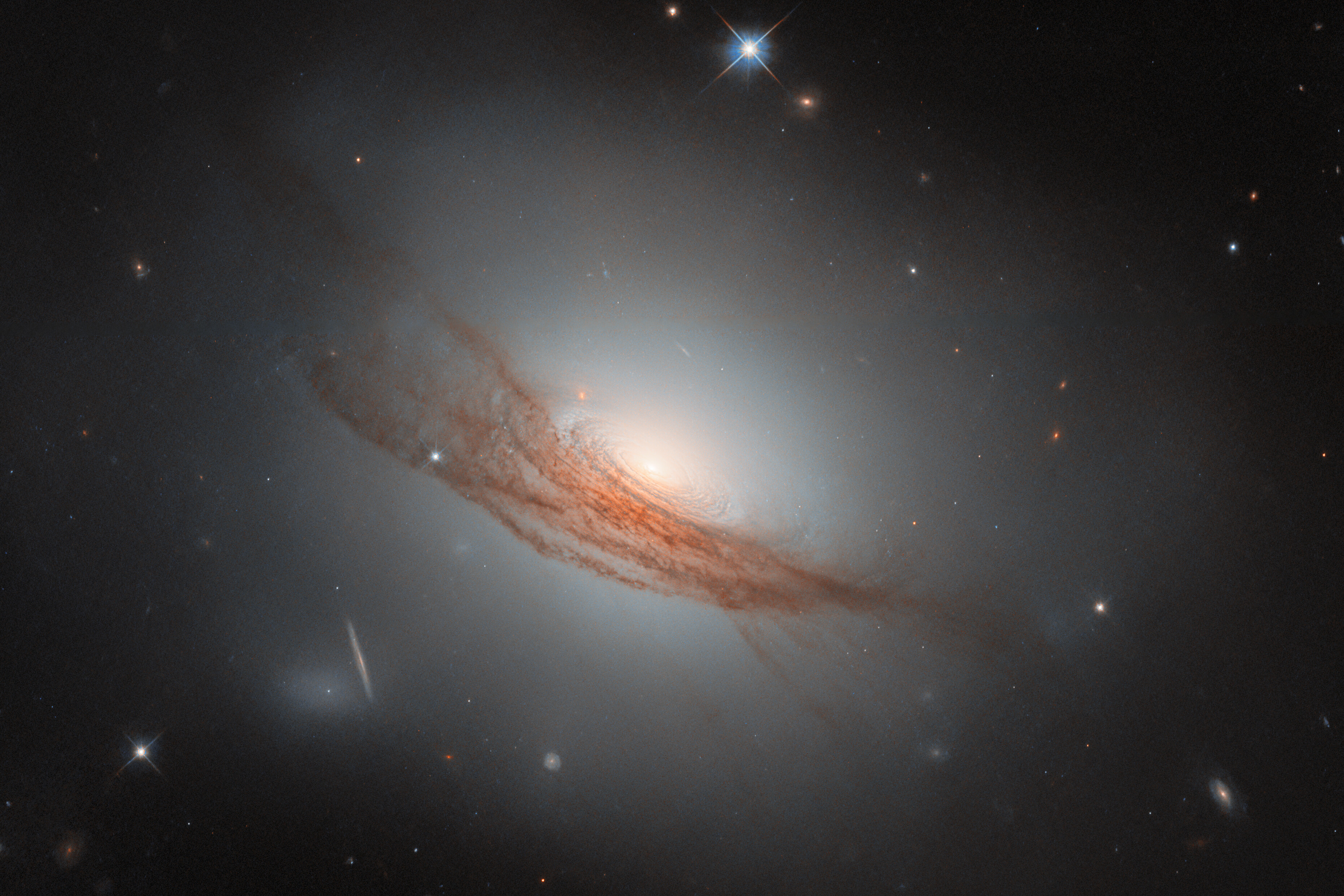
For this picture from the Hubble Space Telescope, we have a sight of an uncommon galaxy with a striking appearance. This is NGC 7722, a lenticular galaxy located about 187 million light-years away in the constellation Pegasus.
A "lenticular", meaning "lens-shaped", galaxy is a type that sits in between the more familiar spiral galaxies and elliptical galaxies. It is also less common than these – partly because when a galaxy has an ambiguous appearance, it can be hard to determine if it is actually a spiral, actually an elliptical galaxy, or something in between. Many of the known lenticular galaxies sport features of both spiral and elliptical galaxies. In this case, NGC 7722 lacks the defined arms of a spiral galaxy, while it has an extended, glowing halo and a bright bulge in the center similar to an elliptical galaxy. Unlike elliptical galaxies, it has a visible disc – concentric rings swirl around its bright nucleus. Its most prominent feature, however, is undoubtedly the long lanes of dark red dust coiling around the outer disc and halo.
This new Hubble image, the sharpest yet taken of NGC 7722, brings the impressive dust lanes into sharp focus. Bands of dust like this are not uncommon in lenticular galaxies, and they stand out against the broad, smooth halo of light that typically surrounds lenticular galaxies. The distinctive dust lanes of NGC 7722 are thought to result from a merger with another galaxy in the past, similar to other lenticular galaxies. It is not yet fully understood how lenticular galaxies form, but mergers and other gravitational interactions are thought to play an important part, reshaping galaxies and exhausting their supplies of gas while bringing new dust.
While it doesn't host as many new, young stars as a spiral galaxy, there's still activity in NGC 7722: in 2020 it was host to the explosion of a star that could be detected from Earth. SN 2020SSF was a Type Ia supernova, an event which occurs when a white dwarf star in a binary system siphons enough mass away from its companion star that it grows unstable and explodes. These explosions output a remarkably consistent level of light: by measuring how bright they appear from Earth and comparing against how bright they really are, it's possible to tell how far away they must be. Type Ia supernovae are one of the best ways to measure distances to galaxies, so understanding exactly how they work is of great importance to astronomers.
Taken with Hubble's Wide Field Camera 3, this Hubble image was obtained as part of an observing programme (#16691, PI: R. J. Foley) that followed up on recent supernovae. SN 2020SSF is not visible in this image, as it was actually taken two years later, when the supernova had long faded. This was on purpose: the aim of the observations was to witness the aftereffects of the supernova and examine its surroundings, which can only be done once the intense light of the explosion is gone. With Hubble's clear vision, astronomers can search for radioactive material created by the supernova, catalogue its neighbours to see how old the star likely was, and look for the companion star it left behind – all from almost 200 million light-years away.
Image Credit: ESA/Hubble and NASA, R. J. Foley (UC Santa Cruz), Dark Energy Survey/DOE/FNAL/DECam/CTIO/NOIRLab/NSF/AURA
Acknowledgement: Mehmet Yüksek
Image enhancement: Jean-Baptiste Faure
Sunday, March 1, 2026

Barred Spiral Lenticular Galaxy NGC 1269

Barred Spiral Lenticular Galaxy NGC 1269
Click the image for higher resolution (13.2 MB)

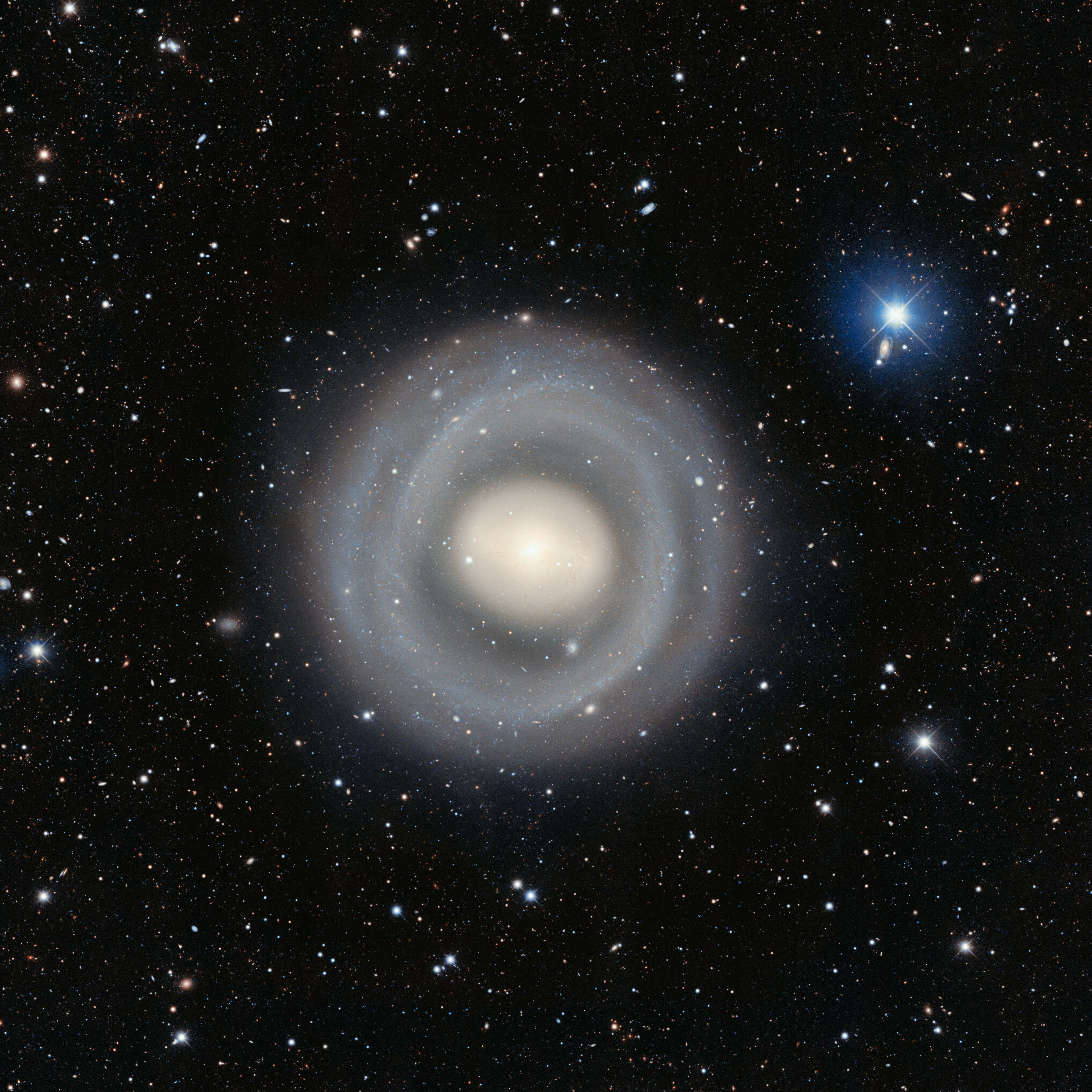
This image of NGC 1269 was taken utilizing the Department of Energy-fabricated Dark Energy Camera (DECam), which is mounted on the U.S. National Science Foundation Víctor M. Blanco 4-meter Telescope at NSF Cerro Tololo Inter-American Observatory, a Program of NSF NOIRLab.
NGC 1269 is an early-type spiral galaxy located about 33 million light-years from Earth in the constellation Eridanus. A bar, a feature common to many spiral galaxies, slices through the center of the galaxy. Surrounding the galactic core are both inner and outer disks, seeming to form "wheels" around the core. Their presence is thought to be the result of a merger with another galaxy, and the inner disk is also believed to have been further shaped by density waves radiating outward from the galactic center.
Data for this image came from the archive of the Dark Energy Survey (DES), operated by the DOE and NSF between 2013 and 2019 with the specially-designed DECam. The survey sought to study the nature of the elusive dark matter by imaging hundreds of millions of galaxies. Today, the DECam is available to other scientists for use on the Blanco telescope.
Image Credit: Dark Energy Survey/DOE/FNAL/DECam/CTIO/NOIRLab/NSF/AURA
Image processing: R. Colombari & M. Zamani (NSF NOIRLab)
Image enhancement: Jean-Baptiste Faure

Monday, April 15, 2024

Peculiar Lenticular Galaxy NGC 2685

Peculiar Lenticular Galaxy NGC 2685
Click the image for higher resolution

The very unusual galaxy NGC 2685, also known as the Helix Galaxy, is located about 40 million light-years away in the constellation Ursa Major. This image was captured by the Gemini North telescope, one half of the International Gemini Observatory, operated by NSF NOIRLab which is funded by the U.S. National Science Foundation.
NGC 2685 is a peculiar lenticular galaxy known as a polar ring galaxy. A ring of gas, stars, and dust orbits NGC 2685 perpendicular to the flat plane of the host galaxy. This odd crossing of planes is believed to be evidence of galaxy interactions, mergers, or tidal accretion events. Current research suggests that the present structure of NGC 2685 was formed when it captured material from another galaxy, which was strung out into an encircling ring.
This galaxy is one of our closest known polar ring galaxies and is therefore one of the easiest of its kind to study. Owing to its odd characteristics, it has been called the most unusual galaxy in the Shapley-Ames Catalog of Bright Galaxies and appears as number 336 in astronomer Halton Arp's Atlas of Peculiar Galaxies.
Image Credit: International Gemini Observatory/NOIRLab/NSF/AURA/L. Bassino
Image processing: J. Miller (Gemini Observatory/NSF's NOIRLab), M. Rodriguez (Gemini Observatory/NSF's NOIRLab), and M. Zamani (NSF's NOIRLab)
Image enhancement: Jean-Baptiste Faure
Tuesday, August 2, 2022

The Cartwheel Galaxy as seen by Webb

The Cartwheel Galaxy as seen by Webb
Click the image for higher resolution (5.5 MB)

This image of the Cartwheel and its companion galaxies is a composite from Webb's Near-Infrared Camera (NIRCam) and Mid-Infrared Instrument (MIRI), which reveals details that are difficult to see in the individual images alone.
This galaxy formed as the result of a high-speed collision that occurred about 400 million years ago. The Cartwheel is composed of two rings, a bright inner ring and a colourful outer ring. Both rings expand outward from the centre of the collision like shockwaves.
However, despite the impact, much of the character of the large, spiral galaxy that existed before the collision remains, including its rotating arms. This leads to the “spokes” that inspired the name of the Cartwheel Galaxy, which are the bright red streaks seen between the inner and outer rings. These brilliant red hues, located not only throughout the Cartwheel, but also the companion spiral galaxy at the top left, are caused by glowing, hydrocarbon-rich dust.
In this near- and mid-infrared composite image, MIRI data are coloured red while NIRCam data are coloured blue, orange, and yellow. Amidst the red swirls of dust, there are many individual blue dots, which represent individual stars or pockets of star formation. NIRCam also defines the difference between the older star populations and dense dust in the core and the younger star populations outside of it.
Webb's observations capture Cartwheel in a very transitory stage. The form that the Cartwheel Galaxy will eventually take, given these two competing forces, is still a mystery. However, this snapshot provides perspective on what happened to the galaxy in the past and what it will do in the future.
Image Credit: NASA, ESA, CSA, STScI
Image enhancement: Jean-Baptiste Faure

Tuesday, June 22, 2021

Intermediate Spiral Galaxy NGC 4680

Intermediate Spiral Galaxy NGC 4680
Click on the image for higher resolution (2.3 MB)

This image, taken with Hubble's Wide Field Camera 3 (WFC3), features the intermediate spiral galaxy NGC 4680. At 2 o'clock and 7 o'clock two other galaxies can be seen flanking NGC 4680. NGC 4680 enjoyed a wave of attention in 1997, as it played host to a supernova explosion known as SN 1997bp. Amazingly, the supernova was identified by an Australian amateur astronomer named Robert Evans, who has identified an extraordinary 42 supernova explosions.
NGC 4680 is actually a rather tricky galaxy to classify. It is sometimes referred to as a spiral galaxy, but it is also sometimes classified as a lenticular galaxy. Lenticular galaxies fall somewhere in between spiral galaxies and elliptical galaxies. Whilst NGC 4680 does have distinguishable spiral arms, they are not clearly defined, and the tip of one arm appears very diffuse. Galaxies are not static, and their morphologies (and therefore their classifications) vary throughout their lifetimes. Spiral galaxies are thought to evolve into elliptical galaxies, most likely by merging with one another, causing them to lose their distinctive spiral structures.
Image Credit: ESA/Hubble and NASA, A. Riess et al.
Image enhancement: Jean-Baptiste Faure
Tuesday, December 22, 2020

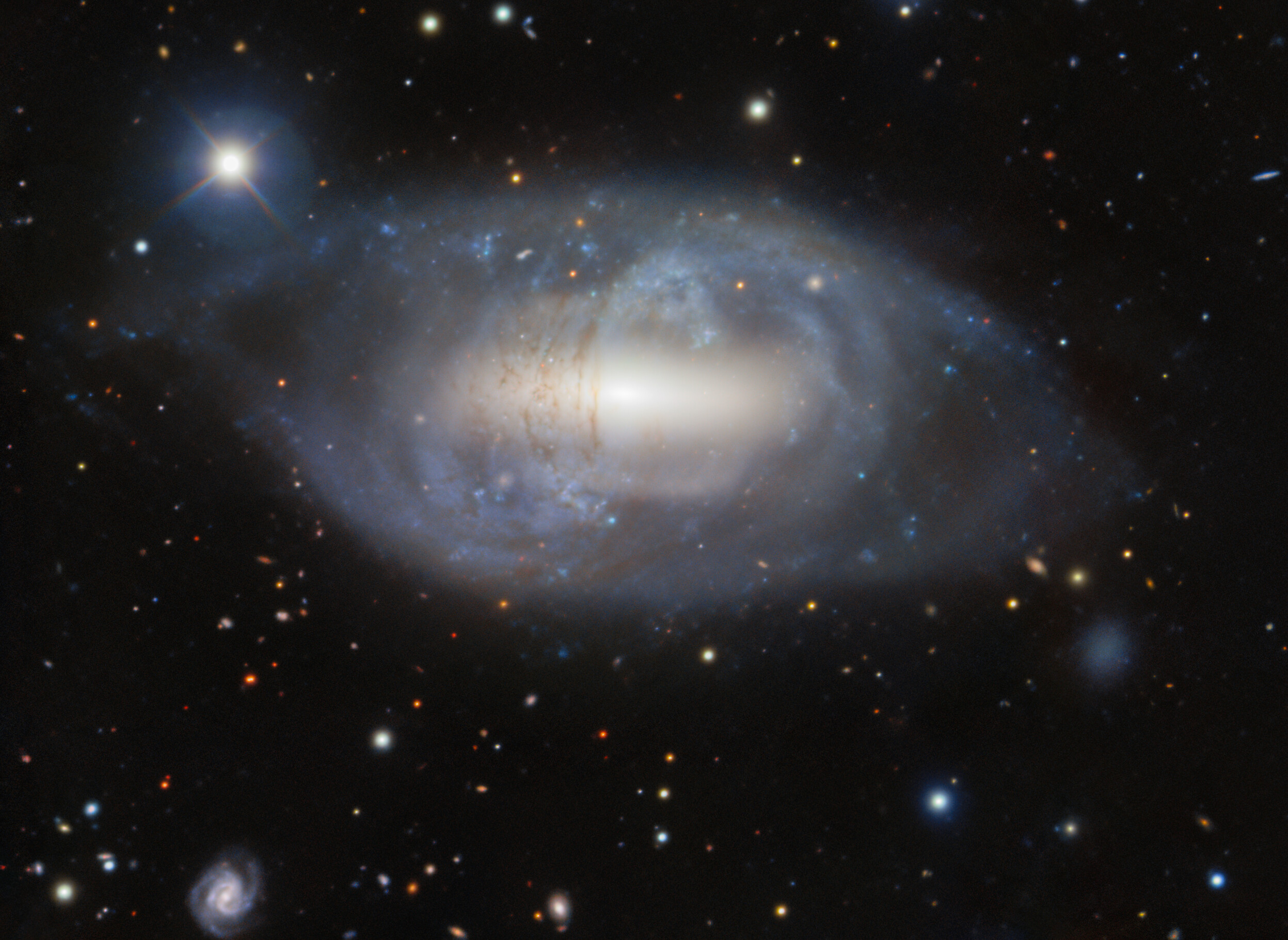
Unusual Lenticular Galaxy NGC 1947

Unusual Lenticular Galaxy NGC 1947
Click on the image for higher resolution (1.9 MB)

This unusual lenticular galaxy, known as NGC 1947, has lost almost all the gas and dust from its signature spiral arms, which used to orbit around its center. Discovered almost 200 years ago by James Dunlop, a Scottish-born astronomer who later studied the sky from Australia, NGC 1947 can only be seen from the southern hemisphere, in the constellation Dorado (The Dolphinfish).
Residing around 40 million light-years away from Earth, this galaxy shows off its structure by backlighting its remaining faint gas and dust disc with millions of stars. In this picture, taken with the Hubble Space Telescope, the faint remnants of the galaxy's spiral arms can still be made out in the stretched thin threads of dark gas encircling it. Without most of its star-forming material, it is unlikely that many new stars will be born within NGC 1947, leaving this galaxy to continue fading with time.
Image Credit: ESA/Hubble and NASA, D. Rosario
Acknowledgement: L. Shatz
Image enhancement: Jean-Baptiste Faure

Monday, November 25, 2019

Ring Galaxy ESO 350-40: the Cartwheel Galaxy

Ring Galaxy ESO 350-40: the Cartwheel Galaxy
Click on the image for higher resolution

This image of the Cartwheel Galaxy was taken with the Hubble Space Telescope. It was reprocessed using the latest techniques. The object was first spotted on wide-field images from the UK Schmidt telescope and then studied in detail using the Anglo-Australian Telescope.
Lying about 500 million light-years away in the constellation of Sculptor, the cartwheel shape of this galaxy is the result of a violent galactic collision. A smaller galaxy has passed right through a large disc galaxy and produced shock waves that swept up gas and dust – much like the ripples produced when a stone is dropped into a lake – and sparked regions of intense star formation (appearing blue). The outermost ring of the galaxy, which is 1.5 times the size of our Milky Way, marks the shock wave's leading edge. ESO 350-40 has a mass of about 2.9–4.8 × 10^9 solar masses; its outer ring has a circular velocity of 217 km/s. This object is one of the most dramatic examples of the small class of ring galaxies.
This image was produced after Hubble data was reprocessed using the free open source software FITS Liberator 3, which was developed at the ST-ECF. Careful use of this widely used state-of-the-art tool on the original Hubble observations of the Cartwheel Galaxy has brought out more detail in the image than ever before.
Image Credit: ESA/Hubble and NASA
Image enhancement: Jean-Baptiste Faure

Wednesday, November 6, 2019

Ring Galaxy AM 0644-741

Ring Galaxy AM 0644-741
Click on the image for higher resolution (3.4 MB)

Resembling a diamond-encrusted bracelet, a ring of brilliant blue star clusters wraps around the yellowish nucleus of AM 0644-741 in this image from the Hubble Space Telescope (HST). The sparkling blue ring is 150,000 light-years in diameter, making it larger than our entire home galaxy, the Milky Way. AM 0644-741, also known as the Lindsay-Shapley Ring, is an unbarred lenticular galaxy, and a "ring galaxy", which is 300 million light-years away in the direction of the southern constellation Dorado.
The ring is theorized to have formed by a collision with another galaxy, which triggered a gravitational disruption that caused dust in the galaxy to condense and form stars, which forced it to then expand away from the galaxy and create a ring. The ring is a region of rampant star formation dominated by young, massive, hot blue stars. The pink regions along the ring are rarefied clouds of glowing hydrogen gas that is fluorescing as it is bombarded with strong ultraviolet light from the blue stars. Galactic simulation models suggest that the ring of AM 0644-741 will continue to expand for about another 300 million years, after which it will begin to disintegrate.
Image Credit: NASA, ESA, and The Hubble Heritage Team (AURA/STScI)
Image enhancement: Jean-Baptiste Faure

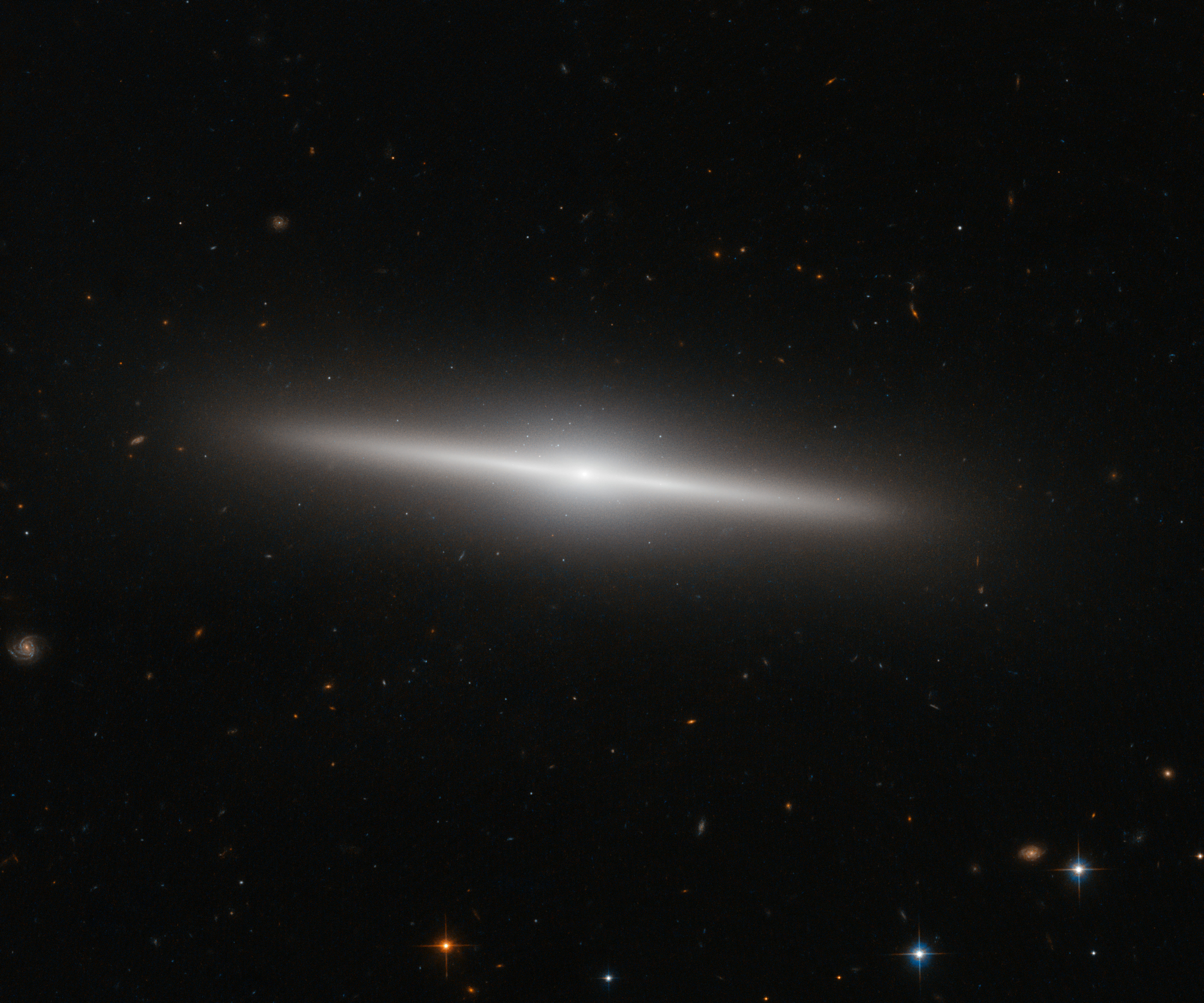
Friday, April 26, 2019

Edge-On Spiral Galaxy NGC 1032

Edge-On Spiral Galaxy NGC 1032
Click on the image for higher resolution (2.3 MB)

Resembling a wizard's staff set aglow, NGC 1032 cleaves the quiet darkness of space in two in this image from the Hubble Space Telescope. NGC 1032 is located about a hundred million light years away in the constellation Cetus (The Sea Monster). Although beautiful, this image perhaps does not do justice to the galaxy's true aesthetic appeal: NGC 1032 is actually a spectacular spiral galaxy, but from Earth, the galaxy's vast disc of gas, dust and stars is seen nearly edge-on.
A handful of other galaxies can be seen lurking in the background, scattered around the narrow stripe of NGC 1032. Many are oriented face-on or at tilted angles, showing off their glamorous spiral arms and bright cores. Such orientations provide a wealth of detail about the arms and their nuclei, but fully understanding a galaxy's three-dimensional structure also requires an edge-on view. This gives astronomers an overall idea of how stars are distributed throughout the galaxy and allows them to measure the "height" of the disc and the bright star-studded core.
Image Credit: ESA/Hubble and NASA
Image enhancement: Jean-Baptiste Faure

Monday, September 12, 2016

Lenticular Galaxy PGC 83677

Lenticular Galaxy PGC 83677
Click on the image for higher resolution (3.4 MB)

A lone source shines out brightly from the dark expanse of deep space, glowing softly against a picturesque backdrop of distant stars and colourful galaxies. Captured by the Hubble Space Telescope's Advanced Camera for Surveys (ACS), this scene shows PGC 83677, a lenticular galaxy – a galaxy type that sits between the more familiar elliptical and spiral varieties in the Hubble sequence. This image was obtained as part of the Coma Cluster Survey. It reveals both the relatively calm outskirts and intriguing core of PGC 83677. Here, studies have uncovered signs of a monstrous black hole that is spewing out high-energy X-rays and ultraviolet light.
Image Credit: ESA/Hubble and NASA
Acknowledgements: Judy Schmidt (Geckzilla)
Image enhancement: Jean-Baptiste Faure

Thursday, July 16, 2015

Lenticular Galaxy ESO 381-12

Lenticular Galaxy ESO 381-12
Click on the image for full resolution (7.0 MB)

The ghostly shells of galaxy ESO 381-12 are captured here in a new image from the Hubble Space Telescope, set against a backdrop of distant galaxies. The strikingly uneven structure and the clusters of stars that orbit around the galaxy suggest that ESO 381-12 may have been part of a dramatic collision sometime in its relatively recent past. Located roughly 270 million light-years from Earth in the constellation of Centaurus (The Centaur), a bright constellation in the southern sky, ESO 381-12, also known as PGC 42871, is categorised as a lenticular galaxy – a hybrid galaxy type that shares properties with both spiral galaxies and elliptical galaxies. The delicate shells that bloom outwards from ESO 381-12 are very rarely found around this type of galaxy and their cause is a bit of a cosmic mystery. It is thought that PGC 42871 may have recently interacted with another galaxy, sending shock waves through its structure much like ripples in a pond. These galactic mergers are violent processes, smashing together material within the clashing galaxies and completely changing how they look and how they will evolve in the future. This violent event likely triggered a wave of star formation throughout the galaxy, leading to the creation of many hot young stars. Astronomers have studied ESO 381-12 in detail because of its very unusual structure. It was one of a sample of galaxies explored by Hubble's Advanced Camera for Surveys during a recent study of the properties of shell galaxies created in merger events a billion or so years ago. The prominent galaxy at the right of the frame, known as ESO 381-13 or PGC 42877, is a different beast altogether and both active star formation and dust can be seen within it. However, ESO 381-13 and the shell galaxy are at very similar distances from Earth and, despite their differences, may well be interacting.
Image Credit: NASA, ESA, P. Goudfrooij (STScI)
Image enhancement: Jean-Baptiste Faure

Saturday, January 31, 2015

Ringed Lenticular Galaxy Arp 230

Ringed Lenticular Galaxy Arp 230
Click on the image for full resolution

This image shows Arp 230, also known as IC 51, observed by the Hubble Space Telescope. Arp 230 is a galaxy of an uncommon or peculiar shape, and is therefore part of the Atlas of Peculiar Galaxies produced by Halton Arp. Its irregular shape is thought to be the result of a violent collision with another galaxy sometime in the past. The collision could also be held responsible for the formation of the galaxy's polar ring. The outer ring surrounding the galaxy consists of gas and stars and rotates over the poles of the galaxy. It is thought that the orbit of the smaller of the two galaxies that created Arp 230 was perpendicular to the disc of the second, larger galaxy when they collided. In the process of merging the smaller galaxy would have been ripped apart and may have formed the polar ring structure astronomers can observe today. Arp 230 is quite small for a lenticular galaxy, so the two original galaxies forming it must both have been smaller than the Milky Way. A version of this image was entered into the Hubble's Hidden Treasures image processing competition by flickr user Det58.
Image Credit: ESA/Hubble and NASA
Acknowledgement: Flickr user Det58
Image enhancement: Jean-Baptiste Faure

Sunday, January 18, 2015

Lenticular Galaxy NGC 6861

Lenticular Galaxy NGC 6861
Click on the image for full resolution

The subject of this image is NGC 6861, a galaxy discovered in 1826 by the Scottish astronomer James Dunlop. Almost two centuries later we now know that NGC 6861 is the second brightest member of a group of at least a dozen galaxies called the Telescopium Group - otherwise known as the NGC 6868 Group - in the small constellation of Telescopium (The Telescope). This Hubble Space Telescope view shows some important details of NGC 6861. One of the most prominent features is the disc of dark bands circling the centre of the galaxy. These dust lanes are a result of large clouds of dust particles obscuring the light emitted by the stars behind them. Dust lanes are very useful for working out whether we are seeing the galaxy disc edge-on, face-on or, as is the case for NGC 6861, somewhat in the middle. Dust lanes like these are typical of a spiral galaxy. The dust lanes are embedded in a white oval shape, which is made up of huge numbers of stars orbiting the centre of the galaxy. This oval is, rather puzzlingly, typical of an elliptical galaxy. So which is it - spiral or elliptical? The answer is neither! NGC 6861 does not belong to either the spiral or the elliptical family of galaxies. It is a lenticular galaxy, a family which has features of both spirals and ellipticals. The relationships between these three kinds of galaxies are not yet well understood. A lenticular galaxy could be a faded spiral that has run out of gas and lost its arms, or the result of two galaxies merging. Being part of a group increases the chances for galactic mergers, so this could be the case for NGC 6861. A version of this image was entered into the Hubble's Hidden Treasures image processing competition by contestant Josh Barrington.
Image Credit: ESA/Hubble and NASA
Acknowledgement: J. Barrington
Image enhancement: Jean-Baptiste Faure

Monday, December 22, 2014

Edge-On Lenticular Galaxy IC 335

Edge-On Lenticular Galaxy IC 335
Click on the image for higher resolution (6.0 MB)

This new Hubble Space Telescope image shows the galaxy IC 335 in front of a backdrop of distant galaxies. IC 335 is part of a galaxy group containing three other galaxies, and located in the Fornax Galaxy Cluster 60 million light-years away. As seen in this image, the disc of IC 335 appears edge-on from the vantage point of Earth. This makes it harder for astronomers to classify it, as most of the characteristics of a galaxy's morphology - the arms of a spiral or the bar across the center - are only visible on its face.
Still, the 45 000 light-year-long galaxy could be classified as an S0 type. These lenticular galaxies are an intermediate state in galaxy morphological classification schemes between true spiral and elliptical galaxies. They have a thin stellar disc and a bulge, like spiral galaxies, but in contrast to typical spiral galaxies they have used up most of the interstellar medium.
Only a few new stars can be created out of the material that is left and the star formation rate is very low. Hence, the population of stars in S0 galaxies consists mainly of aging stars, very similar to the star population in elliptical galaxies. As S0 galaxies have only ill-defined spiral arms they are easily mistaken for elliptical galaxies if they are seen inclined face-on or edge-on as IC 335 here. And indeed, despite the morphological differences between S0 and elliptical class galaxies, they share a some common characteristics, like typical sizes and spectral features.
Both classes are also early-type galaxies, as they are evolving passively. However, elliptical galaxies may be passively evolving when we observe them, but they had violent interactions with other galaxies in their past. Whereas S0 galaxies are either aging and fading spiral galaxies, which never had any interactions with other galaxies, or they are the aging result of a single merger between two spiral galaxies in the past. The exact nature of these galaxies is still a matter of debate.
Image Credit: ESA/Hubble and NASA
Image enhancement: Jean-Baptiste Faure

Saturday, October 25, 2014

Lenticular Galaxy NGC 4526

Lenticular Galaxy NGC 4526
Click on the image for higher resolution (2.9 MB)

This neat little galaxy is known as NGC 4526. Its dark lanes of dust and bright diffuse glow make the galaxy appear to hang like a halo in the emptiness of space in this new image from the Hubble Space Telescope. Although this image paints a picture of serenity, the galaxy is anything but. It is one of the brightest lenticular galaxies known, a category that lies somewhere between spirals and ellipticals. It has hosted two known supernova explosions, one in 1969 and another in 1994, and is known to have a colossal supermassive black hole at its center that has the mass of 450 million Suns. NGC 4526 is part of the Virgo cluster of galaxies. Ground-based observations of galaxies in this cluster have revealed that a quarter of these galaxies seem to have rapidly rotating discs of gas at their centers. The most spectacular of these is this galaxy, NGC 4526, whose spinning disc of gas, dust, and stars reaches out uniquely far from its heart, spanning some 7% of the galaxy's entire radius. This disc is moving incredibly fast, spinning at more than 250 kilometers per second. The dynamics of this quickly whirling region were actually used to infer the mass of NGC 4526’s central black hole - a technique that had not been used before to constrain a galaxy's central black hole. This image was taken using Hubble's Wide Field Planetary Camera 2. A version of this image was entered into the Hubble's Hidden Treasures image processing competition by contestant Judy Schmidt. Hidden Treasures was an initiative to invite astronomy enthusiasts to search the Hubble archive for stunning images that have never been seen by the general public.
Image Credit: ESA/Hubble and NASA
Acknowledgement: Judy Schmidt

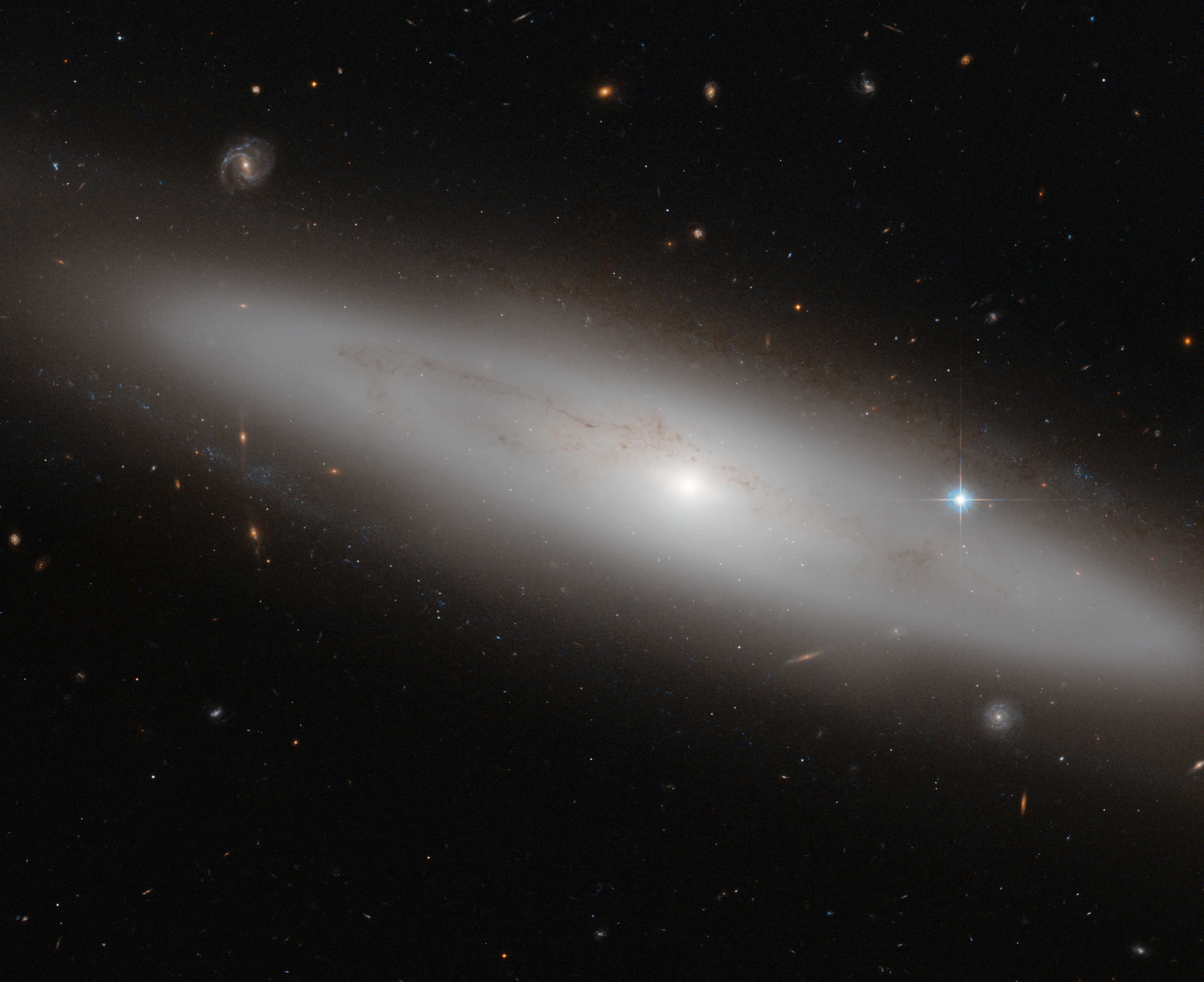
Monday, July 22, 2013

Lenticular Galaxy NGC 4866

Lenticular Galaxy NGC 4866
Click on the image for full resolution (4.5 MB)

The constellation of Virgo (The Virgin) is the largest of the Zodiac constellations, and the second largest overall after Hydra (The Water Snake). Its most appealing feature, however, is the sheer number of galaxies that lie within it. In this picture, among a crowd of face- and edge-on spiral, elliptical, and irregular galaxies, lies NGC 4866, a lenticular galaxy situated about 80 million light-years from Earth. Lenticular galaxies are somewhere between spirals and ellipticals in terms of shape and properties. From the picture, we can appreciate the bright central bulge of NGC 4886, which contains primarily old stars, but no spiral arms are visible. The galaxy is seen from Earth as almost edge-on, meaning that the disc structure - a feature not present in elliptical galaxies - is clearly visible. Faint dust lanes trace across NGC 4866 in this image, obscuring part of the galaxy's light. To the right of the galaxy is a very bright star that appears to lie within NGC 4886's halo. However, this star actually lies much closer to us; in front of the galaxy, along our line of sight. These kinds of perspective tricks are common when observing, and can initially deceive astronomers as to the true nature and position of objects such as galaxies, stars, and clusters. This sharp image of NGC 4866 was captured by the Advanced Camera for Surveys, an instrument on the NASA/ESA Hubble Space Telescope. A version was entered into the Hubble's Hidden Treasures image processing competition by contestant Gilles Chapdelaine.
The full resolution image weighs 4.5 MB, so please be patient when downloading!
Image Credit: ESA/Hubble and NASA
Acknowledgement: Gilles Chapdelaine
Image enhancement: Jean-Baptiste Faure

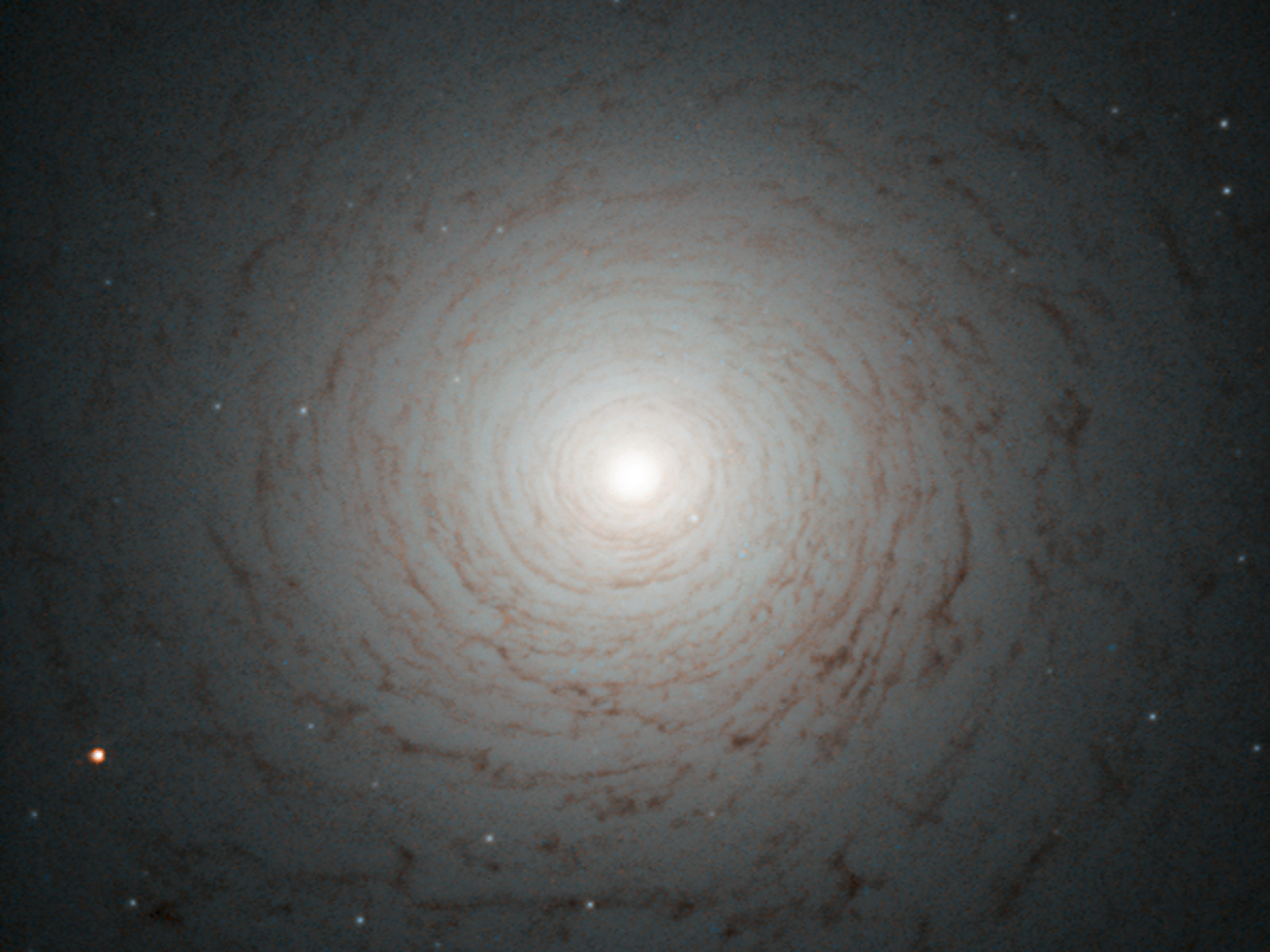
Lenticular Galaxy NGC 524

Lenticular Galaxy NGC 524
Click on the image for full resolution

This striking cosmic whirl is the center of galaxy NGC 524, as seen with the Hubble Space Telescope. This galaxy is located in the constellation of Pisces, some 90 million light-years from Earth. NGC 524 is a lenticular galaxy. Lenticular galaxies are believed to be an intermediate state in galactic evolution - they are neither elliptical nor spiral. Spirals are middle-aged galaxies with vast, pinwheeling arms that contain millions of stars. Along with these stars are large clouds of gas and dust that, when dense enough, are the nurseries where new stars are born. When all the gas is either depleted or lost into space, the arms gradually fade away and the spiral shape begins to weaken. At the end of this process, what remains is a lenticular galaxy - a bright disc full of old, red stars surrounded by what little gas and dust the galaxy has managed to cling on to. This image shows the shape of NGC 524 in detail, formed by the remaining gas surrounding the galaxy's central bulge. Observations of this galaxy have revealed that it maintains some spiral-like motion, explaining its intricate structure. A version of this image was entered into the Hubble's Hidden Treasures image processing competition by contestant Judy Schmidt.
Image Credit: ESA/Hubble and NASA
Acknowledgement: Judy Schmidt
Image enhancement: Jean-Baptiste Faure

Sunday, January 6, 2013

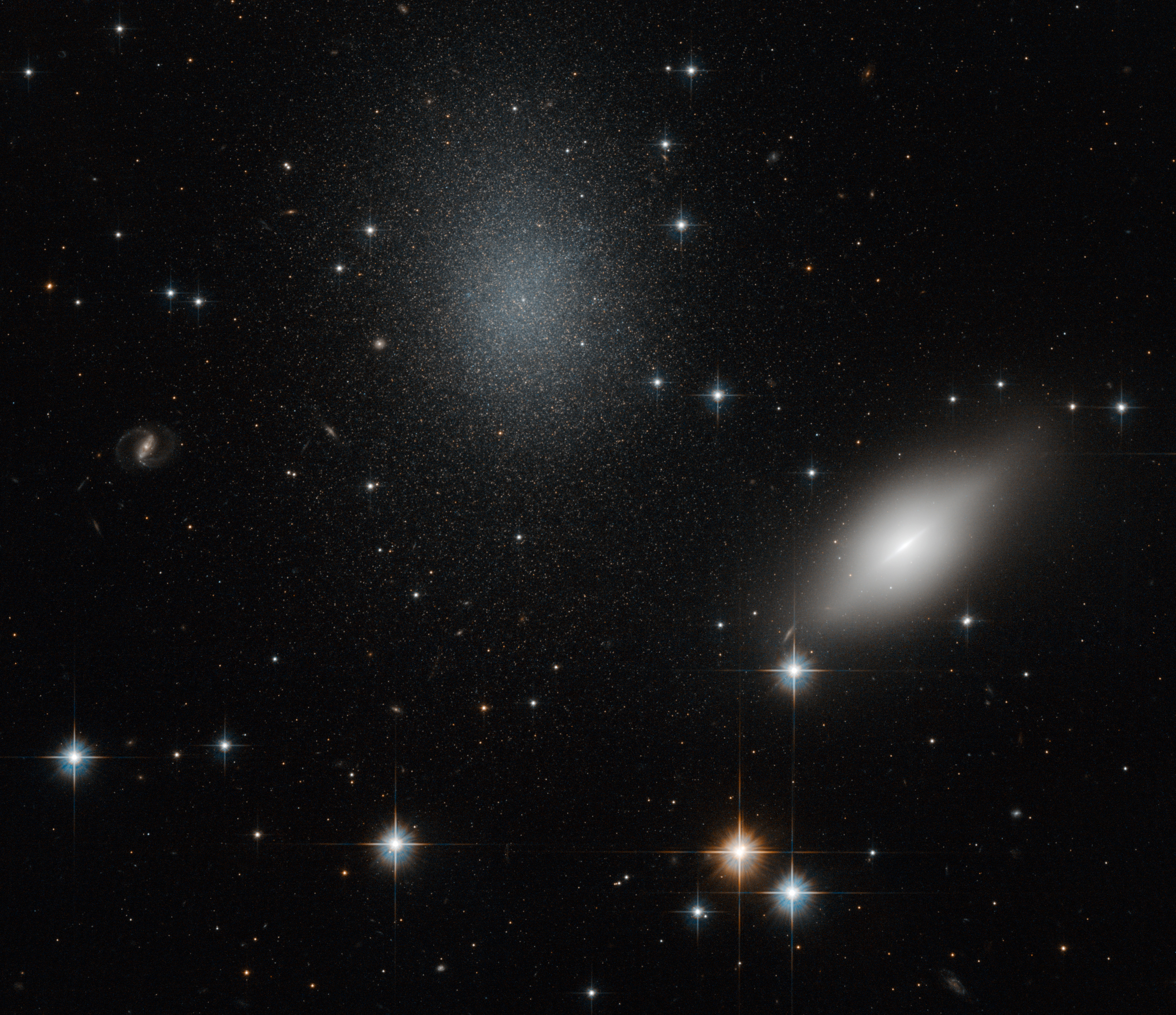
Galaxies NGC 5011B and NGC 5011C

Galaxies NGC 5011B and NGC 5011C
Click on the image for full resolution (5.5 MB)

The Universe loves to fool our eyes, giving the impression that celestial objects are located at the same distance from Earth. A good example can be seen in this spectacular image produced by the Hubble Space Telescope. The galaxies NGC 5011B and NGC 5011C are imaged against a starry background. Located in the constellation of Centaurus, the nature of these galaxies has puzzled astronomers. NGC 5011B (on the right) is a spiral (lenticular) galaxy belonging to the Centaurus Cluster of galaxies lying 156 million light-years away from the Earth. Long considered part of the faraway cluster of galaxies as well, NGC 5011C (the bluish galaxy at the centre of the image) is a peculiar object, with the faintness typical of a nearby dwarf galaxy, alongside the size of an early-type spiral. Astronomers were curious about the appearance of NGC 5011C. If the two galaxies were at roughly the same distance from Earth, they would expect the pair to show signs of interactions between them. However, there was no visual sign of interaction between the two. How could this be possible? To solve this problem, astronomers studied the velocity at which these galaxies are receding from the Milky Way and found that NGC 5011C is moving away far more slowly than its apparent neighbour, and its motion is more consistent with that of the nearby Centaurus A group at a distance of 13 million light-years. Thus, NGC 5011C, with only about ten million times the mass of the Sun in its stars, must indeed be a nearby dwarf galaxy rather than member of the distant Centaurus Cluster as was believed for many years. This image was taken with Hubble's Advanced Camera for Surveys using visual and infrared filters.
The full resolution image weighs 5.5 MB, so please be patient when downloading!
Image Credit: ESA/Hubble and NASA
Image enhancement: Jean-Baptiste Faure

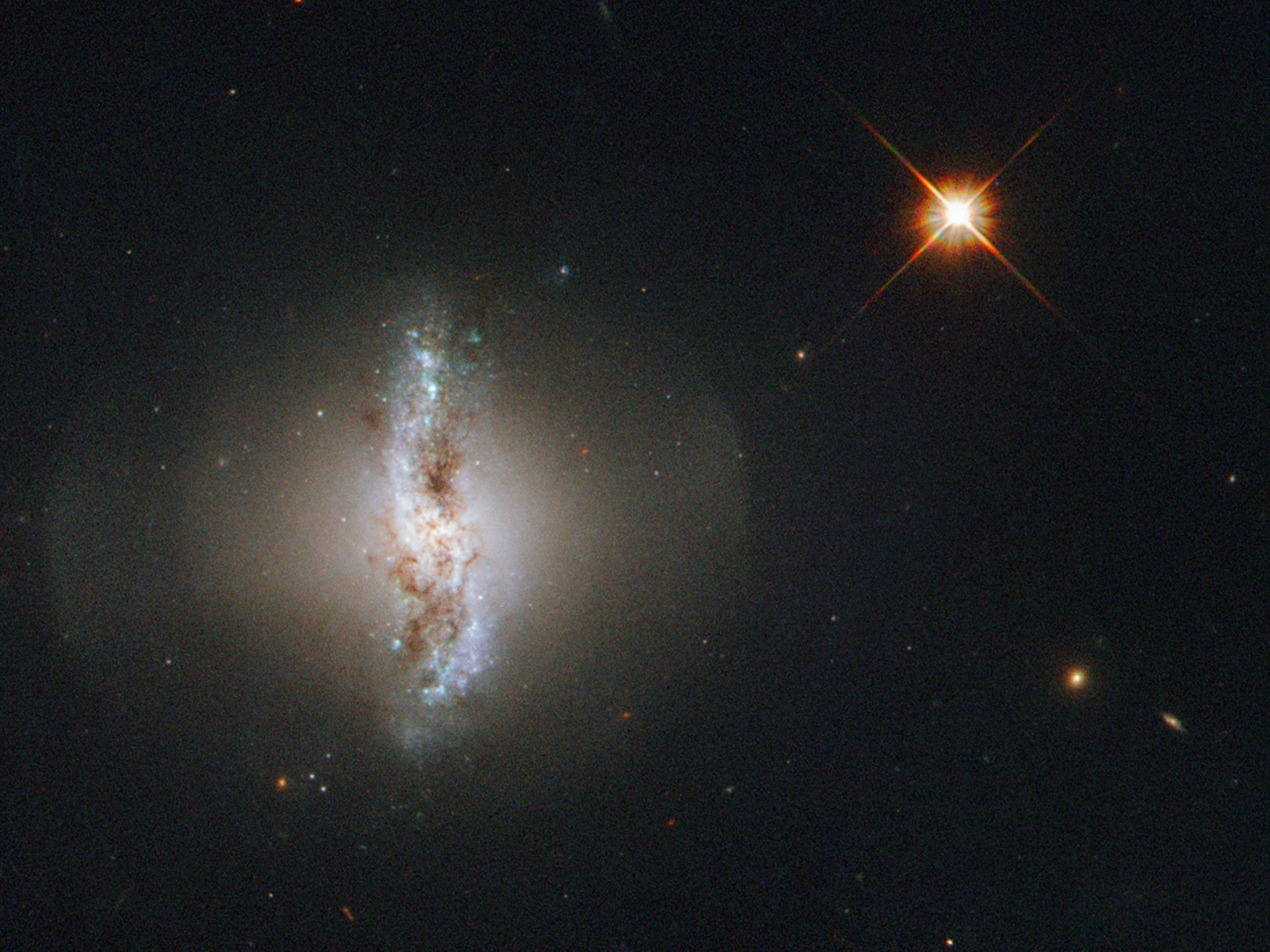
Monday, November 5, 2012

Lenticular Galaxy NGC 5010

Lenticular Galaxy NGC 5010
Click on the image for full resolution (1.6 MB)

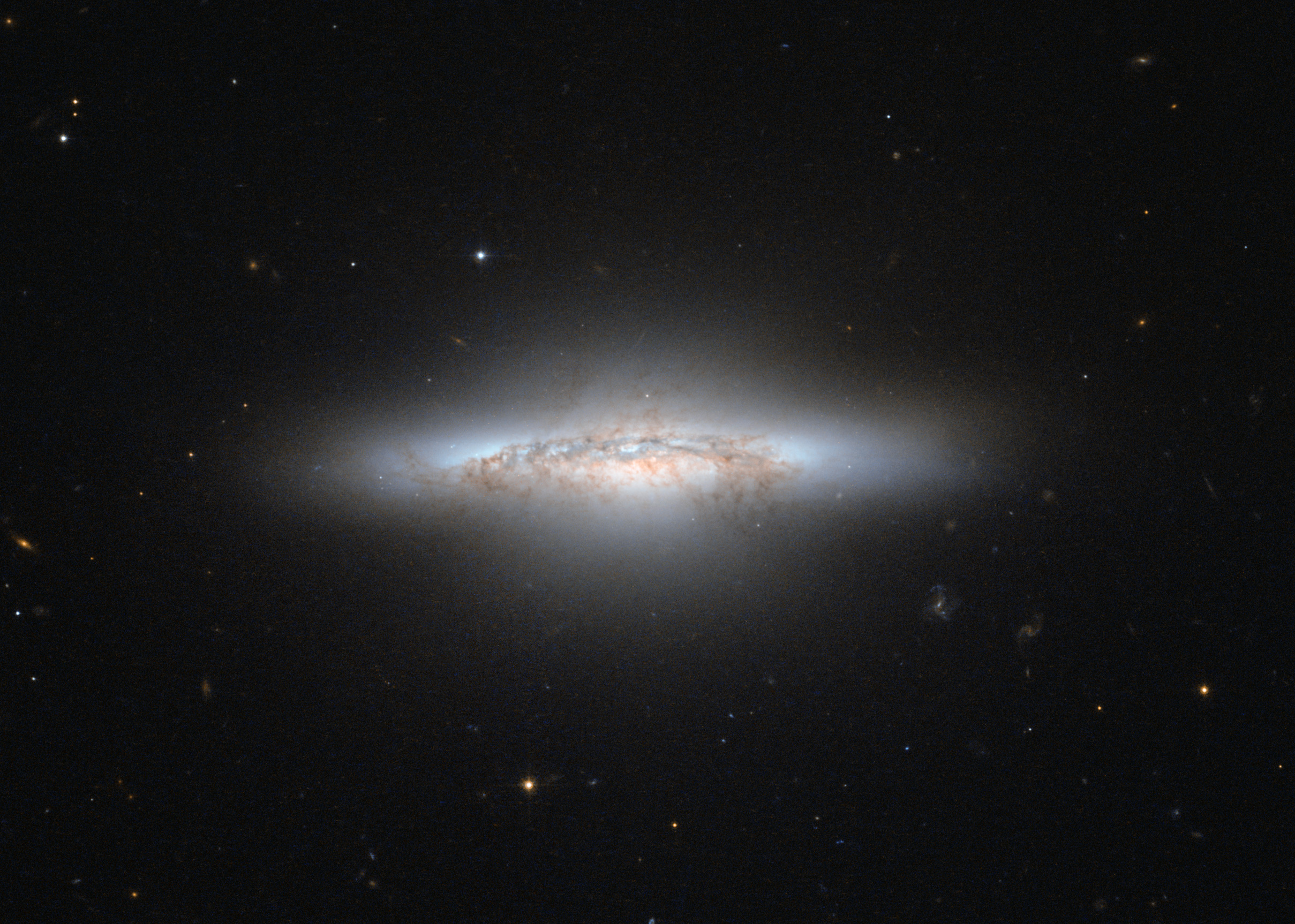
The Hubble Space Telescope has captured a beautiful galaxy that, with its reddish and yellow central area, looks rather like an explosion from a Hollywood movie. The galaxy, called NGC 5010, is in a period of transition. The aging galaxy is moving on from life as a spiral galaxy, like our Milky Way, to an older, less defined type called an elliptical galaxy. In this in-between phase, astronomers refer to NGC 5010 as a lenticular galaxy, which has features of both spirals and ellipticals. NGC 5010 is located around 140 million light-years away in the constellation of Virgo (The Virgin). The galaxy is oriented sideways to us, allowing Hubble to peer into it and show the dark, dusty, remnant bands of spiral arms. NGC 5010 has notably started to develop a big bulge in its disc as it takes on a more rounded shape. Most of the stars in NGC 5010 are red and elderly. The galaxy no longer contains all that many of the fast-lived blue stars common in younger galaxies that still actively produce new populations of stars. Much of the dusty and gaseous fuel needed to create fresh stars has already been used up in NGC 5010. Overt time, the galaxy will grow progressively more "red and dead”, as astronomers describe elliptical galaxies. Hubble's Advanced Camera for Surveys (ACS) snapped this image in violet and infrared light.
The full resolution image weighs 1.6 MB, so please be (a little) patient when downloading!
Credit: ESA/Hubble and NASA
Image enhancement: Jean-Baptiste Faure