Showing posts with label Ring Galaxies. Show all posts

Sunday, March 1, 2026

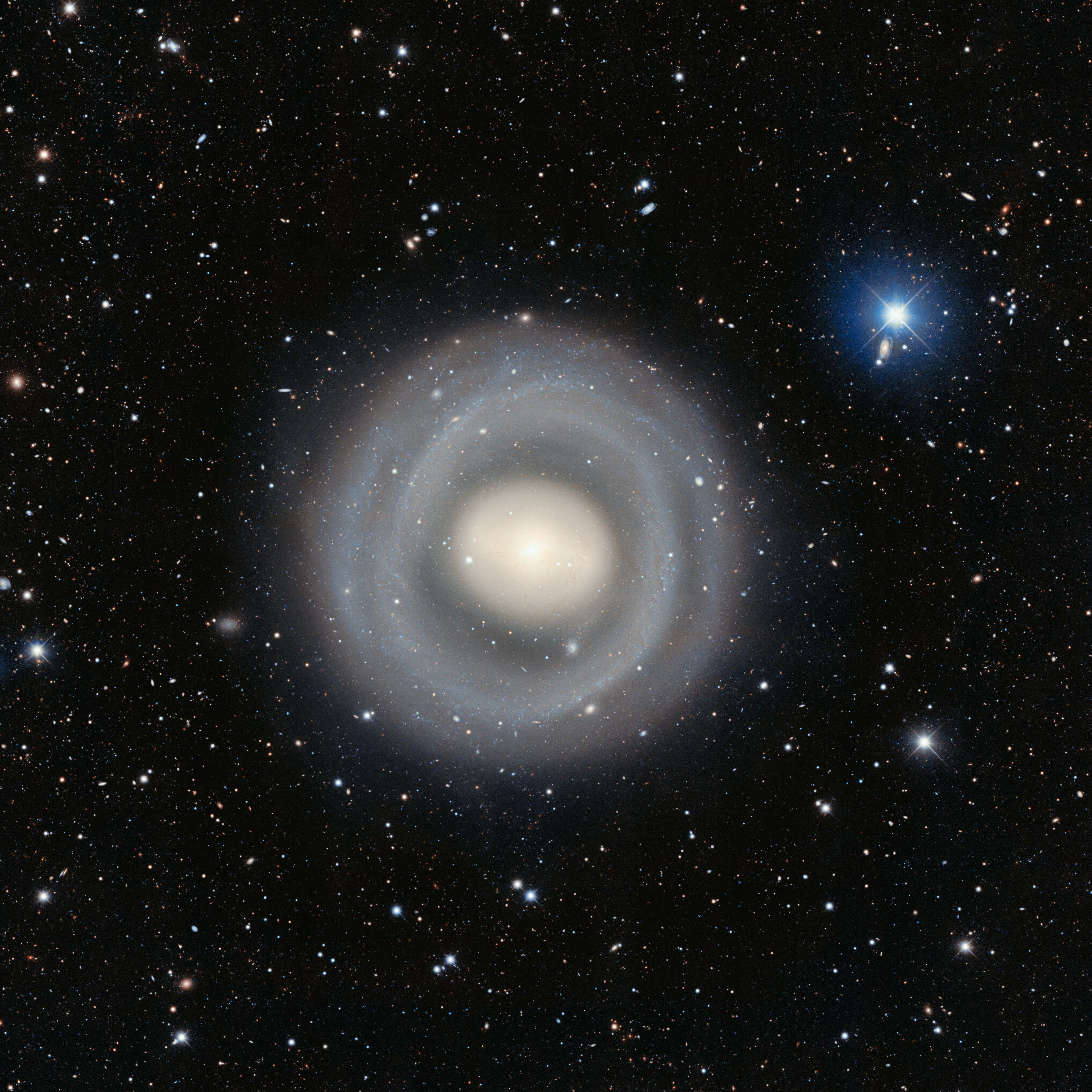
Barred Spiral Lenticular Galaxy NGC 1269

Barred Spiral Lenticular Galaxy NGC 1269
Click the image for higher resolution (13.2 MB)

This image of NGC 1269 was taken utilizing the Department of Energy-fabricated Dark Energy Camera (DECam), which is mounted on the U.S. National Science Foundation Víctor M. Blanco 4-meter Telescope at NSF Cerro Tololo Inter-American Observatory, a Program of NSF NOIRLab.
NGC 1269 is an early-type spiral galaxy located about 33 million light-years from Earth in the constellation Eridanus. A bar, a feature common to many spiral galaxies, slices through the center of the galaxy. Surrounding the galactic core are both inner and outer disks, seeming to form "wheels" around the core. Their presence is thought to be the result of a merger with another galaxy, and the inner disk is also believed to have been further shaped by density waves radiating outward from the galactic center.
Data for this image came from the archive of the Dark Energy Survey (DES), operated by the DOE and NSF between 2013 and 2019 with the specially-designed DECam. The survey sought to study the nature of the elusive dark matter by imaging hundreds of millions of galaxies. Today, the DECam is available to other scientists for use on the Blanco telescope.
Image Credit: Dark Energy Survey/DOE/FNAL/DECam/CTIO/NOIRLab/NSF/AURA
Image processing: R. Colombari & M. Zamani (NSF NOIRLab)
Image enhancement: Jean-Baptiste Faure

Friday, February 19, 2021

Polar Ring Galaxy NGC 660

Polar Ring Galaxy NGC 660
Click on the image for higher resolution (3.2 MB)

This Gemini North telescope image captures the "bloody" aftermath of one galaxy piercing the heart of another. All the action appears in a single frame, with the stunning polar-ring galaxy NGC 660 as the focus of attention. NGC 660 spans some 40,000 light years across and lies about 40 million light years distant in the direction of the constellation of Pisces. It has an unusually high gas content and resolves into hundreds of objects, a considerable fraction of which are blue and red supergiant stars.
The ring's youngest detected stars formed only about seven million years ago, indicating a long and ongoing process of formation. As NGC 660's ring is not truly polar, but inclined ~45˚ from the plane of the disk, it most likely formed by a previous interaction with a gas-rich galaxy about a billion years ago. That event would have stripped the interloper of its gas, directed it into NGC 660's core, and triggered a furious burst of star formation. When the resulting short-lived, massive stars exploded shortly thereafter as supernovae, they would have generated shock waves that triggered more star formation, and so on, even to this day.
This image of the ring galaxy NGC 660 was obtained with the Gemini Multi-Object Spectrograph on the Fredrick C. Gillett Gemini North telescope. The image is made from three images taken through g, r, i, and hydrogen alpha filters and assigned the colors of blue, green, orange and red respectively in this color composite image. The field of view is 9.3x5.6 arcminutes and it is oriented 8 degrees clockwise from north at right and east up. The total exposure (integration) time is 1,620 seconds for all filters. Color composite produced by Travis Rector, University of Alaska Anchorage.
Image Credit: International Gemini Observatory/AURA
Image enhancement: Jean-Baptiste Faure

Monday, November 25, 2019

Ring Galaxy ESO 350-40: the Cartwheel Galaxy

Ring Galaxy ESO 350-40: the Cartwheel Galaxy
Click on the image for higher resolution

This image of the Cartwheel Galaxy was taken with the Hubble Space Telescope. It was reprocessed using the latest techniques. The object was first spotted on wide-field images from the UK Schmidt telescope and then studied in detail using the Anglo-Australian Telescope.
Lying about 500 million light-years away in the constellation of Sculptor, the cartwheel shape of this galaxy is the result of a violent galactic collision. A smaller galaxy has passed right through a large disc galaxy and produced shock waves that swept up gas and dust – much like the ripples produced when a stone is dropped into a lake – and sparked regions of intense star formation (appearing blue). The outermost ring of the galaxy, which is 1.5 times the size of our Milky Way, marks the shock wave's leading edge. ESO 350-40 has a mass of about 2.9–4.8 × 10^9 solar masses; its outer ring has a circular velocity of 217 km/s. This object is one of the most dramatic examples of the small class of ring galaxies.
This image was produced after Hubble data was reprocessed using the free open source software FITS Liberator 3, which was developed at the ST-ECF. Careful use of this widely used state-of-the-art tool on the original Hubble observations of the Cartwheel Galaxy has brought out more detail in the image than ever before.
Image Credit: ESA/Hubble and NASA
Image enhancement: Jean-Baptiste Faure

Wednesday, November 6, 2019

Ring Galaxy AM 0644-741

Ring Galaxy AM 0644-741
Click on the image for higher resolution (3.4 MB)

Resembling a diamond-encrusted bracelet, a ring of brilliant blue star clusters wraps around the yellowish nucleus of AM 0644-741 in this image from the Hubble Space Telescope (HST). The sparkling blue ring is 150,000 light-years in diameter, making it larger than our entire home galaxy, the Milky Way. AM 0644-741, also known as the Lindsay-Shapley Ring, is an unbarred lenticular galaxy, and a "ring galaxy", which is 300 million light-years away in the direction of the southern constellation Dorado.
The ring is theorized to have formed by a collision with another galaxy, which triggered a gravitational disruption that caused dust in the galaxy to condense and form stars, which forced it to then expand away from the galaxy and create a ring. The ring is a region of rampant star formation dominated by young, massive, hot blue stars. The pink regions along the ring are rarefied clouds of glowing hydrogen gas that is fluorescing as it is bombarded with strong ultraviolet light from the blue stars. Galactic simulation models suggest that the ring of AM 0644-741 will continue to expand for about another 300 million years, after which it will begin to disintegrate.
Image Credit: NASA, ESA, and The Hubble Heritage Team (AURA/STScI)
Image enhancement: Jean-Baptiste Faure

Tuesday, November 5, 2019

Ring Galaxy Hoag's Object (PGC 54559)

Ring Galaxy Hoag's Object (PGC 54559)
Click on the image for higher resolution

A nearly perfect ring of hot, blue stars pinwheels about the yellow nucleus of an unusual galaxy known as Hoag's Object. This image from the NASA/ESA Hubble Space Telescope captures a face-on view of the galaxy's ring of stars, revealing more detail than any existing photo of this object.
The entire galaxy is about 120,000 light-years wide, which is slightly larger than our Milky Way Galaxy. The blue ring, which is dominated by clusters of young, massive stars, contrasts sharply with the yellow nucleus of mostly older stars. What appears to be a 'gap' separating the two stellar populations may actually contain some star clusters that are almost too faint to see. Curiously, an object that bears an uncanny resemblance to Hoag's Object can be seen in the gap at the one o'clock position. The object is probably a background ring galaxy.
Image Credit: NASA/ESA and The Hubble Heritage Team (STScI/AURA)

Monday, November 4, 2019

Interacting Galaxies AM 2026-424

Interacting Galaxies AM 2026-424
Click on the image for higher resolution

Although galaxy collisions are common – especially in the early universe – most are not head-on impacts like the collision that likely created this Arp-Madore system 704 million light-years from Earth. This violent encounter gives the system an arresting ring structure, but only for a short amount of time. The crash has pulled and stretched the galaxies' discs of gas, dust, and stars outward, forming the ring of intense star formation that shapes the "nose" and "face" features of the system. Ring galaxies are rare, and only a few hundred of them reside in our larger cosmic neighbourhood. The galaxies have to collide at just the right orientation so that they interact to create the ring, and before long they will have merged completely, hiding their messy past.
The side-by-side juxtaposition of the two central bulges of stars from the galaxies that we see here is also unusual. Since the bulges that form the "eyes" appear to be the same size, we can be sure that the two galaxies involved in the crash were of equal size. This is different from the more common collisions in which small galaxies are gobbled up by their larger neighbours. This galaxy system is catalogued as Arp-Madore 2026-424 (AM 2026-424) in the Arp-Madore "Catalogue of Southern Peculiar Galaxies and Associations". Astronomer Halton Arp published his compendium of 338 unusual-looking interacting galaxies in 1966. He later partnered with astronomer Barry Madore to extend the search for unique galactic encounters in the southern sky. Several thousand galaxies are listed in this 1987 survey.
Hubble observed this unique system as part of a "snapshot" programme that takes advantage of occasional gaps in the telescope's observing schedule to squeeze in additional pictures. Astronomers plan to use this innovative Hubble programme to take a close look at many other unusual interacting galaxies. The goal is to compile a robust sample of nearby interacting galaxies, which could offer insights into how galaxies grew over time through galactic mergers. By analysing these detailed Hubble observations, astronomers will be able to decide which systems are prime targets for follow-up observations by the upcoming NASA/ESA/CSA James Webb Space Telescope, scheduled to launch in 2021.
Image Credit: NASA, ESA, J. Dalcanton, B.F. Williams, and M. Durbin (University of Washington)

Thursday, June 12, 2014

Spiral Seyfert Galaxy NGC 3081

Spiral Seyfert Galaxy NGC 3081
Click on the image for higher resolution

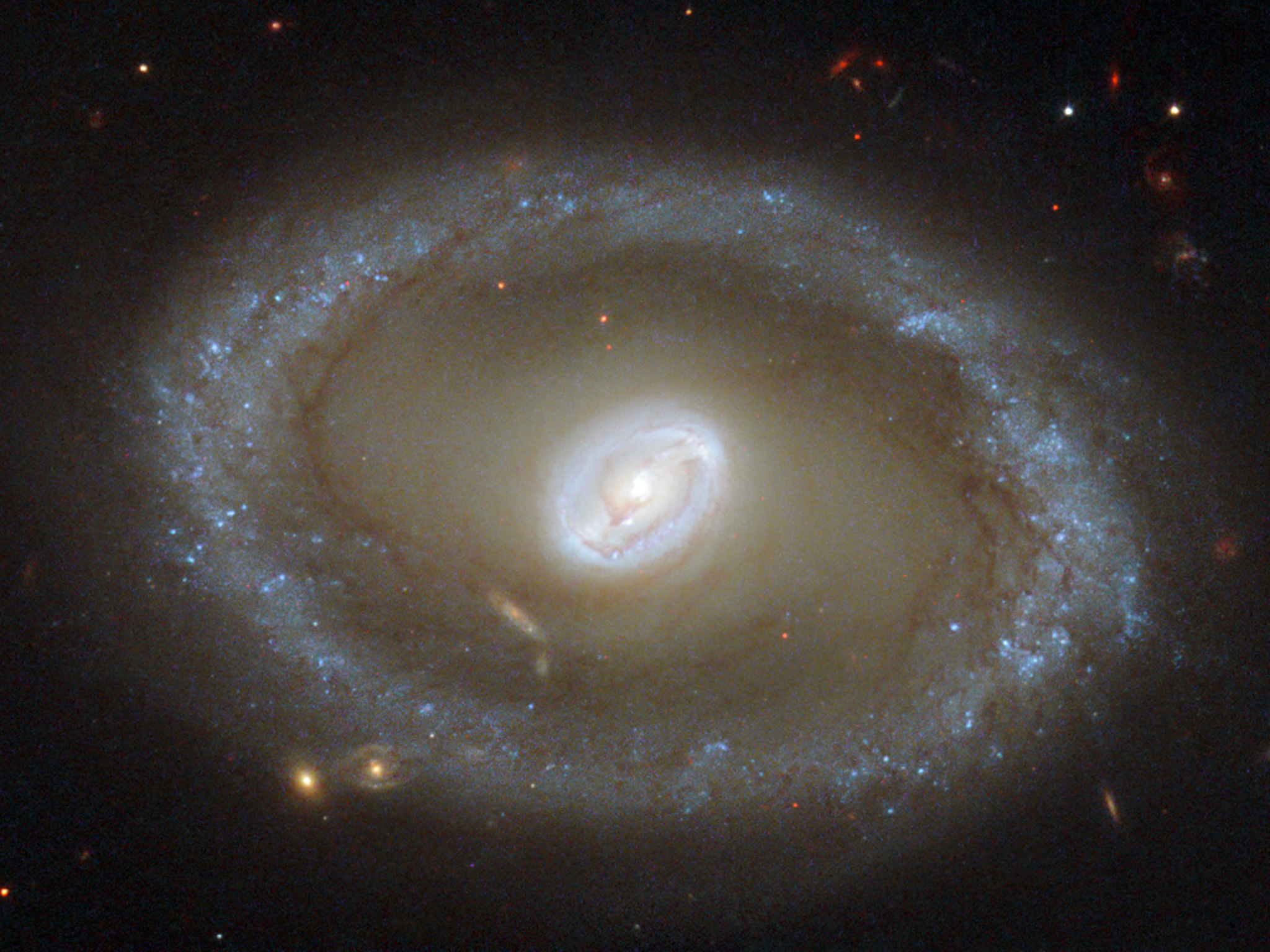
Taking center stage in this new Hubble Space Telescope image is a galaxy known as NGC 3081, set against an assortment of glittering galaxies in the distance. Located in the constellation of Hydra (The Sea Serpent), NGC 3081 is located over 86 million light-years from us. It is known as a type II Seyfert galaxy, characterised by its dazzling nucleus. NGC 3081 is seen here nearly face-on. Compared to other spiral galaxies, it looks a little different. The galaxy's barred spiral center is surrounded by a bright loop known as a resonance ring. This ring is full of bright clusters and bursts of new star formation, and frames the supermassive black hole thought to be lurking within NGC 3081 - which glows brightly as it hungrily gobbles up infalling material. These rings form in particular locations known as resonances, where gravitational effects throughout a galaxy cause gas to pile up and accumulate in certain positions. These can be caused by the presence of a "bar" within the galaxy, as with NGC 3081, or by interactions with other nearby objects. It is not unusual for rings like this to be seen in barred galaxies, as the bars are very effective at gathering gas into these resonance regions, causing pile-ups which lead to active and very well-organised star formation. Hubble snapped this magnificent face-on image of the galaxy using the Wide Field Planetary Camera 2. This image is made up of a combination of ultraviolet, optical, and infrared observations, allowing distinctive features of the galaxy to be observed across a wide range of wavelengths.
Image Credit: ESA/Hubble and NASA
Acknowledgement: R. Buta (University of Alabama)
Image enhancement: Jean-Baptiste Faure

Wednesday, March 13, 2013

Ring Galaxy Zw II 28

Ring Galaxy Zw II 28
Click on the image for full resolution


Galaxies can take many forms - elliptical blobs, swirling spiral arms, bulges, and discs are all known components of the wide range of galaxies we have observed using telescopes like the NASA/ESA Hubble Space Telescope. However, some of the more intriguing objects in the sky around us include ring galaxies like the one pictured above - Zw II 28. Ring galaxies are mysterious objects. They are thought to form when one galaxy slices through the disc of another, larger, one - as galaxies are mostly empty space, this collision is not as aggressive or as destructive as one might imagine. The likelihood of two stars physically colliding is minimal, and it is instead the gravitational effects of the two galaxies that causes the disruption. This disruption upsets the material in both galaxies, causing it to redistribute to form a dense central core, encircled by bright stars. All this commotion causes clouds of gas and dust to collapse and triggers new periods of intense star formation in the outer ring, which is thus full of hot, young, blue stars and regions that are actively giving rise to new stars. The sparkling pink and purple loop of Zw II 28 is not a typical ring galaxy due to its lack of a visible central companion. For many years it was thought to be a lone circle on the sky, but observations using Hubble have shown that there may be a possible companion lurking just inside the ring, where the loop appears to double back on itself. The galaxy has a knotty, swirling ring structure, with some areas appearing much brighter than others. A version of this image was entered into the Hubble's Hidden Treasures image processing competition by contestant Judy Schmidt.
Image Credit: ESA/Hubble and NASA
Acknowledgement: Judy Schmidt
Image enhancement: Jean-Baptiste Faure

Saturday, December 8, 2012

Ring Galaxy NGC 922

Ring Galaxy NGC 922
Click on the image for full resolution (5.7 MB)

An almost complete circle of bright pink nebulae skirts around a spiral galaxy in this NASA/ESA Hubble Space Telescope image of NGC 922. The ring structure and the galaxy's distorted spiral shape result from a smaller galaxy scoring a cosmic bullseye, hitting the centre of NGC 922 some 330 million years ago.
The full resolution image weighs 5.7 MB, so please be patient when downloading!
Image Credit: NASA and ESA
Image enhancement: Jean-Baptiste Faure