Showing posts with label Intermediate Spiral Galaxies. Show all posts

Saturday, May 2, 2026

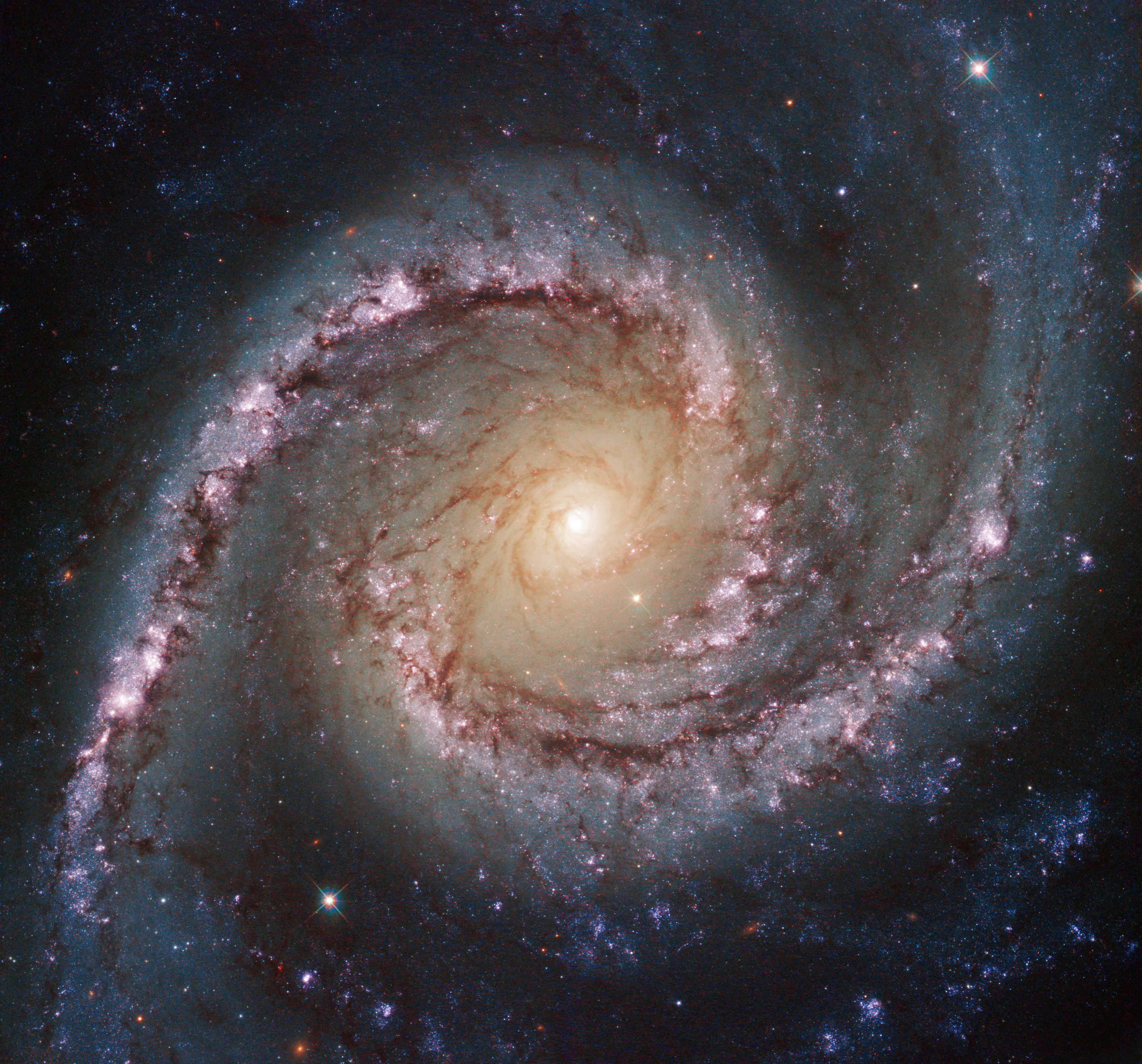
Intermediate Spiral Galaxy NGC 3137

Intermediate Spiral Galaxy NGC 3137
Click the image for higher resolution (7.7 MB)

In this Hubble picture, a spiral galaxy glittering with star clusters is the center of attention. NGC 3137 is located 53 million light-years away in the constellation Antlia (The Air Pump). As a nearby spiral galaxy, this target offers astronomers an excellent opportunity to study the cycle of stellar birth and death, as well as giving researchers a glimpse of a galactic system similar to our own.
NGC 3137 is of particular interest to astronomers because it travels through space with a group of galaxies that is thought to be similar to the Local Group, the galaxy group that contains the Milky Way. Similar to the Local Group, the NGC 3175 group contains two large spiral galaxies: NGC 3137 and NGC 3175, which Hubble has also observed. In the Local Group, the largest members are the Milky Way galaxy and Andromeda, another spiral galaxy. In addition to two large spiral galaxies, both groups also contain a number of smaller dwarf galaxies, although it's not yet known how many of these tiny companions the NGC 3175 group has; researchers have found more than 500 dwarf galaxy candidates. By studying this nearby galaxy group, astronomers can learn about the dynamics of our own galactic home.
NGC 3137 is revealed in fantastic detail by Hubble. This image is crafted from observations in six different colour bands, creating a view that highlights several facets of this beautiful spiral. The galaxy's center, which is encircled by a network of fine, dusty clouds, hosts a black hole estimated to be 60 million times more massive than the Sun. NGC 3137 is highly inclined from our point of view, giving a unique perspective on its loose, feathery spiral structure. A couple of photobombing Milky Way stars and a smattering of far more distant background galaxies complete the image.
As stunning as each of these features may be, it's the galaxy's brilliant star clusters that steal the show. The galaxy is peppered with dense clusters of bright blue stars and glowing red gas clouds, which signal the presence of hot, young stars still encased in their birth nebulae.
Unsurprisingly, these star clusters are exactly what has drawn Hubble's keen eye. Researchers are using Hubble to carry out an observing programme focusing on star clusters in 55 nearby galaxies. The data collected will help astronomers identify star clusters and the glowing nebulae that surround them, providing a way to measure the ages of stars in galaxies like NGC 3137. These observations give an in-depth view of stellar life in spiral galaxies, from the young stars still in the process of forming to the ancient stellar populations that grew up in the early years of their galactic hosts.
The PHANGS-HST programme for which these observations were taken is part of a larger effort by some of the most powerful observatories on (and around) Earth. Hubble contributes greatly to this massive undertaking, which combines data from the James Webb Space Telescope and the Atacama Large Millimetre/submillimetre Array (ALMA). Together, Hubble's powerful optical and ultraviolet capabilities, Webb's sensitive infrared eyes, and ALMA's broad network of radio dishes bring us an unmatched view of star formation in the local Universe.
Image Credit: ESA/Hubble and NASA, D. Thilker and the PHANGS-HST Team
Image enhancement: Jean-Baptiste Faure

Saturday, November 9, 2024

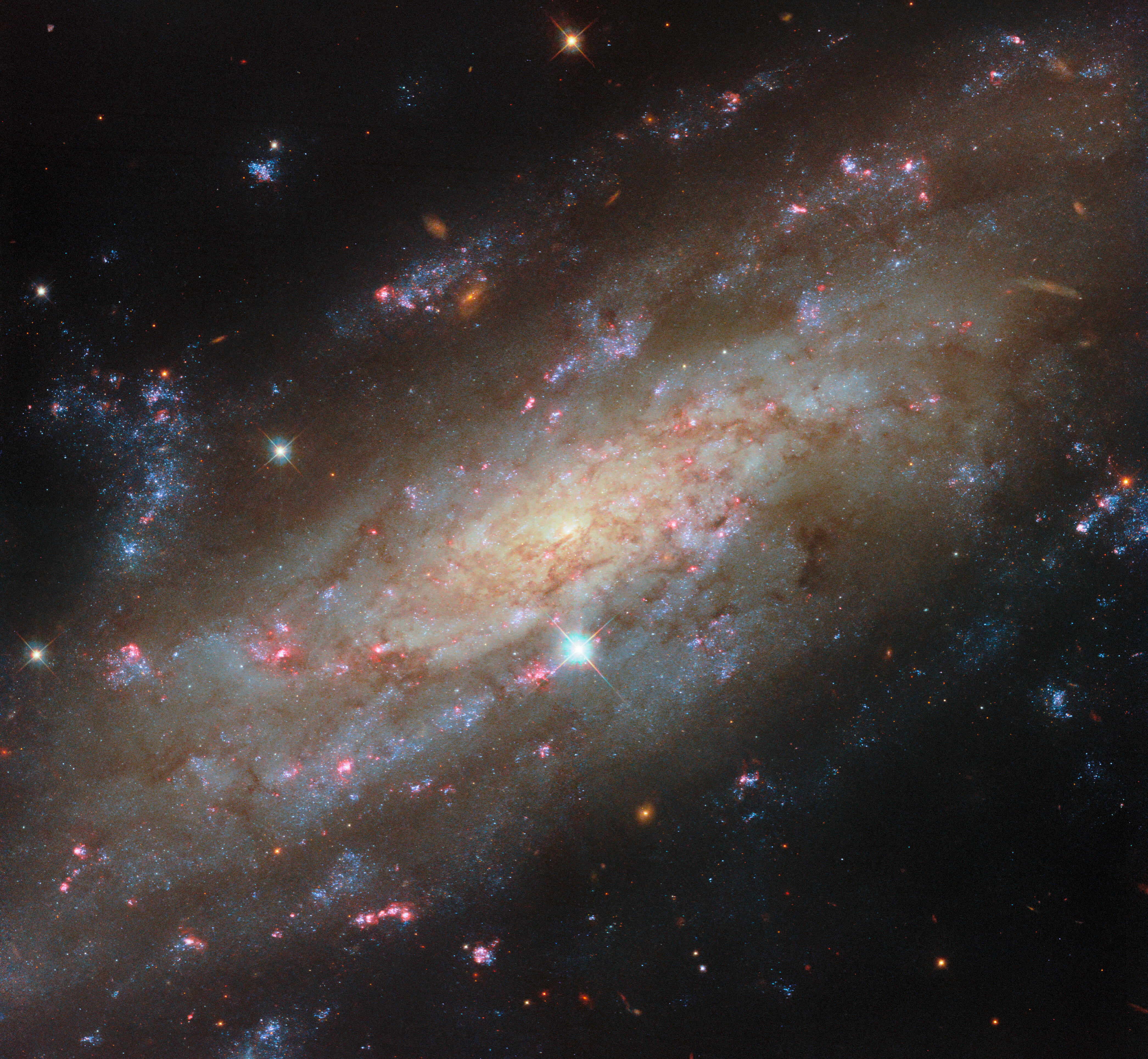
Intermediate Spiral Galaxy M90 (NGC 4569)

Intermediate Spiral Galaxy M90 (NGC 4569)
Click the image for higher resolution (5.6 MB)

The striking spiral galaxy featured in this picture of the Week is M90 (Messier 90, also NGC 4569), located in the constellation Virgo. In 2019, an image of M90 was released using data from the older Wide Field and Planetary Camera 2 – data taken in 1994 soon after the camera's installation. That image has a distinctive stair-step pattern due to the layout of WFPC2's sensors. WFPC2 was replaced in 2010 by the Wide Field Camera 3, and Hubble used WFC3 when it turned its aperture to Messier 90 again in 2019 and 2023. The resulting data was processed to create this stunning new image, providing a much fuller view of the galaxy's dusty disc, its gaseous halo and its bright core.
The inner regions of M90's disc are sites of star formation, which is highlighted here by red H-alpha light from nebulae, but this is absent in the rest of the galaxy. M90 sits among the galaxies of the relatively nearby Virgo Cluster, and the course of its orbit took it on a path near the cluster's center about three hundred million years ago. The density of gas in the inner cluster weighed on M90 like a strong headwind, stripping enormous quantities of gas from the galaxy and creating the diffuse halo that can be seen around it here. This gas is no longer available for M90 to form new stars with, and it will eventually fade as a spiral galaxy as a result.
M90 is located 55 million light-years from Earth, but it's one of the very few galaxies getting closer to us. Its orbit through the Virgo cluster has accelerated it so much that it’s in the process of escaping the cluster entirely, and by happenstance it's moving in our direction – other galaxies in the Virgo cluster have been measured at similar speeds, but in the opposite direction. Over the coming billions of years, we will be treated to a yet better view of M90 while it evolves into a lenticular galaxy.
Image Credit: ESA/Hubble and NASA, D. Thilker, J. Lee and the PHANGS-HST Team
Image enhancement: Jean-Baptiste Faure

Sunday, October 20, 2024

Intermediate Spiral Galaxy NGC 5248

Intermediate Spiral Galaxy NGC 5248
Click the image for higher resolution (7.4 MB)

The sparkling scene depicted in this Hubble picture is of the spiral galaxy NGC 5248, located 42 million light-years from Earth in the constellation Boötes. It is also known as Caldwell 45, having been included in a catalogue of visually interesting celestial objects that were known, but weren't as commonly observed by amateur astronomers as the more famous Messier objects.
NGC 5248 is one of the so-called "grand design" spirals, with prominent spiral arms that reach from near the core out through the disc. It also has a faint bar structure in the center, between the inner ends of the spiral arms, which is not quite so obvious in this visible-light portrait from Hubble. Features like these which break the rotational symmetry of a galaxy have a huge influence on how matter moves through it, and eventually its evolution through time. They feed gas from a galaxy's outer reaches to inner star-forming regions, and even to a galaxy's central black hole where it can kick-start an active galactic nucleus.
These flows of gas have shaped NGC 5248 in a big way; it has many bright "starburst regions" of intense star formation spread across its disc, and it is dominated by a population of young stars. The galaxy even has two very active, ring-shaped starburst regions around its nucleus, filled with young clusters of stars. These "nuclear rings" are remarkable enough, but normally a nuclear ring tends to block gas from getting further into the core of a galaxy. NGC 5248 having a second ring inside the first is a marker of just how forceful its flows of matter and energy are! Its relatively nearby, highly visible starburst regions make the galaxy a target for professional and amateur astronomers alike.
Image Credit: ESA/Hubble and NASA, F. Belfiore, J. Lee and the PHANGS-HST Team
Image enhancement: Jean-Baptiste Faure

Sunday, September 1, 2024

Intermediate Spiral Galaxy NGC 6744

Intermediate Spiral Galaxy NGC 6744
Click the image for higher resolution (13.5 MB)


Behold NGC 6744, a spiral galaxy bearing similarities to our home galaxy, the Milky Way. This cosmic twin is captured here in stunning detail by the Dark Energy Camera (DECam) on the Víctor M. Blanco 4-meter Telescope at the U.S. National Science Foundation Cerro Tololo Inter-American Observatory (CTIO), a Program of NSF NOIRLab in Chile. Located around 30 million light-years away in the constellation Pavo, NGC 6744 exhibits a luminous core and spiral arms spanning 175,000 light-years across, a larger but similar anatomy to our Milky Way. Moreover, to the lower right of NGC 6744, at the end of the spiral arm, is a faint blob. This is its companion galaxy known as NGC 6744A. The companionship between these galaxies is analogous to that between the Milky Way and its dwarf companion the Large Magellanic Cloud. Though it’s impossible to get an external view of our galaxy, these similarities offer insight into how the Milky Way might look to a distant observer.
This is one of the deepest images of NGC 6744 ever taken, and keen observers can spy the faint extended arm on the left hand side of the galaxy – rarely visible in most images.
This image is part of the DESI Legacy Imaging Surveys, an ambitious effort to construct the largest 3D map of the night sky with the DOE-built DECam on the Blanco Telescope at NSF CTIO and other Programs of NSF NOIRLab.
Image Credit: Dark Energy Survey/DOE/FNAL/DECam/CTIO/NOIRLab/NSF/AURA
Image processing: R. Colombari and M. Zamani (NSF NOIRLab)
Image enhancement: Jean-Baptiste Faure

Saturday, April 20, 2024

Peculiar Galaxy NGC 7727

Peculiar Galaxy NGC 7727
Click the image for higher resolution

Gemini South, one half of the International Gemini Observatory operated by NSF's NOIRLab, captured NGC 7727. This giant was born from the merger of two galaxies, an event that started around a billion years ago. At its center lies the closest pair of supermassive black holes ever found, two objects that are destined to coalesce into an even more massive black hole.
Just as you may bump into someone on a busy street, galaxies too can bump into each other. But while galactic interactions are much more violent than a bump on a busy street, individual stars don't generally collide since, compared to their sizes, the distances between them are very large. Rather, the galaxies dance around each other, with gravity creating tidal forces that dramatically change the look of the two dance partners. "Tails" of stars, gas and dust are spun around the galaxies as they eventually form a new, merged galaxy, resulting in the disordered and beautifully asymmetrical shape that we see in NGC 7727.
Also visible in this image are two bright points at the center of the galaxy, another telltale sign of its dramatic past. The core of NGC 7727 still consists of the original two galactic cores, each hosting a supermassive black hole. Located about 89 million light-years away from Earth, in the constellation of Aquarius, this is the closest pair of supermassive black holes to us.
The black holes in NGC 7727 are observed to be just 1600 light-years apart in the sky and are expected to merge within 250 million years, the blink of an eye in astronomical time. When the black holes merge they will create an even more massive black hole.
Our home galaxy, which also sports a supermassive black hole at its center, is on a path to merge with our closest large neighbour, the Andromeda Galaxy, billions of years from now. Perhaps the resulting galaxy will look something similar to the cosmic dance we see in NGC 7727, so this image could be giving us a glimpse into the future.
Image Credit: International Gemini Observatory/NOIRLab/NSF/AURA
Acknowledgment: PI: C. Onken (Australian National University)
Image processing: T.A. Rector (University of Alaska Anchorage/NSF's NOIRLab), J. Miller (International Gemini Observatory/NSF's NOIRLab), M. Rodriguez (International Gemini Observatory/NSF’s NOIRLab), M. Zamani (NSF's NOIRLab)
Image enhancement: Jean-Baptiste Faure

Saturday, March 23, 2024

Intermediate Spiral Galaxy NGC 5468 by Hubble and Webb

Intermediate Spiral Galaxy NGC 5468 by Hubble and Webb
Click the image for higher resolution (3.5 MB)

This image of NGC 5468, a galaxy located about 130 million light-years from Earth, combines data from the Hubble and James Webb space telescopes. This is the most distant galaxy in which Hubble has identified Cepheid variable stars. These are important milepost markers for measuring the expansion rate of the Universe. The distance calculated from Cepheids has been cross-correlated with a Type Ia supernova in the galaxy. Type Ia supernovae are so bright they are used to measure cosmic distances far beyond the range of the Cepheids, extending measurements of the Universe’s expansion rate deeper into space.
Image Credit: NASA, ESA, CSA, STScI, A. Riess (JHU/STScI)
Image enhancement: Jean-Baptiste Faure
Monday, January 3, 2022

Intermediate Barred Spiral Galaxy NGC 1515

Intermediate Barred Spiral Galaxy NGC 1515
Click on the image for higher resolution (2.4 MB)

At the center of this image is NGC 1515, an intermediate barred spiral galaxy that is part of the Dorado Group. Large-scale observations of the Universe have found that galaxies "clump" together. These clumps are held together by a loose gravitational pull and designated a group or cluster, depending on the number of galaxies within a bounded radius. One of the characteristics of groups of galaxies is the slow speed of individual galaxies, about 150 km/s (93 mi/hr), which results in frequent interactions between members. The Dorado Group is composed of three subgroups and NGC 1515 is a member of the subgroup associated with the galaxy NGC 1566. In the background of this image are thousands of other galaxies, located even further away than NGC 1515, alongside stars located in our own Milky Way.
This image is composed of data taken with the Dark Energy Camera on the Víctor M. Blanco 4-meter Telescope at Cerro Tololo Inter-American Observatory (CTIO), a Program of NSF's NOIRLab, as part of the Dark Energy Survey, a project that mapped millions of galaxies. One of the most powerful digital cameras in the world, the Dark Energy Camera was designed specifically for the Dark Energy Survey and was operated by the US Department of Energy and NSF between 2013 and 2019.
Image Credit: Dark Energy Survey/DOE/FNAL/DECam/CTIO/NOIRLab/NSF/AURA
Image processing: T.A. Rector (University of Alaska Anchorage/NSF's NOIRLab), J. Miller (Gemini Observatory/NSF's NOIRLab), M. Zamani & D. de Martin (NSF's NOIRLab)

Tuesday, June 22, 2021

Intermediate Spiral Galaxy NGC 4680

Intermediate Spiral Galaxy NGC 4680
Click on the image for higher resolution (2.3 MB)

This image, taken with Hubble's Wide Field Camera 3 (WFC3), features the intermediate spiral galaxy NGC 4680. At 2 o'clock and 7 o'clock two other galaxies can be seen flanking NGC 4680. NGC 4680 enjoyed a wave of attention in 1997, as it played host to a supernova explosion known as SN 1997bp. Amazingly, the supernova was identified by an Australian amateur astronomer named Robert Evans, who has identified an extraordinary 42 supernova explosions.
NGC 4680 is actually a rather tricky galaxy to classify. It is sometimes referred to as a spiral galaxy, but it is also sometimes classified as a lenticular galaxy. Lenticular galaxies fall somewhere in between spiral galaxies and elliptical galaxies. Whilst NGC 4680 does have distinguishable spiral arms, they are not clearly defined, and the tip of one arm appears very diffuse. Galaxies are not static, and their morphologies (and therefore their classifications) vary throughout their lifetimes. Spiral galaxies are thought to evolve into elliptical galaxies, most likely by merging with one another, causing them to lose their distinctive spiral structures.
Image Credit: ESA/Hubble and NASA, A. Riess et al.
Image enhancement: Jean-Baptiste Faure

Thursday, March 18, 2021

Seyfert Spiral Galaxy M106

Seyfert Spiral Galaxy M106
Click on the image for higher resolution (12.8 MB)


This spectacular image highlights the majestic spiral galaxy M106 (Messier 106) and its diminutive neighbors, as well as a dense field of background galaxies and foreground stars. This may be the best view yet of M106 in its entirety, showing both the warped central disk and the tenuous outer reaches of the galaxy. This celestial snapshot captures the majesty of the spiral galaxy M106, also known as NGC 4258. The image is arguably the best yet captured of the entire galaxy. Obtained using the Nicholas U. Mayall 4-meter Telescope at Kitt Peak National Observatory, a Program of NSF's NOIRLab, this image shows not only the glowing spiral arms, wisps of gas, and dust lanes at the core of the galaxy but also the leisurely twisting bands of stars at its outer edges.
A popular target for amateur astronomers, M106 can be spotted with a small telescope in the constellation Canes Venatici. M106 is similar in size and luminosity to our galactic neighbor the Andromeda Galaxy, but it lies 10 times farther away – more than 20 million light-years from Earth. Though the galaxy measures more than 130 000 light-years from edge to edge, the vast distance between it and the Milky Way renders M106 minuscule when seen from here. Its size in the night sky – if it were visible to the naked eye – is less than that of a penny held at arm's length!
Despite its tranquil appearance, M106 has an unusually energetic inhabitant. The supermassive black hole at the heart of the galaxy – which is about 40 million times as massive as our Sun – is particularly active. As well as consuming vast amounts of gas and dust, the spinning black hole has warped the surrounding disk of gas, churning up vast amounts of material. This process has created the bright, red streamers of gas emanating from the heart of M106, visible in the center of this image.
Accompanying M106 is a pair of dwarf galaxies belonging to the same galaxy group. The loose collection of stars and dust visible in the bottom-right of this image is the small irregular galaxy NGC 4248. Another small galaxy – UGC 7356 – lies to the lower-left of M106 and is dwarfed by its larger neighbor. M106 and its companions are framed by a variety of objects, from foreground stars to background galaxies. Stars from our own galaxy stud the image, easily identified by the criss-cross diffraction patterns surrounding them. In the background, distant galaxies litter the image, some of them visible through the tenuous disk of M106.
As well as being a striking subject for astronomical images, M106 has been instrumental in measuring the scale of the Universe. Astronomers measure distances in the Universe using an interconnected chain of measurements called the cosmic distance ladder, with each rung of the ladder allowing measurements of more and more distant objects. Calibrating these measurements requires objects with a known brightness – such as pulsating stars known as Cepheid variables. Measurements of the Cepheids in M106 have allowed astronomers to calibrate Cepheids elsewhere in the Universe – helping them to measure the distances to other galaxies.
This image was one of the last to be taken with the Mosaic camera before the installation of the Dark Energy Spectroscopic Instrument (DESI), a project of the Department of Energy's Office of Science and Lawrence Berkeley National Laboratory.
Image Credit: KPNO/NOIRLab/NSF/AURA
Acknowledgment: PI: M.T. Patterson (New Mexico State University)
Image processing: T.A. Rector (University of Alaska Anchorage), M. Zamani & D. de Martin
Image enhancement: Jean-Baptiste Faure

Wednesday, February 3, 2021

Intermediate Spiral Galaxy UGC 3855

Intermediate Spiral Galaxy UGC 3855
Click on the image for higher resolution

A bright foreground star isn't enough to distract from the grandeur of the galaxy UGC 3855, captured here by the Hubble Space Telescope. While this foreground star is incredibly bright to Hubble's eye, it does not outshine the details of the background galaxy.
Many young blue stars are sprinkled throughout the circular patterns of UGC 3855's arms, contrasted and complemented by dark lanes of dust also following the spiral structure. A glancing look at UGC 3855 may only leave you with an impression of the galaxy, but spare a moment longer and the intricacies of the galaxy begin to emerge. Located in the constellation of Lynx , UGC 3855 is a cosmic beauty to behold.
Image Credit: ESA/Hubble and NASA, J. Walsh
Image enhancement: Jean-Baptiste Faure

Tuesday, January 5, 2021

Spiral Galaxy NGC 6946

Spiral Galaxy NGC 6946
Click on the image for higher resolution (3.3 MB)

The galaxy NGC 6946 is nothing short of spectacular. In the last century alone, NGC 6946 has experienced 10 observed supernovae, earning its nickname as the Fireworks Galaxy. In comparison, our Milky Way averages just 1-2 supernova events per century. This Hubble Space Telescope image shows the stars, spiral arms, and various stellar environments of NGC 6946 in phenomenal detail.
We are able to marvel at NGC 6946 as it is a face-on galaxy, which means that we see the galaxy "facing" us, rather than seeing it from the side (known as edge-on). The Fireworks Galaxy is further classified as an intermediate spiral galaxy and as a starburst galaxy. The former means the structure of NGC 6946 sits between a full spiral and a barred spiral galaxy, with only a slight bar in its center, and the latter means it has an exceptionally high rate of star formation.
The galaxy resides 25.2 million light-years away, along the border of the northern constellations of Cepheus and Cygnus (The Swan).
Image Credit: ESA/Hubble and NASA, A. Leroy, K. S. Long
Image enhancement: Jean-Baptiste Faure

Tuesday, September 29, 2020

Intermediate Spiral Galaxy NGC 5643

Intermediate Spiral Galaxy NGC 5643
Click on the image for higher resolution (6.1 MB)

This stunning image by the Hubble Space Telescope features the spiral galaxy NGC 5643 in the constellation of Lupus (The Wolf). Looking this good isn’t easy; thirty different exposures, for a total of 9 hours observation time, together with the high resolution and clarity of Hubble, were needed to produce an image of such high level of detail and of beauty.
NGC 5643 is about 60 million light-years away from Earth and has been the host of a recent supernova event (not visible in this latest image). This supernova (2017cbv) was a specific type in which a white dwarf steals so much mass from a companion star that it becomes unstable and explodes. The explosion releases significant amounts of energy and lights up that part of the galaxy.
The observation was proposed by Adam Riess, who was awarded a Nobel Laureate in physics 2011 for his contributions to the discovery of the accelerating expansion of the Universe, alongside Saul Perlmutter and Brian Schmidt.
Image Credit: ESA/Hubble and NASA, A. Riess et al.
Acknowledgement: Mahdi Zamani
Image enhancement: Jean-Baptiste Faure

Saturday, February 1, 2020

Spiral Galaxy M106 Composite Image

Spiral Galaxy M106 Composite Image
Click on the image for higher resolution (1.9 MB)

NGC 4258, also known as M106, is a galaxy about 23 million light-years away and is home of a giant black hole. This galactic fireworks display is taking place in M106, a spiral galaxy like our own Milky Way. This galaxy is famous, however, for something that our galaxy doesn't have – two extra spiral arms that glow in X-ray, optical and radio light. These features, or anomalous arms, are not aligned with the plane of the galaxy, but instead intersect with it.
The anomalous arms are seen in this new composite image, where X-rays from NASA's Chandra X-ray Observatory are blue, radio data from the NSF's Karl Jansky Very Large Array are purple, optical data from NASA's Hubble Space Telescope are yellow and infrared data from NASA's Spitzer Space Telescope are red.
A new study made with Spitzer shows that shock waves, similar to the sonic booms from supersonic planes, are heating large amounts of gas – equivalent to about 10 million suns. What is generating these shock waves? Researchers think that the supermassive black hole at the center of NGC 4258 is producing powerful jets of high-energy particles. These jets strike the disk of the galaxy and generate shock waves. These shock waves, in turn, heat the gas – composed mainly of hydrogen molecules – to thousands of degrees. The Chandra X-ray image reveals huge bubbles of hot gas above and below the plane of the galaxy. These bubbles indicate that much of the gas that was originally in the disk of the galaxy has been heated and ejected into the outer regions by the jets from the black hole.
The ejection of gas from the disk by the jets has important implications for the fate of this galaxy. Researchers estimate that all of the remaining gas will be ejected within the next 300 million years – very soon on cosmic time scales – unless it is somehow replenished. Because most of the gas in the disk has already been ejected, less gas is available for new stars to form. Indeed, the researchers used Spitzer data to estimate that stars are forming in the central regions of NGC 4258, at a rate which is about ten times less than in the Milky Way galaxy.
The European Space Agency's Herschel Space Observatory was used to confirm the estimate from Spitzer data of the low star formation rate in the central regions of NGC 4258. Herschel was also used to make an independent estimate of how much gas remains in the center of the galaxy. After allowing for the large boost in infrared emission caused by the shocks, the researchers found that the gas mass is ten times smaller than had been previously estimated. Because NGC 4258 is relatively close to Earth, astronomers can study how this black hole is affecting its galaxy in great detail.
Image Credit: X-ray: NASA/CXC/Caltech/P.Ogle et al; Optical: NASA/STScI; IR: NASA/JPL-Caltech; Radio: NSF/NRAO/VLA
Image enhancement: Jean-Baptiste Faure

Tuesday, December 3, 2019

Intermediate Spiral Galaxy NGC 5468

Intermediate Spiral Galaxy NGC 5468
Click on the image for higher resolution (5.7 MB)

Some of the most dramatic events in the Universe occur when certain stars die – and explode catastrophically in the process. Such explosions, known as supernovae, mainly occur in a couple of ways: either a massive star depletes its fuel at the end of its life, become dynamically unstable and unable to support its bulk, collapses inwards, and then violently explodes; or a white dwarf in an orbiting stellar couple syphons more mass off its companion than it is able to support, igniting runaway nuclear fusion in its core and beginning the supernova process. Both types result in an intensely bright object in the sky that can rival the light of a whole galaxy.
In the last 20 years the galaxy NGC 5468, visible in this image, has hosted a number of observed supernovae of both the aforementioned types: SN 1999cp, SN 2002cr, SN2002ed, SN2005P, and SN2018dfg. Despite being just over 130 million light-years away, the orientation of the galaxy with respect to us makes it easier to spot these new 'stars' as they appear; we see NGC 5468 face on, meaning we can see the galaxy's loose, open spiral pattern in beautiful detail in images such as this one from the Hubble Space Telescope.
Image Credit: ESA/Hubble and NASA, W. Li et al.
Acknowledgements: Judy Schmidt (Geckzilla)
Image enhancement: Jean-Baptiste Faure

Saturday, June 15, 2019

Intermediate Spiral Galaxy NGC 4051

Intermediate Spiral Galaxy NGC 4051
Click on the image for higher resolution (5.7 MB)

When massive stars die at the end of their short lives, they light up the cosmos with bright, explosive bursts of light and material known as supernovae. A supernova event is incredibly energetic and intensely luminous – so much so that it forms what looks like an especially bright new star that slowly fades away over time. These exploding stars glow so incredibly brightly when they first form that they can be spotted from afar using telescopes such as the Hubble Space Telescope. The subject of this image, a spiral galaxy named NGC 4051 – about 45 million light-years from Earth – has hosted multiple supernovae in past years. The first was spotted in 1983 (SN 1983I), the second in 2003 (SN 2003ie), and the most recent in 2010 (SN 2010br). These explosive events were seen scattered throughout the center and spiral arms of NGC 4051.
The SN 1983I and SN 2010br were both categorised as supernovae of type Ic. This type of supernova is produced by the core collapse of a massive star that has lost its outer layer of hydrogen and helium, either via winds or by mass transfer to a companion. Because of this, type Ic – and also type Ib – supernovae are sometimes referred to as stripped core-collapse supernovae. NGC 4501 sits in the southern part of a cluster of galaxies known as the Ursa Major I Cluster; this cluster is especially rich in spirals such as NGC 4051, and is a subset of the larger Virgo Supercluster, which also houses the Milky Way.
Image Credit: ESA/Hubble and NASA, D. Crenshaw and O. Fox
Image enhancement: Jean-Baptiste Faure

Wednesday, November 16, 2016

The Center of Spiral Galaxy NGC 247

The Center of Spiral Galaxy NGC 247
Click on the image for higher resolution (12.9 MB)

This Hubble image shows the central region of a spiral galaxy known as NGC 247. NGC 247 is a relatively small spiral galaxy in the southern constellation of Cetus (The Whale). Lying at a distance of around 11 million light-years from us, it forms part of the Sculptor Group, a loose collection of galaxies that also contains the more famous NGC 253 (otherwise known as the Sculptor Galaxy). NGC 247's nucleus is visible here as a bright, whitish patch, surrounded by a mixture of stars, gas and dust. The dust forms dark patches and filaments that are silhouetted against the background of stars, while the gas has formed into bright knots known as H II regions, mostly scattered throughout the galaxy's arms and outer areas. This galaxy displays one particularly unusual and mysterious feature – it is not visible in this image, but can be seen clearly in wider views of the galaxy, such as this picture from ESO’s MPG/ESO 2.2-meter telescope. The northern part of NGC 247's disc hosts an apparent void, a gap in the usual swarm of stars and H II regions that spans almost a third of the galaxy's total length. There are stars within this void, but they are quite different from those around it. They are significantly older, and as a result much fainter and redder. This indicates that the star formation taking place across most of the galaxy’s disc has somehow been arrested in the void region, and has not taken place for around one billion years. Although astronomers are still unsure how the void formed, recent studies suggest it might have been caused by gravitational interactions with part of another galaxy.
Image Credit: ESA/Hubble and NASA
Image enhancement: Jean-Baptiste Faure

Thursday, September 10, 2015

Intermediate Spiral Galaxy M96

Intermediate Spiral Galaxy M96
Click on the image for higher resolution (10.0 MB)

This new Hubble Space Telescope shows M96 (Messier 96), a spiral galaxy just over 35 million light-years away in the constellation of Leo (The Lion). It is of about the same mass and size as the Milky Way. It was first discovered by astronomer Pierre Méchain in 1781, and added to Charles Messier's famous catalogue of astronomical objects just four days later. The galaxy resembles a giant maelstrom of glowing gas, rippled with dark dust that swirls inwards towards the nucleus. M96 is a very asymmetric galaxy; its dust and gas is unevenly spread throughout its weak spiral arms, and its core is not exactly at the galactic center. Its arms are also asymmetrical, thought to have been influenced by the gravitational pull of other galaxies within the same group as M96. This group, named the M96 Group, also includes the bright galaxies M105 and M95, as well as a number of smaller and fainter galaxies. It is the nearest group containing both bright spirals and a bright elliptical galaxy (M105).
Image Credit: ESA/Hubble and NASA and the LEGUS Team
Acknowledgement: R. Gendler

Tuesday, June 3, 2014

Spiral Seyfert Galaxy NGC 1566

Spiral Seyfert Galaxy NGC 1566
Click on the image for full resolution (11.1 MB)

This new Hubble image shows NGC 1566, a beautiful galaxy located approximately 40 million light-years away in the constellation of Dorado (The Dolphinfish). NGC 1566 is an intermediate spiral galaxy, meaning that while it does not have a well defined bar-shaped region of stars at its center - like barred spirals - it is not quite an unbarred spiral either. The small but extremely bright nucleus of NGC 1566 is clearly visible in this image, a telltale sign of its membership of the Seyfert class of galaxies. The centers of such galaxies are very active and luminous, emitting strong bursts of radiation and potentially harbouring supermassive black holes that are many millions of times the mass of the Sun. NGC 1566 is not just any Seyfert galaxy; it is the second brightest Seyfert galaxy known. It is also the brightest and most dominant member of the Dorado Group, a loose concentration of galaxies that together comprise one of the richest galaxy groups of the southern hemisphere. This image highlights the beauty and awe-inspiring nature of this unique galaxy group, with NGC 1566 glittering and glowing, its bright nucleus framed by swirling and symmetrical lavender arms. This image was taken by Hubble's Wide Field Camera 3 (WFC3) in the near-infrared part of the spectrum. A version of the image was entered into the Hubble's Hidden Treasures image processing competition by Flickr user Det58.
Image Credit: ESA/Hubble and NASA
Acknowledgement: Flickr user Det58
Image enhancement: Jean-Baptiste Faure
Thursday, January 9, 2014

Spiral Galaxy M83

Spiral Galaxy M83
Click on the image for full resolution (12.1 MB)

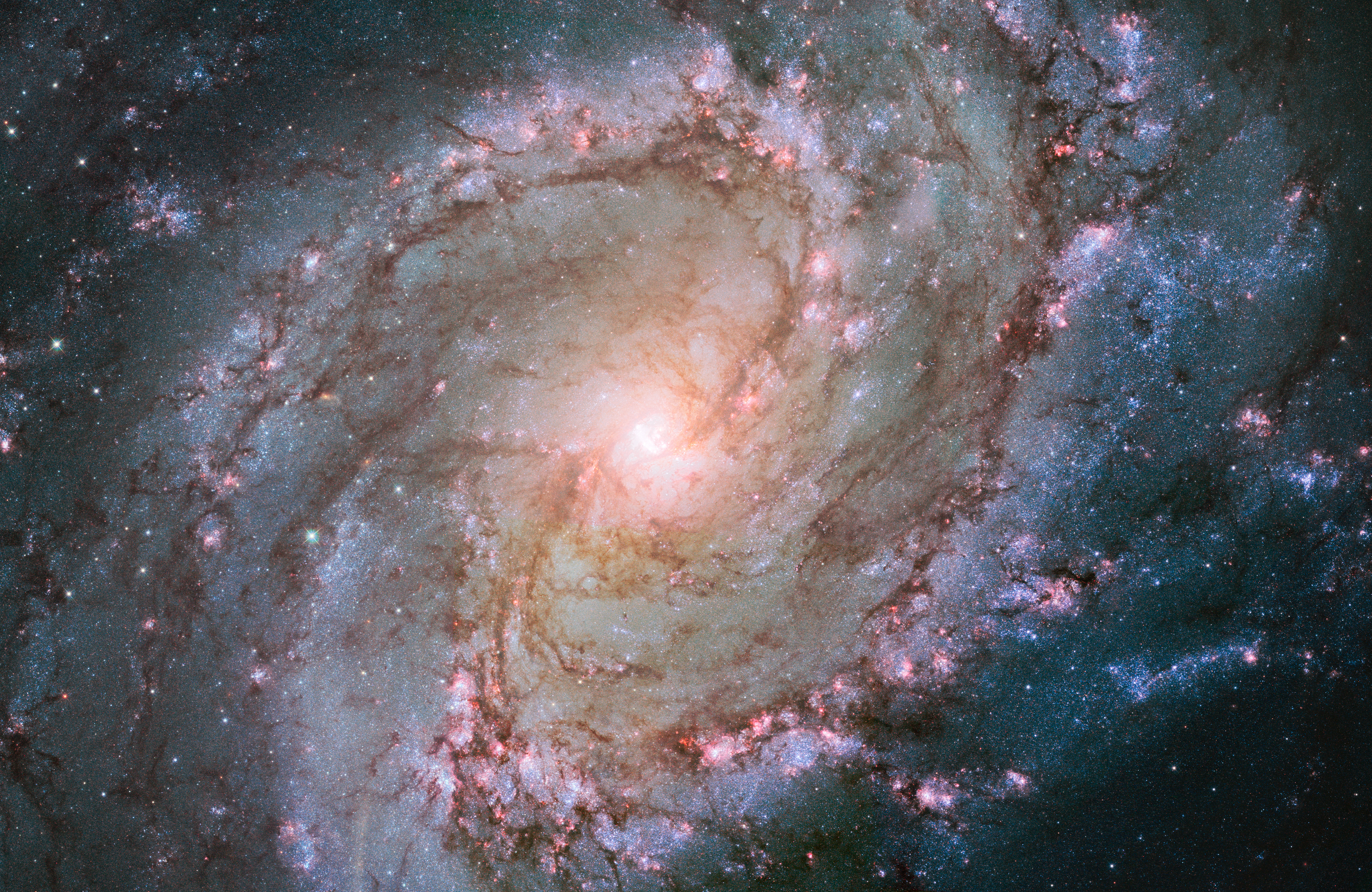
This new Hubble image shows the scatterings of bright stars and thick dust that make up spiral galaxy Messier 83 (M83), otherwise known as the Southern Pinwheel Galaxy. One of the largest and closest barred spirals to us, this galaxy is dramatic and mysterious; it has hosted a large number of supernova explosions, and appears to have a double nucleus lurking at its core. M83 is not one to blend into the background. Located some 15 million light-years away in the constellation of Hydra (The Sea Serpent), it is one of the most conspicuous galaxies of its type in our skies. It is a prominent member of a group of galaxies known as the Centaurus A/M83 Group, which also counts dusty Centaurus A and irregular NGC 5253 as members. Spiral galaxies come in a range of types depending on their appearance and structure - for example, how tightly wound their arms are, and the characteristics of the central bulge. Messier 83 has a "bar" of stars slicing through its center, leading to its classification as a barred spiral. The Milky Way also belongs to this category. These bars are thought to act a bit like a funnel, channelling gas inwards towards the galaxy's center. This gas is then used to form new stars and also to feed the galaxy's central black hole, explaining why many barred or intermediate spirals - including M83 - have very active and luminous central regions. However, M83's center is mysterious and unusual; the supermassive black hole at its heart is not alone. This striking spiral displays a phenomenon known as a double nucleus - a feature that has also been spotted in the Andromeda Galaxy, the nearest spiral galaxy to us. This does not mean that M83 contains two central black holes, but that its single supermassive black hole may be ringed by a lopsided disc of stars, which orbits around the black hole and creates the appearance of a dual core. As well as this double nucleus, M83 has hosted quite a few supernova explosions - six in total that we have observed (SN 1923A, SN 1945B, SN 1950B, SN 1957D, SN 1968L, and SN 1983N). This number is matched by only two other galaxies: M61 which also has six, and NGC 6946, which tops the list with nine. As well as these explosions, almost 300 supernova remnants - the older leftovers from exploded stars - have been found within M83, detected using the data that make up this image. These observations are being used to study the life cycle of stars. As well as these old remnants, some 3000 star clusters have been identified in M83, some of which are very young at under 5 million years old.
Image Credit: NASA, ESA, and the Hubble Heritage Team (STScI/AURA)
Acknowledgement: William Blair (Johns Hopkins University)
Image enhancement: Jean-Baptiste Faure

Saturday, March 30, 2013

Spiral Galaxy NGC 3982

Spiral Galaxy NGC 3982
Click on the image for full resolution (2.3 MB)

Though the universe is chock full of spiral-shaped galaxies, no two look exactly the same. This face-on spiral galaxy, called NGC 3982, is striking for its rich tapestry of star birth, along with its winding arms. The arms are lined with pink star-forming regions of glowing hydrogen, newborn blue star clusters, and obscuring dust lanes that provide the raw material for future generations of stars. The bright nucleus is home to an older population of stars, which grow ever more densely packed toward the center. NGC 3982 is located about 68 million light-years away in the constellation Ursa Major. The galaxy spans about 30,000 light-years, one-third of the size of our Milky Way galaxy. This colour image is composed of exposures taken by the Hubble Space Telescope's Wide Field Planetary Camera 2 (WFPC2), the Advanced Camera for Surveys (ACS), and the Wide Field Camera 3 (WFC3). The observations were taken between March 2000 and August 2009. The rich colour range comes from the fact that the galaxy was photographed invisible and near-infrared light. Also used was a filter that isolates hydrogen emission that emanates from bright star-forming regions dotting the spiral arms.
The full resolution image weighs 2.3 MB, so please be patient when downloading!
Image Credit: NASA, ESA, and the Hubble Heritage Team (STScI/AURA)
Image enhancement: Jean-Baptiste Faure