Showing posts with label Elliptical Galaxies. Show all posts

Sunday, July 12, 2026

Galaxy Centaurus A as seen by Webb

Galaxy Centaurus A as seen by Webb
Click the image for higher resolution (2.6 MB)

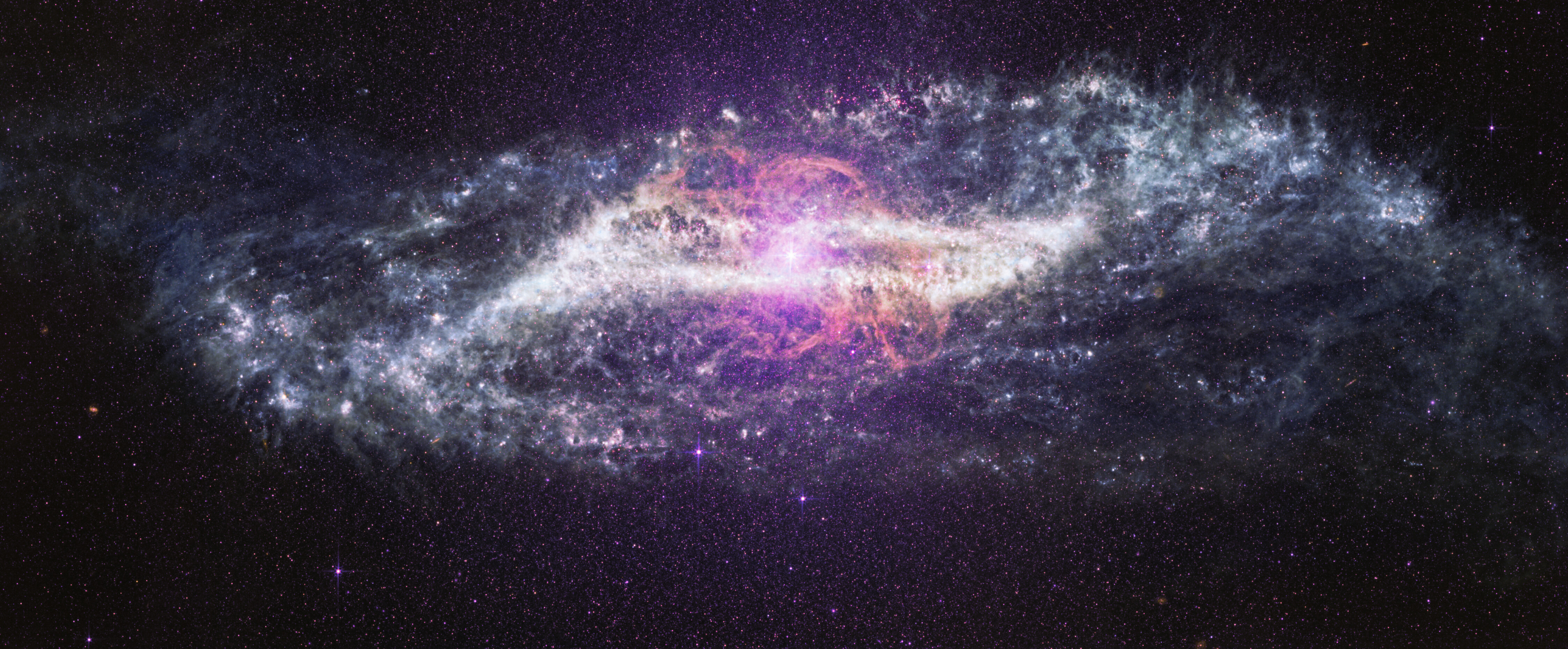
The James Webb Space Telescope's Mid-Infrared Instrument (MIRI) reveals the nearby galaxy Centaurus A, exposing the dusty structures and hidden activity that shape this unusual system. Webb's infrared vision pierces thick lanes of dust that obscure much of the galaxy in visible light, unveiling intricate filaments, loops, and glowing clouds of warm dust stretching across its center. At the heart of the galaxy, an actively feeding supermassive black hole shines brightly, surrounded by complex structures sculpted by a past galactic collision and ongoing activity.
This image of the galaxy Centaurus A stretches across a black background filled with thousands of tiny purple, pink, and white points of light. The galaxy is brightest at its center, where a brilliant white and pale pink glow radiates outward. Eight diffraction spikes extend from the central glow. Delicate loops and wispy ribbons of pink and lavender arc above and below the center of the image in the shape of an "S". A band of gray and white dust in the shape of a parallelogram cuts across the middle of the galaxy. Mottled patches and bright knots are scattered throughout the dusty band. The galaxy's outer edges fade into soft, cloud-like plumes with feathery textures that stretch toward the left and right sides of the image. Against the surrounding darkness, a few bright foreground stars shine with Webb's distinctive diffraction spikes, while countless fainter stars create a speckled backdrop.
Image Credit: NASA, ESA, CSA, STScI
Image Processing: A. Pagan (STScI), J. Depasquale (STScI), M. Garcia Marin (ESA Office at STScI)
Image enhancement: Jean-Baptiste Faure

Saturday, January 6, 2024

Galaxy Cluster SDSS J1226+2152

Galaxy Cluster SDSS J1226+2152
Click the image for higher resolution (1.3 MB)

The vast galaxy cluster SDSS J1226+2152 in the constellation Coma Berenices is distorting the images of distant background galaxies into streaks and smears of light in this image from the James Webb Space Telescope. This is a spectacular example of gravitational lensing, a phenomenon which occurs when a massive celestial object such as a galaxy cluster deforms spacetime and causes the path of light from more distant galaxies to be deflected, almost as if a monumental lens was redirecting it. This image is from a set of early science observations with Webb.
One of the most notable lensed galaxies in this rich field is named SGAS J12265.3+215220. In this image, it's the innermost lensed galaxy, just above and to the right of the central galaxy. This lies far beyond the foreground cluster in distance, giving us a view into the galaxy roughly two billion years after the big bang. Astronomers are now using this eagerly-awaited hoard of bright, gravitationally-lensed galaxies from Webb to explore star formation in distant galaxies.
Just like their optical namesakes, gravitational lenses can magnify as well as distort distant galaxies. This allows astronomers to observe the finer details of galaxies that would usually be too distant to clearly resolve. In the case of SGAS J122651.3+215220, the combination of gravitational lensing and Webb's unprecedented observational capabilities will allow astronomers to measure where, and how fast, stars are forming and also to gain an insight into the environments which support star formation in lensed galaxies.
Amid this spectacular display of gravitational lensing, a menagerie of spiral and elliptical galaxies in all shapes and sizes surround the galaxy cluster. Webb's sensitive infrared instruments have proven prodigious in picking out distant galaxies from the darkness of space. None of the tiny pinpricks in the patch of sky captured here is a star: each one is a galaxy. The variety of colours of the small, dim galaxies gives us hints at what we are seeing: many of the paler white galaxies will date back to the period of intense star formation known as cosmic noon, some two to three billion years after the big bang, while the few small orange and red systems are probably from even earlier in the Universe's history.
Image Credit: ESA/Webb, NASA and CSA, J. Rigby and the JWST TEMPLATES team
Image enhancement: Jean-Baptiste Faure

Thursday, July 14, 2022

Stephan's Quintet as seen by the Webb telescope

Stephan's Quintet as seen by the Webb telescope
Click the image for full resolution (181.64 MB)

An enormous mosaic of Stephan's Quintet is the largest image to date from NASA's James Webb Space Telescope, covering about one-fifth of the Moon's diameter. It contains over 150 million pixels and is constructed from almost 1,000 separate image files. The visual grouping of five galaxies was captured by Webb's Near-Infrared Camera (NIRCam) and Mid-Infrared Instrument (MIRI).
With its powerful, infrared vision and extremely high spatial resolution, Webb shows never-before-seen details in this galaxy group. Sparkling clusters of millions of young stars and starburst regions of fresh star birth grace the image. Sweeping tails of gas, dust and stars are being pulled from several of the galaxies due to gravitational interactions. Most dramatically, Webb's MIRI instrument captures huge shock waves as one of the galaxies, NGC 7318B, smashes through the cluster. These regions surrounding the central pair of galaxies are shown in the colors red and gold.
This composite NIRCam-MIRI image uses two of the three MIRI filters to best show and differentiate the hot dust and structure within the galaxy. MIRI sees a distinct difference in color between the dust in the galaxies versus the shock waves between the interacting galaxies. The image processing specialists at the Space Telescope Science Institute in Baltimore opted to highlight that difference by giving MIRI data the distinct yellow and orange colors, in contrast to the blue and white colors assigned to stars at NIRCam's wavelengths.  
Stephan's Quintet as seen by the Webb telescope – NIRCam only

Right: NIRCam image. Click the image for full resolution (172.05 MB)

Together, the five galaxies of Stephan's Quintet are also known as the Hickson Compact Group 92 (HCG 92). Although called a “quintet,” only four of the galaxies are truly close together and caught up in a cosmic dance. The fifth and leftmost galaxy, called NGC 7320, is well in the foreground compared with the other four. NGC 7320 resides 40 million light-years from Earth, while the other four galaxies (NGC 7317, NGC 7318A, NGC 7318B, and NGC 7319) are about 290 million light-years away. This is still fairly close in cosmic terms, compared with more distant galaxies billions of light-years away. Studying these relatively nearby galaxies helps scientists better understand structures seen in a much more distant universe.
This proximity provides astronomers a ringside seat for witnessing the merging of and interactions between galaxies that are so crucial to all of galaxy evolution. Rarely do scientists see in so much exquisite detail how interacting galaxies trigger star formation in each other, and how the gas in these galaxies is being disturbed. Stephan’s Quintet is a fantastic “laboratory” for studying these processes fundamental to all galaxies.
Tight groups like this may have been more common in the early universe when their superheated, infalling material may have fueled very energetic black holes called quasars. Even today, the topmost galaxy in the group – NGC 7319 – harbors an active galactic nucleus, a supermassive black hole that is actively accreting material.
In NGC 7320, the leftmost and closest galaxy in the visual grouping, NIRCam was remarkably able to resolve individual stars and even the galaxy's bright core. Old, dying stars that are producing dust clearly stand out as red points with NIRCam.
The new information from Webb provides invaluable insights into how galactic interactions may have driven galaxy evolution in the early universe. As a bonus, NIRCam and MIRI revealed a vast sea of many thousands of distant background galaxies reminiscent of Hubble's Deep Fields.
Image Credit: NASA, ESA, CSA, and STScI
Image enhancement: Jean-Baptiste Faure

Monday, April 20, 2020

Dwarf Elliptical Galaxy PGC 29388

Dwarf Elliptical Galaxy PGC 29388
Click on the image for higher resolution (3.6 MB)

As beautiful as the surrounding space may be, the sparkling galaxy in the foreground of this image from the Hubble Space Telescope undeniably steals the show.
This spotlight-hogging galaxy, seen set against a backdrop of more distant galaxies of all shapes and sizes, is known as PGC 29388. Although it dominates in this image, this galaxy is a small player on the cosmic stage, and is known as a dwarf elliptical galaxy. As the "dwarf" moniker suggests, the galaxy is on the smaller side, and boasts a "mere" 100 million to a few billion stars – a very small number indeed when compared to the Milky Way's population of around 250 to 400 billion stellar residents.
Image Credit: ESA/Hubble and NASA, T. Armandroff
Image enhancement: Jean-Baptiste Faure

Saturday, November 23, 2019

Elliptical Galaxy M87 with Black-Hole-Powered Jet

Elliptical Galaxy M87 with Black-Hole-Powered Jet
Click on the image for higher resolution (2.2 MB)

The monstrous elliptical galaxy M87 is the home of several trillion stars, a supermassive black hole, and family of 13,000 globular star clusters. M87 is the dominant galaxy at the center of the neighbouring Virgo Cluster of galaxies, which contains some 2,000 galaxies. Amid the smooth yellow population of older stars, the two features that stand out most in this Hubble Space Telescope image of M87 are its soft blue jet and the myriad of starlike globular clusters scattered throughout the image.
The jet is a black-hole-powered stream of material that is being ejected from the core of the galaxy. As gaseous material from the center of the galaxy accretes onto the black hole, the resultant energy released produces a fire-hose stream of subatomic particles that are accelerated to velocities near the speed of light. Being in the center of the Virgo Cluster of galaxies, M87 may have accumulated some of its globular clusters by gravitationally pulling them from nearby dwarf galaxies that seem to be devoid of globulars today. The 120,000-light-year-diameter galaxy lies at a distance of 54 million light-years from the Sun in the spring constellation Virgo.
This image, which was made with Hubble's Advanced Camera for Surveys, is a composite of individual filtered data that cover the visible and infrared portions of the spectrum.
Image Credit: NASA, ESA, and the Hubble Heritage Team (STScI/AURA) Acknowledgment: P. Cote (Herzberg Institute of Astrophysics) and E. Baltz (Stanford University)
Image enhancement: Jean-Baptiste Faure

Friday, November 15, 2019

Elliptical Galaxy M59

Elliptical Galaxy M59
Click on the image for higher resolution (2.0 MB)

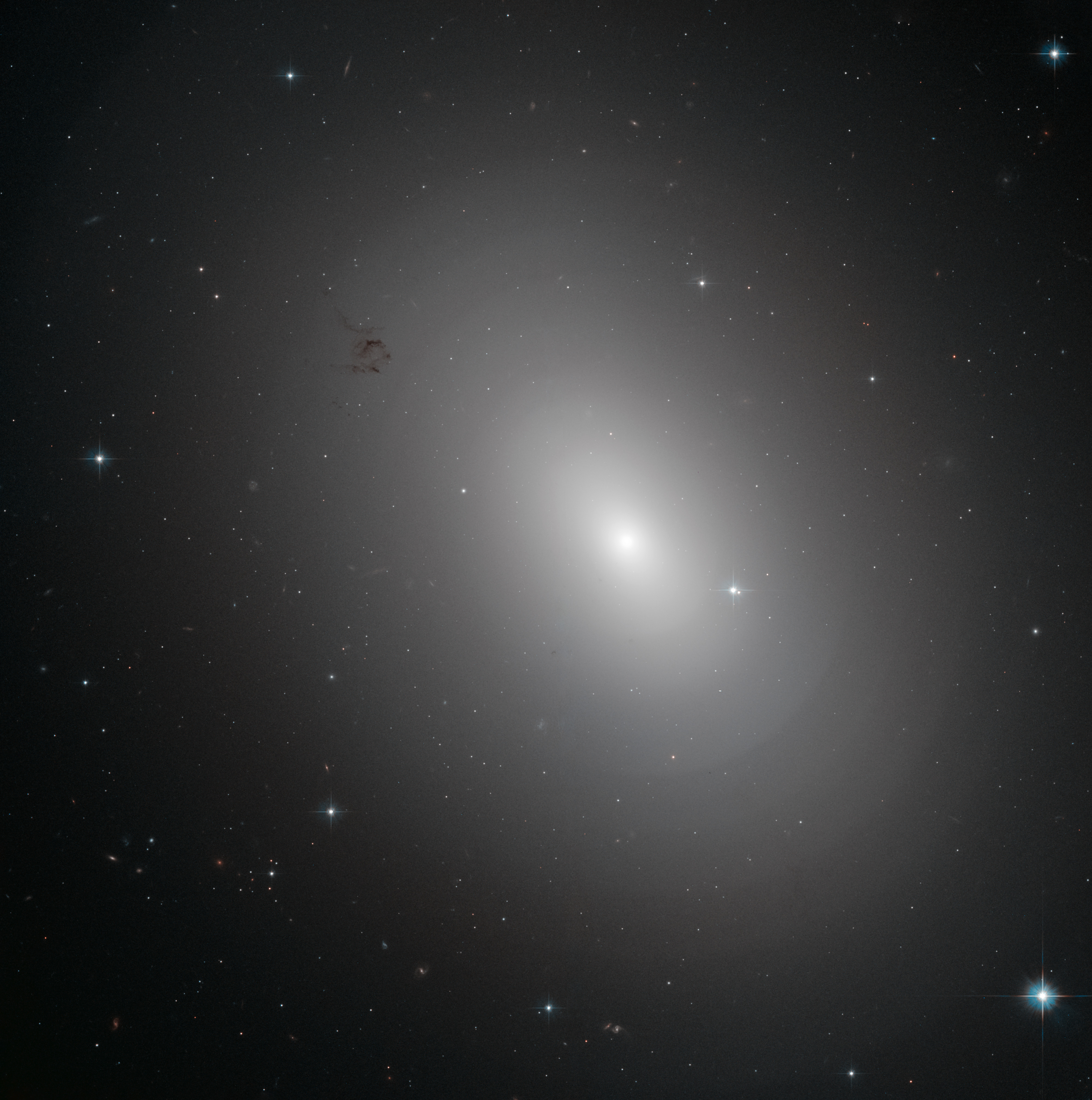
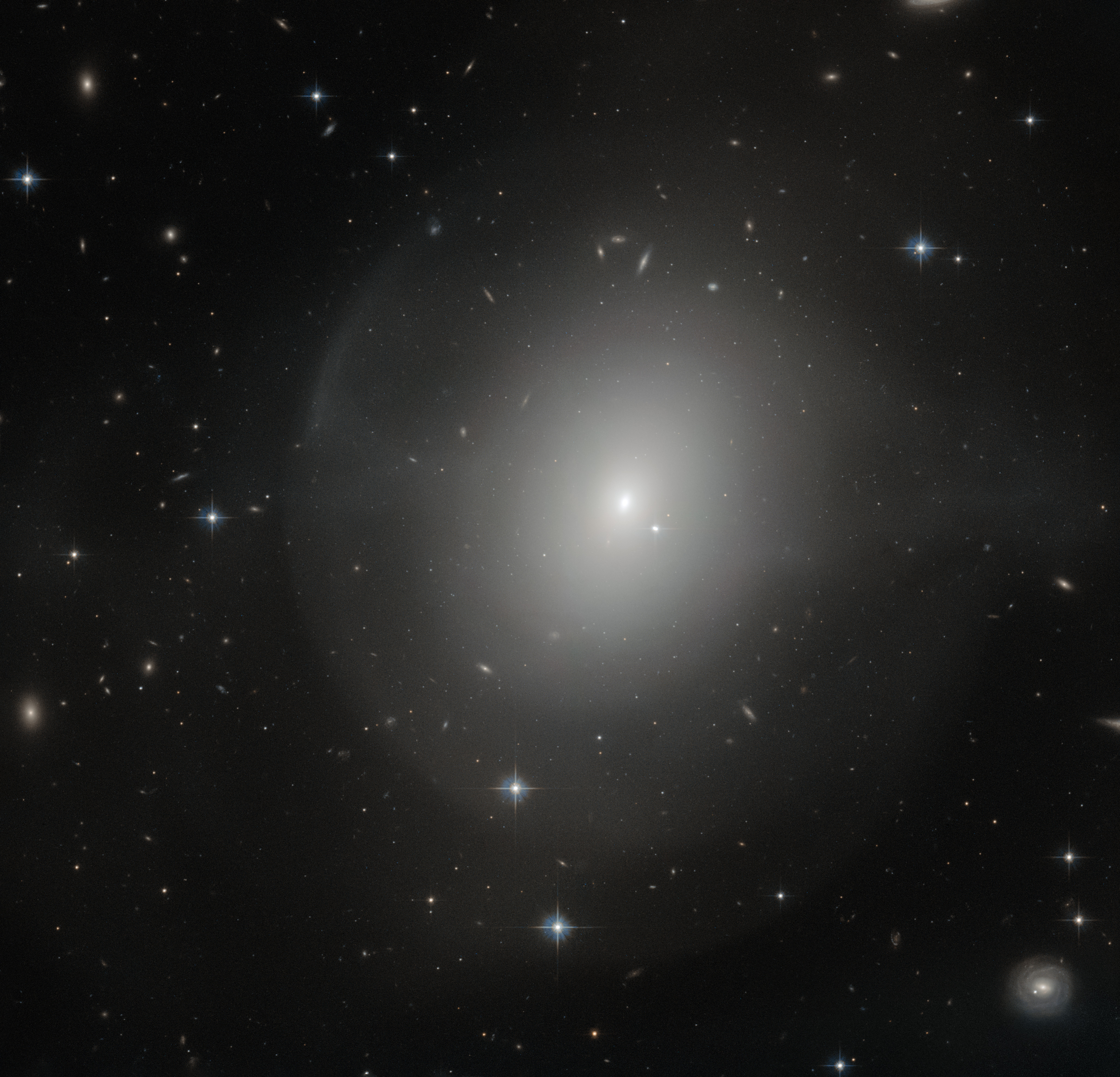
This luminous orb is the galaxy NGC 4621, better known as M59 (Messier 59). As this latter moniker indicates, the galaxy was listed in the famous catalogue of deep-sky objects compiled by French comet-hunter Charles Messier in 1779. However, German astronomer Johann Gottfried Koehler is credited with discovering the galaxy just days before Messier added it to his collection.
Modern observations show that M59 is an elliptical galaxy, one of the three main kinds of galaxies along with spirals and irregulars. Ellipticals tend to be the most evolved of the trio, full of old, red stars and exhibiting little or no new star formation. M59, however, bucks this trend somewhat; the galaxy does show signs of star formation, with some newborn stars residing within a disc near the core.
Located in the 2,000-strong Virgo Cluster of galaxies within the constellation of Virgo (The Virgin), M59 lies approximately 50 million light-years away from us. This image was taken by the Hubble Space Telescope's Advanced Camera for Surveys.
Image Credit: ESA/Hubble and NASA, P. Cote
Image enhancement: Jean-Baptiste Faure

Sunday, December 11, 2016

Elliptical Galaxy NGC 4696

Elliptical Galaxy NGC 4696
Click on the image for higher resolution

This picture, taken by Hubble's Wide Field Camera 3 (WFC3), shows NGC 4696, the largest galaxy in the Centaurus Cluster. The new images taken with Hubble show the dusty filaments surrounding the center of this huge galaxy in greater detail than ever before. These filaments loop and curl inwards in an intriguing spiral shape, swirling around the supermassive black hole at such a distance that they are dragged into and eventually consumed by the black hole itself. NGC 4696 is a member of the Centaurus galaxy cluster, a swarm of hundreds of galaxies all sitting together, bound together by gravity, about 150 million light-years from Earth and located in the constellation of Centaurus. Despite the cluster's size, NGC 4696 still manages to stand out from its companions – it is the cluster's brightest member, known for obvious reasons as the Brightest Cluster Galaxy. This puts it in the same category as some of the biggest and brightest galaxies known in the Universe. Even if NGC 4696 keeps impressive company, it has a further distinction: the galaxy's unique structure.
Previous observations have revealed curling filaments that stretch out from its main body and carve out a cosmic question mark in the sky, the dark tendrils encircling a brightly glowing center. An international team of scientists, led by astronomers from the University of Cambridge, UK, have now used new observations from the Hubble Space Telescope to explore this thread-like structure in more detail. They found that each of the dusty filaments has a width of about 200 light-years, and a density some 10 times greater than the surrounding gas. These filaments knit together and spiral inwards towards the center of NGC 4696, connecting the galaxy's constituent gas to its core. In fact, it seems that the galaxy's core is actually responsible for the shape and positioning of the filaments themselves. At the center of NGC 4696 lurks an active supermassive black hole. This floods the galaxy's inner regions with energy, heating the gas there and sending streams of heated material outwards. It appears that these hot streams of gas bubble outwards, dragging the filamentary material with them as they go. The galaxy's magnetic field is also swept out with this bubbling motion, constraining and sculpting the material within the filaments. At the very center of the galaxy, the filaments loop and curl inwards in an intriguing spiral shape, swirling around the supermassive black hole at such a distance that they are dragged into and eventually consumed by the black hole itself. Understanding more about filamentary galaxies such as NGC 4696 may help us to better understand why so many massive galaxies near to us in the Universe appear to be dead; rather than forming newborn stars from their vast reserves of gas and dust, they instead sit quietly, and are mostly populated with old and aging stars. This is the case with NGC 4696. It may be that the magnetic structure flowing throughout the galaxy stops the gas from creating new stars.
Image Credit: NASA, ESA/Hubble, A. Fabian
Image enhancement: Jean-Baptiste Faure

Wednesday, November 18, 2015

Elliptical Galaxy NGC 3610

Elliptical Galaxy NGC 3610
Click on the image for higher resolution (2.9 MB)

At the center of this amazing image is the elliptical galaxy NGC 3610. Surrounding the galaxy are a wealth of other galaxies of all shapes. There are spiral galaxies, galaxies with a bar in their central regions, distorted galaxies and elliptical galaxies, all visible in the background. In fact, almost every bright dot in this image is a galaxy – the few foreground stars are clearly distinguishable due to the diffraction spikes that overlay their images. NGC 3610 is of course the most prominent object in this image – and a very interesting one at that! Discovered in 1793 by William Herschel, it was later found that this elliptical galaxy contains a disc. This is very unusual, as discs are one of the main distinguishing features of a spiral galaxy. And NGC 3610 even hosts a memarkable bright disc. The reason for the peculiar shape of NGC 3610 stems from its formation history. When galaxies form, they usually resemble our galaxy, the Milky Way, with flat discs and spiral arms where star formation rates are high and which are therefore very bright. An elliptical galaxy is a much more disordered object which results from the merging of two or more disc galaxies. During these violent mergers most of the internal structure of the original galaxies is destroyed. The fact that NGC 3610 still shows some structure in the form of a bright disc implies that it formed only a short time ago. The galaxy's age has been put at around four billion years and it is an important object for studying the early stages of evolution in elliptical galaxies.
Image Credit: ESA/Hubble and NASA, Acknowledgement: Judy Schmidt (Geckzilla)
Image enhancement: Jean-Baptiste Faure

Tuesday, May 12, 2015

Elliptical Galaxy NGC 3923

Elliptical Galaxy NGC 3923
Click on the image for full resolution (3.7 MB)

The glowing object in this image is an elliptical galaxy called NGC 3923. It is located over 90 million light-years away in the constellation of Hydra. NGC 3923 is an example of a shell galaxy where the stars in its halo are arranged in layers. Finding concentric shells of stars enclosing a galaxy is quite common and is observed in many elliptical galaxies. In fact, every tenth elliptical galaxy exhibits this onion-like structure, which has never been observed in spiral galaxies. The shell-like structures are thought to develop as a consequence of galactic cannibalism, when a larger galaxy ingests a smaller companion. As the two centers approach, they initially oscillate about a common center, and this oscillation ripples outwards forming the shells of stars just as ripples on a pond spread when the surface is disturbed. NGC 3923 has over twenty shells, with only a few of the outer ones visible in this image and its shells are much more subtle than those of other shell galaxies. The shells of this galaxy are also interestingly symmetrical, while other shell galaxies are more skewed. A version of this image was entered into the Hubble's Hidden Treasures image processing competition by contestant Judy Schmidt.
Image Credit: ESA/Hubble and NASA
Acknowledgement: Judy Schmidt
Image enhancement: Jean-Baptiste Faure

Monday, April 13, 2015

Elliptical Galaxy NGC 2865

Elliptical Galaxy NGC 2865
Click on the image for full resolution (5.7 MB)

This Hubble Space Telescope image shows an elliptical galaxy called NGC 2865. It lies just over 100 million light-years away from us in the constellation of Hydra – The Sea Serpent – and was discovered in 1835 by astronomer John Herschel. Elliptical galaxies are usually filled with old, dying stars. NGC 2865, however, is relatively youthful and dynamic, with a rapidly rotating disc full of young stars and metal-rich gas. For an elliptical galaxy it contains an unusually high number of young stars – suggesting that a galaxy-wide starburst took place about one billion years ago. The starburst itself was induced by a merger between a spiral galaxy, similar to our galaxy, the Milky Way, and an elliptical galaxy some three times more massive – the progenitor galaxy of NGC 2865. The new gas from the spiral galaxy revitalised the dying population of old stars in the elliptical galaxy, and several new generations of stars were born. The faint halo surrounding the galaxy, visible in this image, is also a result of this merger. It consists of cold gas that was ripped away from the spiral galaxy during the merging process. The gas now forms an almost closed shell around its host galaxy. A version of this image was entered into the Hubble's Hidden Treasures image processing competition by contestant Judy Schmidt.
Image Credit: ESA/Hubble and NASA
Acknowledgement: Judy Schmidt
Image enhancement: Jean-Baptiste Faure

Thursday, July 31, 2014

Centaurus A and its halo

Centaurus A and its halo
Click on the image for full resolution (7.6 MB)

This image shows the stunning elliptical galaxy Centaurus A. Recently, astronomers have used the Hubble Space Telescope to probe the outskirts of this galaxy to learn more about its dim halo of stars. The galaxy's halo of stars has been found to reach much further than expected, extending across 4 degrees in the sky - equivalent to eight times the apparent width of the Moon, or almost twice the width of this image. This image is a composite of images from Digitized Sky Survey 2 (DSS2), the MPG/ESO 2.2-meter telescope, and the NASA/ESA Hubble Space Telescope's Advanced Camera for Surveys (ACS).
Image Credit: ESA/Hubble, NASA, Digitized Sky Survey, MPG/ESO
Acknowledgement: Davide de Martin
Image enhancement: Jean-Baptiste Faure
Tuesday, July 15, 2014

Galaxy Cluster [HGO2008]SDSS J1531+3414

Galaxy Cluster [HGO2008]SDSS J1531+3414
Click on the image for full resolution (8.6 MB)

This new Hubble Space Telescope image shows two galaxies from the cluster SDSS J1531+3414. The two galaxies have been found to be merging into one and a "chain" of young stellar superclusters are seen winding around the galaxies' nuclei. The galaxies are surrounded by an egg-shaped blue ring caused by the immense gravity of the cluster bending light from other galaxies beyond it. Finding two elliptical galaxies merging is rare, but it is even rarer to find a merger between ellipticals rich enough in gas to induce star formation. Galaxies in clusters are generally thought to have been deprived of their gaseous contents; a process that Hubble has recently seen in action. Yet, in this image, not only have two elliptical galaxies been caught merging but their newborn stellar population is also a rare breed. The stellar infants - thought to be a result of the merger - are part of what is known as "beads on a string" star formation. This type of formation appears as a knotted rope of gaseous filaments with bright patches of new stars and the process stems from the same fundamental physics which causes rain to fall in droplets, rather than as a continuous column. Nineteen compact clumps of young stars make up the length of this "string", woven together with narrow filaments of hydrogen gas. The star formation spans 100,000 light years, which is about the size of our galaxy, the Milky Way. The strand is dwarfed, however, by the ancient, giant merging galaxies that it inhabits. They are about 330,000 light years across, nearly three times larger than our own galaxy. This is typical for galaxies at the center of massive clusters, as they tend to be the largest galaxies in the Universe. The electric blue arcs making up the spectacular egg-like shape framing these objects are a result of the galaxy cluster's immense gravity. The gravity warps the space around it and creates bizarre patterns using light from more distant galaxies. Astronomers have ruled out the possibility that the blue strand is also just a lensed mirage from distant galaxies and now their challenge is to understand the origin of the cold gas that is fuelling the growth of the stellar superclusters. Was the gas already in the merging galaxies? Did it condense like rain from the rapidly cooling X-ray plasma surrounding the two galaxies? Or, did it cool out of a shock in the X-ray gas as the ten-million-degree gaseous halos surrounding the galaxies collided together? Future observations with both space- and ground-based observatories are needed to unravel this mystery.
Image Credit: NASA, ESA/Hubble and Grant Tremblay (European Southern Observatory)
Image enhancement: Jean-Baptiste Faure

Saturday, October 12, 2013

Elliptical Galaxy PGC 6240

Elliptical Galaxy PGC 6240
Click on the image for full resolution (3.8 MB)

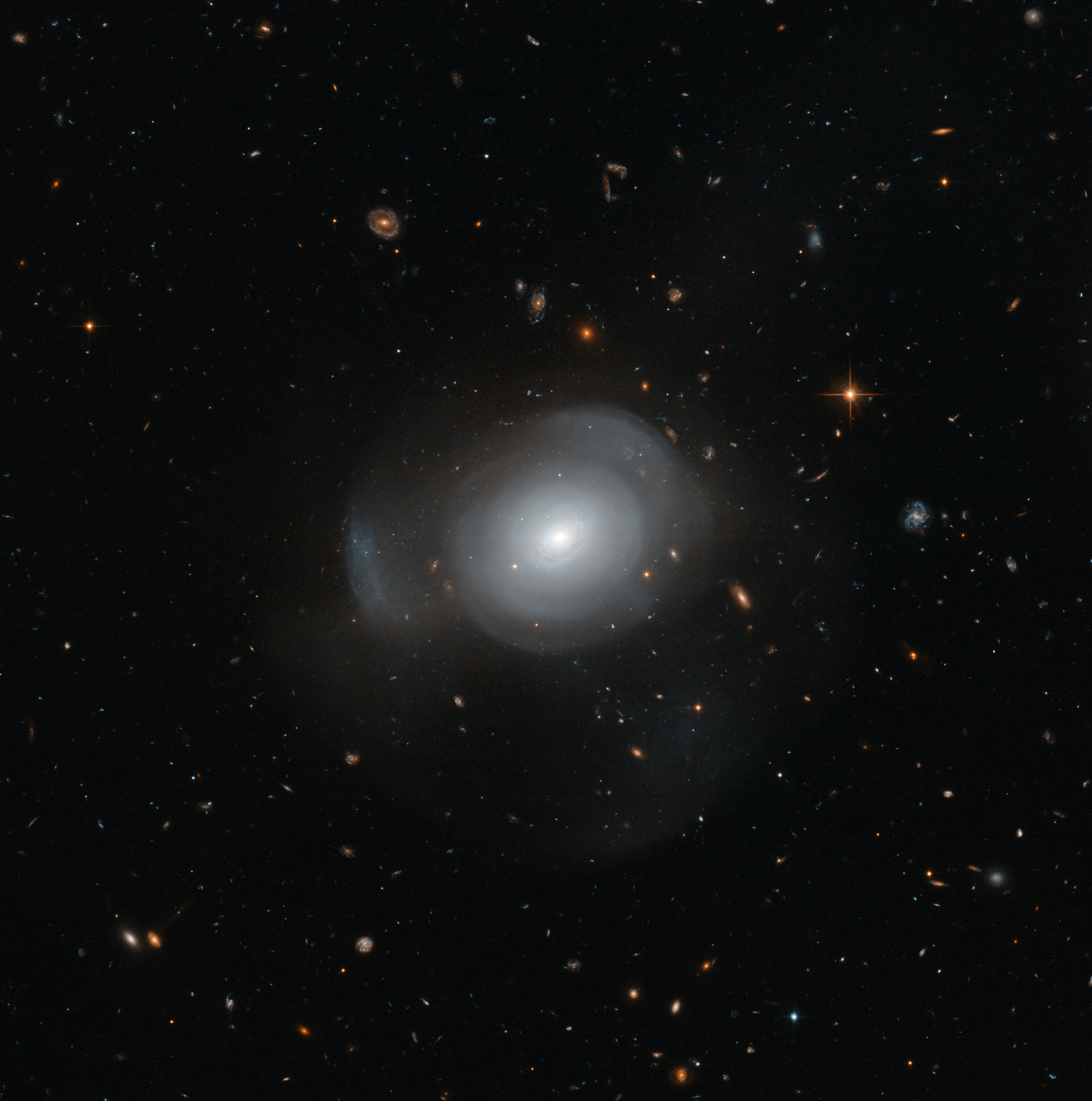
The beautiful, petal-like shells of galaxy PGC 6240 are captured here in intricate detail by the Hubble Space Telescope, set against a sky full of distant background galaxies. PGC 6240 is an elliptical galaxy approximately 350 000 000 light years away in the southern constellation of Hydrus (The Water Snake). Also visible in this region are numerous background galaxies, speckled across the sky behind PGC 6240. Even though these bodies are at such vast distances from us, it is possible to make out the structure of many of the galaxies, especially the small spirals that stand out colourfully against the dark sky. PGC 6240 is orbited by a number of globular clusters that contain both young and old stars - thought to be a result of a galactic merger in the recent past. PGC 6240 is an elliptical galaxy that resembles a pale rose in the sky, with hazy shells of stars encircling a very bright center. Some of these shells are packed close to the center of the galaxy, while others are flung further out into space. Several wisps of material have been thrown so far that they appear to be almost detached from the galaxy altogether. Astronomers have studied PGC 6240 in detail due to this structure, and also because of its surrounding globular clusters - dense, tightly packed groups of gravitationally bound stars that orbit galaxies. Over 150 of these clusters orbit our own galaxy, the Milky Way, all composed of old stars. All the globular clusters around a certain galaxy form at approximately the same time, giving them all the same age. This is echoed within the clusters - all the stars within a single cluster form at around the same time, too. Because of this, most galaxies have cluster populations of pretty similar ages, both in terms of overall cluster, and individual stars. However, PGC 6240 is unusual in that its clusters are varied - while some do contain old stars, as expected, others contain younger stars which formed more recently. The most likely explanation for both the galaxy's stacked shell structure and the unexpectedly young star clusters is that PGC 6240 merged with another galaxy at some point in the recent past. Such a merger would send ripples through the galaxy and disrupt its structure, forming the concentric shells of material seen here. It would also ignite a strong burst of star formation in the galaxy, which would then trigger similar activity in nearby space - leading to the creation of new, younger globular clusters around PGC 6240.
Image Credit: ESA/Hubble and NASA
Acknowledgement: Judy Schmidt
Image enhancement: Jean-Baptiste Faure

Monday, November 12, 2012

Elliptical Galaxy 4C 73.08

Elliptical Galaxy 4C 73.08
Click on the image for full resolution (7.5 MB)

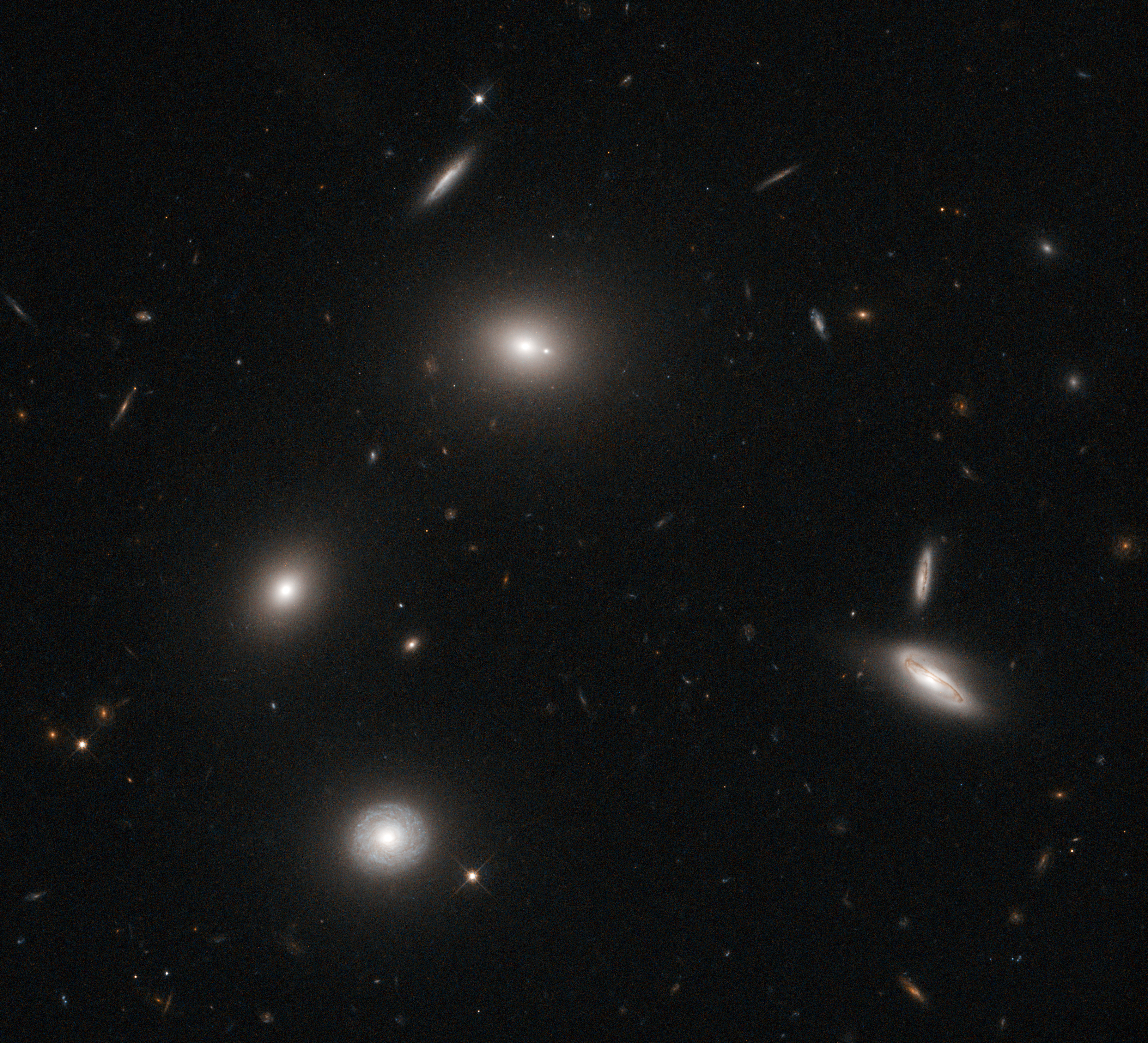
Luminous galaxies glow like fireflies on a dark night in this image snapped by the Hubble Space Telescope. The central galaxy in this image is a gigantic elliptical galaxy designated 4C 73.08. A prominent spiral galaxy seen from "above" shines in the lower part of the image, while examples of galaxies viewed edge-on also populate the cosmic landscape. In the optical and near-infrared light captured to make this image, 4C 73.08 does not appear all that beastly. But when viewed in longer wavelengths the galaxy takes on a very different appearance. Dust-piercing radio waves reveal plumes emanating from the core, where a supermassive black hole spews out twin jets of material. 4C 73.08 is classified as a radio galaxy as a result of this characteristic activity in the radio part of the electromagnetic spectrum. Astronomers must study objects such as 4C 73.08 in multiple wavelengths in order to learn their true natures, just as seeing a firefly's glow would tell a scientist only so much about the insect. Observing 4C 73.08 in visible light with Hubble illuminates galactic structure as well as the ages of constituent stars, and therefore the age of the galaxy itself. 4C 73.08 is decidedly redder than the prominent, bluer spiral galaxy in this image. The elliptical galaxy's redness comes from the presence of many older, crimson stars, which shows that 4C 73.08 is older than its spiral neighbour. The image was taken using Hubble's Wide Field Camera 3 through two filters: one which captures green light, and one which captures red and near-infrared light.
The full resolution image weighs 7.5 MB, so please be patient when downloading!
Credit: ESA/Hubble and NASA
Image enhancement: Jean-Baptiste Faure

Friday, September 7, 2012

Arp 116, a peculiar Galaxy Pair

Arp 116, a peculiar Galaxy Pair
Click on the image for full resolution (8.5 MB)

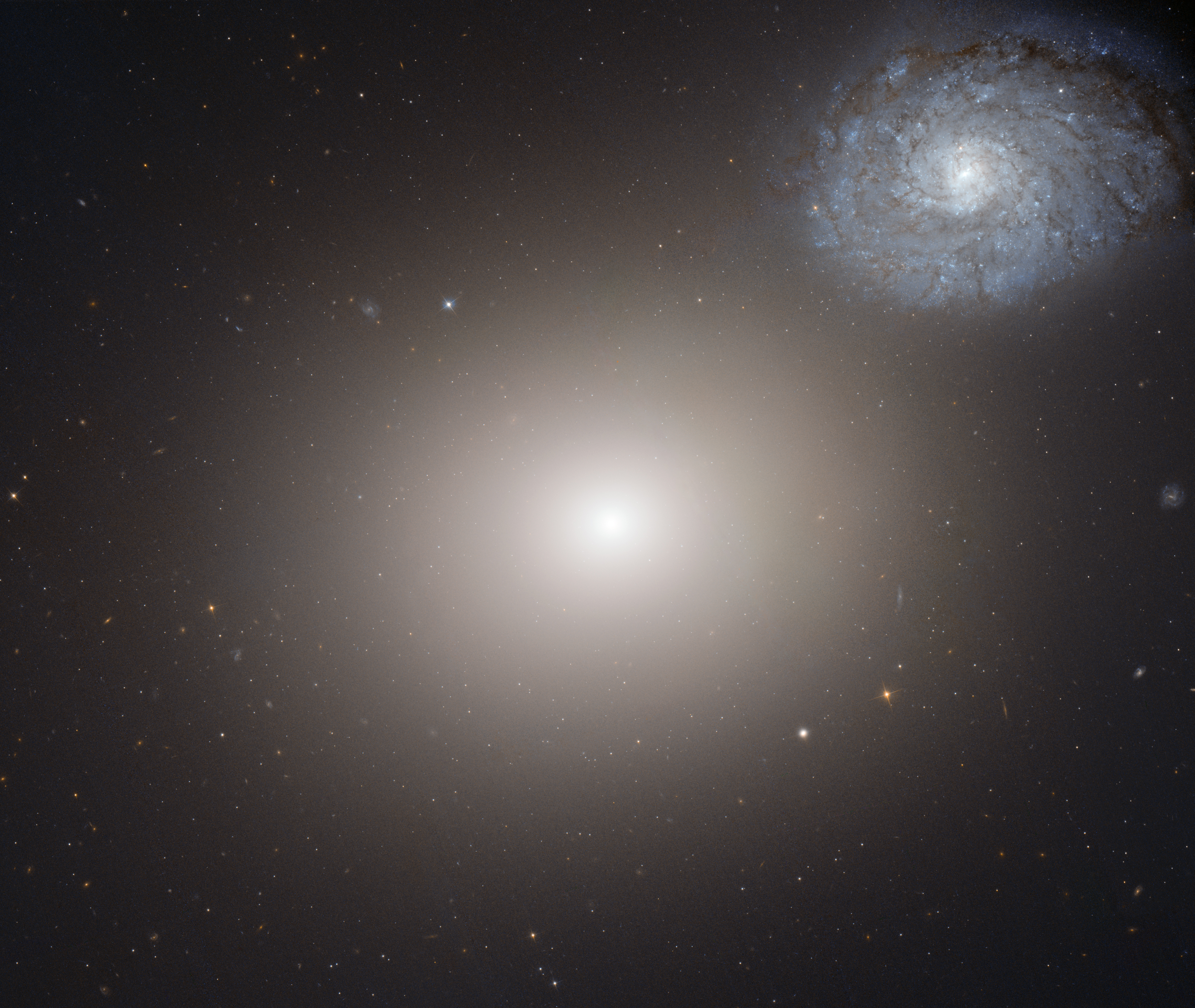
Two very different galaxies feature in this image taken by the NASA/ESA Hubble Space Telescope, forming a peculiar galaxy pair called Arp 116. Arp 116 is composed of a giant elliptical galaxy known as M60 (Messier 60), and a much smaller spiral galaxy, NGC 4647. Being a typical elliptical galaxy, M60 on its own may not be very exciting to look at, but together with its adjacent spiral friend, the pair becomes a rather interesting feature in the night sky. M60 is very bright - the third brightest in the Virgo cluster of galaxies, a collection of more than 1300 galaxies. It is noticeably larger than its neighbour, and has a far higher mass of stars. M 60, like other elliptical galaxies, has a golden colour because of the many old, cool and red stars in it. NGC 4647, on the other had, has many young and hot stars that glow blue, giving the galaxy a noticeably different hue. Astronomers have long tried to determine whether these two galaxies are actually interacting. Although they overlap as seen from Earth, there is no clear evidence of vigorous new star formation. In interacting pairs of galaxies, the mutual gravitational pull that the galaxies exert on each other typically disrupts gas clouds, much like tides on Earth are caused by the Moon’s gravity. This disruption can cause gas clouds to collapse, forming a sudden burst of new stars. Although this does not appear to have happened in Arp 116, studies of very detailed Hubble images suggest the onset of some tidal interaction between the two. Regardless of whether they are actually close enough to be interacting, however, the two galaxies are certainly near neighbours. This means we see the two galaxies at the same scale, making Hubble's family portrait a textbook example of how giant elliptical galaxies differ in size, structure and colour from their smaller spiral brethren. Surprisingly M60 was discovered independently by three different astronomers in 1779. Johann Gottfried Koehler of Dresden first spotted it on 11 April that year while observing a comet, the Italian Barnabus Oriani noticed it a day later, and the French Charles Messier saw it on 15 April. Charles Messier then listed the galaxy in the Messier Catalogue. Having photographed the galaxy pair with the 5-meter Hale telescope, US astronomer Halton Arp included it in his Atlas of Peculiar Galaxies, published in 1966. The catalogue contains images of 338 "peculiar galaxies" - merging, overlapping and interacting galaxies. This large image is a mosaic of images in visible and infrared light taken by Hubble's Advanced Camera for Surveys and Wide Field and Planetary Camera 2.
The full resolution image weighs 8.5 MB, so please be patient when downloading!
Credit: NASA, ESA
Image enhancement: Jean-Baptiste Faure

Wednesday, May 30, 2012

Giant Elliptical Galaxy NGC 4874 in the Coma Galaxy Cluster

Giant Elliptical Galaxy NGC 4874 in the Coma Galaxy Cluster
Click on the image for full resolution (9.9 MB)

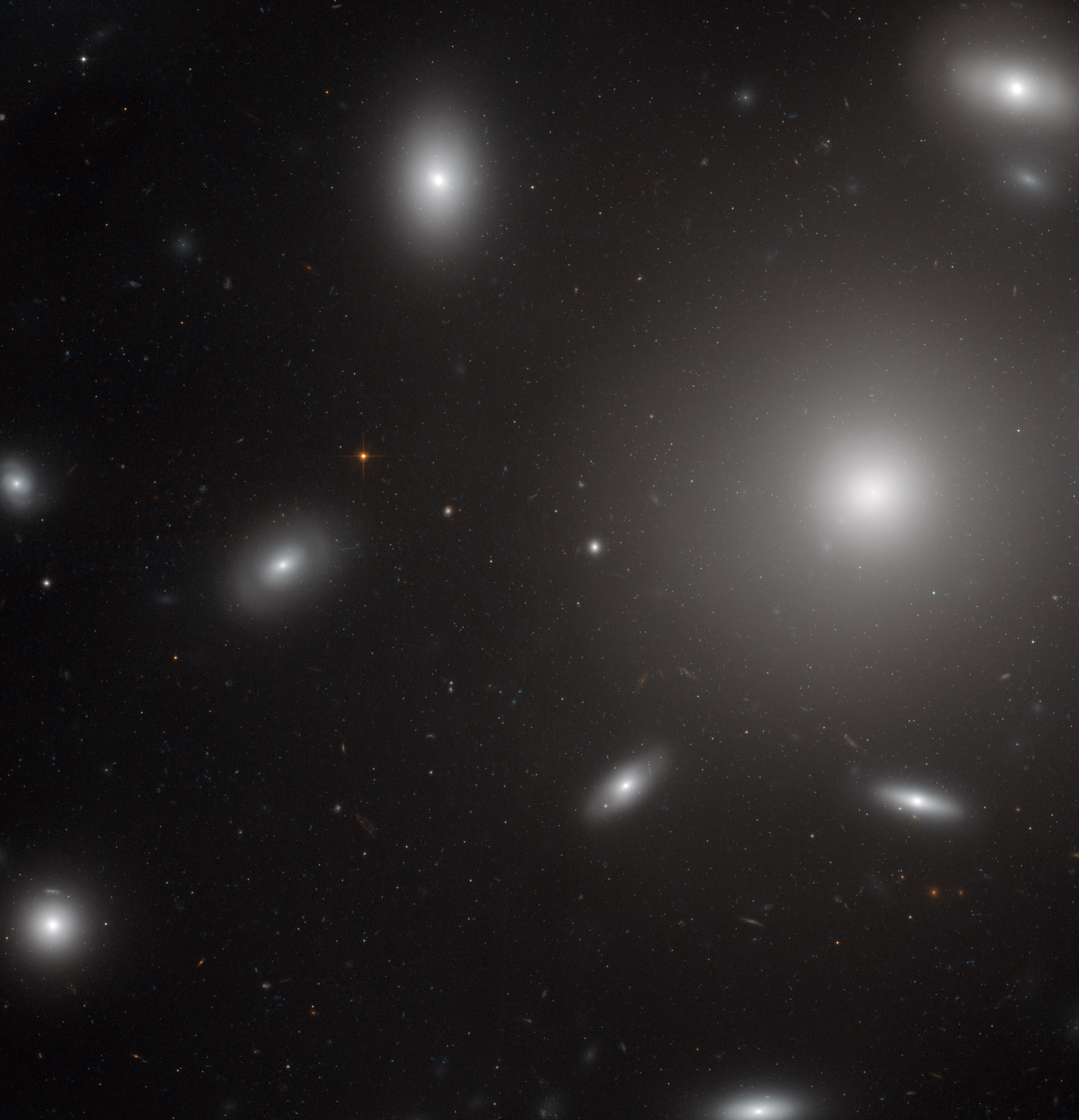
In the center of a rich cluster of galaxies located in the direction of the constellation of Coma Berenices, lies a galaxy surrounded by a swarm of star clusters. NGC 4874 is a giant elliptical galaxy, about ten times larger than the Milky Way, at the center of the Coma Galaxy Cluster. With its strong gravitational pull, it is able to hold onto more than 30 000 globular clusters of stars, more than any other galaxy that we know of, and even has a few dwarf galaxies in its grasp. In this NASA/ESA Hubble Space Telescope image, NGC 4874 is the brightest object, located to the right of the frame and seen as a bright star-like core surrounded by a hazy halo. A few of the other galaxies of the cluster are also visible, looking like flying saucers dancing around NGC 4874. But the really remarkable feature of this image is the point-like objects around NGC 4874, revealed on a closer look: almost all of them are clusters of stars that belong to the galaxy. Each of these globular star clusters contains many hundreds of thousands of stars. Recently, astronomers discovered that a few of these point-like objects are not star clusters but ultra-compact dwarf galaxies, also under the gravitational influence of NGC 4874. Being only about 200 light-years across and mostly made up of old stars, these galaxies resemble brighter and larger versions of globular clusters. They are thought to be the cores of small elliptical galaxies that, due to the violent interactions with other galaxies in the cluster, lost their gas and surrounding stars. This Hubble image also shows many more distant galaxies that do not belong to the cluster, seen as small smudges in the background. While the galaxies in the Coma Cluster are located about 350 million light-years away, these other objects are much further out. Their light took several hundred million to billions of years to reach us. Most unusually, the image also shows a very faint blue satellite trail, extending across the whole image, from the upper left corner of the frame to the lower right. Because Hubble’s cameras can only see a tiny part of the sky at one time, such trails are very rare. This picture was created from optical and near-infrared exposures taken with the Wide Field Channel of Hubble's Advanced Camera for Surveys. The field of view is 3.3 arcminutes across.
The full resolution image weighs 9.9 MB, so please be patient when downloading!
Credit: ESA/Hubble and NASA
Image enhancement: Jean-Baptiste Faure

Monday, May 28, 2012

Centaurus A: a very strange Galaxy!

Centaurus A: a very strange Galaxy!
Click on the image for full resolution (7.6 MB)

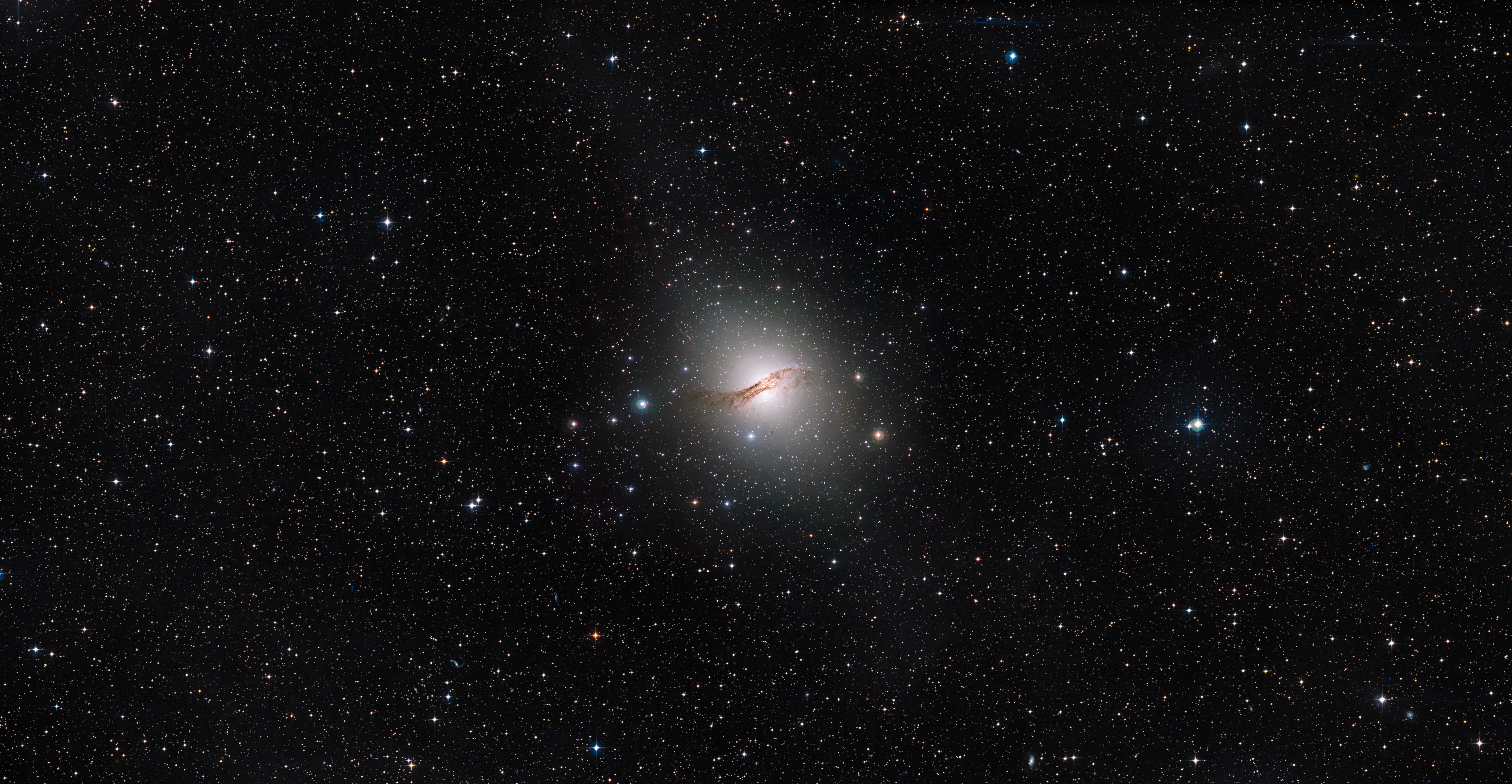
The peculiar galaxy Centaurus A, also known as NGC 5128, is pictured in this image taken with by the Wide Field Imager attached to the MPG/ESO 2.2-meter telescope at the La Silla Observatory in Chile. With a total exposure time of more than 50 hours this is probably the deepest view of this peculiar and spectacular object every created. Centaurus A is a peculiar massive elliptical galaxy with a supermassive black hole at its heart. It lies about 12 million light-years away in the southern constellation of Centaurus (The Centaur) and has the distinction of being the most prominent radio galaxy in the sky. Astronomers think that the bright nucleus, strong radio emission and jet features of Centaurus A are produced by a central black hole with a mass of about 100 million times that of the Sun. Matter from the dense central parts of the galaxy releases vast amounts of energy as it falls towards the black hole. This Wide Field Imager (WFI) picture allows us to appreciate the galaxy's elliptical nature, which shows up as the elongated shape of the fainter outer parts. The glow that fills much of the picture comes from hundreds of billions of cooler and older stars. Unlike most elliptical galaxies, however, Centaurus A's smooth shape is disturbed by a broad and patchy band of dark material that obscures the galaxy's center. The dark band harbours large amounts of gas, dust and young stars. Bright young star clusters appear at the upper-right and lower-left edges of the band along with the red glow of star-forming clouds of hydrogen, whilst some isolated dust clouds are silhouetted against the stellar background. These features, and the prominent radio emission, are strong evidence that Centaurus A is the result of a merger between two galaxies. The dusty band is probably the mangled remains of a spiral galaxy in the process of being ripped apart by the gravitational pull of the giant elliptical galaxy. The new set of images from WFI include long exposures through red, green and blue filters as well as filters specially designed to isolate the light from glowing hydrogen and oxygen. The latter help us to spot the known optical jet features around Centaurus A, which were barely visible in a previous image from the Wide Field Imager. Extending from the galaxy to the upper left corner of the image are two groups of reddish filaments, which are roughly lined up with the huge jets that are prominent in radio images. Both sets of filaments are stellar nurseries, containing hot young stars. Above the left side of the dusty band, we find the inner filaments, lying about 30 000 light-years away of the nucleus. Further out, around 65 000 light-years away from the galaxy's nucleus and close to the upper left corner of the image, the outer filaments are visible. There is also possibly a very much fainter trace of a counter jet extending to the lower right.
The full resolution image weighs 7.6 MB, so please be patient when downloading!
Credit: ESO
Image enhancement: Jean-Baptiste Faure

Wednesday, January 4, 2012

Atypical Elliptical Galaxy NGC 4696 as seen by Hubble

Atypical Elliptical Galaxy NGC 4696 as seen by Hubble
Click on the image for full resolution (2.4 MB)

This picture, taken by Hubble's Advanced Camera for Surveys, shows NGC 4696, the largest galaxy in the Centaurus Cluster. The huge dust lane, around 30 000 light-years across, that sweeps across the face of the galaxy makes NGC 4696 look different from most other elliptical galaxies. Viewed at certain wavelengths, strange thin filaments of ionised hydrogen are visible within it. In this picture, these structures are visible as a subtle marbling effect across the galaxy's bright centre.
The full resolution image weighs 2.4 MB, so please be patient when downloading!
Credit: ESA/Hubble and NASA

Monday, November 28, 2011

SDSS J162702.56+432833.9: a long-ago Galactic Collision!

SDSS J162702.56+432833.9: a long-ago Galactic Collision!
Click on the image for full resolution (6.6 MB)

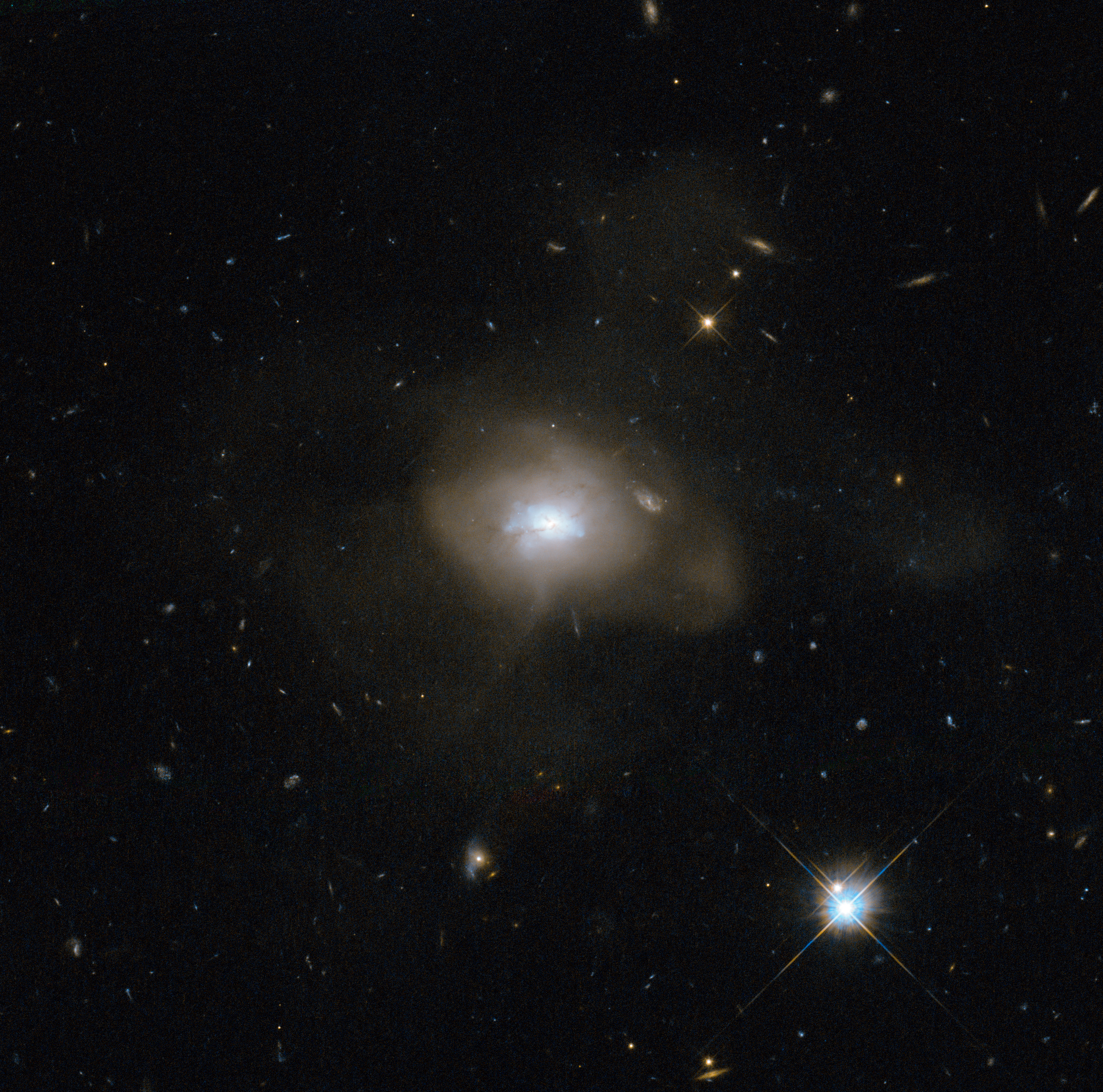
The NASA/ESA Hubble Space Telescope has caught sight of a soft, diffuse-looking galaxy that is probably the aftermath of a long-ago galactic collision. Two spiral galaxies, each perhaps much like the Milky Way, swirled together for millions of years. In such mergers, the original galaxies are often stretched and pulled apart as they wrap around a common centre of gravity. After a few back-and-forths, this starry tempest settles down into a new, round object. The now subdued celestial body, catalogued as SDSS J162702.56+432833.9, is technically known as an elliptical galaxy. When galaxies collide - a common event in the Universe - a fresh burst of star formation typically takes place as gas clouds mash together. At this point, the galaxy has a blue hue, but the colour does not mean it is cold: it is a result of the intense heat of newly formed blue–white stars. Those stars do not last long, and after a few billion years the reddish hues of aging smaller stars dominate an elliptical galaxy's spectrum. Hubble has helped astronomers learn of this sequence by observing galaxy mergers at all stages of the process. In SDSS J162702.56+432833.9, some ribbons of dust notably obscure parts of the conglomerated galaxy's central, bluish region. Those dust lanes could be remnants of the spiral arms of the recently departed galaxies. This picture was snapped by the Wide Field Camera of Hubble's Advanced Camera for Surveys. The image was made through a red (F625W) and a blue (F438W) filter. The field of view is approximately 2.4 by 2.4 arcminutes.
The full resolution image weighs 6.6 MB, so please be patient when downloading!
Credit: ESA/Hubble and NASA

Tuesday, October 18, 2011

Centaurus A with Jets emanating from the central Black Hole!

Centaurus A with Jets emanating from the central Black Hole!
Click on the image for full resolution (2.4 MB)

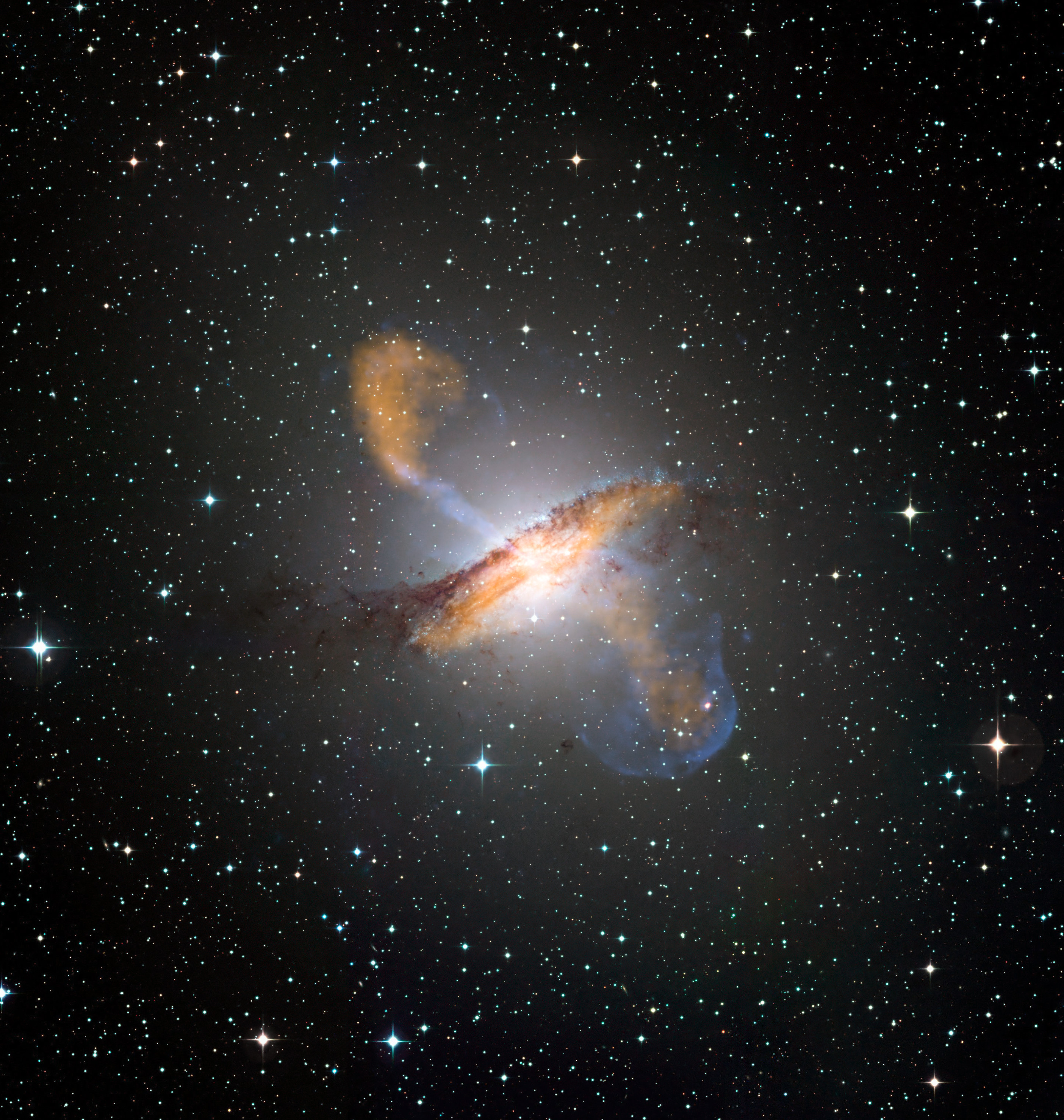
Awesome colour composite image of Centaurus A, revealing the lobes and jets emanating from the active galaxy's central black hole. This is a composite of images obtained with three instruments, operating at very different wavelengths. The 870-micron submillimetre data, from LABOCA on APEX, are shown in orange. X-ray data from the Chandra X-ray Observatory are shown in blue. Visible light data from the Wide Field Imager (WFI) on the MPG/ESO 2.2-meter telescope located at La Silla, Chile, show the background stars and the galaxy’s characteristic dust lane in close to "true colour".
The full resolution image weighs 2.4 MB, so please be patient when downloading!
Credit: ESO/WFI (Optical); MPIfR/ESO/APEX/A.Weiss et al. (Submillimetre); NASA/CXC/CfA/R.Kraft et al. (X-ray)