Showing posts with label Globular Clusters. Show all posts

Monday, June 29, 2026

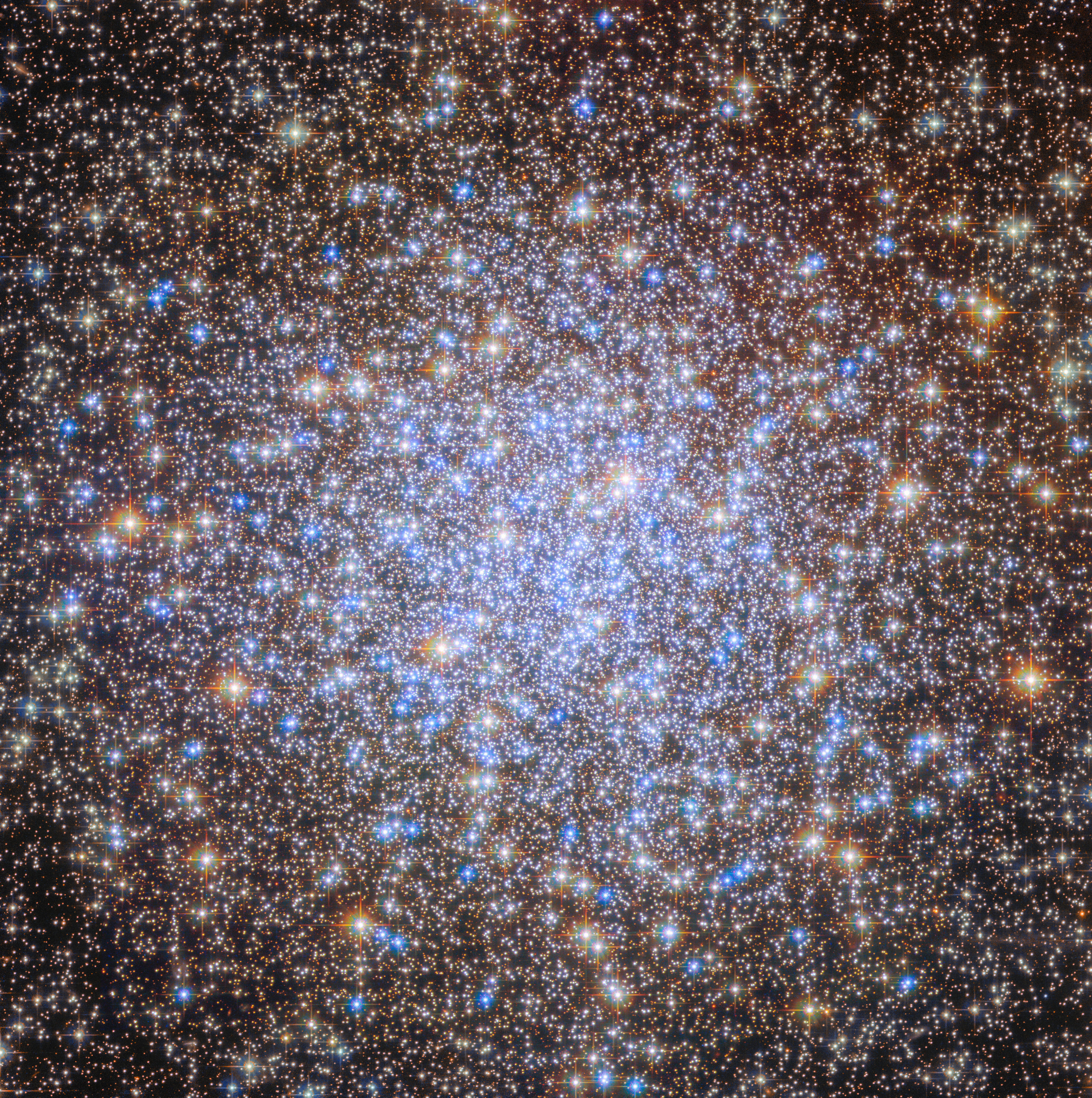
Globular Cluster NGC 6723

Globular Cluster NGC 6723
Click the image for higher resolution (12.4 MB)

The subject of this picture is an ancient inhabitant of our galaxy. This sparkling scene is of a globular cluster: a collection of tens of thousands to millions of stars, all tightly bound together under the influence of gravity. Astronomers know of more than 150 globular clusters in our galaxy, though there may be others yet to be discovered, hidden from view by dust or densely packed fields of stars.
This particular globular cluster is NGC 6723, sometimes called the Chandelier Cluster. Much like its namesake, this cluster sparkles with countless lights – but each "lightbulb" in this chandelier is an individual star 27 000 light-years away in the constellation Sagittarius (the Archer).
Globular clusters like NGC 6723 contain some of the oldest stars in our galaxy. The ages of these clusters often exceed 10 billion years old, and some are nearly as old as the Universe itself. Globular clusters are thought to be some of the first structures to have formed in our galaxy, coalescing potentially billions of years before the thin disk of stars in which our Sun orbits. The details of how globular clusters formed, however, are not yet certain.
Astronomers initially thought that all stars in a globular cluster formed at the same time in a single flourish of star formation. This would mean that all stars in a globular cluster would be the same age and be made of the same mixture of chemical elements. Now, thanks to observations from telescopes like Hubble, researchers know that these seemingly simple stellar populations have more complex histories than originally thought.
Hubble first observed NGC 6723 as part of an ambitious survey dedicated to demystifying the properties of globular clusters in our Milky Way galaxy. In this observing programme, researchers used Hubble to study 65 globular clusters in our galaxy in visible and near-infrared light. These data allowed researchers to study everything from the ages of globular clusters to the process through which massive stars sink to the centre of a star cluster and lower-mass stars drift toward the cluster outskirts. This survey has been immensely scientifically valuable, and these observations have inspired several hundred published research papers.
In a later observing programme, researchers set their sights again on many of these same clusters, including NGC 6723. This time, they used Hubble's unique sensitivity to ultraviolet light to detect the subtle variations in chemical composition between the stars of globular clusters and determine the age spread among the clusters' stars. For NGC 6723, researchers found evidence of two closely-spaced periods of star formation, the second occurring within 634 million years of the first. "Closely-spaced" is relative; 634 million years is a blink of an eye for a star cluster that is more than 10 billion years old!
Thanks to these findings, astronomers are on the path to understanding how and when globular clusters formed – and Hubble observations of celestial chandeliers like NGC 6723 are lighting the way.
Image Credit: ESA/Hubble and NASA, A. Sarajedini, G. Piotto
Image enhancement: Jean-Baptiste Faure

Saturday, November 29, 2025

Globular Cluster NGC 1786

Globular Cluster NGC 1786
Click the image for higher resolution (3.6 MB)

For this Hubble picture, we gaze upon the field of stars that is NGC 1786. This object is a globular cluster in the Large Magellanic Cloud (LMC), a small satellite galaxy of the Milky Way Galaxy that is approximately 160 000 light-years away from Earth. NGC 1786 itself is in the constellation Dorado. It was discovered in the year 1835 by John Herschel.
The data for this image comes from an observing programme comparing old globular clusters in nearby dwarf galaxies – the LMC, the Small Magellanic Cloud and the Fornax dwarf spheroidal galaxy – to the globular clusters in the Milky Way galaxy. Our galaxy contains over 150 of these old, spherical collections of tightly-bound stars, which have been studied in depth – especially with Hubble Space Telescope images like this one, which show them in previously-unattainable detail. Being very stable and long-lived, they act as galactic time capsules, preserving stars from the earliest stages of a galaxy's formation.
Astronomers once thought that the stars in a globular cluster all formed together at about the same time, but study of the old globular clusters in our galaxy has uncovered multiple populations of stars with different ages. In order to use globular clusters as historical markers, we must understand how they form and where these stars of varying ages come from. This observing programme examined old globular clusters like NGC 1786 in these external galaxies to see if they, too, contain multiple populations of stars. This research can tell us more not only about how the LMC was originally formed, but the Milky Way Galaxy, too.
Image Credit: ESA/Hubble and NASA, M. Monelli
Acknowledgement: M. H. Özsaraç
Image enhancement: Jean-Baptiste Faure

Saturday, August 3, 2024

Globular Cluster Terzan 12

Globular Cluster Terzan 12
Click the image for higher resolution (5.6 MB)

The glittering globular cluster Terzan 12 – a vast, tightly bound collection of stars – fills the frame of this image from the Hubble Space Telescope. This star-studded stellar census comes from a string of observations that aim to systematically explore globular clusters located towards the center of our galaxy, such as this one in the constellation Sagittarius. The locations of these globular clusters – deep in the Milky Way galaxy – mean that they are shrouded in gas and dust, which can block or alter the wavelengths of starlight emanating from the clusters.
Here, astronomers were able to sidestep the effect of gas and dust by comparing the new observations made with the razor-sharp vision of Hubble's Advanced Camera for Surveys and Wide-Field Camera 3 with pre-existing images. Their observations should shed light on the relation between age and composition in the Milky Way's innermost globular clusters.
Image Credit: ESA/Hubble and NASA, R. Cohen (Rutgers University)
Image enhancement: Jean-Baptiste Faure

Saturday, July 27, 2024

Globular Cluster Omega Centauri

Globular Cluster Omega Centauri
Click the image for higher resolution (12.6 MB)

An international team of astronomers has used more than 500 images from the Hubble Space Telescope spanning two decades to detect seven fast-moving stars in the innermost region of Omega Centauri, the largest and brightest globular cluster in the sky. These stars provide compelling new evidence for the presence of an intermediate-mass black hole.
Omega Centauri is visible from Earth with the naked eye and is one of the favourite celestial objects for stargazers in the southern hemisphere. Although the cluster is 17 700 light-years away, lying just above the plane of the Milky Way, it appears almost as large as the full Moon when seen from a dark rural area. The exact classification of Omega Centauri has evolved through time, as our ability to study it has improved. It was first listed in Ptolemy's catalogue nearly two thousand years ago as a single star. Edmond Halley reported it as a nebula in 1677, and in the 1830s the English astronomer John Herschel was the first to recognise it as a globular cluster. Omega Centauri consists of roughly 10 million stars that are gravitationally bound.
Image Credit: ESA/Hubble and NASA, M. Häberle (MPIA)
Image enhancement: Jean-Baptiste Faure

Friday, June 14, 2024

Globular Cluster NGC 2005

Globular Cluster NGC 2005
Click the image for higher resolution (6.2 MB)

The globular cluster NGC 2005, featured in this picture, is not unusual in and of itself; but it is a peculiarity in relation to its surroundings. NGC 2005 is located about 750 light-years from the heart of the Large Magellanic Cloud (LMC), which is the Milky Way's largest satellite galaxy and which itself lies about 162 000 light-years from Earth. Globular clusters are densely-packed clusters that can constitute tens of thousands or millions of stars. Their density means that they are tightly gravitationally bound and are therefore very stable. This stability contributes to their longevity: globular clusters can be billions of years old, and as such often comprise very old stars. Thus, studying globular clusters in space can be a little like studying fossils on Earth: where fossils give insights into the characteristics of ancient plants and animals, globular clusters illuminate the characteristics of ancient stars.
Current theories of galaxy evolution predict that galaxies merge with one another. It is widely thought that the relatively large galaxies that we observe in the modern Universe were formed via the merging of smaller galaxies. If this is correct, then astronomers would expect to see evidence that the most ancient stars in nearby galaxies originated in different galactic environments. As globular clusters are known to contain ancient stars, and because of their stability, they are an excellent laboratory to test this hypothesis.
NGC 2005 is such a globular cluster, and its very existence has provided evidence to support the theory of galaxy evolution via mergers. Indeed, the stars in NGC 2005 have a chemical composition that is distinct from the stars in the LMC around it. This suggests that the LMC underwent a merger with another galaxy somewhere in its history. That other galaxy has long-since merged and otherwise dispersed, but NGC 2005 remains behind as an ancient witness to the long-past merger.
Image Credit: ESA/Hubble and NASA, F. Niederhofer, L. Girardi
Image enhancement: Jean-Baptiste Faure

Wednesday, May 8, 2024

Globular Cluster NGC 6440 as seen by Webb

Globular Cluster NGC 6440 as seen by Webb
Click the image for higher resolution (4.8 MB)

This new image from the James Webb Space Telescope features NGC 6440, a globular cluster that resides roughly 28 000 light-years from Earth in the constellation Sagittarius. The object was first discovered by William Herschel in May of 1786.
Globular clusters like NGC 6440 are roughly spherical, tightly packed, collections of old stars bound together by gravity. They can be found throughout galaxies, but often live on the outskirts. They hold hundreds of thousands to millions of stars that are on average about one light-year apart, but they can be as close together as the size of our Solar System. NGC 6440 is known to be a high-mass and metal-rich cluster that formed and is orbiting within the Galactic bulge, which is a dense, near-spherical region of old stars in the inner part of the Milky Way.
This image was obtained with 2023 data from Webb's Near-InfraRed Camera (NIRCam) as part of an observation programme to explore the stars in the cluster and to investigate details of the cluster's pulsars. A pulsar is a highly magnetised, rotating neutron star that emits a beam of electromagnetic radiation from their magnetic poles. To us, that beam appears as a short burst or pulse as the star rotates. Pulsars spin extremely fast. Astronomers have clocked the fastest pulsars at more than 716 rotations per second, but a pulsar could theoretically rotate as fast as 1500 rotations per second before slowly losing energy or breaking apart.
The new data obtained by the science team indicate the first evidence from Webb observations of abundance variations of helium and oxygen in stars in a globular cluster. These results open the window for future, in-depth investigations of other clusters in the Galactic bulge, which were previously infeasible with other telescope facilities given the significant crowding of stars in the cluster and the strong reddening caused by interstellar dust between the cluster and Earth.
Image Credit: ESA/Webb, NASA and CSA, P. Freire
Acknowledgement: M. Cadelano and C. Pallanca
Image enhancement: Jean-Baptiste Faure

Saturday, April 6, 2024

Globular Cluster NGC 1651

Globular Cluster NGC 1651
Click the image for higher resolution (6.5 MB)

This image shows a globular cluster known as NGC 1651. Like the object in another recent Picture of the Week, it is located about 162 000 light-years away in the largest and brightest of the Milky Way's satellite galaxies, the Large Magellanic Cloud (LMC). A notable feature of this image is that the globular cluster almost fills the entire image, even though globular clusters are only about 10 to 300 light-years in diameter (NGC 1651 has a diameter of roughly 120 light-years). In contrast, there are numerous Hubble Pictures of the Week that feature entire galaxies – which can be tens or hundreds of millions of light-years in diameter – that also more or less fill the whole image.
A common misconception is that Hubble and other large telescopes manage to observe wildly differently sized celestial objects by zooming in on them, as one would with a specialised camera here on Earth. However, whilst small telescopes might have the option to zoom in and out to a certain extent, large telescopes do not. Each telescope's instrument has a fixed "field of view" (the size of the region of sky that it can observe in a single observation). For example, the ultraviolet/visible light channel of Hubble's Wide Field Camera 3 (WFC3), the channel and instrument that were used to collect the data used in this image, has a field of view roughly one twelfth the diameter of the Moon as seen from Earth. Whenever WFC3 makes an observation, that is the size of the region of sky that it can observe.
The reason that Hubble can observe objects of such wildly different sizes is two-fold. Firstly, the distance to an object will determine how big it appears to be from Earth, so entire galaxies that are relatively far away might take up the same amount of space in the sky as a globular cluster like NGC 1651 that is relatively close by. In fact, there's a distant spiral galaxy lurking in this image, directly left of the cluster – though undoubtedly much larger than this star cluster, it appears small enough here to blend in with foreground stars! Secondly, multiple images spanning different parts of the sky can be mosaiced together to create single images of objects that are too big for Hubble's field of view.
Image Credit: ESA/Hubble and NASA, L. Girardi, F. Niederhofer
Image enhancement: Jean-Baptiste Faure

Saturday, March 9, 2024

Globular Cluster NGC 1841

Globular Cluster NGC 1841
Click the image for higher resolution (6.2 MB)

This densely populated group of stars is the globular cluster known as NGC 1841, which is found within the Large Magellanic Cloud (LMC), a satellite galaxy to the Milky Way galaxy that lies about 162 000 light-years away. Satellite galaxies are galaxies that are bound by gravity in orbits around a more massive host galaxy. We typically think of our galaxy's nearest galactic companion as being the Andromeda Galaxy, but it would be more accurate to say that Andromeda is the nearest galaxy that is not in orbit around the Milky Way galaxy. In fact, our galaxy is orbited by tens of known satellite galaxies that are far closer than Andromeda, the largest and brightest of which is the LMC, which is easily visible to the naked eye from the southern hemisphere (although this is decreasingly the case thanks to light pollution).
The LMC is home to many globular clusters. These celestial bodies fall somewhere between open clusters – which are much less dense and tightly bound – and small, compact galaxies. Increasingly sophisticated observations have revealed the stellar populations and other characteristics of globular clusters to be varied and complex, and it is not well understood how these tightly-packed clusters form. However, there are certain consistencies across all globular clusters: they are very stable and so are capable of lasting a long time, and can therefore be very old. This means that globular clusters often contain large numbers of very old stars, which make them something akin to celestial "fossils". Just as fossils provide insight into the early development of life on Earth, globular clusters such as NGC 1841 can provide insights into very early star formation in galaxies.
Image Credit: ESA/Hubble and NASA, A. Sarajedini, F. Niederhofer
Image enhancement: Jean-Baptiste Faure

Monday, January 1, 2024

Globular Cluster NGC 2210

Globular Cluster NGC 2210
Click the image for higher resolution (6.0 MB)

This striking image shows the densely packed globular cluster known as NGC 2210, which is situated in the Large Magellanic Cloud (LMC). The LMC lies about 157 000 light-years from Earth, and is a so-called satellite galaxy of the Milky Way, meaning that the two galaxies are gravitationally bound. Globular clusters are very stable, tightly bound clusters of thousands or even millions of stars. Their stability means that they can last a long time, and therefore globular clusters are often studied in order to investigate potentially very old stellar populations.
In fact, 2017 research that made use of some of the data that were also used to build this image revealed that a sample of LMC globular clusters were incredibly close in age to some of the oldest stellar clusters found in the Milky Way's halo. They found that NGC 2210 specifically probably clocks in at around 11.6 billion years of age. Even though this is only a couple of billion years younger than the Universe itself, it made NGC 2210 by far the youngest globular cluster in their sample. All other LMC globular clusters studied in the same work were found to be even older, with four of them over 13 billion years old. This is interesting, because it tells astronomers that the oldest globular clusters in the LMC formed contemporaneously with the oldest clusters in the Milky Way, even though the two galaxies formed independently.
As well as being a source of interesting research, this old-but-relatively-young cluster is also extremely beautiful, with its highly concentrated population of stars. The night sky would look very different from the perspective of an inhabitant of a planet orbiting one of the stars in a globular cluster's center: the sky would appear to be stuffed full of stars, in a stellar environment that is thousands of times more crowded than our own.
Image Credit: ESA/Hubble and NASA, A. Sarajedini, F. Niederhofer
Image enhancement: Jean-Baptiste Faure

Tuesday, September 26, 2023

Globular Cluster NGC 6652

Globular Cluster NGC 6652
Click the image for higher resolution (6.7 MB)

The glittering, glitzy contents of the globular cluster NGC 6652 sparkle in this star-studded image from the Hubble Space Telescope. The core of the cluster is suffused with the pale blue light of countless stars, and a handful of particularly bright foreground stars are adorned with criss-crossing diffraction spikes. NGC 6652 lies in our own Milky Way galaxy in the constellation Sagittarius, just under 30 000 light-years from Earth and only 6500 light-years from the Galactic center.
Globular clusters are stable, tightly gravitationally bound clusters containing anywhere between tens of thousands and millions of stars. The intense gravitational attraction between the closely packed stars in globular clusters is what gives these star-studded objects their regular, spherical shape.
This image combines data from two of Hubble's third-generation instruments; the Advanced Camera for Surveys and Wide Field Camera 3. As well as two instruments, this image draws on two different observing programmes from two different teams of astronomers. The first team set out to survey globular clusters in the Milky Way galaxy in the hope of shedding light on topics ranging from the ages of these objects to the gravitational potential of the galaxy as a whole. The second team of astronomers used a trio of exquisitely sensitive filters in Hubble’s Wide Field Camera 3 to disentangle the proportions of carbon, nitrogen, and oxygen in globular clusters such as NGC 6652.
The stars merge into a bright core in the center, and spread out to the edges gradually, giving way to an empty, dark background. Most of the stars are small points of light. A few stars with cross-shaped diffraction spikes appear larger, and stand out in front.
Image Credit: ESA/Hubble and NASA, A. Sarajedini, G. Piotto
Image enhancement: Jean-Baptiste Faure
Sunday, February 5, 2023

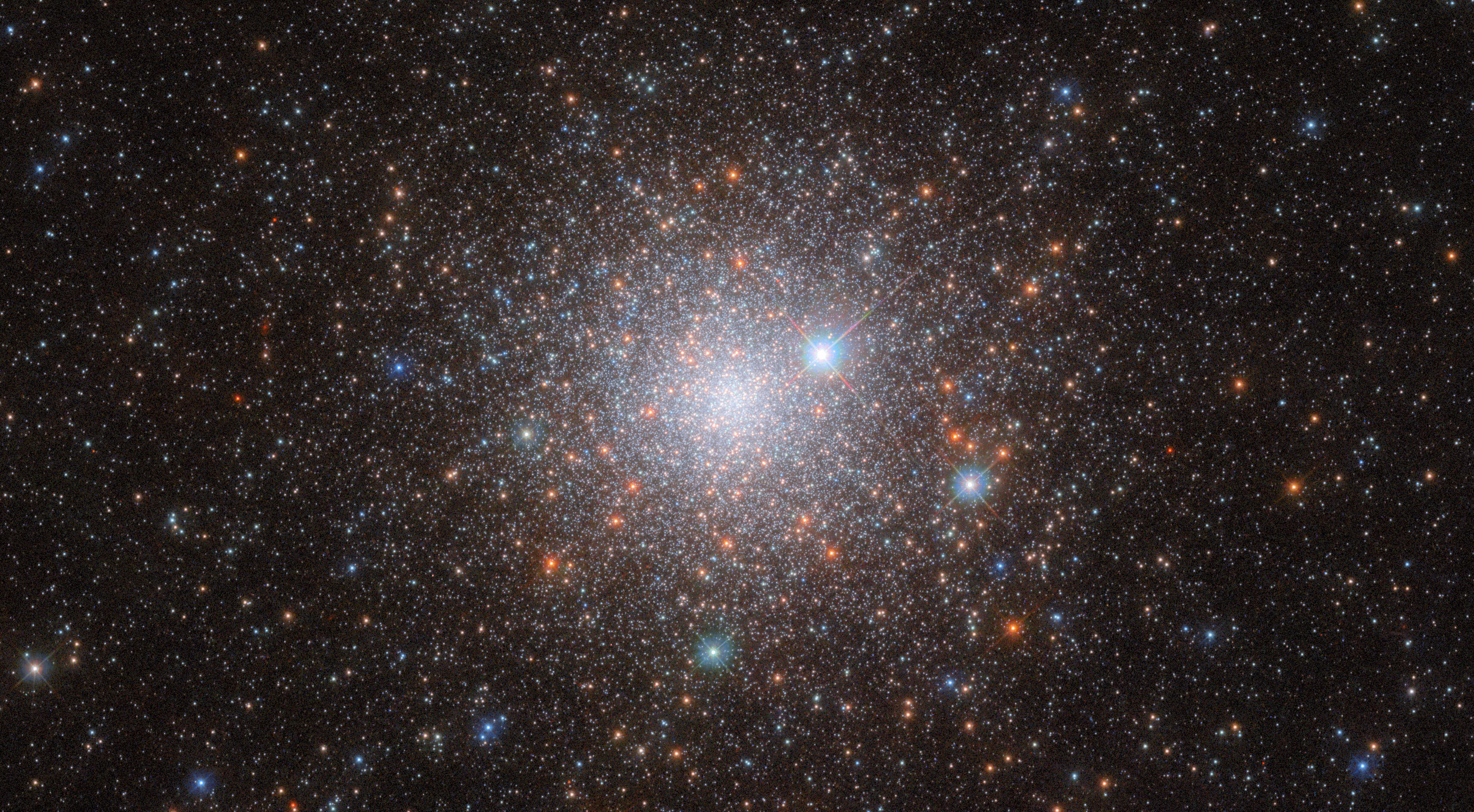
Globular Cluster NGC 6355

Globular Cluster NGC 6355
Click the image for higher resolution (5.6 MB)

The scattered stars of the globular cluster NGC 6355 are strewn across this image from the Hubble Space Telescope. This globular cluster lies less than 50,000 light-years from Earth in the Ophiuchus constellation. NGC 6355 is a galactic globular cluster that resides in our Milky Way galaxy's inner regions.
Globular clusters are stable, tightly bound clusters of tens of thousands to millions of stars, and can be found in all types of galaxies. Their dense populations of stars and mutual gravitational attraction give these clusters a roughly spherical shape, with a bright concentration of stars surrounded by an increasingly sparse sprinkling of stars. The dense, bright core of NGC 6355 was picked out in crystal-clear detail by Hubble in this image, and is the crowded area of stars towards the center of this image.
With its vantage point above the distortions of the atmosphere, Hubble has revolutionised the study of globular clusters. It is almost impossible to distinguish the stars in globular clusters from one another with ground-based telescopes, but astronomers have been able to use Hubble to study the constituent stars of globular clusters in detail. This Hubble image of NGC 6355 contains data from both the Advanced Camera for Surveys and Wide Field Camera 3.
Image Credit: ESA/Hubble and NASA, E. Noyola, R. Cohen
Image enhancement: Jean-Baptiste Faure

Thursday, July 14, 2022

Globular Cluster Liller 1

Globular Cluster Liller 1
Click on the image for higher resolution (3.3 MB)

The muted red tones of the globular cluster Liller 1 are partially obscured in this image by a dense scattering of piercingly blue stars. In fact, it is thanks to Hubble's Wide Field Camera 3 (WFC3) that we are able to see Liller 1 so clearly in this image, because the WFC3 is sensitive to wavelengths of light that the human eye cannot detect. Liller 1 is only 30 000 light-years from Earth – relatively neighbourly in astronomical terms – but it lies within the Milky Way's "bulge", the dense and dusty region at our galaxy's center. Because of that, Liller 1 is heavily obscured from view by interstellar dust, which scatters visible light (particularly blue light) very effectively. Fortunately, some infrared and red visible light are able to pass through these dusty regions. WFC3 is sensitive to both visible and near-infrared (infrared that is close to the visible) wavelengths, allowing us to see through the obscuring clouds of dust, and providing this spectacular view of Liller 1.
Liller 1 is a particularly interesting globular cluster, because unlike most of its kind, it contains a mix of very young and very old stars. Globular clusters typically house only old stars, some nearly as old as the Universe itself. Liller1 instead contains at least two distinct stellar populations with remarkably different ages: the oldest one is 12 billion years old and the youngest component is just 1-2 billion years old. This led astronomers to conclude that this stellar system was able to form stars over an extraordinary long period of time.
Image Credit: ESA/Hubble and NASA, F. Ferraro
Image enhancement: Jean-Baptiste Faure

Wednesday, June 22, 2022

Globular Cluster NGC 6558

Globular Cluster NGC 6558
Click on the image for higher resolution (9.2 MB)

This glittering gathering of stars is the globular cluster NGC 6558, and it was captured by the Hubble Space Telescope's Advanced Camera for Surveys. NGC 6558 is closer to the centre of the Milky Way than Earth is, and lies about 23 000 light years away in the constellation Sagittarius.
Globular clusters like NGC 6558 are tightly bound collections of tens of thousands to millions of stars, and they can be found in a wide range of galaxies. As this observation shows, the stars in globular clusters can be densely packed; this image is thronged with stars in a rich variety of hues. Some of the brightest inhabitants of this globular cluster are surrounded by prominent diffraction spikes, which are imaging artefacts caused by starlight interacting with the inner workings of Hubble.
Globular clusters equip astronomers with interesting natural laboratories in which to test their theories, as all the stars in a globular cluster formed at approximately the same time with similar initial composition. These stellar clusters therefore provide unique insights into how different stars evolve under similar conditions. This image comes from a set of observations investigating globular clusters in the inner Milky Way. Astronomers were interested in studying these globular clusters to gain greater insight into how globular clusters in the inner Milky Way form and evolve.
Image Credit: ESA/Hubble and NASA, R. Cohen
Image enhancement: Jean-Baptiste Faure

Wednesday, September 29, 2021

Globular Cluster ESO 520-21

Globular Cluster ESO 520-21
Click on the image for higher resolution (3.7 MB)

This sparkling starfield, captured by the Hubble Space Telescope's Wide Field Camera 3 and Advanced Camera for Surveys, contains the globular cluster ESO 520-21 (also known as Palomar 6). A densely packed, roughly spherical collection of stars, it lies close to the centre of the Milky Way, where interstellar gas and dust absorb starlight and make observations more challenging.
This absorption by interstellar material affects some wavelengths of light more than others, changing the colours of astronomical objects and causing them to appear redder than they actually are. Astronomers call this process “reddening”, and it makes determining the properties of globular clusters close to the galactic center – such as ESO 520-21 – particularly difficult.
ESO 520-21 lies in the constellation Ophiuchus, near the celestial equator. Ophiuchus was one of the 48 constellations which appeared in the writings of the second-century Egyptian astronomer Ptolemy, all of which are among the 88 constellations officially recognised by the International Astronomical Union today. Not all the constellations proposed by astronomers throughout history have survived, however – forgotten or obsolete constellations include Felis (the Cat), Rangifer (the Reindeer), and even Officina Typographica (the Printer's Workshop).
Image Credit: ESA/Hubble and NASA, R. Cohen
Image enhancement: Jean-Baptiste Faure

Globular Cluster NGC 6717

Globular Cluster NGC 6717
Click on the image for higher resolution (3.6 MB)

This star-studded image from the Hubble Space Telescope depicts NGC 6717, which lies more than 20 000 light-years from Earth in the constellation Sagittarius. NGC 6717 is a globular cluster, a roughly spherical collection of stars tightly bound together by gravity. Globular clusters contain more stars in their centers than their outer fringes, as this image aptly demonstrates; the sparsely populated edges of NGC 6717 are in stark contrast to the sparkling collection of stars at its center.
The center of the image also contains some interlopers from closer to home. Bright foreground stars close to Earth are surrounded by criss-cross diffraction spikes formed by starlight interacting with the structures supporting Hubble's secondary mirror.
The area of the night sky which contains the constellation Sagittarius also contains the centre of the Milky Way, which is filled with light-absorbing gas and dust. This absorption of light – which astronomers refer to as extinction – makes studying globular clusters near the Galactic center a challenging endeavour. To determine the properties of NGC 6717, astronomers relied on a combination of Hubble's Wide Field Camera 3 and the Advanced Camera for Surveys.
Image Credit: ESA/Hubble and NASA, A. Sarajedini
Image enhancement: Jean-Baptiste Faure

Wednesday, July 28, 2021

Globular Cluster NGC 6380

Globular Cluster NGC 6380
Click on the image for higher resolution (5.9 MB)

This image shows the globular cluster NGC 6380, which lies around 35 000 light-years from Earth, in the constellation Scorpio (The Scorpion). The very bright star at the top of the image is HD 159073, which is only around 4000 light-years from Earth, making it a much nearer neighbour to Earth than NGC 6380. This image was taken with Hubble's Wide Field Camera 3 (WFC3), which, as its name suggests, has a wide field of view, meaning that it can image relatively large areas of the sky in enormous detail.
NGC 6380 is not a particularly exciting name, but it indicates that this cluster is catalogued in the New General Catalogue (NGC), which was originally compiled in 1888. This cluster has, however, been known by many other names. It was originally discovered by James Dunlop in 1826, and he rather immodestly named it Dun 538. Eight years later, in 1834, it was independently rediscovered by John Herschel and he (similarly immodestly) went on to name it H 3688. The cluster was re-rediscovered in 1959 in Paris by Pişmiş, who catalogued it as Tonantzintla 1 – and who, to continue the pattern, also referred to it as Pişmiş 25. In addition to its colourful history of rediscovery, up until the 1950s NGC 6380 was thought to be an open cluster. It was A. D. Thackeray who realised that it was in fact a globular cluster. Nowadays, this cluster is reliably recognised in widely available catalogues as a globular cluster, and referred to simply as NGC 6380.
Image Credit: ESA/Hubble and NASA, E. Noyola
Image enhancement: Jean-Baptiste Faure

Thursday, February 11, 2021

Globular Cluster NGC 6397

Globular Cluster NGC 6397
Click on the image for higher resolution (4.1 MB)

This ancient stellar jewelry box, a globular cluster called NGC 6397, glitters with the light from hundreds of thousands of stars. Astronomers used the Hubble Space Telescope to gauge the cluster4s distance at 7800 light-years away. NGC 6397 is one of the closest globular clusters to Earth. The cluster's blue stars are near the end of their lives. These stars have used up their hydrogen fuel that makes them shine. Now they are converting helium to energy in their cores, which fuses at a higher temperature and appears blue.
The reddish glow is from red giant stars that have consumed their hydrogen fuel and have expanded in size. The myriad small white objects include stars like our Sun.
When Eduardo Vitral and Gary A. Mamon of the Institut d'Astrophysique de Paris set out to study the core of NGC 6397, they expected to find evidence for an “intermediate-mass” black hole (IMBH). These are smaller than the supermassive black holes that lie at the cores of large galaxies, but larger than stellar-mass black holes formed by the collapse of massive stars. IMBH are the long-sought “missing link” in black hole evolution and their mere existence is hotly debated, although a few candidates have been found. Instead, the scientists found evidence of a concentration of smaller black holes lurking there. New data from the Hubble Space Telescope have led to the first measurement of the extent of a collection of black holes in a core-collapsed globular cluster.
This image is composed of a series of observations taken with Hubble's Advanced Camera for Surveys. The research team used Hubble's Wide Field Camera 3 to measure the distance to the cluster.
Image Credit: NASA, ESA, and T. Brown and S. Casertano (STScI)
Acknowledgement: NASA, ESA, and J. Anderson (STScI)
Image enhancement: Jean-Baptiste Faure

Tuesday, September 8, 2020

Globular Cluster NGC 1805

Globular Cluster NGC 1805
Click on the image for higher resolution (3.6 MB)

Many colourful stars are packed close together in this image of the globular cluster NGC 1805, taken by the Hubble Space Telescope. This tight grouping of thousands of stars is located near the edge of the Large Magellanic Cloud, a satellite galaxy of our own Milky Way. The stars orbit closely to one another, like bees swarming around a hive. In the dense center of one of these clusters, stars are 100 to 1000 times closer together than the nearest stars are to our Sun, making planetary systems around them unlikely.
The striking difference in star colours is illustrated beautifully in this image, which combines two different types of light: blue stars, shining brightest in near-ultraviolet light, and red stars, illuminated in red and near-infrared. Space telescopes like Hubble can observe in the ultraviolet because they are positioned above Earth's atmosphere, which absorbs most of this wavelength, making it inaccessible to ground-based facilities.
This young globular cluster can be seen from the southern hemisphere, in the Dorado constellation, which is Portugese for dolphinfish. Usually, globular clusters contain stars which are born at the same time; however, NGC 1805 is unusual as it appears to host two different populations of stars with ages millions of years apart. Observing such clusters of stars can help astronomers understand how stars evolve, and what factors determine whether they end their lives as white dwarfs, or explode as supernovae.
Image Credit: ESA/Hubble and NASA, J. Kalirai
Image enhancement: Jean-Baptiste Faure

Saturday, August 1, 2020

Globular Cluster NGC 6441

Globular Cluster NGC 6441
Click on the image for higher resolution (7.9 MB)

Almost like snowflakes, the stars of the globular cluster NGC 6441 sparkle peacefully in the night sky, about 13 000 light-years from the Milky Way's galactic center. Like snowflakes, the exact number of stars in such a cluster is difficult to discern. It is estimated that together the stars weigh 1.6 million times the mass of the Sun, making NGC 6441 one of the most massive and luminous globular clusters in the Milky Way.
NGC 6441 is host to four pulsars that each complete a single rotation in a few milliseconds. Also hidden within this cluster is JaFu 2, a planetary nebula. Despite its name, this has little to do with planets. A phase in the evolution of intermediate-mass stars, planetary nebulae last for only a few tens of thousands of years, the blink of an eye on astronomical timescales.
There are about 150 known globular clusters in the Milky Way. Globular clusters contain some of the first stars to be produced in a galaxy, but the details of their origins and evolution still elude astronomers.
Image Credit: ESA/Hubble and NASA, G. Piotto
Image enhancement: Jean-Baptiste Faure

Friday, November 15, 2019

Globular Cluster NGC 1898

Globular Cluster NGC 1898
Click on the image for higher resolution (4.3 MB)

This glittering ball of stars is the globular cluster NGC 1898, which lies towards the center of the Large Magellanic Cloud – one of our closest cosmic neighbours. The Large Magellanic Cloud is a dwarf galaxy that hosts an extremely rich population of star clusters, making it an ideal laboratory for investigating star formation.
Discovered in November 1834 by British astronomer John Herschel, NGC 1898 has been scrutinised numerous times by the Hubble Space Telescope. Today we know that globular clusters belong to the oldest known objects in the Universe and that they are relics of the first epochs of galaxy formation. While we already have a pretty good picture on the globular clusters of the Milky Way – still with many unanswered questions – our studies on globular clusters in nearby dwarf galaxies just started.
The observations of NGC 1898 will help to determine if their properties are similar to the ones found in the Milky Way, or if they have different features, due to being in a different cosmic environment.
This image was taken by Hubble's Advanced Camera for Surveys (ACS) and Wide Field Camera 3 (WFC3). The WFC3 observes light ranging from near-infrared to near-ultraviolet wavelengths, while the ACS explores the near-infrared to the ultraviolet.
Image Credit: ESA/Hubble and NASA
Image enhancement: Jean-baptiste Faure