Showing posts with label Galaxy Clusters. Show all posts

Sunday, July 5, 2026

Galaxy Cluster MACS J0553.4-3342 by Webb

Galaxy Cluster MACS J0553.4-3342 by Webb
Click the image for higher resolution (9.0 MB)

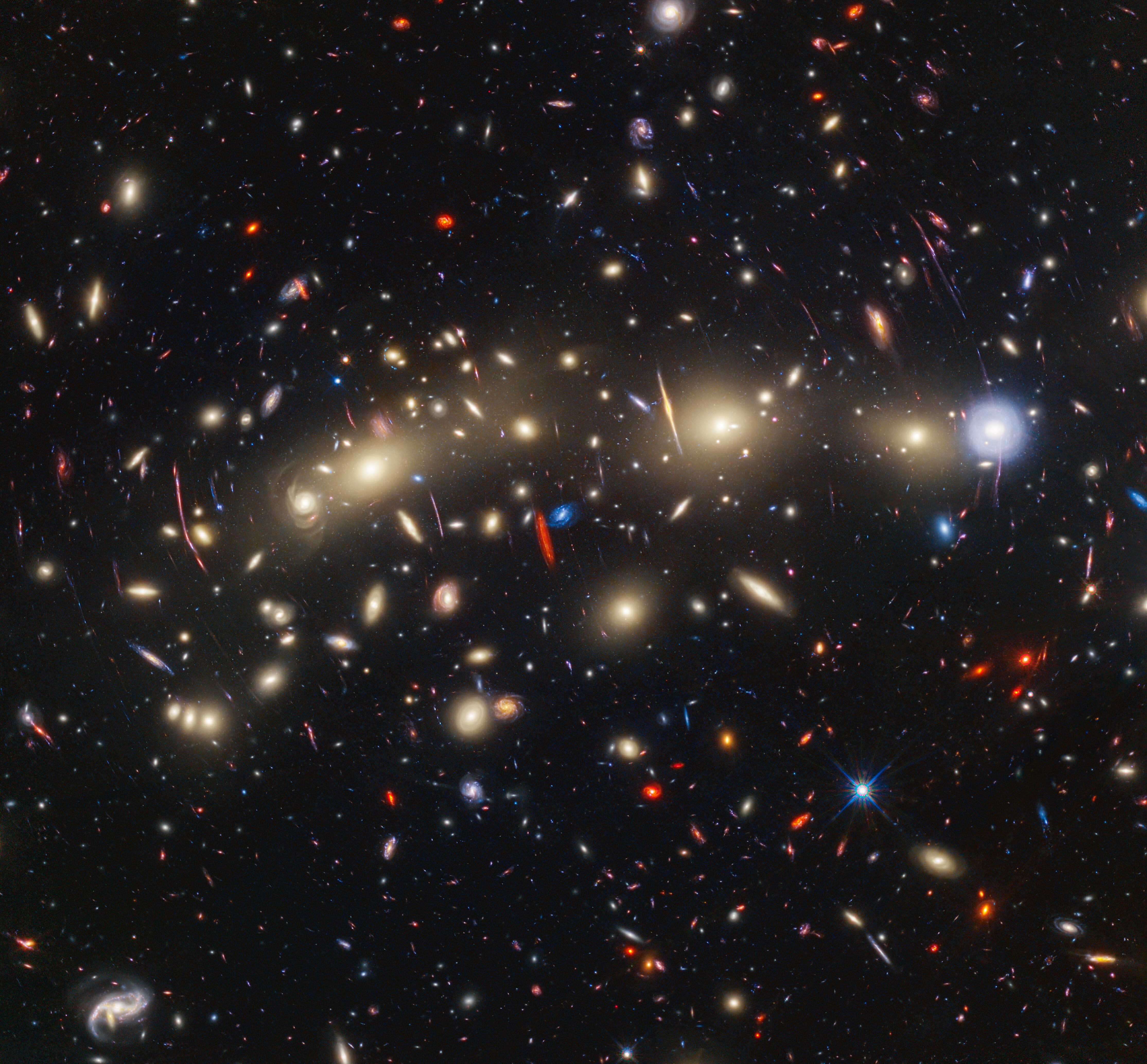
In this picture from the James Webb Space Telescope we are taken on a visit to a building site of significant scale. The project is a galaxy cluster named MACS J0553.4-3342, located in the constellation Columba (the Dove).
MACS J0553.4-3342 is situated at a redshift of 0.412. Redshift is a measure of how much the cluster's light has been stretched by the expansion of the Universe over the course of its long journey to Webb's mirrors; this unassuming number tells us that we are seeing MACS J0553.4-3342 as it was 4.4 billion years in the past. But for a galaxy cluster, this is relatively young. In fact, observations with the Hubble Space Telescope and other telescopes show a cluster still in the process of being built.
MACS J0553.4-3342 is composed of two sub-clusters – roughly equal in mass – that are actively merging. The two subclusters have already slammed through each other and travelled over one million light-years apart, but they will eventually come back together again and again until they finally merge. The construction process is messy, and MACS J0553.4-3342 is filled with extremely hot gas that radiates powerful X-rays. Each subcluster is anchored on an immensely bright and massive elliptical galaxy, which are easily identifiable as the two brightest points in the centre of this scene with the largest glowing halos around them. The many smaller white elliptical galaxies are bound to one of the two subclusters by gravity, and will be incorporated into the final galaxy cluster. This image also features many foreground galaxies – spirals and dusty discs that are unrelated to MACS J0553.4-3342 – and prominent bright stars in our own Milky Way galaxy.
Even mid-way through its construction, the titanic clumps of matter swirling around in this galaxy cluster have built a device that is already very useful for us here on Earth: a gravitational lens. The extreme and concentrated mass in MACS J0553.4-3342 curves light with its gravity, similar to how a glass lens bends and focuses light. In this image you can see prominent orange, stretched-out arcs alongside each of the subclusters. These arcs are images of distant background galaxies, whose light has been warped by the galaxy cluster's gravitational pull. The arc on the left side, three bright spots joined together, is actually three images of a single background galaxy! A forest of smaller arcs and lines are scattered across the image too; such a fantastic view appears in few other places in the Universe.
Look in the right spot, however, and this galaxy cluster turns from a distorting funhouse mirror into a precision scientific device. The gravitational lensing focuses light, magnifying objects and enhancing their brightness so if they lie in exactly the right place, background galaxies and even individual stars that would have been far too faint and distant to spot will be made visible. By carefully mapping out the mass of the cluster, researchers can reconstruct where and how strongly it distorts light from our point of view, then search for serendipitously-magnified distant objects to study. The arcs we can see in MACS J0553.4-3342 already show a few galaxies from less than a billion years after the Big Bang.
This image, taken with Webb's Near-Infrared Camera (NIRCam), stems from a survey programme named VENUS (#6882). Astronomers aimed to create a collection of deep, high-quality images of massive galaxy clusters like MACS J0553.4-3342 across a wide range of infrared wavelengths, greatly expanding the area covered by Webb's sensitive instruments. Researchers can then scour the clusters for distant and faint objects that have been brightened through gravitational lensing, from young galaxies and low-mass black holes to supernova explosions and individual stars. Gravitational lensing has been key to many of Webb's most dramatic discoveries in recent years, and having many more examples of it allows us to systematically study the distant past and the evolutionary stages of the galaxies, stars and black holes we see today.
Image Credit: ESA/Webb, NASA and CSA, S. Fujimoto
Image enhancement: Jean-Baptiste Faure

Monday, June 29, 2026

Galaxy Cluster Abell 3574

Galaxy Cluster Abell 3574
Click the image for higher resolution (6.2 MB)

The galaxy cluster Abell 3574 is captured here by the 570-megapixel Department of Energy-fabricated Dark Energy Camera (DECam) on the Víctor M. Blanco 4-meter Telescope, one of around 40 telescopes at the U.S. National Science Foundation Cerro Tololo Inter-American Observatory (CTIO) in Chile, a Program of NSF NOIRLab.
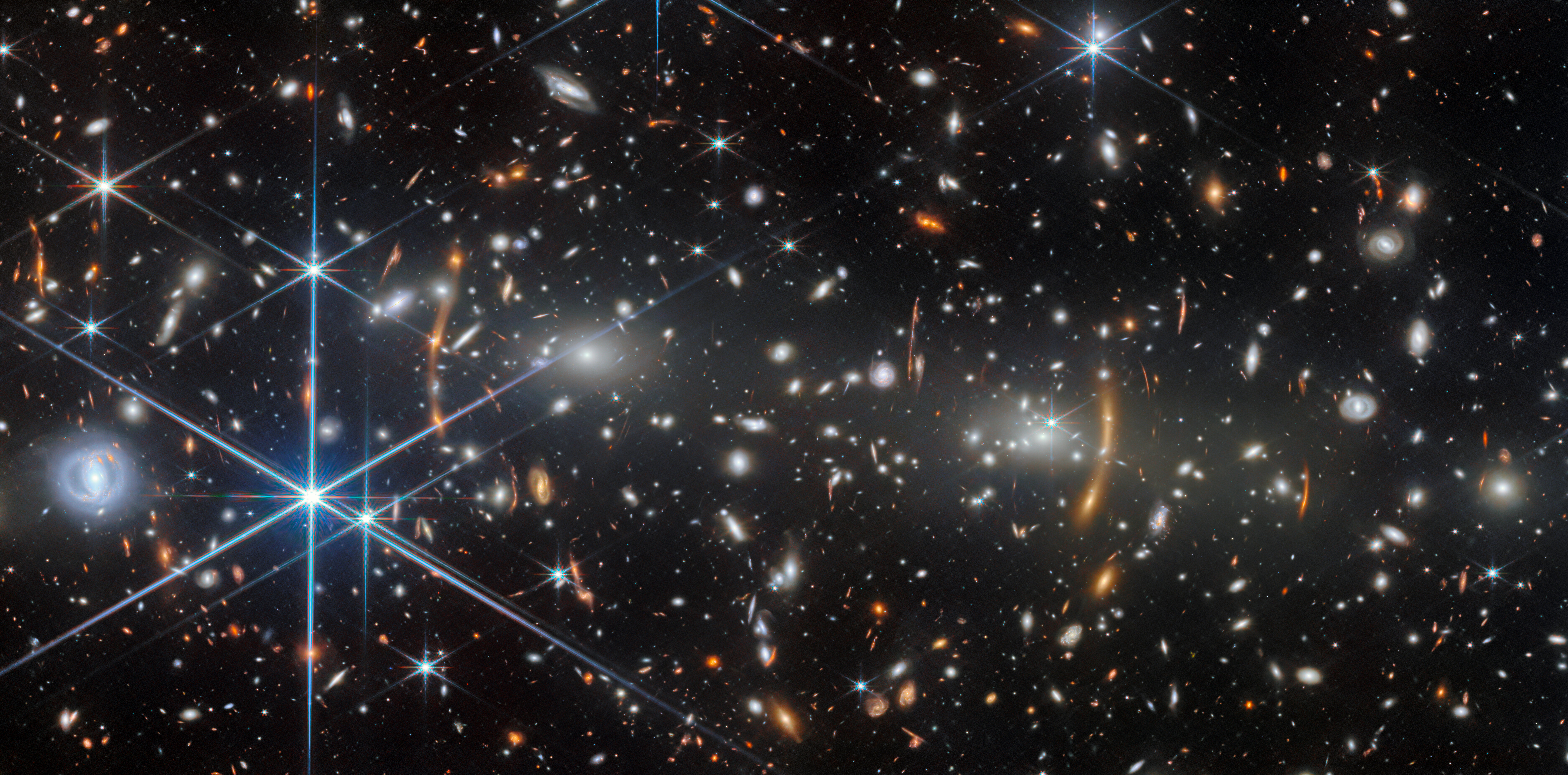
Located about 200 million light-years away, Abell 3574 is a gravitationally-bound group of hundreds of galaxies. Galaxy clusters are the second-largest-scale structures known in the Universe, but even at their massive scale these galaxies are never all that far from each other. In the top left, the large galaxy IC 4329, surrounded by rings of light, shows evidence of a past cosmic collision. The spread-out fragments of illuminated blue and white gas on the right side of the image are evidence of a similar clash with the galaxy NGC 5291 (yellow color). If you look closely, you can see more evidence of gravitationally interacting galaxies. Do you notice any?
The camera that captured this image was specifically designed for the Dark Energy Survey (DES) and was operated by the Department of Energy (DOE) and NSF between 2013 and 2019. The purpose of DES was to map out hundreds of millions of galaxies and record their distances to help astronomers understand dark energy. Since the conclusion of DES, the DES data have been made available to the public and the DECam has been available to other researchers on the Blanco telescope.
Image Credit: Dark Energy Survey/DOE/FNAL/DECam/CTIO/NOIRLab/NSF/AURA
Image processing: R. Colombari, M. Zamani (NSF NOIRLab) and T.A. Rector (University of Alaska Anchorage/NSF NOIRLab)
Image enhancement: Jean-Baptiste Faure
Sunday, April 19, 2026

Galaxy Cluster MACS J1149.5+2223 by Webb

Galaxy Cluster MACS J1149.5+2223 by Webb
Click the image for higher resolution (5.3 MB)

This James Webb Space Telescope picture brings us a scene from the distant Universe. Pictured here is the galaxy cluster MACS J1149.5+2223, or MACS J1149 for short, which is located about 5 billion light-years away in the constellation Leo.
Galaxy clusters are the largest structures in the Universe that are held together by gravity. Astronomers have confirmed more than 300 galaxies belonging to the MACS J1149 cluster, and they've identified several hundred more possible members. At the cluster's center, a huddle of ghostly elliptical galaxies rules over the cluster with their immense gravity.
The crushing gravity of this cluster does more than just hold all the galaxies together as they drift through space. As light from galaxies located behind the cluster makes its way toward our telescope, journeying for billions of years, its path through spacetime is bent by the mass of the intervening galaxies.
This phenomenon is called gravitational lensing, and the result is evident in this image of MACS J1149; scattered across the image are subtle and not-so-subtle examples of gravitational lensing, from galaxies that appear to have been stretched into narrow streaks of light to galaxy images that have morphed into strange shapes.
A fantastic example of gravitational lensing can be seen near the centre of the image, just below the brilliant white galaxies at the heart of the cluster. There, the image of a galaxy with distinct spiral arms has been stretched into something resembling a pink jellyfish. This tangled-looking galaxy is home to what was once the most distant single star ever discovered as well as a supernova whose image appeared four times at once.
MACS J1149 has long received the celebrity treatment from leading telescopes, and for good reason. This cluster was one of six investigated through the Hubble Space Telescope's Frontier Fields programme. The Frontier Fields galaxy clusters were selected for the strength of their gravitational lensing, and their ability to warp spacetime has granted researchers a glimpse into the early Universe.
Now, Webb is pushing our knowledge horizon to even earlier times, enabling new discoveries like a feasting supermassive black hole less than 600 million years after the Big Bang. Using Webb's Near-Infrared Spectrograph (NIRSpec), Near-InfraRed Camera (NIRCam), and Near-InfraRed Imager and Slitless Spectrograph (NIRISS), researchers are revealing never-before-seen details of the lives of early galaxies.
The Webb data used to create this image were collected as part of the CAnadian NIRISS Unbiased Cluster Survey (CANUCS) programme #1208. This programme uses Webb's sensitive instruments to unveil the evolution of low-mass galaxies in the early Universe, revealing their star formation, dust and chemistry. These data will also help researchers study the epoch of reionisation, when the first stars and galaxies lit up the Universe, map the distribution of mass within galaxy clusters, and understand how star formation can slow to a trickle in a cluster environment.
Image Credit: ESA/Webb, NASA and CSA, C. Willott (National Research Council Canada), R. Tripodi (INAF - Astronomical Observatory of Rome)
Image enhancement: Jean-Baptiste Faure

Monday, April 13, 2026

The Virgo Cluster deeply imaged by Rubin

The Virgo Cluster deeply imaged by Rubin
Click the image for higher resolution (4.7 MB)

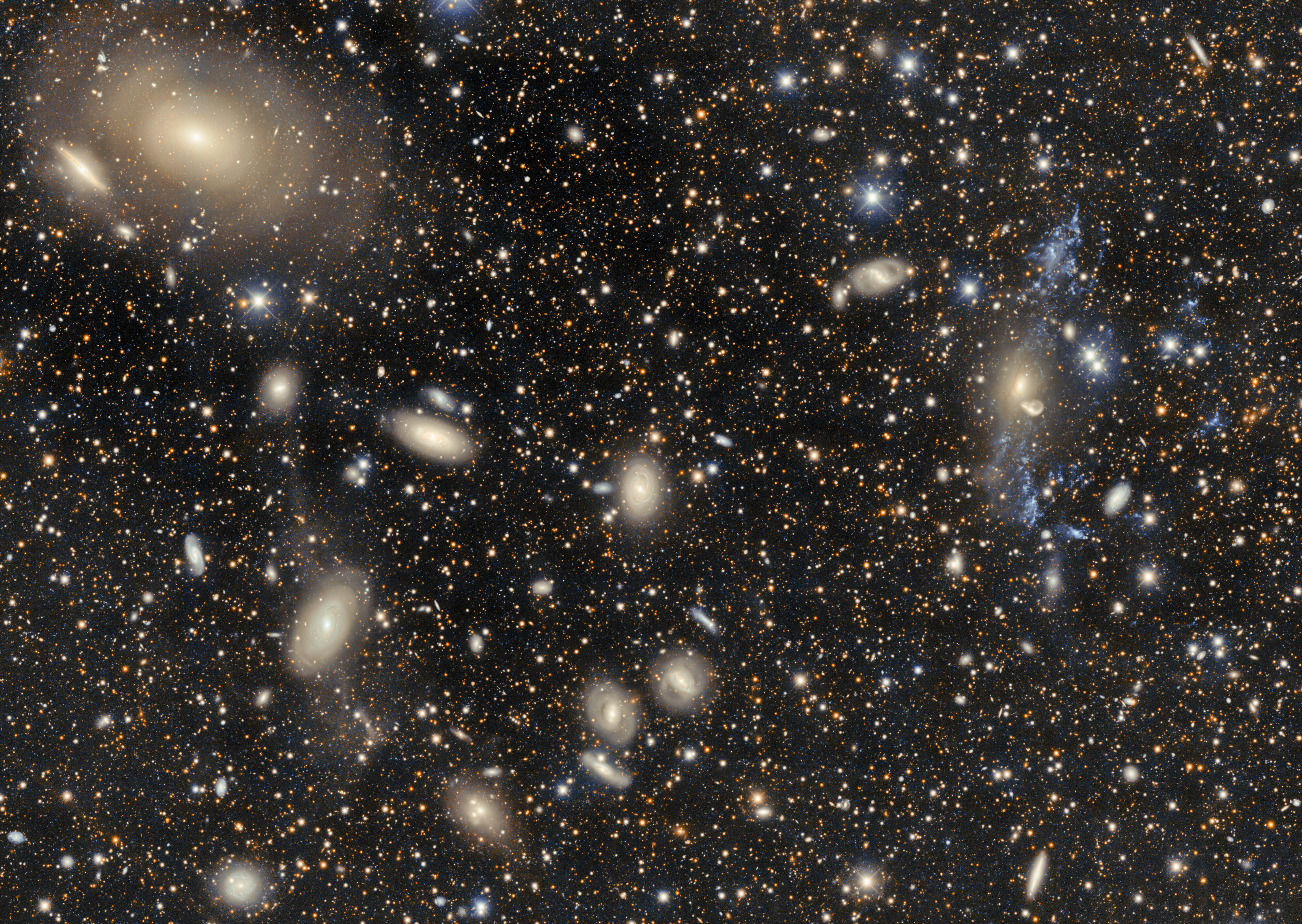
Introducing the first riches from NSF–DOE Vera C. Rubin Observatory's cosmic treasure chest, a wealth of data that will help scientists make countless new discoveries about our Universe. This image exposes a Universe teeming with stars and galaxies – transforming seemingly empty, inky-black pockets of space into glittering tapestries for the first time. Only Rubin can quickly produce such large images with this much color and richness. Here, Rubin's view is focused on the southern region of the Virgo Cluster, about 55 million light-years away from Earth and the nearest large collection of galaxies to our own Milky Way.
The image offers a stunning variety of objects – from bright stars ranging from blue to red in color, to nearby blue spiral galaxies, to distant red galaxy groups – demonstrating the broad range of science made possible by Rubin data. During the 10-year Legacy Survey of Space and Time, scientists around the world will access Rubin’s treasure trove of data to address questions like: How did the Milky Way form? What makes up the 95% of the Universe we can’t see? What will a detailed inventory of Solar System objects reveal? What will we learn from watching hundreds of millions of changes in the night sky over 10 years?
Apart from a few foreground stars in our own Milky Way, the myriad specks of light captured here make up a rich tapestry of about 10 million galaxies – just 0.05% of the roughly 20 billion galaxies Rubin will image during its 10-year Legacy Survey of Space and Time (LSST). By the end of the survey, Rubin will have revealed this level of detail across the entire southern sky.
In addition to showcasing the richness and variety of celestial light in (this area), this deep, 15-square-degree image provides a sample of the way Rubin will observe during the main survey. Each individual exposure taken by Rubin Observatory covers 10 square degrees, (about 45 full moons). Combining multiple exposures of the same place on the sky – taken at different times and with different color filters – reveals extremely faint details that wouldn't be captured in a single exposure. The 1185 exposures combined to make this image were taken over a period of just 7 nights. Rubin Observatory is the only astronomical tool in existence that can assemble an image this wide and deep so quickly.
The bright stars scattered throughout this image belong to our home galaxy. By tracking their positions, brightness, and for some, even their motion over time, Rubin will help map the Milky Way in extraordinary detail – revealing its structure, history, and how it has evolved over time. With observations of never-before-seen stellar streams, dwarf galaxies, and more, Rubin data will help scientists investigate the dynamic past of our cosmic neighborhood.
In Rubin Observatory's Skyviewer tool, you can use the "display" setting to toggle between a view with and without asteroids, which appear as multicolored streaks. These moving asteroids in our Solar System were captured by Rubin's fast system at a different location in each exposure, and this is how they look when the exposures are combined. Rubin's wide field and frequent imaging make it uniquely capable of detecting and tracking asteroids, comets, and distant trans-Neptunian objects – building a detailed inventory of our Solar System and helping protect Earth by alerting scientists to potentially hazardous objects.
This image also offers a starting point for watching the ever-changing sky. Rubin will return to this same region many times over the coming decade, catching brief but important events like supernova explosions and the flares from stars as they are consumed by hungry black holes. Rubin's software will automatically compare new images to templates built from previous images, identifying up to 10 million changes each night and providing insight into short-lived cosmic phenomena and objects in motion.
On the largest scales, scientists will use Rubin's observations of galaxies like those seen here to investigate two of the Universe's biggest mysteries: dark matter and dark energy. By mapping the shapes and distributions of galaxies over time, scientists can infer the underlying structure of dark matter and observe how the expansion of the Universe is being influenced by dark energy.
The image was captured by Rubin Observatory using the 3200-megapixel LSST Camera – the largest digital camera in the world. Rubin Observatory will scan the sky every night for 10 years, creating an ultra-wide, ultra-high-definition, time-lapse record of our Universe.
Image Credit: NSF–DOE Vera C. Rubin Observatory/NOIRLab/SLAC/AURA
Image enhancement: Jean-Baptiste Faure
Saturday, January 3, 2026

Galaxy Cluster Abell S1063 as seen by Webb

Galaxy Cluster Abell S1063 as seen by Webb
Click the image for higher resolution (11.3 MB)

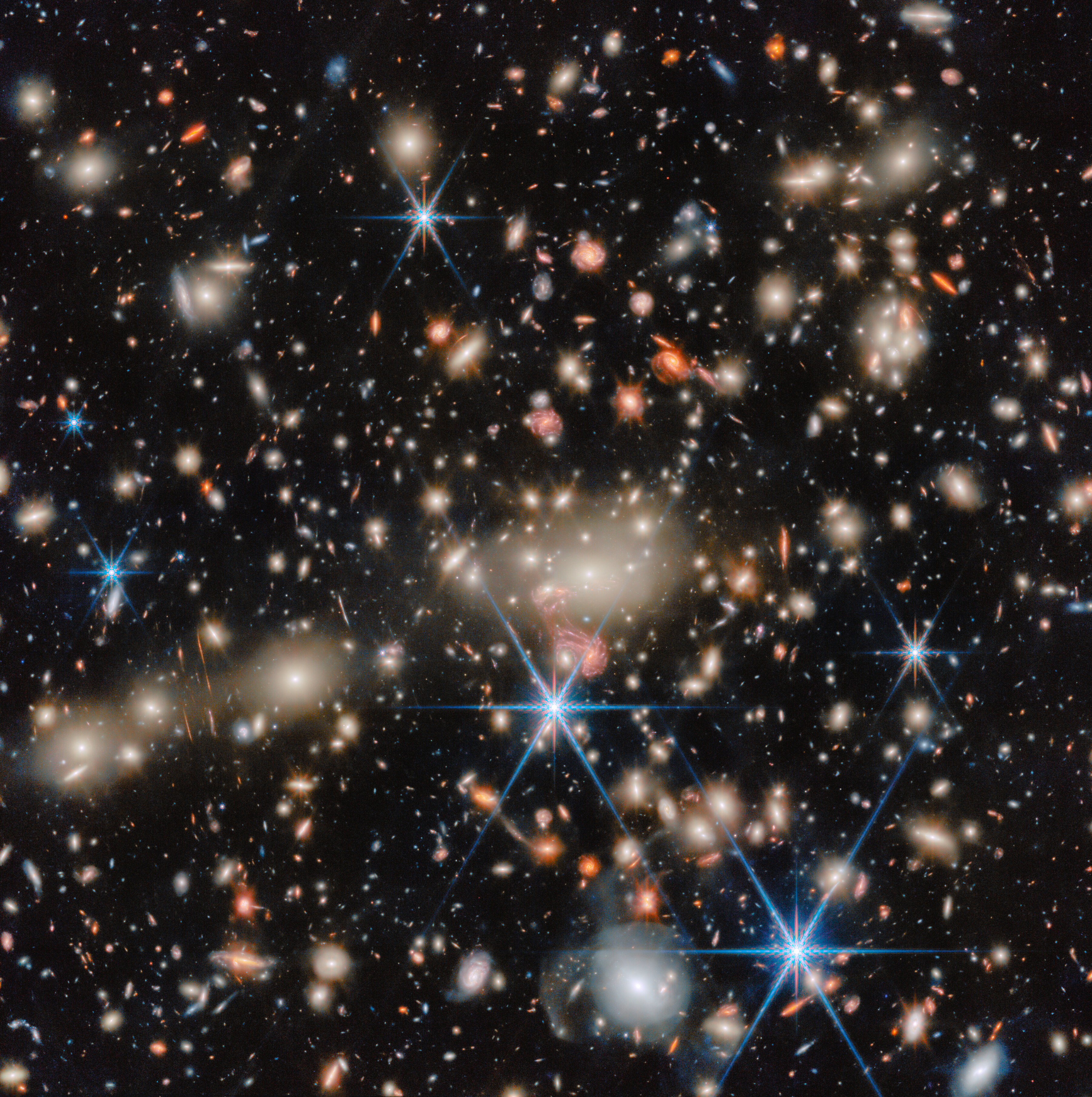
The eye is first drawn, in this James Webb Space Telescope picture, to the central mega-monster that is galaxy cluster Abell S1063. This behemoth collection of galaxies, lying 4.5 billion light-years from Earth in the constellation Grus (the Crane), dominates the scene. Looking more closely, this dense collection of heavy galaxies is surrounded by glowing streaks of light, and these warped arcs are the true object of scientists’ interest: faint galaxies from the Universe's distant past.
Abell S1063 was previously observed by the Hubble Space Telescope's Frontier Fields programme. It is a strong gravitational lens: the galaxy cluster is so massive that the light of distant galaxies aligned behind it is bent around it, creating the warped arcs that we see here. Like a glass lens, it focuses the light from these faraway galaxies. The resulting images, albeit distorted, are both bright and magnified — enough to be observed and studied. This was the aim of Hubble’s observations, using the galaxy cluster as a magnifying glass to investigate the early Universe.
The new imagery from Webb's Near-Infrared Camera (NIRCam) takes this quest even further back in time. This image showcases an incredible forest of lensing arcs around Abell S1063, which reveal distorted background galaxies at a range of cosmic distances, along with a multitude of faint galaxies and previously unseen features.
This image is what's known as a deep field – a long exposure of a single area of the sky, collecting as much light as possible to draw out the most faint and distant galaxies that don't appear in ordinary images. With 9 separate snapshots of different near-infrared wavelengths of light, totalling around 120 hours of observing time and aided by the magnifying effect of gravitational lensing, this is Webb's deepest gaze on a single target to date. Focusing such observing power on a massive gravitational lens, like Abell S1063, therefore has the potential to reveal some of the very first galaxies formed in the early Universe.
The observing programme that produced this data, GLIMPSE, aims to probe the period known as Cosmic Dawn, when the Universe was only a few million years old. Studying the galaxies revealed by gravitational lensing has the potential to develop our understanding of the emergence of the first galaxies. Analysis of this NIRCam data by the GLIMPSE team has already produced candidates for galaxies that existed as early as 200 million years after the Big Bang, and hints of the elusive first population of stars in the Universe.
Image Credit: ESA/Webb, NASA and CSA, H. Atek, M. Zamani (ESA/Webb)
Acknowledgement: R. Endsley
Image enhancement: Jean-Baptiste Faure

Saturday, December 20, 2025

The Virgo Cluster as seen by Rubin

The Virgo Cluster as seen by Rubin
Click the image for higher resolution (5.0 MB)

This image captures a small section of NSF–DOE Vera C. Rubin Observatory's view of the Virgo Cluster, revealing both the grand scale and the faint details of this dynamic region of the cosmos. Bright stars from our own Milky Way shine in the foreground, while a sea of distant reddish galaxies speckle the background.
Image Credit: NSF–DOE Vera C. Rubin Observatory
Image enhancement: Jean-Baptiste Faure

Saturday, December 6, 2025

Galaxy Cluster MACS J1149.5+2223 as seen by Webb

Click the image for higher resolution (4.9 MB)

This image shows a portion of the galaxy cluster MACS J1149.5+2223, as seen by Webb's Near-Infrared Camera (NIRCam). With Webb's excellent sensitivity to infrared light and the hours of exposure time combined in this image, distant galaxies (red colours) are brought out of the darkness. Other galaxies glow strongly from the abundance of light they radiate.
These observations come from the CANUCS survey (#1208, PI: C. J. Willott). The survey employed Webb's advanced instruments, including NIRCam, NIRISS and NIRSpec, to capture detailed images and spectra of massive galaxy clusters in infrared light. Astronomers could then study low-mass galaxies in these early clusters at early stages of evolution. Because of how Webb's instruments work, for each cluster the survey targeted both the cluster's center, where the brightest and largest galaxies are gathered, and a "parallel field" of a neighbouring area within the cluster. This image features one of these parallel fields.
Researchers studying the data from the CANUCS survey uncovered a distant galaxy, named CANUCS-LRD-z8.6, in this parallel field. The galaxy is extremely distant (seen only 570 million years after the Big Bang) and the team’s research revealed that it hosts a supermassive black hole that is unusually large for such an early stage in the Universe. This result challenges existing theories about the formation of galaxies and black holes in the early Universe.
Image Credit: ESA/Webb, NASA and CSA, G. Rihtaršič (University of Ljubljana, FMF), R. Tripodi (University of Ljubljana, FMF)
Image enhancement: Jean-Baptiste Faure

Sunday, September 1, 2024

Galaxy Cluster SPT-CL J0615−5746 as seen by Webb


Galaxy Cluster SPT-CL J0615−5746 as seen by Webb

Click the image for higher resolution (3.2 MB)

An international team of astronomers have used the James Webb Space Telescope to discover gravitationally bound star clusters when the Universe was 460 million years old. This is the first discovery of star clusters in an infant galaxy less than 500 million years after the Big bang.
Young galaxies in the early Universe underwent significant burst phases of star formation, generating substantial amounts of ionising radiation. However, because of their cosmological distances, direct studies of their stellar content have proven challenging. Using Webb, an international team of astronomers have now detected five young massive star clusters in the Cosmic Gems arc (SPT0615-JD1), a strongly-lensed galaxy emitting light when the Universe was roughly 460 million years old, looking back across 97% of cosmic time.
The Cosmic Gems arc was initially discovered in Hubble Space Telescope images obtained by the RELICS (Reionization Lensing Cluster Survey) programme of the lensing galaxy cluster SPT-CL J0615−5746.
With Webb, the science team can now see where stars formed and how they are distributed, in a similar way to how the Hubble Space Telescope is used to study local galaxies. Webb's view provides a unique opportunity to study star formation and the inner workings of infant galaxies at such an unprecedented distance.
Image Credit: ESA/Webb, NASA and CSA, L. Bradley (STScI), A. Adamo (Stockholm University) and the Cosmic Spring collaboration
Image enhancement: Jean-Baptiste Faure
Friday, August 30, 2024

Galaxy Cluster Abell 2390 as seen by Euclid

Galaxy Cluster Abell 2390 as seen by Euclid
Click the image for higher resolution (2.81 MB)

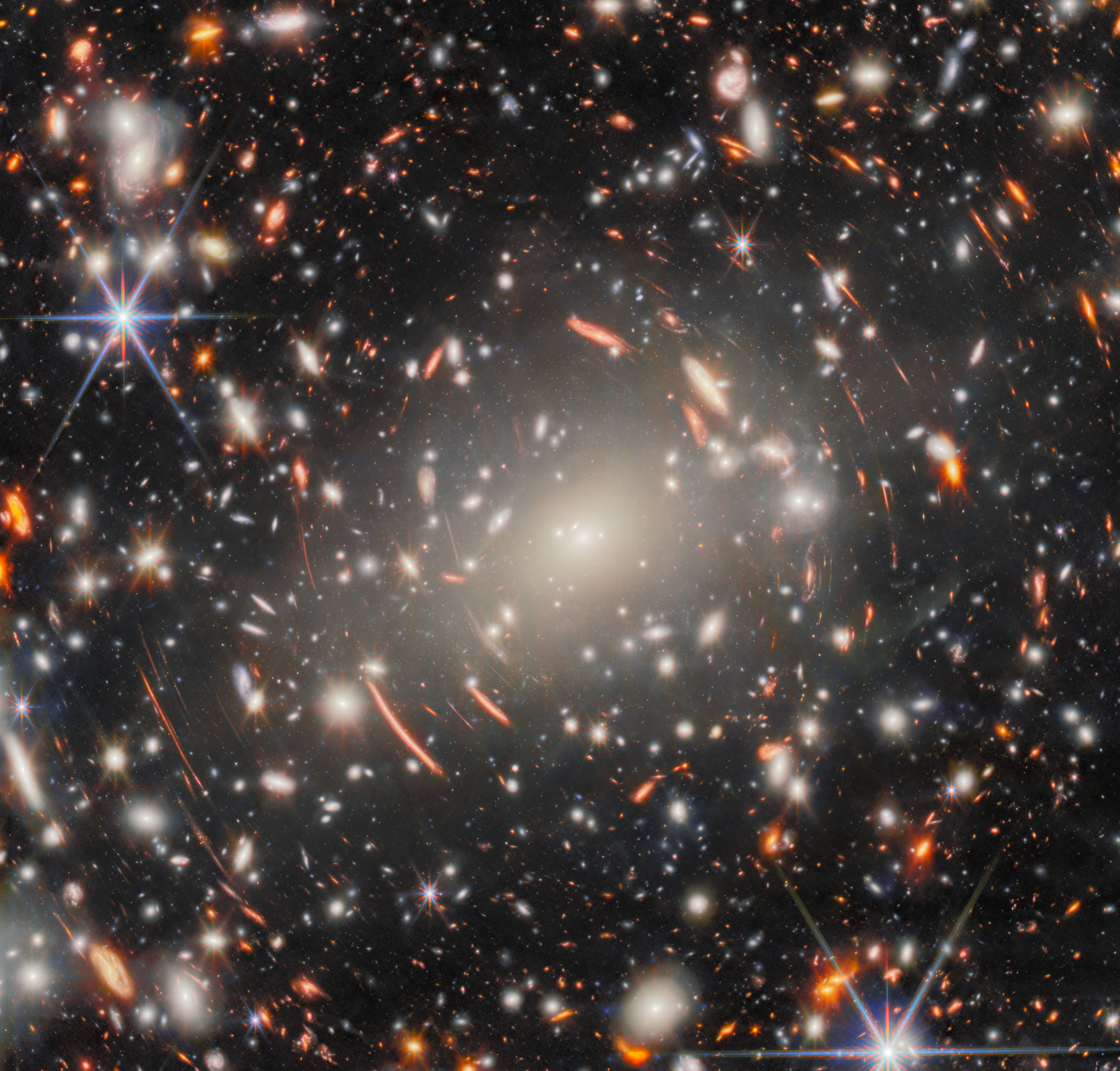
Abell 2390 is a galaxy cluster, a giant conglomeration of many galaxies like the Milky Way. More than 50 000 galaxies are seen here, the distances to which can be measured thanks to these new observations. Such clusters contain huge amounts of mass (up to 10 trillion times that of the Sun), with much of this being in the form of dark matter – a form of matter that we can’t observe directly, but is purported to together with dark energy make up the bulk of the contents of the Universe. Galaxy clusters like Abell 2390 are large repositories of dark matter, making them ideal astrophysical laboratories for studying its properties. Once Euclid begins its main survey it will capture many thousands of galaxy clusters over around one-third of the sky, obtaining information we can use to make unprecedented constraints on the dark Universe.
Euclid's new view of the cluster showcases one of the telescope's key techniques for exploring this dark Universe: indirectly measuring the amount and distribution of dark matter in a galaxy cluster via gravitational lensing, a phenomenon where the light travelling to us from more distant galaxies is bent and distorted by this mysterious matter. Thanks to Euclid's advanced instruments we can see an especially beautiful display of lensing in Abell 2390, with multiple giant curved arcs, some of which are actually multiple views of the same distant object.
Alongside understanding more about dark matter, scientists are using Euclid data to measure how the masses and number of galaxy clusters on the sky change over cosmic time, revealing more about the evolution of the Universe (and by extension more about dark energy, which is thought to influence this evolution). Euclid's cutout view of Abell 2390 also shows the faint "intracluster light" emitted by stars that have been ripped away from their parent galaxies into intergalactic space (the light has been enhanced in the cutout image to make it more clearly visible). Viewing this light is a specialty of Euclid, and these stellar orphans may allow us to "see" where dark matter lies.
Euclid captures light ranging from the visible to the near-infrared using its VIS (visible) and NISP (near-infrared) cameras. These can operate simultaneously, imaging wide areas of the sky to create images hundreds of times larger than comparable ones from other space telescopes. This wide field-of-view lets us take pictures of extended objects like Abell 2390 in a single shot, rather than having to take many pictures and stitch them together.
Observing a galaxy cluster in both visible and infrared light allows us to see galaxies at a greater range of distances than using either visible or infrared alone – crucial if we want to observe both the galaxies in a relatively nearby cluster and the galaxies lying behind it (far further from us). Euclid can take these types of deep, wide, high-resolution images hundreds of times faster than other telescopes.
Abell 2390 lies 2.7 billion light-years away in the constellation of Pegasus.
Image Credit: ESA/Euclid/Euclid Consortium/NASA
Image processing: Jean-Charles Cuillandre (CEA Paris-Saclay) and Giovanni Anselmi
Image enhancement: Jean-Baptiste Faure

Saturday, June 15, 2024

The Fornax Galaxy Cluster

The Fornax Galaxy Cluster
Click the image for higher resolution (1.9 MB)

The Fornax Galaxy Cluster is one of the closest of such groupings beyond our Local Group of galaxies. This new VLT Survey Telescope image shows the central part of the cluster in great detail. At the lower-right is the elegant barred-spiral galaxy NGC 1365 and to the left the big elliptical NGC 1399.
It has an estimated mass of (7±2)×1013 solar masses, making it the second richest galaxy cluster within 100 million light-years, after the considerably larger Virgo Cluster. It may be associated with the nearby Eridanus Group. It lies primarily in the constellation Fornax, with its southern boundaries partially crossing into the constellation of Eridanus, and covers an area of sky about 6° across or about 28 sq degrees.
The Fornax Galaxy Cluster is a particularly valuable source of information about the evolution of such clusters due to its relatively close proximity to the Sun. It also shows the gravitational effects of a merger of a galaxy subgroup with the main galaxy group, which in turn lends clues about the associated galactic superstructure. At the center of the cluster lies NGC 1399. Other cluster members include NGC 1316 (the group's brightest galaxy), NGC 1365, NGC 1427A, NGC 1427 and NGC 1404.
Image Credit: ESO
Acknowledgement: Aniello Grado and Luca Limatola
Image enhancement: Jean-Baptiste Faure

Saturday, January 6, 2024

Galaxy Cluster SDSS J1226+2152

Galaxy Cluster SDSS J1226+2152
Click the image for higher resolution (1.3 MB)

The vast galaxy cluster SDSS J1226+2152 in the constellation Coma Berenices is distorting the images of distant background galaxies into streaks and smears of light in this image from the James Webb Space Telescope. This is a spectacular example of gravitational lensing, a phenomenon which occurs when a massive celestial object such as a galaxy cluster deforms spacetime and causes the path of light from more distant galaxies to be deflected, almost as if a monumental lens was redirecting it. This image is from a set of early science observations with Webb.
One of the most notable lensed galaxies in this rich field is named SGAS J12265.3+215220. In this image, it's the innermost lensed galaxy, just above and to the right of the central galaxy. This lies far beyond the foreground cluster in distance, giving us a view into the galaxy roughly two billion years after the big bang. Astronomers are now using this eagerly-awaited hoard of bright, gravitationally-lensed galaxies from Webb to explore star formation in distant galaxies.
Just like their optical namesakes, gravitational lenses can magnify as well as distort distant galaxies. This allows astronomers to observe the finer details of galaxies that would usually be too distant to clearly resolve. In the case of SGAS J122651.3+215220, the combination of gravitational lensing and Webb's unprecedented observational capabilities will allow astronomers to measure where, and how fast, stars are forming and also to gain an insight into the environments which support star formation in lensed galaxies.
Amid this spectacular display of gravitational lensing, a menagerie of spiral and elliptical galaxies in all shapes and sizes surround the galaxy cluster. Webb's sensitive infrared instruments have proven prodigious in picking out distant galaxies from the darkness of space. None of the tiny pinpricks in the patch of sky captured here is a star: each one is a galaxy. The variety of colours of the small, dim galaxies gives us hints at what we are seeing: many of the paler white galaxies will date back to the period of intense star formation known as cosmic noon, some two to three billion years after the big bang, while the few small orange and red systems are probably from even earlier in the Universe's history.
Image Credit: ESA/Webb, NASA and CSA, J. Rigby and the JWST TEMPLATES team
Image enhancement: Jean-Baptiste Faure

Sunday, November 19, 2023

Galaxy Cluster MACS0416

Galaxy Cluster MACS0416
Click the image for higher resolution (8.6 MB)

This panchromatic view of galaxy cluster MACS0416 was created by combining infrared observations from the James Webb Space Telescope with visible-light data from the Hubble Space Telescope. To make the image, in general the shortest wavelengths of light were colour-coded blue, the longest wavelengths red, and intermediate wavelengths green. The resulting wavelength coverage, from 0.4 to 5 microns, reveals a vivid landscape of galaxies that could be described as one of the most colourful views of the universe ever created.
MACS0416 is a galaxy cluster located about 4.3 billion light-years from Earth, meaning that the light from it that we see now left the cluster shortly after the formation of our Solar System. This cluster magnifies the light from more distant background galaxies through gravitational lensing. As a result, the research team has been able to identify magnified supernovae and even very highly magnified individual stars.
Those colours give clues to galaxy distances: the bluest galaxies are relatively nearby and often show intense star formation, as best detected by Hubble, while the redder galaxies tend to be more distant, or else contain copious amounts of dust, as best detected by Webb. The image reveals a wealth of details that it is only possible to capture by combining the power of both space telescopes.
In this image, blue represents data at wavelengths of 0.435, 0.606, 0.814, and 1.05 microns (Hubble filters F435W, F606W, F814W, and F105W). Green combines data at 0.90, 1.15, 1.5, 1.6, 2.0, and 2.77 microns (Hubble filter F160W and Webb filters F090W, F115W, F150W, F200W, and F277W). Red represents data at 3.56, 4.1, and 4.44 microns (Webb filters F356W, F410M and F444W).
Image Credit: NASA, ESA, CSA, STScI, J. Diego (Instituto de Física de Cantabria, Spain), J. D’Silva (U. Western Australia), A. Koekemoer (STScI), J. Summers & R. Windhorst (ASU), and H. Yan (U. Missouri)
Image enhancement: Jean-Baptiste Faure
Tuesday, February 21, 2023

Galaxy Cluster SPT-CL J0019-2026

Galaxy Cluster SPT-CL J0019-2026
Click the image for higher resolution (5.0 MB)

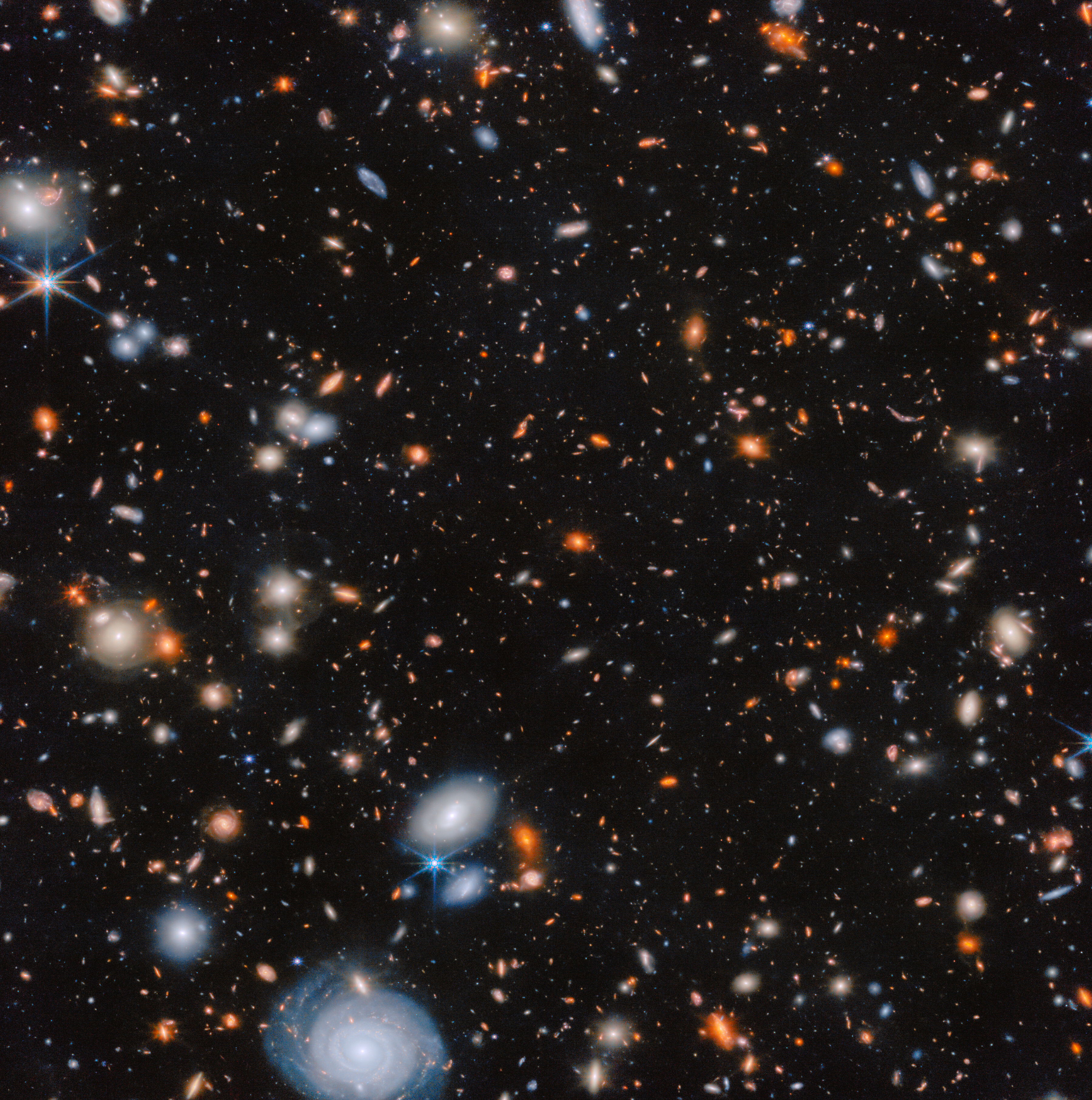
A massive galaxy cluster in the constellation Cetus dominates the center of this image from the Hubble Space Telescope. This image is populated with a serene collection of elliptical and spiral galaxies, but galaxies surrounding the central cluster – which is named SPT-CL J0019-2026 – appear stretched into bright arcs, as if distorted by a gargantuan magnifying glass. This cosmic contortion is called gravitational lensing, and it occurs when a massive object like a galaxy cluster has a sufficiently powerful gravitational field to distort and magnify the light from background objects. Gravitational lenses magnify light from objects that would usually be too distant and faint to observe, and so these lenses can extend Hubble’s view even deeper into the Universe.
This observation is part of an ongoing project to fill short gaps in Hubble's observing schedule by systematically exploring the most massive galaxy clusters in the distant Universe, in the hopes of identifying promising targets for further study with both Hubble and the James Webb Space Telescope. This particular galaxy cluster lies at a vast distance of 4.6 billion light years from Earth.
Each year, the Space Telescope Science Institute is inundated with observing proposals for Hubble, in which astronomers suggest targets for observation. Even after selecting only the very best proposals, scheduling observations of all of Hubble's targets for a year is a formidable task. There is sometimes a small fraction of observing time left unused in Hubble's schedule, so in its ‘spare time’ the telescope has a collection of objects to explore – including the lensing galaxy cluster shown in this image.
Image Credit: ESA/Hubble and NASA, H. Ebeling
Image enhancement: Jean-Baptiste Faure

Thursday, July 14, 2022

Galaxy Cluster Abell 1351

Galaxy Cluster Abell 1351
Click the image for higher resolution (2.4 MB)

The massive galaxy cluster Abell 1351 is captured in this image by the Hubble Space Telescope's Wide Field Camera 3 and Advanced Camera for Surveys. This galaxy cluster lies in the constellation Ursa Major in the northern hemisphere.
This image is filled with streaks of light, which are actually the images of distant galaxies. The streaks are the result of gravitational lensing, an astrophysical phenomenon that occurs when a massive celestial body such as a galaxy cluster distorts spacetime sufficiently strongly to affect the path of light passing through it – almost as if the light were passing through a gigantic lens. Gravitational lensing comes in two varieties – strong and weak – and both can give astronomers an insight into the distribution of mass within a lensing galaxy cluster such as Abell 1351.
This observation is part of an astronomical album comprising snapshots of some of the most massive galaxy clusters. This menagerie of massive clusters demonstrates interesting astrophysical phenomena such as strong gravitational lensing, as well as showcasing spectacular examples of violent galaxy evolution. To obtain this astronomical album, astronomers proposed a Snapshot Program to be slotted into Hubble's packed observing schedule. These Snapshot Programs are lists of separate, relatively short exposures which can fit into gaps between longer Hubble observations. Having a large pool of Snapshot candidates to dip into allows Hubble to use every second of observing time possible and to maximise the scientific output of the observatory.
Image Credit: ESA/Hubble and NASA, H. Ebeling
Acknowledgement: L. Shatz
Image enhancement: Jean-Baptiste Faure
Wednesday, July 28, 2021

Galaxy Cluster MACSJ0138.0-2155

Galaxy Cluster MACSJ0138.0-2155
Click on the image for higher resolution (2.8 MB)

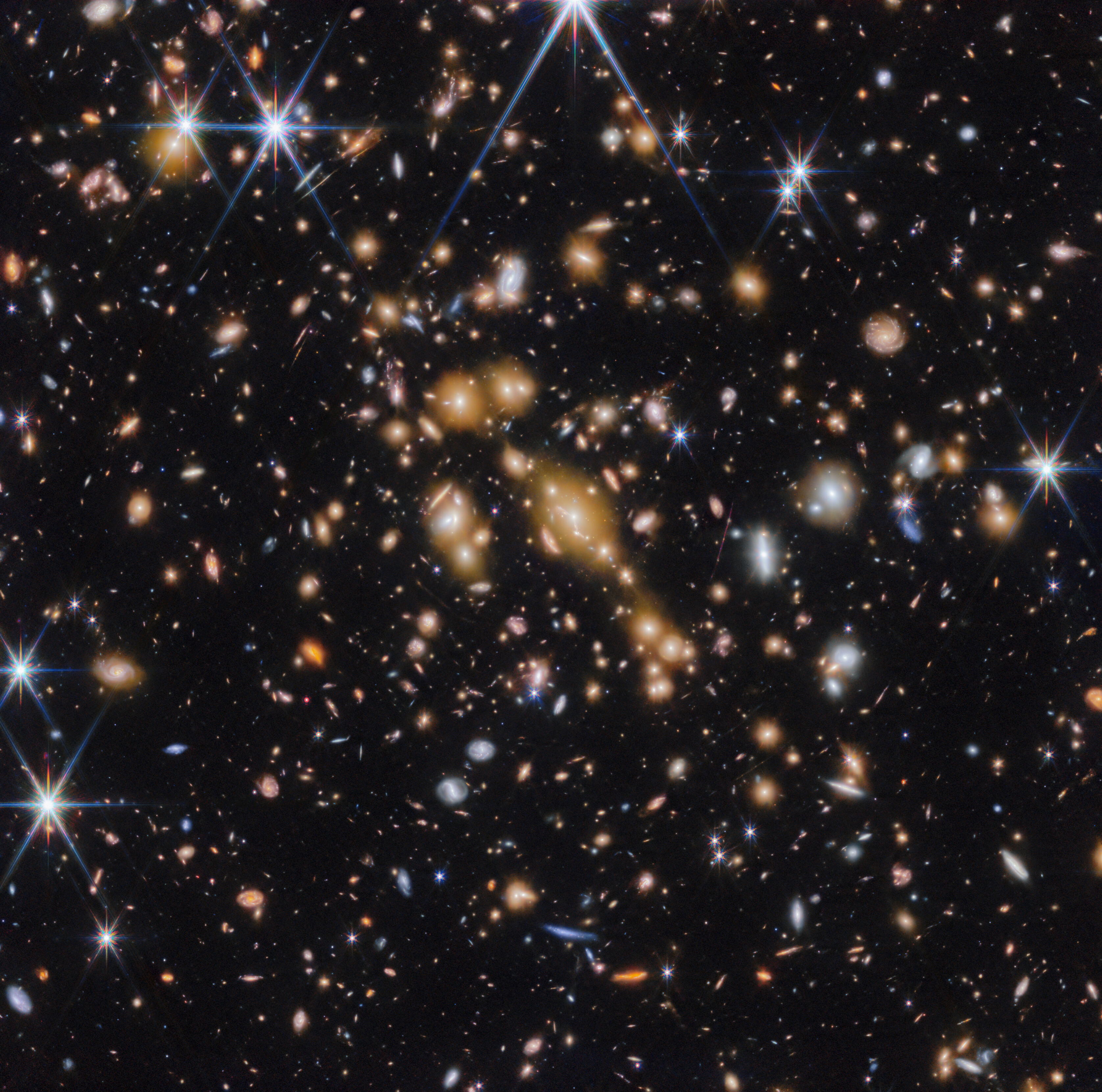
The center of this image from the Hubble Space Telescope is framed by the tell-tale arcs that result from strong gravitational lensing, a striking astronomical phenomenon which can warp, magnify, or even duplicate the appearance of distant galaxies.
Gravitational lensing occurs when light from a distant galaxy is subtly distorted by the gravitational pull of an intervening astronomical object. In this case, the relatively nearby galaxy cluster MACSJ0138.0-2155 has lensed a significantly more distant quiescent galaxy – a slumbering giant known as MRG-M0138 which has run out of the gas required to form new stars and is located 10 billion light years away. Astronomers can use gravitational lensing as a natural magnifying glass, allowing them to inspect objects like distant quiescent galaxies which would usually be too difficult for even Hubble to resolve.
This image was made using observations from eight different infrared filters spread across two of Hubble's most advanced astronomical instruments: the Advanced Camera for Surveys and the Wide Field Camera 3. These instruments were installed by astronauts during the final two servicing missions to Hubble, and provide astronomers with superbly detailed observations across a large area of sky and a wide range of wavelengths.
Image Credit: ESA/Hubble and NASA, A. Newman, M. Akhshik, K. Whitaker
Image enhancement: Jean-Baptiste Faure

Tuesday, May 18, 2021

Galaxy Cluster ACO S 295

Galaxy Cluster ACO S 295
Click on the image for higher resolution (2.8 MB)

This ESA/Hubble picture showcases the galaxy cluster ACO S 295, as well as a jostling crowd of background galaxies and foreground stars. Galaxies of all shapes and sizes populate this image, ranging from stately spirals to fuzzy ellipticals. As well as a range of sizes, this galactic menagerie boasts a range of orientations, with spiral galaxies such as the one at the center of this image appearing almost face on, and some edge-on spiral galaxies visible only as thin slivers of light.
The cluster dominates the center of this image, both visually and physically. The huge mass of the galaxy cluster has gravitationally lensed the background galaxies, distorting and smearing their shapes. As well as providing astronomers with a natural magnifying glass with which to study distant galaxies, gravitational lensing has subtly framed the center of this image, producing a visually striking scene.
Image Credit: ESA/Hubble and NASA, F. Pacaud, D. Coe
Image enhancement: Jean-Baptiste Faure

Thursday, April 15, 2021

Galaxy Cluster Abell 2813

Galaxy Cluster Abell 2813
Click on the image for higher resolution (1.3 MB)

This extraordinary image from the Hubble Space Telescope of the galaxy cluster Abell 2813 (also known as ACO 2813) has an almost delicate beauty, which also illustrates the remarkable physics at work within it. The image spectacularly demonstrates the concept of gravitational lensing.
In amongst the tiny dots, spirals and ovals that are the galaxies that belong to the cluster, there are several distinct crescent shapes. These curved arcs of light are strong examples of a phenomenon known as gravitational lensing. The image was compiled using observations taken with the Hubble Space Telescope's Advanced Camera for Surveys (ACS) and Wide Field Camera 3 (WFC3).
Gravitational lensing occurs when an object's mass causes light to bend. The curved crescents and s-shapes of light in this image are not curved galaxies, but are light from galaxies that actually lie beyond Abell 2813. The galaxy cluster has so much mass that it acts as a gravitational lens, causing light from more distant galaxies to bend around it. These distortions can appear as many different shapes, such as long lines or arcs. This very visual evidence that mass causes light to bend has been famously used as a proof of one of the most famous scientific theories: Einstein’s theory of general relativity.
Image Credit: ESA/Hubble and NASA, D. Coe
Image enhancement: Jean-Baptiste Faure

Sunday, February 7, 2021

Einstein Ring GAL-CLUS-022058s

Einstein Ring GAL-CLUS-022058s
Click on the image for higher resolution

The narrow galaxy elegantly curving around its spherical companion in this image is a fantastic example of a truly strange and very rare phenomenon. This image, taken with the Hubble Space Telescope, depicts GAL-CLUS-022058s, located in the southern hemisphere constellation of Fornax (The Furnace). GAL-CLUS-022058s is the largest and one of the most complete Einstein rings ever discovered in our Universe. The object has been nicknamed by the Principal Investigator and his team who are studying this Einstein ring as the "Molten Ring", which alludes to its appearance and host constellation.
First theorised to exist by Einstein in his general theory of relativity, this object's unusual shape can be explained by a process called gravitational lensing, which causes light shining from far away to be bent and pulled by the gravity of an object between its source and the observer. In this case, the light from the background galaxy has been distorted into the curve we see by the gravity of the galaxy cluster sitting in front of it.
The near exact alignment of the background galaxy with the central elliptical galaxy of the cluster, seen in the middle of this image, has warped and magnified the image of the background galaxy around itself into an almost perfect ring. The gravity from other galaxies in the cluster is soon to cause additional distortions. Objects like these are the ideal laboratory in which to research galaxies too faint and distant to otherwise see.
Image Credit: ESA/Hubble and NASA, S. Jha
Acknowledgement: L. Shatz
Image enhancement: Jean-Baptiste Faure
Tuesday, February 2, 2021

Galaxy Cluster Abell 370 and Asteroids

Galaxy Cluster Abell 370 and Asteroids
Click on the image for higher resolution (2.4 MB)

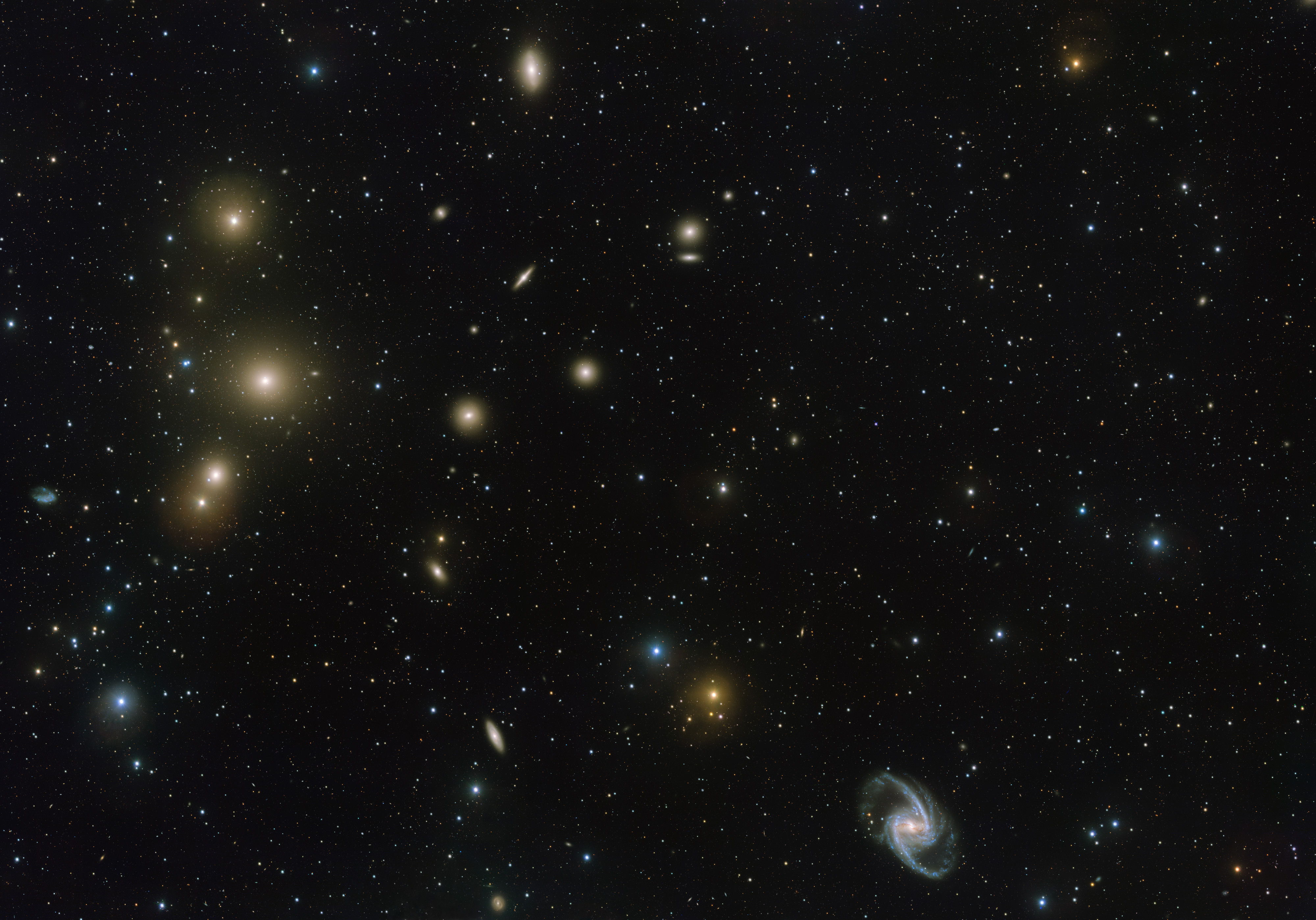
As if this Hubble Space Telescope picture isn't cluttered enough with myriad galaxies, nearby asteroids photobomb the image, their trails sometimes mimicking background astronomical phenomena.
The stunningly beautiful galaxy cluster Abell 370 contains an astounding assortment of several hundred galaxies tied together by the mutual pull of gravity. Located approximately 4 billion light-years away in the constellation Cetus, the Sea Monster, this immense cluster is a rich mix of a variety of galaxy shapes.
Entangled among the galaxies are thin, white trails that look like curved or S-shaped streaks. These are trails from asteroids that reside, on average, only about 260 million kilometers from Earth – right around the corner in astronomical terms. The trails appear in multiple Hubble exposures that have been combined into one image. Of the 22 total asteroid sightings for this field, five are unique objects. These asteroids are so faint that they were not previously identified.
The asteroid trails look curved due to an observational effect called parallax. As Hubble orbits around Earth, an asteroid will appear to move along an arc with respect to the vastly more distant background stars and galaxies. The motion of Earth around the Sun, and the motion of the asteroids along their orbits, are other contributing factors to the apparent skewing of asteroid paths.
All the asteroids were found manually, the majority by "blinking" consecutive exposures to capture apparent asteroid motion. Astronomers found a unique asteroid for every 10 to 20 hours of exposure time. These asteroid trails should not be confused with the mysterious-looking arcs of blue light that are actually distorted images of distant galaxies behind the cluster. Many of these far-flung galaxies are too faint for Hubble to see directly. Instead, in a dramatic example of "gravitational lensing", the cluster functions as a natural telescope, warping space and affecting light traveling through the cluster toward Earth.
The Frontier Fields program is a collaboration among several space telescopes and ground-based observatories to study six massive galaxy clusters and their effects. Using a different camera, pointing in a slightly different direction, Hubble photographed six so-called "parallel fields" at the same time it photographed the massive galaxy clusters. This maximised Hubble's observational efficiency in doing deep space exposures. These parallel fields are similar in depth to the famous Hubble Deep Field, and include galaxies about four-billion times fainter than can be seen by the human eye.
This image was assembled from several exposures taken in visible and infrared light. The field's position on the sky is near the ecliptic, the plane of our Solar System. This is the zone in which most asteroids reside, which is why Hubble astronomers saw so many crossings. Hubble deep-sky observations taken along a line-of-sight near the plane of our Solar System commonly record asteroid trails.
Image Credit: NASA, ESA, and B. Sunnquist and J. Mack (STScI)
Acknowledgment: NASA, ESA, and J. Lotz (STScI) and the HFF Team
Image enhancement: Jean-Baptiste Faure

Friday, December 11, 2020

Gravitationally-lensed Galaxy SDSS J090122.37+181432.3

Gravitationally-lensed Galaxy SDSS J090122.37+181432.3
Click on the image for higher resolution (1.0 MB)

This Hubble Space Telescope image features the galaxy SDSS J090122.37+181432.3, also known as LRG-3-817. The galaxy, its image distorted by the effects of gravitational lensing, appears as a long arc to the left of the central galaxy cluster.
Gravitational lensing occurs when a large distribution of matter, such as a galaxy cluster, sits between Earth and a distant light source. As space is warped by massive objects, the light from the distant object bends as it travels to us and we see a distorted image of it. This effect was first predicted by Einstein’s general theory of relativity.
Strong gravitational lenses provide an opportunity for studying properties of distant galaxies, since Hubble can resolve details within the multiple arcs that are one of the main results of gravitational lensing. An important consequence of lensing distortion is magnification, allowing us to observe objects that would otherwise be too far away and too faint to be seen. Hubble makes use of this magnification effect to study objects beyond the sensitivity of its 2.4-meter-diameter primary mirror, showing us the most distant galaxies humanity has ever encountered.
This lensed galaxy was found as part of the Sloan Bright Arcs Survey, which discovered some of the brightest gravitationally lensed high-redshift galaxies in the night sky.
Image Credit: ESA/Hubble and NASA, S. Allam et al.
Image enhancement: Jean-Baptiste Faure