Showing posts with label Protoplanetary Nebulae. Show all posts

Saturday, February 4, 2023

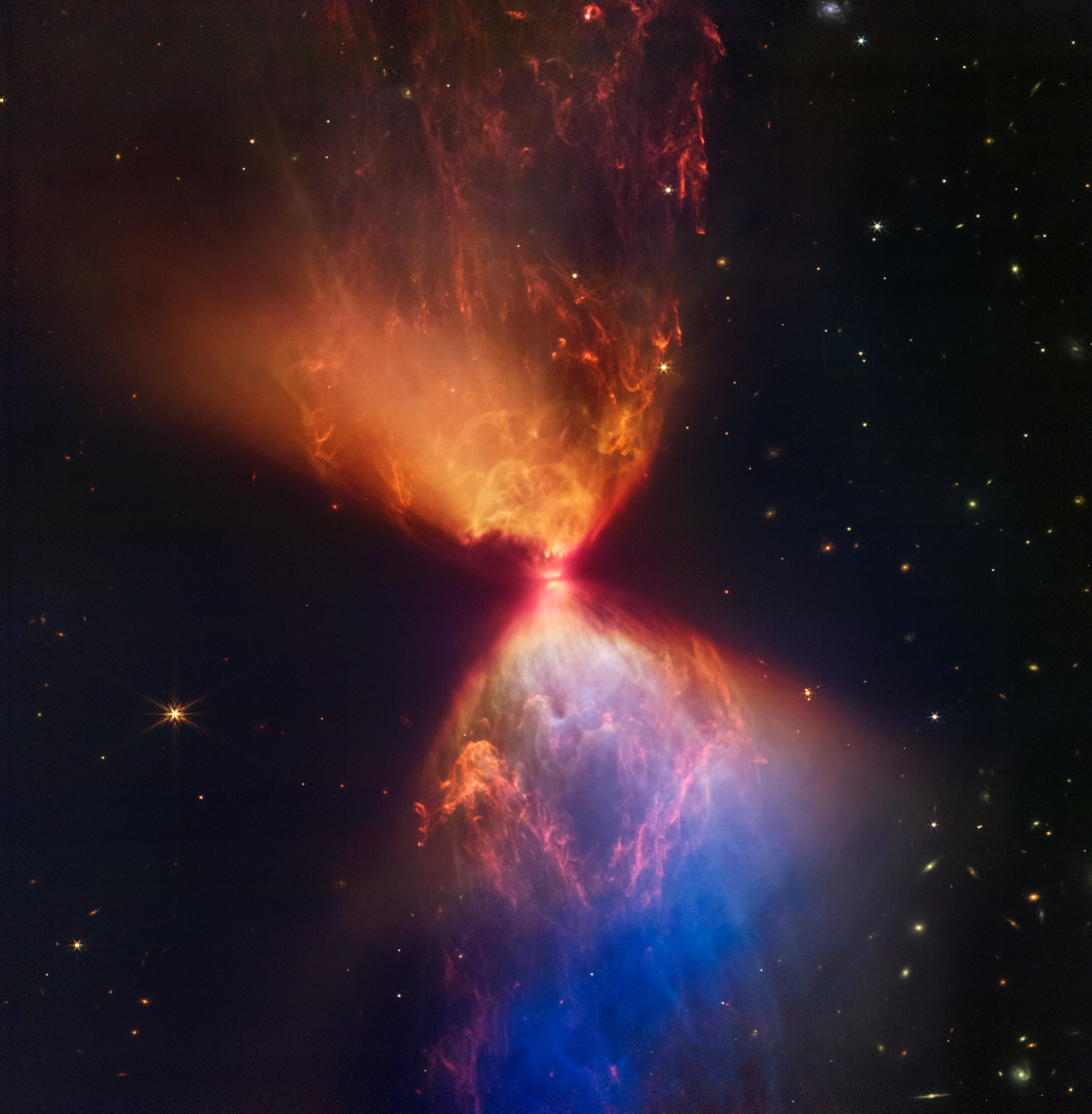
Protostar L1527 as seen by Webb

Protostar L1527 as seen by Webb
Click the image for higher resolution (3.9 MB)

The protostar L1527, shown in this image from the James Webb Space Telescope, is embedded within a cloud of material that is feeding its growth. Material ejected from the star has cleared out cavities above and below it, whose boundaries glow orange and blue in this infrared view. The upper central region displays bubble-like shapes due to stellar 'burps,' or sporadic ejections. Webb also detects filaments made of molecular hydrogen that has been shocked by past stellar ejections. Intriguingly, the edges of the cavities at upper left and lower right appear straight, while the boundaries at upper right and lower left are curved. The region at lower right appears blue, as there’s less dust between it and Webb than the orange regions above it.
Image Credit: NASA, ESA, CSA, and STScI, J. DePasquale (STScI)
Image enhancement: Jean-Baptiste Faure

Sunday, August 2, 2020

The Coldest Object in the Universe: the Boomerang Nebula

The Coldest Object in the Universe: the Boomerang Nebula
Click on the image for higher resolution

This picture shows the Boomerang Nebula, a protoplanetary nebula, as seen by the Atacama Large Millimeter/submillimeter Array (ALMA). The background purple structure, as seen in visible light with the Hubble Space Telescope, shows a classic double-lobe shape with a very narrow central region. ALMA's ability to see the cold molecular gas reveals the nebula's more elongated shape, in orange.
Since 2003 the nebula, located about 5000 light-years from Earth, has held the record for the coldest known object in the Universe. The nebula is thought to have formed from the envelope of a star in its later stages of life which engulfed a smaller, binary companion. It is possible that this is the cause of the ultra-cold outflows, which are illuminated by the light of the central, dying star.
ALMA looked at the nebula's central dusty disc and the outflows further out, which span a distance of almost four light-years across the sky. These outflows are even colder than the cosmic microwave background, reaching temperatures below –270 °C! The outflows are also expanding at a speed of 590 000 kilometers per hour.
Image Credit: ALMA (ESO/NAOJ/NRAO)/R. Sahai
Image enhancement: Jean-Baptiste Faure

Monday, October 8, 2012

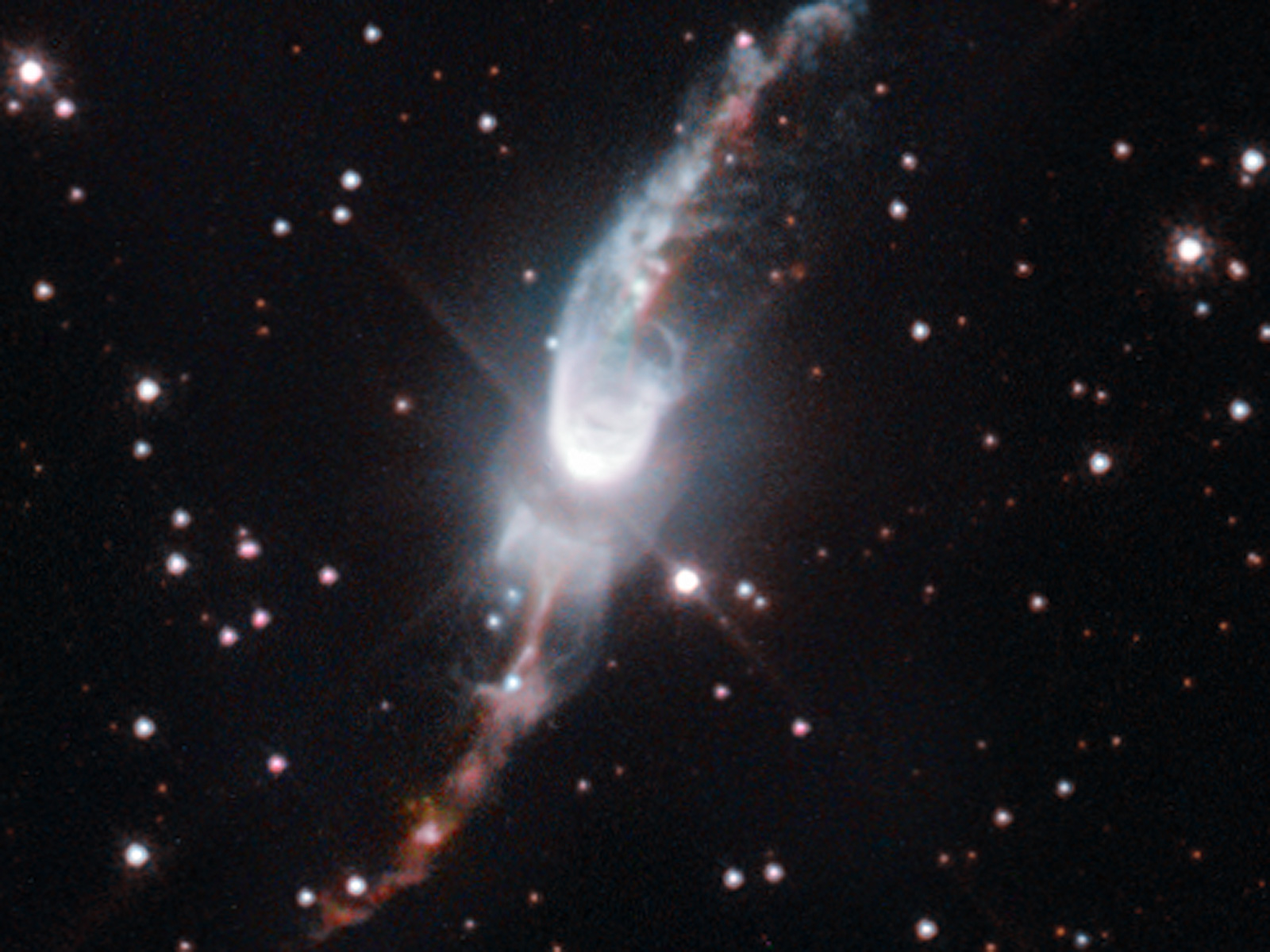
Protoplanetary Nebula Hen 3-1475

Protoplanetary Nebula Hen 3-1475
Click on the image for full resolution

The Universe is filled with mysterious objects. Many of them are as strange as they are beautiful. Among these, planetary nebulae are probably one of the most fascinating objects to behold in the night sky. No other type of object has such a large variety of shapes and structures. The NASA/ESA Hubble Space Telescope provides us this week with a striking image of Hen 3-1475, a planetary nebula in the making. Planetary nebulae — the name arises because most of these objects resembled a planet when they were first discovered through early telescopes — are expanding, glowing shells of gas coming from Sun-like stars at the ends of their lives. They glow brightly because of the radiation that comes from a hot, compact core, which remains after the outer envelope is ejected, and is powerful enough to make these gossamer shells shine. Each planetary nebula is complex and unique. Hen 3-1475 is a great example of a planetary nebula in the making, a phase which is known to astronomers as a protoplanetary or preplanetary nebula. Since the central star has not yet blown away its complete shell, the star is not hot enough to ionise the shell of gas and so the nebula does not shine. Rather, we see the expelled gas thanks to light reflected off it. When the star's envelope is fully ejected, it will begin to glow and become a planetary nebula. Hen 3-1475 is located in the constellation of Sagittarius around 18 000 light-years away from us. The central star is more than 12 000 times as luminous as our Sun. Its most characteristic feature is a thick torus of dust around the central star and two S-shaped jets that are emerging from the pole regions of the central star. These jets are long outflows of fast-moving gas travelling at hundreds of kilometres per second. The formation of these bipolar jets has puzzled astronomers for a long time. How can a spherical star form these complex structures? Recent studies suggest that the object’s characteristic shape and the large velocity outflow is created by a central source that ejects streams of gas in opposite directions and precesses once every thousand years. It is like an enormous, slowly rotating garden sprinkler in the middle of the sky. No wonder astronomers also have nicknamed this object the "Garden-sprinkler Nebula". This picture was taken with Hubble's Wide Field Camera 3, which provides significantly higher resolution than previous observations made with the Wide Field and Planetary Camera 2.
Credit: ESA/Hubble and NASA
Image enhancement: Jean-Baptiste Faure

Monday, April 23, 2012

New Hubble image of the Egg Nebula

New Hubble image of the Egg Nebula
Click on the image for full resolution

The NASA/ESA Hubble Space Telescope has been at the cutting edge of research into what happens to stars like our Sun at the ends of their lives. One stage that stars pass through as they run out of nuclear fuel is the preplanetary, or protoplanetary nebula. This Hubble image of the Egg Nebula shows one of the best views to date of this brief but dramatic phase in a star's life. The preplanetary nebula phase is a short period in the cycle of stellar evolution - over a few thousand years, the hot remains of the star in the centre of the nebula heat it up, excite the gas, and make it glow as a planetary nebula. The short lifespan of preplanetary nebulae means there are relatively few of them in existence at any one time. Moreover, they are very dim, requiring powerful telescopes to be seen. This combination of rarity and faintness means they were only discovered comparatively recently. The Egg Nebula, the first to be discovered, was first spotted less than 40 years ago, and many aspects of this class of object remain shrouded in mystery. At the center of this image, and hidden in a thick cloud of dust, is the nebula's central star. While we can't see the star directly, four searchlight beams of light coming from it shine out through the nebula. It is thought that ring-shaped holes in the thick cocoon of dust, carved by jets coming from the star, let the beams of light emerge through the otherwise opaque cloud. The precise mechanism by which stellar jets produce these holes is not known for certain, but one possible explanation is that a binary star system, rather than a single star, exists at the centre of the nebula. The onion-like layered structure of the more diffuse cloud surrounding the central cocoon is caused by periodic bursts of material being ejected from the dying star. The bursts typically occur every few hundred years. The distance to the Egg Nebula is only known very approximately, the best guess placing it at around 3000 light-years from Earth. This in turn means that astronomers do not have any accurate figures for the size of the nebula (it may be larger and further away, or smaller but nearer). This image is produced from exposures in visible and infrared light from Hubble's Wide Field Camera 3.
Credit: ESA/Hubble and NASA
Image enhancement: Jean-Baptiste Faure

Monday, December 5, 2011

Hubble view of IRAS 09371+1212, the Frosty Leo Nebula

Hubble view of IRAS 09371+1212, the Frosty Leo Nebula
Click on the image for full resolution

Three thousand light-years from Earth lies the strange protoplanetary nebula IRAS 09371+1212, nicknamed the Frosty Leo Nebula. Despite their name, protoplanetary nebulae have nothing to do with planets: they are formed from material shed from their aging central star. The Frosty Leo Nebula has acquired its curious name as it has been found to be rich in water in the form of ice grains, and because it lies in the constellation of Leo. This nebula is particularly noteworthy because it has formed far from the galactic plane, away from interstellar clouds that may block our view. The intricate shape comprises a spherical halo, a disc around the central star, lobes and gigantic loops. This complex structure strongly suggests that the formation processes are complex and it has been suggested that there could be a second star, currently unseen, contributing to the shaping of the nebula. Protoplanetary nebulae like the Frosty Leo Nebula have brief lifespans by astronomical standards and are precursors to the planetary nebula phase, in which radiation from the star will make the nebula's gas light up brightly. Their rarity makes studying them a priority for astronomers who seek to understand better the evolution of stars. This picture was created from images taken with the High Resolution Channel of Hubble's Advanced Camera for Surveys, which images a small area of sky (only 26 by 29 arcseconds) in high detail.
Credit: ESA/Hubble and NASA

Monday, July 11, 2011

Hubble captures rare Protoplanetary Nebula Minkowski 92

Hubble captures rare Protoplanetary Nebula Minkowski 92
Click on the image for full resolution

The NASA/ESA Hubble Space Telescope has been used to capture a striking image of a rare astronomical phenomenon called a protoplanetary nebula. This particular example, called Minkowski's Footprint, also known as Minkowski 92, features two vast onion-shaped structures either side of an ageing star, giving it a very distinctive shape. Protoplanetary nebulae like Minkowski's Footprint have short lives, being a preliminary stage to the more common planetary nebula phase. In the middle of the image is a star, soon to be a white dwarf, puffing out material due to intense surface pulsations. Charged particle streams, called stellar winds, are shaping this gas into the interesting shapes that Hubble allows us to see. Technically speaking Minkowski's Footprint is currently a reflection nebula as it is only visible due to the light reflected from the central star. In a few thousand years the star will get hotter and its ultraviolet radiation will light up the surrounding gas from within, causing it to glow. At this point it will have become a fully fledged planetary nebula. The processes behind protoplanetary nebulae are not completely understood, making observations such as this even more important. Hubble has already conducted sterling work in this field, and is set to continue. The image was obtained with the Hubble's Wide Field Planetary Camera 2. The picture has been made from many exposures through four different colour filters. Light from ionised oxygen has been coloured blue (F502N), light passing through a green/yellow filter (F547M) is coloured cyan, light from atomic oxygen is coloured yellow (F631N) and light from ionised sulphur is coloured red (F673N). The total exposure times per filter were 2080 s, 960 s, 2080 s and 1980 s respectively and the field of view is only about 36 arcseconds across.
Credit: ESA/Hubble and NASA

Thursday, June 30, 2011

Hubble shoots HD 44179, the unique Red Rectangle Nebula

Hubble shoots HD 44179, the unique Red Rectangle Nebula
Click on the image for full resolution

The star HD 44179 is surrounded by an extraordinary structure known as the Red Rectangle. It acquired its moniker because of its shape and its apparent colour when seen in early images from Earth. This strikingly detailed new Hubble image reveals how, when seen from space, the nebula, rather than being rectangular, is shaped like an X with additional complex structures of spaced lines of glowing gas, a little like the rungs of a ladder. The star at the centre is similar to the Sun, but at the end of its lifetime, pumping out gas and other material to make the nebula, and giving it the distinctive shape. It also appears that the star is a close binary that is surrounded by a dense torus of dust - both of which may help to explain the very curious shape. Precisely how the central engine of this remarkable and unique object spun the gossamer threads of nebulosity remains mysterious. It is likely that precessing jets of material played a role. The Red Rectangle is an unusual example of what is known as a proto-planetary nebula. These are old stars, on their way to becoming planetary nebulae. Once the expulsion of mass is complete a very hot white dwarf star will remain and its brilliant ultraviolet radiation will cause the surrounding gas to glow. The Red Rectangle is found about 2 300 light-years away in the constellation Monoceros (the Unicorn). The High Resolution Channel of the NASA/ESA Hubble Space Telescope's Advanced Camera for Surveys captured this view of HD 44179 and the surrounding Red Rectangle nebula - the sharpest view so far. Red light from glowing Hydrogen was captured through the F658N filter and coloured red. Orange-red light over a wider range of wavelengths through a F625W filter was coloured blue. The field of view is about 25 by 20 arcseconds.
Credit: ESA/Hubble and NASA

Sunday, June 26, 2011

Hungry? IRAS 18059-3211, the Gomez's Hamburger, is for you!

Hungry? IRAS 18059-3211, the Gomez's Hamburger, is for you!
Click on the image for full resolution (1.97 MB)

Hold the pickles; hold the lettuce. Space is serving up giant hamburgers. The NASA/ESA Hubble Space Telescope has snapped a photograph of a strange object that bears an uncanny resemblance to a hamburger. The object, IRAS 18059-3211, nicknamed Gomez's Hamburger, is a sun-like star nearing the end of its life. It already has expelled large amounts of gas and dust and is on its way to becoming a colorful, glowing planetary nebula. The ingredients for the giant celestial hamburger are dust and light. The hamburger buns are light reflecting off dust and the patty is the dark band of dust in the middle.
The full resolution image weighs 1.97 MB, so please be (a little) patient when downloading!
Credit: NASA/ESA and The Hubble Heritage Team (STScI/AURA)

Monday, June 13, 2011

Hubble catches odd Protoplanetary Nebula IRAS 22036+5306

Hubble catches odd Protoplanetary Nebula IRAS 22036+5306
Click on the image for full resolution

The NASA/ESA Hubble Space Telescope has made a rare celestial catch. Close to a bright, nearby star in this image, the bizarre, whorl-shaped object known as IRAS 22036+5306 has been captured during a brief tumultuous period late in a star's life. Inside IRAS 22036+5306 lies an aged star that has coughed off almost all of its outer material, forming a cloud in space. Hidden under this veil, the dense, still-burning, exposed core of the star grows hotter. Encircling the star is a torus consisting partly of castoff material, as well as possibly the grainy remnants of comets and other small, rocky bodies. Twin jets spout from the star’s poles and pierce this dusty waist. The jets contain gobbets of material - typically about ten thousand times the mass of the Earth - hurling outwards at a speed of nearly 800 000 kilometers per hour. IRAS 22036+5306 is making the transition through the protoplanetary, or preplanetary, nebula phase. Only a few hundred such nebulae have been spotted in our galaxy. For now, light from the central star is merely being reflected off its expelled gaseous shell. Soon, however, the star will become a very hot, white dwarf, and its intense ultraviolet radiation will ionise the blown-off gas, making it glow in rich colours. IRAS 22036+5306 will have then blossomed into a fully-fledged planetary nebula, and this event will serve as a last hurrah before the star starts its very slow final cool-down. Planetary nebulae are much longer-lived than their precursors, protoplanetary nebulae, and are therefore more commonly spotted. The term planetary nebula is a leftover from observations through small telescopes made by early astronomers to whom some of these objects looked circular and similar in appearance to the outer planets Uranus and Neptune. IRAS 22036+5306 is found about 6500 light-years away in the constellation of Cepheus (The King). Studying rarities such as IRAS 22036+5306 provides astronomers with a window into the short and poorly understood phase of stellar evolution when bloated red giant stars pare down to small white dwarfs. For example, mysteries remain about how exactly the dusty torus and jets form. The planetary nebula phase is thought to be the fate that awaits most medium-sized stars, including our Sun. But it is not clear that our star will make such a fuss on its way out - the star that generated all the gaseous splendour of IRAS 22036+5306 is reckoned to have been at least four times the mass of the Sun. The image was obtained with the High Resolution Channel of Hubble's Advanced Camera for Surveys. The picture has been made from images through a yellow/orange filter (F606W, coloured blue), a near-infrared filter (F814W, coloured orange) and a filter that lets through the red glow of hydrogen (F658N, coloured red). The total exposure times per filter were 1600 s, 3200 s and 5104 s, respectively and the field of view is about 22 arcseconds across.
Credit: ESA/Hubble and NASA

Tuesday, June 7, 2011

Hubble watches IRAS 13208-6020, a Celestial Prologue!

Hubble watches IRAS 13208-6020, a Celestial Prologue!
Click on the image for full resolution

The two billowing structures in this NASA/ESA Hubble Space Telescope image of IRAS 13208-6020 are formed from material that is shed by a central star. This is a relatively short-lived phenomenon that gives astronomers an opportunity to watch the early stages of planetary nebula formation, hence the name protoplanetary, or preplanetary nebula. Planetary nebulae are unrelated to planets and the name arose because of the visual similarity between some planetary nebulae and the small discs of the outer planets in the Solar System when viewed through early telescopes. This object has a very clear bipolar form, with two very similar outflows of material in opposite directions and a dusty ring around the star. Protoplanetary nebulae do not shine, but are illuminated by light from the central star that is reflected back to us. But as the star continues to evolve, it becomes hot enough to emit strong ultraviolet radiation that can ionise the surrounding gas, making it glow as a spectacular planetary nebula. But before the nebula begins to shine, fierce winds of material ejected from the star will continue to shape the surrounding gas into intricate patterns that can only be truly appreciated later once the nebula begins to glow. This picture was created from images taken using the High Resolution Channel of Hubble's Advanced Camera for Surveys. Images taken through an orange filter (F606W, coloured blue) and a near-infrared filter (F814W, coloured red) have been combined to create this picture. The exposure times were 1130 s and 150 s respectively and the field of view is just 22 x 17 arcseconds.
Credit: ESA/Hubble and NASA