Showing posts with label Barred Spiral Galaxies. Show all posts

Sunday, March 1, 2026

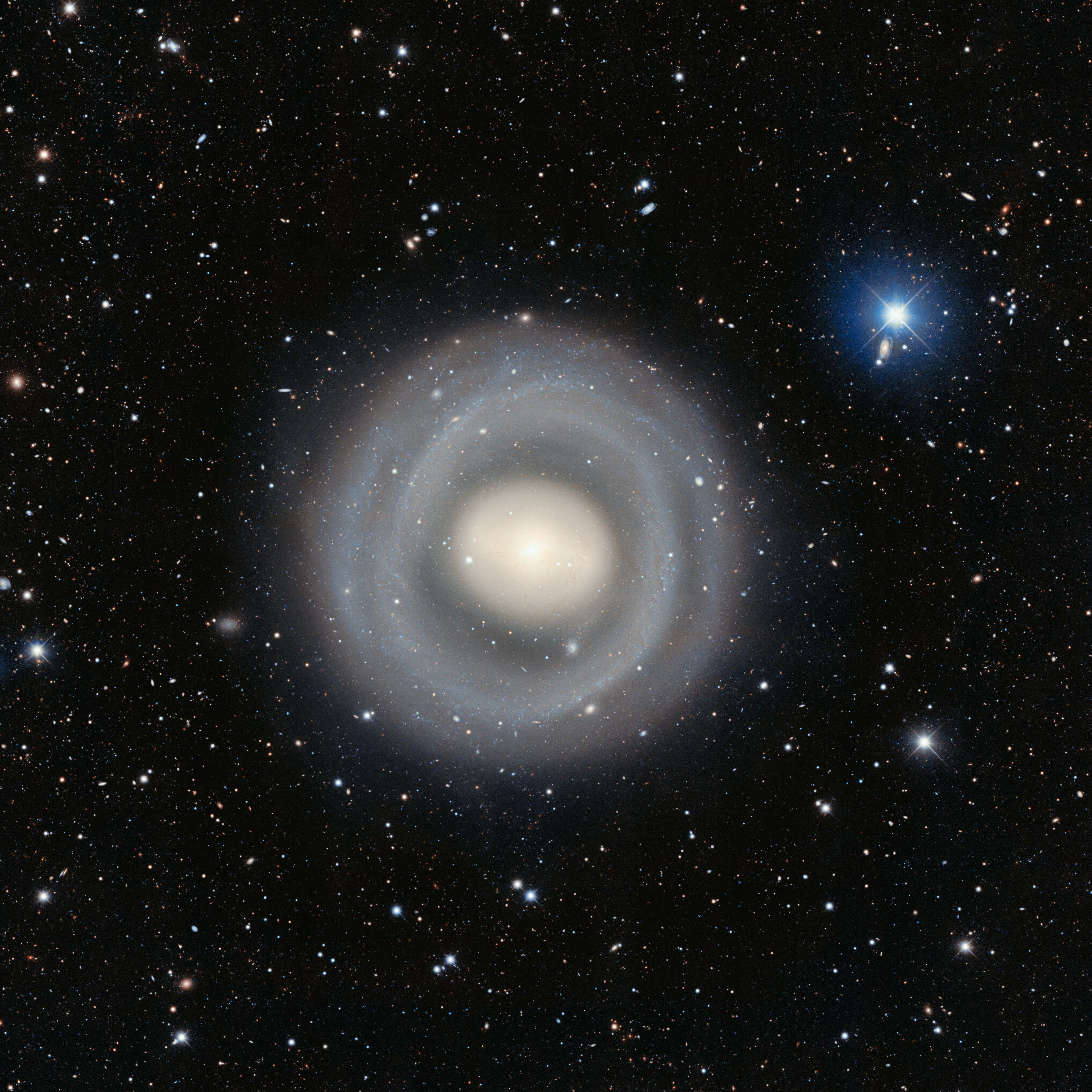
Barred Spiral Lenticular Galaxy NGC 1269

Barred Spiral Lenticular Galaxy NGC 1269
Click the image for higher resolution (13.2 MB)

This image of NGC 1269 was taken utilizing the Department of Energy-fabricated Dark Energy Camera (DECam), which is mounted on the U.S. National Science Foundation Víctor M. Blanco 4-meter Telescope at NSF Cerro Tololo Inter-American Observatory, a Program of NSF NOIRLab.
NGC 1269 is an early-type spiral galaxy located about 33 million light-years from Earth in the constellation Eridanus. A bar, a feature common to many spiral galaxies, slices through the center of the galaxy. Surrounding the galactic core are both inner and outer disks, seeming to form "wheels" around the core. Their presence is thought to be the result of a merger with another galaxy, and the inner disk is also believed to have been further shaped by density waves radiating outward from the galactic center.
Data for this image came from the archive of the Dark Energy Survey (DES), operated by the DOE and NSF between 2013 and 2019 with the specially-designed DECam. The survey sought to study the nature of the elusive dark matter by imaging hundreds of millions of galaxies. Today, the DECam is available to other scientists for use on the Blanco telescope.
Image Credit: Dark Energy Survey/DOE/FNAL/DECam/CTIO/NOIRLab/NSF/AURA
Image processing: R. Colombari & M. Zamani (NSF NOIRLab)
Image enhancement: Jean-Baptiste Faure

Monday, January 12, 2026

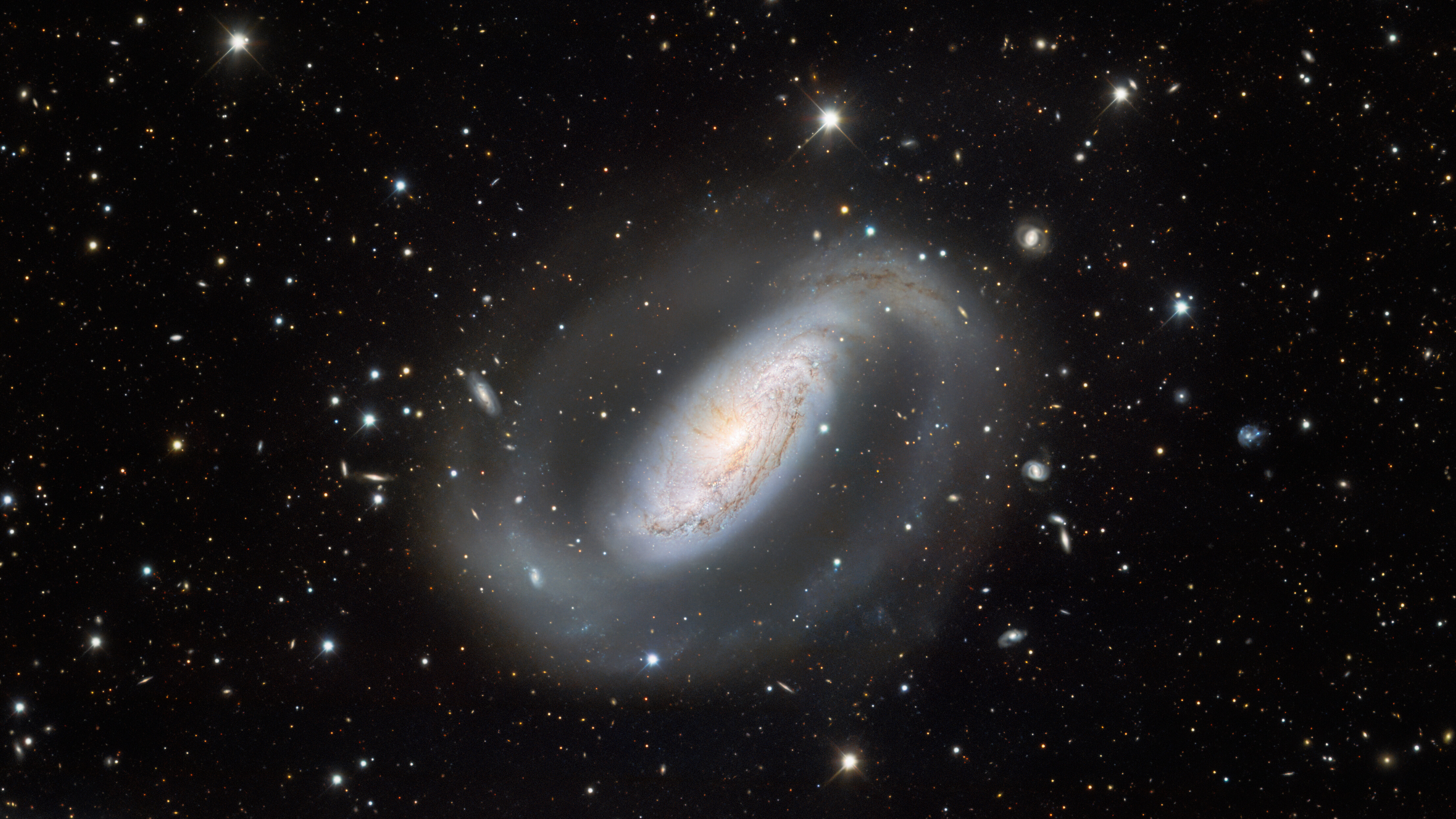
Barred Spiral Galaxy NGC 646 by Euclid

Barred Spiral Galaxy NGC 646 by Euclid
Click the image for higher resolution (6.0 MB)

Galaxy NGC 646 sparkles like a cosmic holiday garland in this new image from the European Space Agency's Euclid space telescope. This large barred spiral galaxy is located in the constellation Hydrus and was discovered in 1834 by the British astronomer John Herschel (the son of William Herschel). The galaxy is moving away from us at about 8145 km per second. It's located roughly 392 million light-years from Earth, which means its light takes hundreds of millions of years to reach us. Although this sounds very far, NGC 646 is actually quite close compared to the billions of galaxies that Euclid will observe during its six-year mission.
By the end of 2026, ESA and the Euclid Consortium will release the first year of observations, covering about 1900 square degrees of the sky (approximately 14% of the total survey area). These images will reveal hundreds of thousands of galaxies in exquisite detail, offering new insights into how galaxies form and evolve – and why barred galaxies become more common as the Universe ages.
In this image, NGC 646 appears close to a smaller galaxy to the left, called PGC 6014. They look like neighbours, but they're actually about 45 million light-years apart, with PGC 6014 at a distance of 347 million light-years from us. So, any gravitational interaction between them, if it exists, would be very weak and short-lived. Image Credit: ESA/Euclid/Euclid Consortium/NASA
Image processing by the Euclid Science Ground Segment and M. Schirmer (MPIA)
Image enhancement: Jean-Baptiste Faure

Saturday, November 9, 2024

Barred Spiral Galaxy NGC 1672

Barred Spiral Galaxy NGC 1672
Click the image for higher resolution (5.1 MB)

This Hubble picture features NGC 1672, a barred spiral galaxy located 49 million light-years from Earth in the constellation Dorado. This galaxy is a multi-talented light show, showing off an impressive array of different celestial lights. Like any spiral galaxy, its disc is filled with billions of shining stars that give it a beautiful glow. Along its two large arms, bubbles of hydrogen gas are made to shine a striking red light by the powerful radiation of newly-forming stars within. Near to the centre lie some particularly spectacular stars; newly-formed and extremely hot, they are embedded in a ring of hot gas and are emitting powerful X-rays. And in the very centre sits an even more brilliant source of X-rays, an active galactic nucleus created by the heated accretion disc around NGC 1672's supermassive black hole; this makes NGC 1672 a Seyfert galaxy.
But a highlight of this image is the most fleeting and temporary of these lights: supernova SN 2017GAX, visible in just one of the six Hubble images that make up this composite image. This was a Type I supernova caused by the core-collapse and subsequent explosion of a giant star, going from invisibility to a new light in the sky in just a matter of days. In that image from later that year, the supernova is already fading, and so is only just visible here as a small green dot, just below the crook of the spiral arm on the right side. In fact this was on purpose, as astronomers wanted to look for any companion star that the supernova progenitor may have had – something impossible to spot beside a live supernova! For a closer look at the supernova's appearance, you can compare the two images with this slider tool.
Image Credit: ESA/Hubble and NASA, O. Fox, L. Jenkins, S. Van Dyk, A. Filippenko, J. Lee and the PHANGS-HST Team, D. de Martin (ESA/Hubble), M. Zamani (ESA/Hubble)
Image enhancement: Jean-Baptiste Faure

Saturday, September 21, 2024

Barred Spiral Galaxy NGC 1559

Barred Spiral Galaxy NGC 1559
Click the image for higher resolution (6.0 MB)

The magnificent galaxy featured in this Hubble picture is NGC 1559. It is a barred spiral galaxy located in the constellation Reticulum near the Large Magellanic Cloud, but much more distant at approximately 35 million light-years from Earth. Hubble last visited this object in 2018. The brilliant light captured in this image offers a wealth of information, which thanks to Hubble can be put to use by both scientists and the public.
This picture is composed of a whopping ten different images taken by the Hubble Space Telescope, each filtered to collect light from a specific wavelength or range of wavelengths. It spans Hubble's sensitivity to light, from ultraviolet around 275 nanometres through blue, green and red to near-infrared at 1600 nanometres. This allows information about many different astrophysical processes in the galaxy to be recorded: a notable example is the red 656-nanometre filter used here. Hydrogen atoms which get ionised can emit light at this particular wavelength, called H-alpha emission. New stars forming in a molecular cloud, made mostly of hydrogen gas, emit copious amounts of ultraviolet light which is absorbed by the cloud, but which ionises it and causes it to glow with this H-alpha light. Therefore, filtering to detect only this light provides a reliable means to detect areas of star formation (called H II regions), shown in this image by the bright red and pink colours of the blossoming patches filling NGC 1559's spiral arms.
These ten images come from six different observing programmes with Hubble, running from 2009 all the way up to the present year. These programmes were led by teams of astronomers from around the world with a variety of scientific goals, ranging from studying ionised gas and star formation, to following up on a supernova, to tracking variable stars as a contribution to calculating the Hubble constant. The data from all of these observations live on in the Hubble archive, available for anyone to use – not only for new science, but also to create spectacular images like this one! This image of NGC 1559, then, is a reminder of the incredible opportunities that the Hubble Space Telescope has provided and continues to provide.
Image Credit: ESA/Hubble and NASA, F. Belfiore, W. Yuan, J. Lee and the PHANGS-HST Team, A. Riess, K. Takáts, D. de Martin and M. Zamani (ESA/Hubble)
Image enhancement: Jean-Baptiste Faure

Saturday, June 15, 2024

Dwarf Barred Spiral Galaxy IC 776

Dwarf Barred Spiral Galaxy IC 776
Click the image for higher resolution (2.5 MB)

Featured in this picture is the dwarf galaxy IC 776. This swirling collection of stars new and old is located in the constellation Virgo – in fact, in the Virgo galaxy cluster – 100 million light-years from Earth. While a dwarf galaxy, it's also been classified as an SAB-type or "weakly barred" spiral, one study naming it a "complex case" in morphology. This highly detailed view from Hubble demonstrates that complexity well. IC 776 has a ragged, disturbed disc that nevertheless looks to spiral around the core, and arcs of star-forming regions.
This image is from an observation programme dedicated to the study of dwarf galaxies in the Virgo cluster, searching for sources of X-rays in such galaxies. X-rays are often emitted by accretion discs, where material that is drawn into a compact object by gravity crashes together and forms a hot, glowing disc. The compact object can be a white dwarf or neutron star in a binary pair, stealing material from its companion star, or it can be the supermassive black hole at the heart of a galaxy, devouring all around it. Dwarf galaxies like IC 776, travelling through the Virgo cluster, experience a pressure from the intergalactic gas which can both stimulate star formation and feed the central black hole in a galaxy. That can create energetic accretion discs, hot enough to emit X-rays.
While Hubble is not able to see X-rays, it can coordinate with X-ray telescopes such as NASA's Chandra, revealing the sources of this radiation in high resolution using visible light. Dwarf galaxies are thought to be very important for our understanding of cosmology and the evolution of galaxies. As with many areas of astronomy, the ability to examine these galaxies across the electromagnetic spectrum is critical to their study.
Image Credit: ESA/Hubble and NASA, M. Sun
Image enhancement: Jean-Baptiste Faure

Saturday, June 8, 2024

Barred Spiral Galaxy NGC 3059

Barred Spiral Galaxy NGC 3059
Click the image for higher resolution (7.6 MB)

This picture features the barred spiral galaxy NGC 3059, which lies about 57 million light-years from Earth. The data used to compose this image were collected by Hubble in May 2024, as part of an observing programme that studied a number of galaxies. All the observations were made using the same range of filters: partially transparent materials that allow only very specific wavelengths of light to pass through.
Filters are used extensively in observational astronomy, and can be calibrated to allow either extremely narrow or somewhat broader ranges of light through. Narrow-band filters are invaluable from a scientific perspective because certain light wavelengths are associated with specific physical and chemical processes. For example, under particular conditions, hydrogen atoms are known to emit red light with wavelength value of 656.46 nanometers. Red light at this wavelength is known as H-alpha emission, or the "H-alpha line". It is very useful to astronomers because its presence acts as an indicator of certain physical processes and conditions; it is often a tell-tale sign of new stars being formed, for example.
Thus, narrow-band filters calibrated to allow H-alpha emission through can be used to identify regions of space where stars are forming.
Such a filter was used for this image, the narrow-band filter called F657N or the H-alpha filter. The F stands for filter, and the N stands for narrow. The numerical value refers to the peak wavelength (in nanometers) that the filter lets through. The eagle-eyed amongst you may have noticed that 657 is very close to the 656.46 H-alpha line's wavelength. Data collected using five other filters contributed to this image as well, all of which were wide-band filters; meaning that they allow a wider range of light wavelengths through. This is less useful for identifying extremely specific lines (such as the H-alpha line) but still enables astronomers to explore relatively specific parts of the electromagnetic spectrum. In addition, collectively the information from multiple filters can be used to make beautiful images such as this one.
Image Credit: ESA/Hubble and NASA, D. Thilker
Image enhancement: Jean-Baptiste Faure

Barred Spiral Galaxy NGC 4731

Barred Spiral Galaxy NGC 4731
Click the image for higher resolution (7.7 MB)

The barred spiral galaxy NGC 4731 lies among the galaxies of the Virgo cluster, in the constellation Virgo, and is located 43 million light-years from Earth. This highly detailed image was created using six different filters. The abundance of colour illustrates the galaxy's billowing clouds of gas, dark dust bands, bright pink star-forming regions and, most obviously, the long, glowing bar with trailing arms.
Barred spiral galaxies outnumber both regular spirals and elliptical galaxies put together, numbering around 60% of all galaxies. The visible bar structure is a result of orbits of stars and gas in the galaxy lining up, forming a dense region that individual stars move in and out of over time. This is the same process that maintains a galaxy's spiral arms, but it is somewhat more mysterious for bars: spiral galaxies seem to form bars in their centers as they mature, accounting for the large number of bars we see today, but can also lose them later on as the accumulated mass along the bar grows unstable. The orbital patterns and the gravitational interactions within a galaxy that sustain the bar also transport matter and energy into it, fuelling star formation. Indeed, the observing programme studying NGC 4731 seeks to investigate this flow of matter in galaxies.
Beyond the bar, the spiral arms of NGC 4731 stretch out far past the confines of this close-in Hubble view. The galaxy's elongated arms are thought to result from gravitational interactions with other, nearby galaxies in the Virgo cluster.
Image Credit: ESA/Hubble and NASA, D. Thilker
Image enhancement: Jean-Baptiste Faure

Friday, April 19, 2024

Barred Spiral Galaxy NGC 1559 as seen by Webb

Barred Spiral Galaxy NGC 1559 as seen by Webb
Click the image for higher resolution (5.6 MB)

This image features the barred spiral galaxy NGC 1559 as seen by the James Webb Space Telescope. The galaxy hosts a visible central region with a distinct open pattern in the loosely-wound spiral arms. NGC 1559 resides approximately 35 million light-years away in the little-observed southern constellation Reticulum (The Reticule).
The data featured in this portrait make use of two of Webb's instruments: the Mid-InfraRed Instrument (MIRI) and Near-InfraRed Camera (NIRCam). Here MIRI captures the glow of interstellar dust grains, which trace out the interstellar medium, the fuel for future star formation. NIRCam shows the light from stars, even young stars hidden behind prodigious amounts of dust. NIRCam also captures emission from ionised nebulae around young stars.
The data were collected by the PHANGS team as part of an observing programme in which Webb will observe 55 galaxies that have also been mapped by the Atacama Large Millimeter/submillimeter Array (ALMA) radio telescope, the Hubble Space Telescope and more. By combining Webb's unprecedented view of the dust and stars with data from these other facilities, the team aims to obtain a new, highly detailed view of how stars are born, live, and die in galaxies across the Universe. This is also a Treasury programme, which means that the data will have no exclusive access period and so the scientific community (and others, including the general public) can access the data immediately. This has the advantage that more research can be done with the data more quickly.
NGC 1559 has massive spiral arms that abound with star formation, and it is receding from us at a speed of about 1300 kilometers per second. Although NGC 1559 appears to sit near one of our nearest neighbours in the sky – the Large Magellanic Cloud (LMC) – this is just a trick of perspective. In reality, NGC 1559 is physically nowhere near the LMC in space; in fact it truly is a loner, lacking the company of any nearby galaxies or membership of any galaxy cluster. NGC 1559 may be alone in space, but with Webb we are admiring from far away.
Image Credit: ESA/Webb, NASA and CSA, A. Leroy, J. Lee and the PHANGS Team
Image enhancement: Jean-Baptiste Faure

Wednesday, April 17, 2024

Barred Spiral Galaxy NGC 3783

Barred Spiral Galaxy NGC 3783
Click the image for higher resolution (4.9 MB)

This image features NGC 3783, a bright barred spiral galaxy about 130 million light-years from Earth, that also lends its name to the eponymous NGC 3783 galaxy group. Like galaxy clusters, galaxy groups are aggregates of gravitationally bound galaxies. Galaxy groups, however, are less massive and contain fewer members than galaxy clusters do: where galaxy clusters can contain hundreds or even thousands of constituent galaxies, galaxy groups do not typically include more than 50. The Milky Way is actually part of a galaxy group, known as the Local Group, which contains two other large galaxies (Andromeda and the Triangulum galaxy), as well as several dozen satellite and dwarf galaxies. The NGC 3783 galaxy group, meanwhile, contains 47 galaxies. It also seems to be at a fairly early stage of its evolution, making it an interesting object of study.
Whilst the focus of this image is the spiral galaxy NGC 3783, the eye is equally drawn to the very bright object in the lower right part of this image. This is the star HD 101274. The perspective in this image makes the star and the galaxy look like close companions, but this is an illusion. HD 101274 lies only about 1530 light-years from Earth, meaning it is about 85 thousand times closer than NGC 3783. This explains how a single star can appear to outshine an entire galaxy!
NGC 3783 is a type-1 Seyfert galaxy, which is a galaxy with a bright central region – so it's particularly bright itself, as far as galaxies go. In this image it is recorded by Hubble in incredible detail, from its glowing central bar to its narrow, winding arms and the dust threaded through them, thanks to five separate images taken in different wavelengths of light. In fact, the galactic centre is bright enough to Hubble that it exhibits diffraction spikes, normally only seen on stars such as HD 101274.
Image Credit: ESA/Hubble and NASA, M. C. Bentz, D. J. V. Rosario
Image enhancement: Jean-Baptiste Faure

Saturday, March 9, 2024

Barred Spiral Galaxy NGC 1808

Barred Spiral Galaxy NGC 1808
Click the image for higher resolution (2.9 MB)

NGC 1808 is a barred spiral galaxy located in the southern constellation Columba (the dove). This image was captured using the Dark Energy Camera (DECam), which is mounted on the Víctor M. Blanco 4-meter Telescope at Cerro Tololo Inter-American Observatory (CTIO), a Program of NSF's NOIRLab, in Chile. The core of NGC 1808 is thought to house a supermassive black hole, characterized by its accretion of material and higher-than-normal brightness. The smoldering center is closely surrounded by a faint blue ring populated with star clusters and supernova remnants. This region is defined by its starburst activity, producing an exceptional number of hot, bright, young stars. The abundance of rapid star formation is thought to be the result of past tidal interactions with the nearby galaxy NGC 1792. Laced throughout this middle region of NGC 1808 are dark dust lanes resulting from large outflows of hydrogen gas from the galactic nucleus. The softly glowing outer arms surrounding the galaxy are slightly warped, again pointing to tidal interactions with NGC 1792. Such an interaction could have created the asymmetrical shape of NGC 1808 and hurled gas towards the nucleus, igniting the rapid star formation in its surrounding ring.
Image Credit: Dark Energy Survey/DOE/FNAL/DECam/CTIO/NOIRLab/NSF/AURA
Image processing: R. Colombari and M. Zamani (NSF's NOIRLab)
Image enhancement: Jean-Baptisste Faure

Irregular Galaxy ESO 245-5

Irregular Galaxy ESO 245-5
Click the image for higher resolution (7.9 MB)

This image shows a densely packed field of stars, laid on top of a background of dust, gas, and light from more distant celestial objects. The stars take up so much of the field of view in this image that it is a little tricky to discern that you are in fact looking at most of a galaxy, known as ESO 245-5. This galaxy is a relatively close neighbour of the Milky Way, lying at the fairly modest distance of 15 million light-years from Earth in the constellation Phoenix.
Another reason that it is perhaps a little tricky to spot that ESO 245-5 is a galaxy is its apparent lack of structure. We frequently enjoy Hubble's spectacular images of spiral galaxies, which are so interesting to look at in part because of their seemingly extraordinarily ordered arms of stars, gas and dust. ESO 245-5, in contrast, is classified as an IB(s)m type galaxy under the system of galaxy classification known as the De Vaucouleurs system. The IB(s)m designation specifically means that the galaxy is irregular (I), barred (B), has a slight spiral structure ((s)), and is of the Magellanic type (m).
Irregular in this context is quite intuitive: the galaxy does not appear to have a regular, ordered structure. In fact, essentially the entire view here is covered by the stars of this galaxy. The second term means that the galaxy has a barred shape at its center: this is the dense stretch of stars that crosses through the center of this image. The third term says that there are hints of a spiral structure, but nothing clear or definitive (hence the "s" is bracketed). Finally, the last term indicates ESO 245-5's similarity to the Magellanic clouds, the two dwarf galaxies that are close neighbours of the Milky Way.
Image Credit: ESA/Hubble and NASA, M. Messa
Image enhancement: Jean-Baptiste Faure

Thursday, October 19, 2023

Intermediate Spiral Galaxy IC 5332

Intermediate Spiral Galaxy IC 5332
Click the image for higher resolution (7.8 MB)

This glittering image shows the spiral galaxy IC 5332, which lies about 30 million light-years away in the constellation Sculptor, and has an almost face-on orientation to Earth. To explain what is meant by "face-on", it is helpful to visualise a spiral galaxy as an (extremely) large disc. If the galaxy is oriented so that it appears circular and disc-shaped from our perspective here on Earth, then we can say that it is "face-on". In contrast, if it is oriented so that it appears squashed and oval-shaped, then we would say that it is "edge-on". The key thing is that the same galaxy would look extremely different from our perspective depending on whether it was face-on or edge-on as seen from Earth. Check out these previous Hubble Pictures of the Week for examples of another face-on spiral galaxy and an almost edge-on spiral galaxy.
IC 5332 is designated as an SABc-type galaxy in the De Vaucouleurs system of galaxy classification. The "S" is straightforward, identifying it as a spiral galaxy, which it clearly is, given the well-defined arms of bright stars and darker dust that curl outwards from the galaxy's dense and bright core. The ‘AB’ is a little more complex. It means that the galaxy is weakly barred, which refers to the shape of the galaxy’s centre. The majority of spiral galaxies do not spiral out from a single point, but rather from an elongated bar-type structure. SAB galaxies — which are also known as intermediate spiral galaxies – do not have a clear bar-shape at their core, but also do not spiral out from a single point, instead falling somewhere in between. The lowercase "c" describes how tightly wound the spiral arms are: "a" would indicate very tightly wound, and "d" very loosely wound. Thus, IC 5332 is quite an intermediate spiral galaxy on many fronts: weakly barred, with quite loosely wound arms, and almost completely face-on!
The galaxy glows brightly in the center and dims to cool colours towards the edge. Dark, faint filaments of dust and brightly glowing, pink and orange bubbles of star formation mark the face of the galaxy.
Image Credit: ESA/Hubble and NASA, R. Chandar, J. Lee and the PHANGS-HST team
Image enhancement: Jean-Baptiste Faure

Tuesday, February 21, 2023

Inner Ring of Galaxy NGC 1097

Inner Ring of Galaxy NGC 1097
Click the image for higher resolution (1.3 MB)

ERIS, the Very Large Telescope's newest infrared eye on the sky, captured this stunning image of the inner ring of the galaxy NGC 1097. This galaxy is located 45 million light-years away from Earth, in the constellation Fornax. ERIS has captured the gaseous and dusty ring that lies at the very centre of the galaxy. The bright spots in the ring are stellar nurseries, shown in unprecedented detail. The center of this galaxy is active, with a supermassive black hole that feeds off its surroundings.
This image has been taken through four different filters by ERIS's state-of-the-art infrared imager, the Near Infrared Camera System – or NIX. The filters have been represented here by blue, green, red and magenta, where the last one highlights the compact regions in the ring. To put NIX's resolution in perspective, this image shows, in detail, a portion of the sky less than 0.03% the size of the full Moon.
Image Credit: ESO/ERIS team
Image enhancement: Jean-Baptiste Faure

Tuesday, August 2, 2022

The Cartwheel Galaxy as seen by Webb

The Cartwheel Galaxy as seen by Webb
Click the image for higher resolution (5.5 MB)

This image of the Cartwheel and its companion galaxies is a composite from Webb's Near-Infrared Camera (NIRCam) and Mid-Infrared Instrument (MIRI), which reveals details that are difficult to see in the individual images alone.
This galaxy formed as the result of a high-speed collision that occurred about 400 million years ago. The Cartwheel is composed of two rings, a bright inner ring and a colourful outer ring. Both rings expand outward from the centre of the collision like shockwaves.
However, despite the impact, much of the character of the large, spiral galaxy that existed before the collision remains, including its rotating arms. This leads to the “spokes” that inspired the name of the Cartwheel Galaxy, which are the bright red streaks seen between the inner and outer rings. These brilliant red hues, located not only throughout the Cartwheel, but also the companion spiral galaxy at the top left, are caused by glowing, hydrocarbon-rich dust.
In this near- and mid-infrared composite image, MIRI data are coloured red while NIRCam data are coloured blue, orange, and yellow. Amidst the red swirls of dust, there are many individual blue dots, which represent individual stars or pockets of star formation. NIRCam also defines the difference between the older star populations and dense dust in the core and the younger star populations outside of it.
Webb's observations capture Cartwheel in a very transitory stage. The form that the Cartwheel Galaxy will eventually take, given these two competing forces, is still a mystery. However, this snapshot provides perspective on what happened to the galaxy in the past and what it will do in the future.
Image Credit: NASA, ESA, CSA, STScI
Image enhancement: Jean-Baptiste Faure

Thursday, July 14, 2022

Stephan's Quintet as seen by the Webb telescope

Stephan's Quintet as seen by the Webb telescope
Click the image for full resolution (181.64 MB)

An enormous mosaic of Stephan's Quintet is the largest image to date from NASA's James Webb Space Telescope, covering about one-fifth of the Moon's diameter. It contains over 150 million pixels and is constructed from almost 1,000 separate image files. The visual grouping of five galaxies was captured by Webb's Near-Infrared Camera (NIRCam) and Mid-Infrared Instrument (MIRI).
With its powerful, infrared vision and extremely high spatial resolution, Webb shows never-before-seen details in this galaxy group. Sparkling clusters of millions of young stars and starburst regions of fresh star birth grace the image. Sweeping tails of gas, dust and stars are being pulled from several of the galaxies due to gravitational interactions. Most dramatically, Webb's MIRI instrument captures huge shock waves as one of the galaxies, NGC 7318B, smashes through the cluster. These regions surrounding the central pair of galaxies are shown in the colors red and gold.
This composite NIRCam-MIRI image uses two of the three MIRI filters to best show and differentiate the hot dust and structure within the galaxy. MIRI sees a distinct difference in color between the dust in the galaxies versus the shock waves between the interacting galaxies. The image processing specialists at the Space Telescope Science Institute in Baltimore opted to highlight that difference by giving MIRI data the distinct yellow and orange colors, in contrast to the blue and white colors assigned to stars at NIRCam's wavelengths.  
Stephan's Quintet as seen by the Webb telescope – NIRCam only

Right: NIRCam image. Click the image for full resolution (172.05 MB)

Together, the five galaxies of Stephan's Quintet are also known as the Hickson Compact Group 92 (HCG 92). Although called a “quintet,” only four of the galaxies are truly close together and caught up in a cosmic dance. The fifth and leftmost galaxy, called NGC 7320, is well in the foreground compared with the other four. NGC 7320 resides 40 million light-years from Earth, while the other four galaxies (NGC 7317, NGC 7318A, NGC 7318B, and NGC 7319) are about 290 million light-years away. This is still fairly close in cosmic terms, compared with more distant galaxies billions of light-years away. Studying these relatively nearby galaxies helps scientists better understand structures seen in a much more distant universe.
This proximity provides astronomers a ringside seat for witnessing the merging of and interactions between galaxies that are so crucial to all of galaxy evolution. Rarely do scientists see in so much exquisite detail how interacting galaxies trigger star formation in each other, and how the gas in these galaxies is being disturbed. Stephan’s Quintet is a fantastic “laboratory” for studying these processes fundamental to all galaxies.
Tight groups like this may have been more common in the early universe when their superheated, infalling material may have fueled very energetic black holes called quasars. Even today, the topmost galaxy in the group – NGC 7319 – harbors an active galactic nucleus, a supermassive black hole that is actively accreting material.
In NGC 7320, the leftmost and closest galaxy in the visual grouping, NIRCam was remarkably able to resolve individual stars and even the galaxy's bright core. Old, dying stars that are producing dust clearly stand out as red points with NIRCam.
The new information from Webb provides invaluable insights into how galactic interactions may have driven galaxy evolution in the early universe. As a bonus, NIRCam and MIRI revealed a vast sea of many thousands of distant background galaxies reminiscent of Hubble's Deep Fields.
Image Credit: NASA, ESA, CSA, and STScI
Image enhancement: Jean-Baptiste Faure

Monday, January 3, 2022

Intermediate Barred Spiral Galaxy NGC 1515

Intermediate Barred Spiral Galaxy NGC 1515
Click on the image for higher resolution (2.4 MB)

At the center of this image is NGC 1515, an intermediate barred spiral galaxy that is part of the Dorado Group. Large-scale observations of the Universe have found that galaxies "clump" together. These clumps are held together by a loose gravitational pull and designated a group or cluster, depending on the number of galaxies within a bounded radius. One of the characteristics of groups of galaxies is the slow speed of individual galaxies, about 150 km/s (93 mi/hr), which results in frequent interactions between members. The Dorado Group is composed of three subgroups and NGC 1515 is a member of the subgroup associated with the galaxy NGC 1566. In the background of this image are thousands of other galaxies, located even further away than NGC 1515, alongside stars located in our own Milky Way.
This image is composed of data taken with the Dark Energy Camera on the Víctor M. Blanco 4-meter Telescope at Cerro Tololo Inter-American Observatory (CTIO), a Program of NSF's NOIRLab, as part of the Dark Energy Survey, a project that mapped millions of galaxies. One of the most powerful digital cameras in the world, the Dark Energy Camera was designed specifically for the Dark Energy Survey and was operated by the US Department of Energy and NSF between 2013 and 2019.
Image Credit: Dark Energy Survey/DOE/FNAL/DECam/CTIO/NOIRLab/NSF/AURA
Image processing: T.A. Rector (University of Alaska Anchorage/NSF's NOIRLab), J. Miller (Gemini Observatory/NSF's NOIRLab), M. Zamani & D. de Martin (NSF's NOIRLab)

Sunday, January 2, 2022

Barred Spiral Galaxy NGC 3568

Barred Spiral Galaxy NGC 3568
Click on the image for higher resolution (6.5 MB)

In this image, the Hubble Space Telescope captures a side-on view of NGC 3568, a barred spiral galaxy roughly 57 million light-years from the Milky Way in the constellation Centaurus. In 2014 the light from a supernova explosion in NGC 3568 reached Earth – a sudden flare of light caused by the titanic explosion accompanying the death of a massive star. Whilst most astronomical discoveries are the work of teams of professional astronomers, this supernova was discovered by amateur astronomers from the Backyard Observatory Supernova Search in New Zealand. Dedicated amateur astronomers often make intriguing discoveries – particularly of fleeting astronomical phenomena such as supernovae.
This Hubble observation comes from a hoard of data built up to pave the way for future science with the upcoming NASA/ESA/CSA James Webb Space Telescope. By combining ground-based observations with data from Hubble's Advanced Camera for Surveys and Wide Field Camera 3, astronomers have built a treasure trove of data on the connections between young stars and the clouds of cold gas in which they form. One of Webb’s key science goals is to explore the life cycle of stars – particularly how and where stars are born. Since Webb observes at infrared wavelengths, it will be able to peer through the clouds of gas and dust in stellar nurseries and observe the fledgling stars within. Webb's superb sensitivity will even allow astronomers to directly investigate faint protostellar cores – the earliest stages of star birth.
Image Credit: ESA/Hubble and NASA, M. Sun
Image enhancement: Jean-Baptiste Faure

Saturday, December 11, 2021

Barred Spiral Galaxy NGC 7329

Barred Spiral Galaxy NGC 7329
Click on the image for higher resolution (3.3 MB)

This stellar whirlpool is a spiral galaxy named NCG 7329, which has been imaged by Hubble's Wide Field Camera 3 (WFC3). Creating a colourful image such as this one using a telescope such as Hubble is not as straightforward as pointing and clicking a camera. Commercial cameras will typically try to collect as much light of all visible wavelengths as they can, in order to create the most vibrant images possible. In contrast, raw images collected by Hubble are always monochromatic, because astronomers typically want to capture very specific ranges of wavelengths of light at any time, in order to do the best, most accurate science possible. In order to control which wavelengths of light will be collected, Hubble’s cameras are equipped with a wide variety of filters, which only allow certain wavelengths of light to reach the cameras' CCDs (a CCD is a camera's light sensor – phone cameras also have CCDs!).
How are the colourful Hubble images possible given that the raw Hubble images are monochromatic? This is accomplished by combining multiple different observations of the same object, obtained using different filters. This image, for example, was processed from Hubble observations made using four different filters, each of which spans a different region of the light spectrum, from the ultraviolet to optical and infrared. Specialised image processors and artists can make informed judgements about which optical colours best correspond to each filter used. They can then colour the images taken using that filter accordingly. Finally, the images taken with different filters are stacked together, and voila! The colourful image of a distant galaxy is complete, with colours as representative of reality as possible.
Image Credit: ESA/Hubble and NASA, A. Riess et al.
Image enhancement: Jean-Baptiste Faure

Wednesday, October 6, 2021

Barred Spiral Galaxy NGC 1398 and Surroundings

Barred Spiral Galaxy NGC 1398 and Surroundings
Click on the image for higher resolution (8.9 MB)

This image captures the spiral galaxy NGC 1398, which lies roughly 65 million light-years from Earth in the constellation Fornax. NGC 1398 is a barred spiral galaxy, and both its bright central bar and delicate spiral arms are clearly visible in this image, with the galaxy itself seemingly adrift and alone in a field of stars. Upon closer inspection, however, the sky around NGC 1398 is teeming with the smudges and whirls of distant galaxies.
This deep portrait of NGC 1398 and its neighborhood was captured by the Víctor M. Blanco 4-meter Telescope at Cerro Tololo Inter-American Observatory (CTIO), a Program of NSF's NOIRLab. In 1995 the telescope was named in honor of Puerto Rican astronomer Víctor Manuel Blanco, the second director of CTIO. Today, the telescope is a high-performance astronomical workhorse, providing astronomers with detailed observations over a wide field of view.
The image was taken as part of the Dark Energy Survey (DES), funded by the DOE, with one of the highest-performance, wide-field CCD imagers in the world, DECam, built and tested at DOE's Fermilab.
Image Credit: Dark Energy Survey/DOE/FNAL/DECam/CTIO/NOIRLab/NSF/AURA
Image processing: T.A. Rector (University of Alaska Anchorage/NSF's NOIRLab), J. Miller (Gemini Observatory/NSF's NOIRLab), M. Zamani & D. de Martin (NSF's NOIRLab)

Wednesday, September 29, 2021

Barred Spiral Galaxy IC 1954

Barred Spiral Galaxy IC 1954
Click on the image for higher resolution (6.5 MB)

The barred spiral galaxy IC 1954 takes center stage in this image from the Hubble Space Telescope. The galaxy, which lies approximately 45 million light-years from Earth in the constellation Horologium (The Clock), boasts a bright central bar and lazily winding spiral arms threaded with dark clouds of dust.
This portrait of IC 1954 was captured with Hubble's Wide Field Camera 3, and is one of a set of observations designed to take advantage of some telescope teamwork. Hubble observed groups of young stars in nearby galaxies at ultraviolet and optical wavelengths while the Atacama Large Millimeter/submillimeter Array – a ground-based radio telescope – gathered data on star-forming discs and clouds of cold gas. Combining the two sets of observations allowed astronomers to join the dots and understand the connections between young stars and the clouds of cold gas which give rise to them.
These observations also lay the groundwork for future observations with the upcoming NASA/ESA/CSA James Webb Space Telescope, which will peer into nearby galaxies and observe the earliest phases of star formation.
Image Credit: ESA/Hubble and NASA, J. Lee and the PHANGS-HST Team
Image enhancement: Jean-Baptiste Faure