Showing posts with label Absorption Nebulae. Show all posts

Saturday, July 18, 2026

The Pillars of Creation as seen by Webb

The Pillars of Creation as seen by Webb
Click the image for higher resolution (9.8 MB)

By combining images of the iconic Pillars of Creation from two cameras aboard the James Webb Space Telescope, the Universe has been framed in its infrared glory. Webb's near-infrared image was fused with its mid-infrared image, setting this star-forming region ablaze with new details.
Myriad stars are spread throughout the scene. The stars primarily show up in near-infrared light, marking a contribution of Webb's Near-Infrared Camera (NIRCam). Near-infrared light also reveals thousands of newly formed stars – look for bright orange spheres that lie just outside the dusty pillars.
In mid-infrared light, the dust is on full display. The contributions from Webb's Mid-Infrared Instrument (MIRI) are most apparent in the layers of diffuse, orange dust that drape the top of the image, relaxing into a V. The densest regions of dust are cast in deep indigo hues, obscuring our view of the activities inside the dense pillars.
Dust also makes up the spire-like pillars that extend from the bottom left to the top right. This is one of the reasons why the region is overflowing with stars – dust is a major ingredient of star formation. When knots of gas and dust with sufficient mass form in the pillars, they begin to collapse under their own gravitational attraction, slowly heat up, and eventually form new stars. Newly formed stars are especially apparent at the edges of the top two pillars – they are practically bursting onto the scene.
At the top edge of the second pillar, undulating detail in red hints at even more embedded stars. These are even younger, and are quite active as they form. The lava-like regions capture their periodic ejections. As stars form, they periodically send out supersonic jets that can interact within clouds of material, like these thick pillars of gas and dust. These young stars are estimated to be only a few hundred thousand years old, and will continue to form for millions of years.
Almost everything you see in this scene is local. The distant universe is largely blocked from our view both by the interstellar medium, which is made up of sparse gas and dust located between the stars, and a thick dust lane in our Milky Way galaxy. As a result, the stars take center stage in Webb’s view of the Pillars of Creation.
The Pillars of Creation is a small region within the vast Eagle Nebula, which lies 6,500 light-years away.
MIRI was contributed by ESA and NASA, with the instrument designed and built by a consortium of nationally funded European Institutes (The MIRI European Consortium) in partnership with JPL and the University of Arizona.
Webb's NIRCam was built by a team at the University of Arizona and Lockheed Martin's Advanced Technology Center.
Image Credit: NASA, ESA, CSA, STScI, J. DePasquale (STScI), A. Pagan (STScI), A. M. Koekemoer (STScI)
Image enhancement: Jean-Baptiste Faure

Monday, January 12, 2026

Star-Forming Region Sagittarius B2 by Webb

Star-Forming Region Sagittarius B2 by Webb
Click the image for higher resolution (4.8 MB)

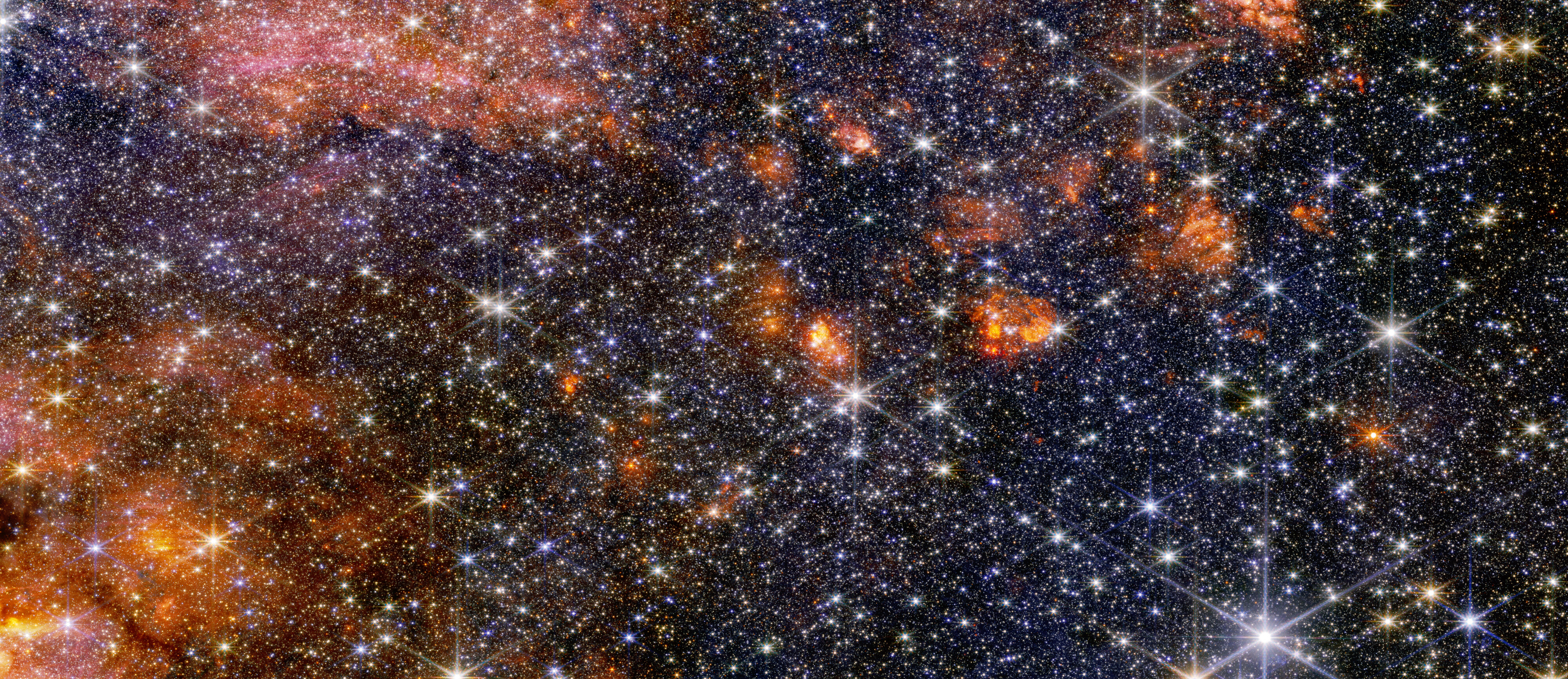
Stars, gas and cosmic dust in the Sagittarius B2 molecular cloud glow in near-infrared light, captured by Webb's NIRCam (Near-Infrared Camera). In this light, astronomers see more of the region's diverse, colourful stars, but less of its gas and dust structure. Webb's instruments each provide astronomers with important information that help build a more complete picture of what is happening in this intriguing portion of the centre of our galaxy.
Sagittarius B2 is the Milky Way galaxy's most massive and active star forming cloud, producing half of the stars created in the galactic center region despite having only 10 percent of the area's star-making material. Now, Webb has revealed stunning new views of the region, using both its near-infrared and mid-infrared instruments, to capture both its colourful stars and gaseous stellar nurseries in unprecedented detail.
Sagittarius B2 is located only a few hundred light-years from the supermassive black hole at the heart of the galaxy called Sagittarius A, a region densely packed with stars, star-forming clouds, and complex magnetic fields. The infrared light that Webb detects is able to pass through some of the area's thick clouds to reveal young stars and the warm dust surrounding them. Astronomers think that analysis of Webb's data will help unravel enduring mysteries of the star formation process, and why Sagittarius B2 is forming so many more stars than the rest of the galactic center.
However, one of the most notable aspects of Webb's images of Sagittarius B2 are the portions that remain dark. These ironically empty-looking areas of space are actually so dense with gas and dust that even Webb cannot see through them. These thick clouds are the raw material of future stars and a cocoon for those still too young to shine.
Image Credit: NASA, ESA, CSA, STScI, A. Ginsburg (University of Florida); Image Processing: A. Pagan (STScI)
Image enhancement: Jean-Baptiste Faure
Sunday, August 10, 2025

The Trifid Nebula as seen by Rubin

The Trifid Nebula as seen by Rubin
Click the image for higher resolution (4.7 MB)

The star-forming Trifid Nebula, also known as Messier 20 (M20), as imaged by NSF–DOE Vera C. Rubin Observatory. The Trifid Nebula is an unusual combination of an open cluster of stars, an emission nebula (the pink region), a reflection nebula (the blue region), and a dark nebula (the dark regions).
Image Credit: RubinObs/NOIRLab/SLAC/NSF/DOE/AURA
Image enhancement: Jean-Baptiste Faure

Sunday, May 26, 2024

Cometary Globule CG 4

Cometary Globule CG 4
Click the image for higher resolution (4.5 MB)

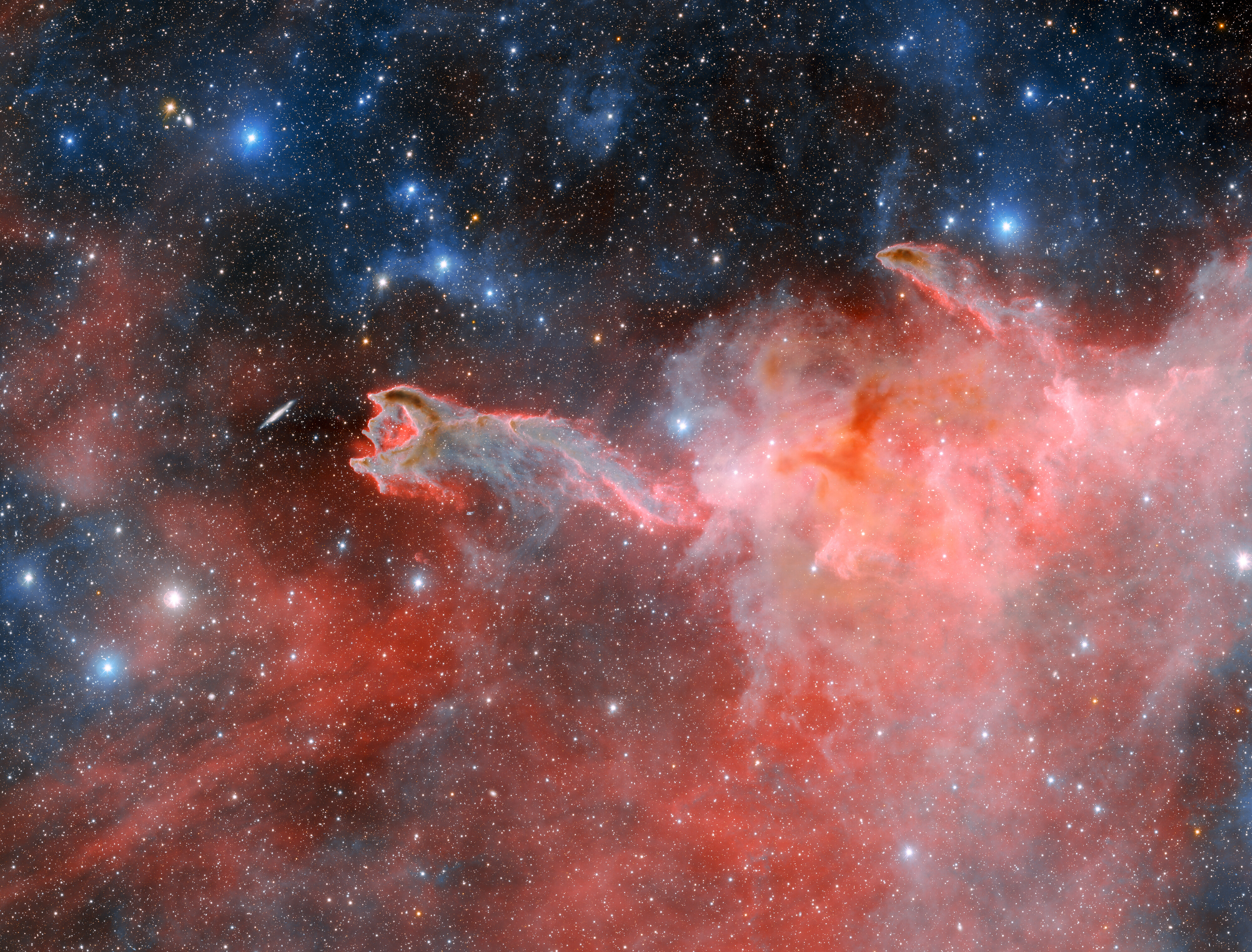
This cloudy, ominous structure is CG 4, a cometary globule nicknamed "God's Hand". CG 4 is one of many cometary globules present within the Milky Way, and how these objects get their distinct form is still a matter of debate among astronomers. This image was captured by the Department of Energy-fabricated Dark Energy Camera on the U.S. National Science Foundation Víctor M. Blanco 4-meter Telescope at Cerro Tololo Inter-American Observatory, a Program of NSF NOIRLab. In it, the features that classify CG 4 as a cometary globule are hard to miss. Its dusty head and long, faint tail vaguely resemble the appearance of a comet, though they have nothing in common. Astronomers theorize that cometary globules get their structure from the stellar winds of nearby hot, massive stars.
Image Credit: CTIO/NOIRLab/DOE/NSF/AURA
Image Processing: T.A. Rector (University of Alaska Anchorage/NSF's NOIRLab), D. de Martin & M. Zamani (NSF's NOIRLab)
Image enhancement: Jean-Baptiste Faure

Saturday, April 20, 2024

Reflection Nebula Bernes 149 in Absorption Nebula Lupus 3

Reflection Nebula Bernes 149 in Absorption Nebula Lupus 3
Click the image for higher resolution (4.7 MB)

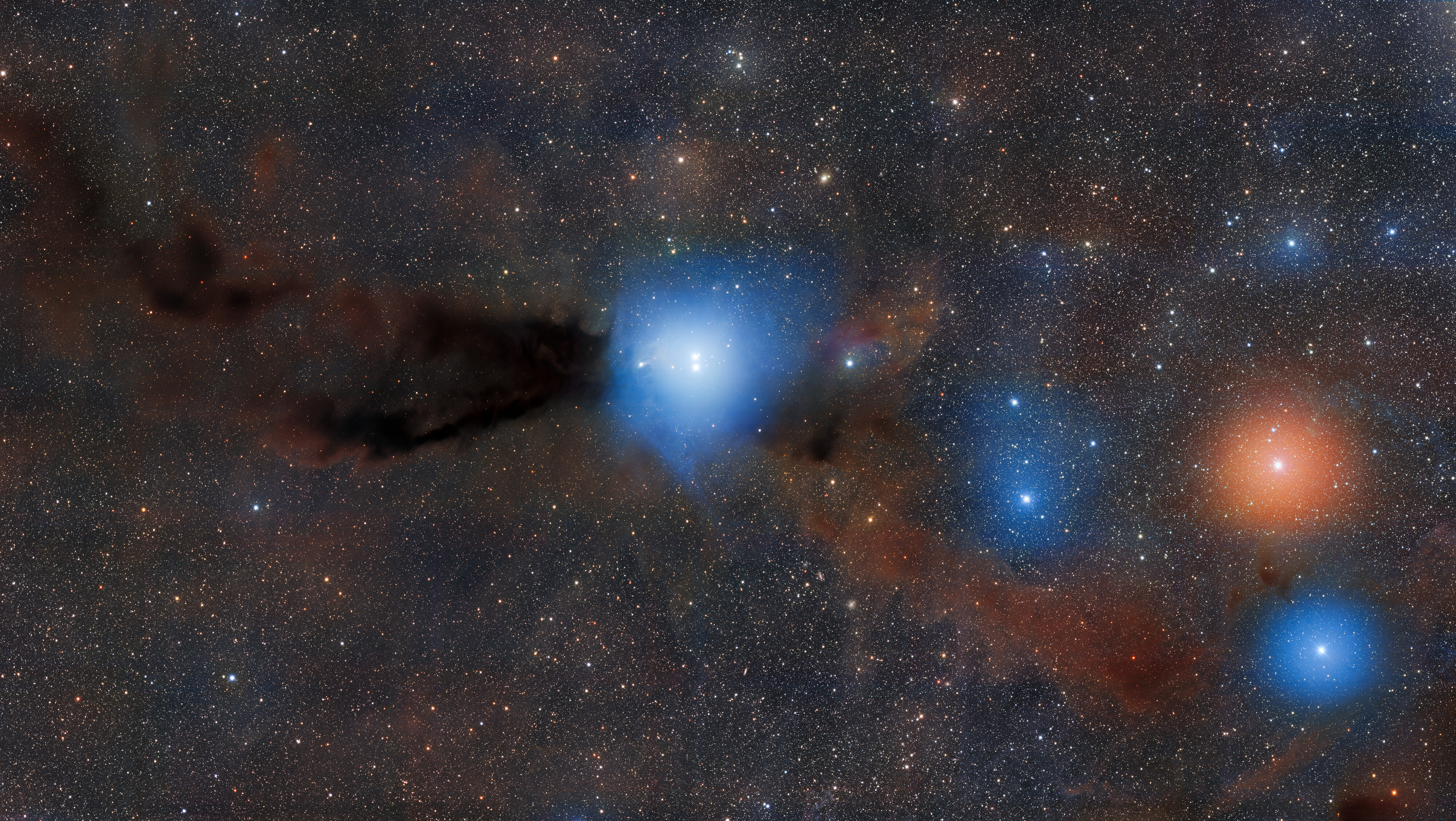
The massive, star-forming interstellar cloud Lupus 3 is captured with the 570-megapixel US Department of Energy-fabricated Dark Energy Camera at the National Science Foundation's NOIRLab's Cerro Tololo Inter-American Observatory in Chile. The dazzling central region of this sprawling cloud reveals a pair of infant stars bursting from their natal cocoons of dust and gas to illuminate the reflection nebula known as Bernes 149. These contrasting regions make this object a prime target of research on star formation. This star-forming nebula is located about 500 light-years from Earth in the direction of the constellation Lupus (the Wolf).
The clashing of energy and matter can lead to fantastical sites on Earth, such as glowing auroras and powerful lightning displays. The same can be said about space, where energy from bright young stars and protostars floods their surroundings, illuminating vast interstellar clouds of dust and gas to create spectacular objects known as reflection nebulae.
The two blue stars blazing in the center of the sprawling nebula, known as HR 5999 and HR 6000, illuminate nearby gas and dust, creating the bright blue reflection nebula Bernes 149. These stars grew out of the dark nebula Lupus 3, which stretches like a blanket across the background of stars. This cloud is not just a coal-black cosmic blob, however. It is home to a fleet of infant stars known as T Tauri stars, which will eventually use the material of Lupus 3 to grow into fully fledged stars.
At the relatively young age of about 1 million years, HR 5999 and HR 6000 are the oldest of the stars in the Lupus 3 region. These stars are pre-main-sequence stars, meaning that despite their brightness, they are not yet powered by nuclear fusion, like our Sun. They are instead powered by gravity, which compresses and heats up the internal matter. These sibling stars have blown away nearby gas and dust, illuminating the remnants and creating the Bernes 149 reflection nebula.
Lupus 3 is one of at least nine clouds within the massive Lupus cloud complex. Lupus 3 itself stretches across an area of the sky equivalent to about 24 Moon-diameters as seen from Earth. With a whopping 2.2-degree field of view, DECcam can capture massive objects like Lupus 3 in a single image.
Image Credit: CTIO/NOIRLab/DOE/NSF/AURA/ T.A. Rector (University of Alaska Anchorage/NSF's NOIRLab)
Image Processing: D. de Martin and M. Zamani (NSF's NOIRLab)
Image enhancement: Jean-Baptiste Faure

Thursday, November 30, 2023

Star-Forming Region Sagittarius C by Webb

Star-Forming Region Sagittarius C by Webb
Click the image for higher resolution (5.2 MB)

The full view of the James Webb Space Telescope's NIRCam (Near-Infrared Camera) instrument reveals a 50 light-years-wide portion of the Milky Way's dense center. An estimated 500,000 stars shine in this image of the Sagittarius C (Sgr C) region, along with some as-yet unidentified features.
A vast region of ionised hydrogen, shown in cyan, wraps around an infrared-dark cloud, which is so dense that it blocks the light from distant stars behind it. Intriguing needle-like structures in the ionised hydrogen emission lack any uniform orientation. Researchers note the surprising extent of the ionised region, covering about 25 light-years.
A cluster of protostars – stars that are still forming and gaining mass – are producing outflows that glow like a bonfire at the base of the large infrared-dark cloud, indicating that they are emerging from the cloud's protective cocoon and will soon join the ranks of the more mature stars around them. Smaller infrared-dark clouds dot the scene, appearing like holes in the starfield.
Researchers say they have only begun to dig into the wealth of unprecedented high-resolution data that Webb has provided on this region, and many features bear detailed study. This includes the rose-coloured clouds on the right side of the image, which have never been seen in such detail.
Image Credit: NASA, ESA, CSA, STScI, S. Crowe (UVA)
Image enhancement: Jean-Baptiste Faure
Friday, October 20, 2023

Dark Nebula LDN 1622

Dark Nebula LDN 1622
Click the image for higher resolution (1.8 MB)

The shadowy clouds of Lynds' Dark Nebula (LDN) 1622 are pictured in this observation from the Nicholas U. Mayall 4-meter Telescope at Kitt Peak National Observatory (KPNO), a Program of NSF's NOIRLab. This image was captured in 2018 by the Mosaic-3 instrument, a wide-field camera used to capture large swaths of the night sky from Kitt Peak in Arizona. Mosaic-3 has since been retired to make way for the Dark Energy Spectroscopic Instrument (DESI), the most powerful multi-object survey spectrograph in the world. This swap highlights one of the benefits of ground-based astronomy: the ability to upgrade and replace instruments as new technologies become available.
LDN 1622 is a dark nebula, so called because these dense interstellar clouds of gas and dust blot out light from background objects, appearing as ink-dark clouds against a backdrop of stars. This enigmatic cosmic cloud lies 1300 light-years from Earth in the nearby Orion complex, a star-forming region thronging with young stars and other dark nebulae.
This observation was taken before the 2022 Contreras Fire, which affected KPNO.
Image Credit: KPNO/NOIRLab/NSF/AURA/T. A. Rector Image processing: T.A. Rector (University of Alaska Anchorage/NSF's NOIRLab), M. Zamani (NSF’s NOIRLab) & D. de Martin (NSF's NOIRLab)
Image enhancement: Jean-Baptiste Faure

Saturday, February 18, 2023

Dark Nebulae Barnard 92 and Barnard 93

Dark Nebulae Barnard 92 and Barnard 93
Click the image for higher resolution (7.2 MB)

The dark clouds in this image, taken from ESO's Paranal Observatory in Chile, almost resemble something supernatural, like the wispy trails of ghosts in the sky. But there is no need to call the ghostbusters! These clouds, known as Barnard 92 (right) and Barnard 93 (left) are dark nebulae: they look pitch black because the dense gas and dust they contain block out the background light, creating these hazy ghostlike features.
These nebulae are stellar nurseries, where new stars are born out of the collapsing dense gas and dust. This whole region of space imaged here is actually part of a much larger stellar complex, called the Small Sagittarius Star Cloud (or Messier 24, catalogued by Charles Messier in 1764). This area is so rich in stars that it is clearly visible to the naked eye during dark nights, in the constellation of Sagittarius.
This image was taken with an enormous 268 million pixel camera called OmegaCAM on the VLT Survey Telescope. OmegaCAM is designed for capturing wide fields like this image, where you could impressively fit four full Moons. This image is part of the VST Photometric Hα Survey of the Southern Galactic Plane and Bulge (VPHAS+), which has mapped diffuse nebulae as well as both young and evolved stars in our galaxy.
Image Credit: ESO/VPHAS+ team.
Acknowledgement: Cambridge Astronomical Survey Unit
Image enhancement: Jean-Baptiste Faure
Friday, September 30, 2022

Young Stellar Object IRAS 05506+2414

Young Stellar Object IRAS 05506+2414
Click the image for higher resolution

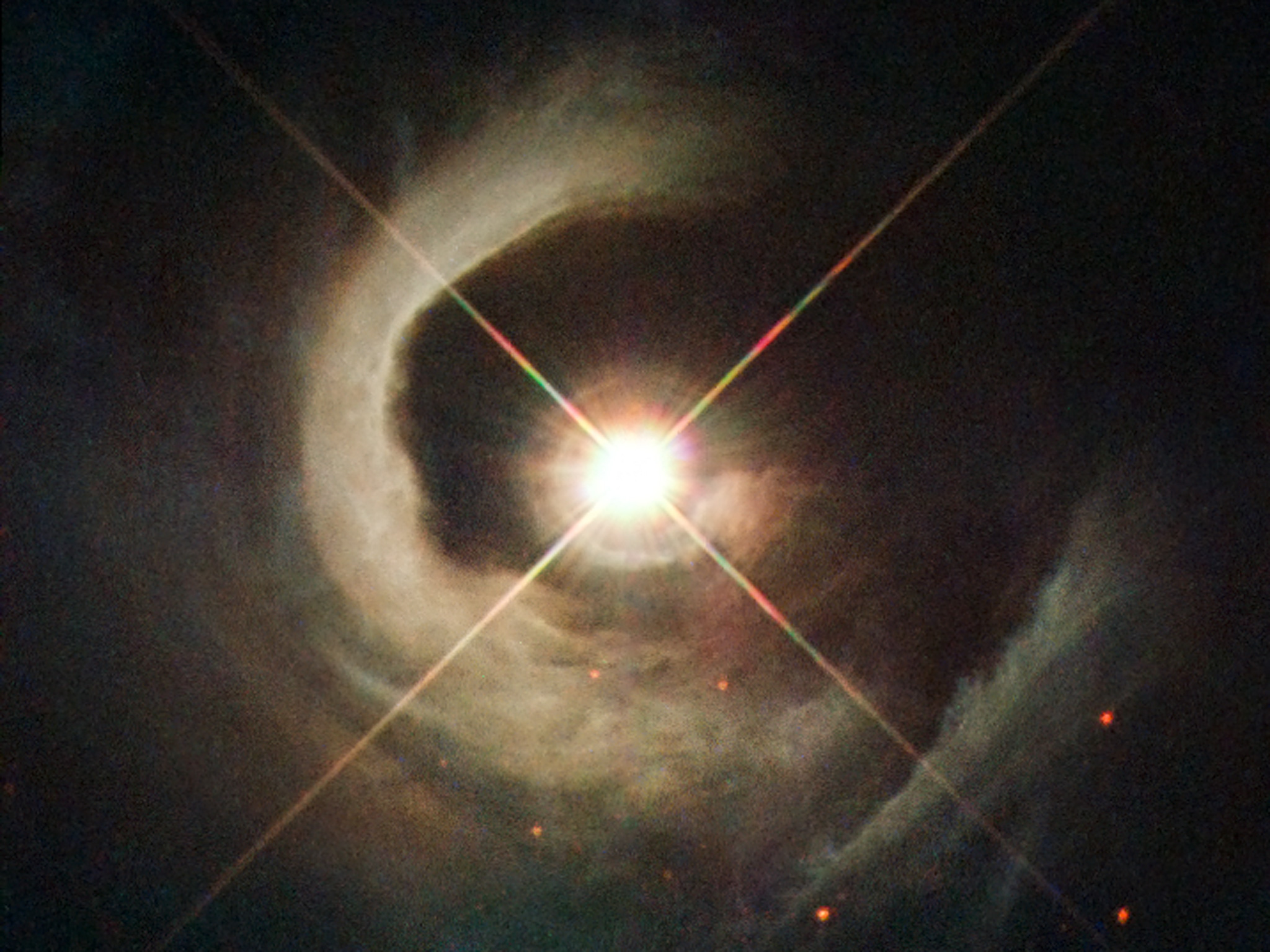
A bright young star is surrounded by a shroud of thick gas and dust in this image from the Hubble Space Telescope. Hubble's Wide Field Camera 3 inspected a young stellar object, over 9000 light years away in the constellation Taurus, to help astronomers understand the earliest stages in the lives of massive stars. This object – which is known to astronomers as IRAS 05506+2414 – is thought to be an example of an explosive event caused by the disruption of a massive young star system. If so, it would only be the second such example known.
Usually the swirling discs of material surrounding a young star are funnelled into twin outflows of gas and dust from the star. In the case of IRAS 05506+2414, however, a fan-like spray of material travelling at velocities of up to 350 kilometers per second is spreading outwards from the center of this image.
Astronomers turned to Hubble's Wide Field Camera 3 to measure the distance to IRAS 05506+2414. While it is possible to measure the velocity of material speeding outwards from the star, astronomers cannot tell how far from Earth the star actually is from a single observation. However, by measuring the distance that the outflow travels between successive images, they will be able to infer the distance to IRAS 05506+2414. This will allow astronomers to determine how bright the star is and how much energy it is emitting, and hence to estimate its mass – all vital information that will help to understand the origin of this bright young star's unusual outflow.
Image Credit: ESA/Hubble and NASA, R. Sahai
Image enhancement: Jean-Baptiste Faure

Tuesday, January 25, 2022

Young Stellar Jet MHO 2147

Young Stellar Jet MHO 2147
Click on the image for higher resolution (11.3 MB)

The sinuous young stellar jet, MHO 2147, meanders lazily across a field of stars in this image captured from Chile by the international Gemini Observatory, a Program of NSF's NOIRLab. The stellar jet is the outflow from a young star that is embedded in an infrared dark cloud. Astronomers suspect its sidewinding appearance is caused by the gravitational attraction of companion stars. These crystal-clear observations were made using the Gemini South telescope's adaptive optics system, which helps astronomers counteract the blurring effects of atmospheric turbulence.
Young stellar jets are a common by-product of star formation and are thought to be caused by the interplay between the magnetic fields of rotating young stars and the disks of gas surrounding them. These interactions eject twin torrents of ionized gas in opposite directions, such as those pictured in two images captured by astronomers using the Gemini South telescope on Cerro Pachón on the edge of the Chilean Andes. Gemini South is one half of the international Gemini Observatory, a Program of NSF's NOIRLab, that comprises twin 8.1-meter optical/infrared telescopes on two of the best observing sites on the planet. Its counterpart, Gemini North, is located near the summit of Maunakea in Hawai‘i.
The jet in the first image, named MHO 2147, is roughly 10,000 light-years from Earth, and lies in the galactic plane of the Milky Way, close to the boundary between the constellations Sagittarius and Ophiuchus. MHO 2147 snakes across a starry backdrop in the image – an appropriately serpentine appearance for an object close to Ophiuchus. Like many of the 88 modern astronomical constellations, Ophiuchus has mythological roots – in ancient Greece it represented a variety of gods and heroes grappling with a serpent. MHO 1502, the jet pictured in the second image, is located in the constellation of Vela, approximately 2000 light-years away.
Most stellar jets are straight but some can be wandering or knotted. The shape of the uneven jets is thought to be related to a characteristic of the object or objects that created them. In the case of the two bipolar jets MHO 2147 and MHO 1502, the stars which created them are obscured from view.
In the case of MHO 2147, this young central star, which has the catchy identifier IRAS 17527-2439, is embedded in an infrared dark cloud – a cold, dense region of gas that is opaque at the infrared wavelengths represented in this image. The sinuous shape of MHO 2147 is caused because the direction of the jet has changed over time, tracing out a gentle curve on either side of the central star. These almost unbroken curves suggest that MHO 2147 has been sculpted by continuous emission from its central source. Astronomers found that the changing direction (precession) of the jet may be due to the gravitational influence of nearby stars acting on the central star. Their observations suggest that IRAS 17527-2439 could belong to a triple star system separated by more than 300 billion kilometers (almost 200 billion miles).
MHO 1502, on the other hand, is embedded in a totally different environment – an area of star formation known as an HII region. The bipolar jet is composed of a chain of knots, suggesting that its source, thought to be two stars, has been intermittently emitting material.
These detailed image were captured by the Gemini South Adaptive Optics Imager (GSAOI), an instrument on the 8.1-meter-diameter Gemini South telescope. Gemini South is perched on the summit of Cerro Pachón, where dry air and negligible cloud cover provide one of the best observing sites on the planet. Even atop Cerro Pachón, however, atmospheric turbulence causes the stars to blur and twinkle.
GSAOI works with GeMs, the Gemini Multi-Conjugate Adaptive Optics System, to cancel out this blurring effect using a technique called adaptive optics. By monitoring the twinkling of natural and artificial guide stars up to 800 times a second, GeMs can determine how atmospheric turbulence is distorting Gemini South’s observations. A computer uses this information to minutely adjust the shape of deformable mirrors, canceling out the distortions caused by turbulence. In this case, the sharp adaptive optics images have made it possible to recognize more details in each knot of the young stellar jets than in previous studies.
Image Credit: International Gemini Observatory/NOIRLab/NSF/AURA
Acknowledgments: Image processing: T.A. Rector (University of Alaska Anchorage/NSF's NOIRLab), M. Zamani (NSF's NOIRLab) & D. de Martin (NSF's NOIRLab)
PI: L. Ferrero (Universidad Nacional de Córdoba)
Image enhancement: Jean-Baptiste Faure

Wednesday, March 10, 2021

Cometary Globule CG4

Cometary Globule CG4
Click on the image for higher resolution (4.2 MB)

Like the gaping mouth of a gigantic celestial creature, the cometary globule CG4 glows menacingly in this image from ESO's Very Large Telescope. Although it looks huge and bright in this image it is actually a faint nebula and not easy to observe. The exact nature of CG4 remains a mystery.
Image Credit: ESO
Image enhancement: Jean-Baptiste Faure

Monday, February 15, 2021

Dark Nebula Caldwell 99: the Coalsack Nebula

Dark Nebula Caldwell 99: the Coalsack Nebula
Click on the image for higher resolution (2.3 MB)

This stunning image captures a small region on the edge of the inky Coalsack Nebula, or Caldwell 99. Caldwell 99 is a dark nebula – a dense cloud of interstellar dust that completely blocks out visible wavelengths of light from objects behind it. The object at the center of the image is a (much smaller) protoplanetary nebula. The protoplanetary nebula phase is a late stage in the life of a star in which it has ejected a shell of hydrogen gas and is quickly heating up. This stage only lasts for a few thousand years before the protoplanetary nebula's central star reaches roughly 30,000 Kelvin. At this point, the central star is producing enough energy to make its surrounding shell of gas glow, becoming what's known as a planetary nebula.
The observations that comprise this image were made using Hubble's Advanced Camera for Surveys in visible and infrared wavelengths. Astronomers took these observations to learn more about the evolution of protoplanetary nebulae into planetary nebulae.
Caldwell 99 is a very prominent object in the southern night sky. On a clear night, it can be spotted easily with the naked eye as a dark patch, void of stars, next to the Southern Cross in the constellation Crux. It is easiest to spot in the Southern Hemisphere during the autumn. (Northern Hemisphere observers will want to be positioned near the equator and look for it in the springtime.)
Having been viewed by stargazers in the Southern Hemisphere for millennia, Caldwell 99 has no discoverer, but Europeans first learned of it from Spanish explorer Vicente Yáñez Pinzón in 1499. Caldwell 99 is located approximately 600 light-years from Earth and is about 100 light-years across.
Image Credit: NASA, ESA, and R. Sahai (Jet Propulsion Laboratory)
Processing: Gladys Kober (NASA/Catholic University of America)
Image enhancement: Jean-Baptiste Faure

Monday, August 10, 2020

Star-Forming Region Lupus 3

Star-Forming Region Lupus 3
Click on the image for higher resolution (6.1 MB)

A dark cloud of cosmic dust snakes across this spectacular wide field image, illuminated by the brilliant light of new stars. This dense cloud is a star-forming region called Lupus 3, where dazzlingly hot stars are born from collapsing masses of gas and dust. This image was created from images taken using the VLT Survey Telescope and the MPG/ESO 2.2-meter telescope and is the most detailed image taken so far of this region.
Image Credit: ESO/R. Colombari
Image enhancement: Jean-Baptiste Faure

Monday, November 11, 2019

Dark Nebula Barnard 59

Dark Nebula Barnard 59
Click on the image for higher resolution (10.6 MB)

This picture shows Barnard 59, part of a vast dark cloud of interstellar dust called the Pipe Nebula. This very detailed image of what is known as a dark nebula was captured by the Wide Field Imager on the MPG/ESO 2.2-meter telescope at ESO's La Silla Observatory.
The dense molecular clump at the center of the Barnard 59 complex is the only region in the Pipe Nebula that has formed a small, stellar cluster. An analysis of a high-resolution near-IR dust extinction map revealed that the nuclear region in Barnard 59 is a massive, mostly quiescent clump of 18.9 million solar masses. This strange and complex dark nebula lies about 600–700 light-years away from Earth.
Barnard 59 is a prime example of a dark nebula. Originally, astronomers believed these were areas in space where there were no stars. But it was later discovered that dark nebulae actually consist of clouds of interstellar dust so thick it can block out the light from the stars beyond. Barnard 59 appears silhouetted against the rich star clouds close to the center of the Milky Way in the constellation of Ophiuchus (The Serpent Bearer).
The nebula is named after the American astronomer Edward Emerson Barnard who was the first to systematically record dark nebulae using long-exposure photography and one of those who recognized their dusty nature. Barnard cataloged a total of 370 dark nebulae all over the sky. A self-made man, he bought his first house with the prize money from discovering several comets. Barnard was an extraordinary observer with exceptional eyesight who made contributions in many fields of astronomy in the late 19th and early 20th century.
Image Credit: ESO
Image enhancement: Jean-Baptiste Faure

Sunday, January 6, 2019

Absorption Nebula LDN 673

Absorption Nebula LDN 673
Click on the image for higher resolution (7.9 MB)

This image was obtained with the wide-field view of the Mosaic camera on the Mayall 4-meter telescope at Kitt Peak National Observatory. LDN 673 is part of a giant cloud of dust and gas in the constellation of Aquilla. It is fragmented into many pieces, inside of which are forming stars. Some of these stars are illuminating parts of the nebula, such as in the upper-left and upper-right corners. The image was generated with observations in B (blue), V (cyan), I (orange) and H-alpha (red) filters. In this image, North is left, East is down.
Image Credit: T.A. Rector (University of Alaska Anchorage) and H. Schweiker (WIYN and NOAO/AURA/NSF)
Image enhancement: Jean-Baptiste Faure

Tuesday, March 3, 2015

Young Star V1331 Cyg And Surrounding Nebula

Young Star V1331 Cyg And Surrounding Nebula
Click on the image for full resolution

With its helical appearance resembling a snail's shell, this reflection nebula seems to spiral out from a luminous central star in this new Hubble Space Telescope image. The star in the center, known as V1331 Cyg and located in the dark cloud LDN 981 - or, more commonly, Lynds 981 - had previously been defined as a T Tauri star. A T Tauri is a young star - or Young Stellar Object - that is starting to contract to become a main sequence star similar to the Sun. What makes V1331Cyg special is the fact that we look almost exactly at one of its poles. Usually, the view of a young star is obscured by the dust from the circumstellar disc and the envelope that surround it. However, with V1331Cyg we are actually looking in the exact direction of a jet driven by the star that is clearing the dust and giving us this magnificent view. This view provides an almost undisturbed view of the star and its immediate surroundings allowing astronomers to study it in greater detail and look for features that might suggest the formation of a very low-mass object in the outer circumstellar disc.
Image Credit: ESA/Hubble, NASA, Karl Stapelfeldt (GSFC), B. Stecklum and A. Choudhary (Thüringer Landessternwarte Tautenburg, Germany)
Image enhancement: Jean-Baptiste Faure

Sunday, January 25, 2015

Dark Nebula LDN 483

Dark Nebula LDN 483
Click on the image for full resolution (15.3 MB)

The Wide Field Imager (WFI) on the MPG/ESO 2.2-meter telescope at the La Silla Observatory in Chile snapped this image of the dark nebula LDN 483 (Lynds Dark Nebula 483). The object is a region of space clogged with gas and dust. These materials are dense enough to effectively eclipse the light of background stars. LDN 483 is located about 700 light-years away in the constellation of Serpens (The Serpent). The starless nature of LDN 483 and its ilk would suggest that they are sites where stars cannot take root and grow. But in fact the opposite is true: dark nebulae offer the most fertile environments for eventual star formation. Astronomers studying star formation in LDN 483 have discovered some of the youngest observable kinds of baby stars buried in LDN 483’s shrouded interior. These gestating stars can be thought of as still being in the womb, having not yet been born as complete, albeit immature, stars. In this first stage of stellar development, the star-to-be is just a ball of gas and dust contracting under the force of gravity within the surrounding molecular cloud. The protostar is still quite cool - about - 250 degrees Celsius - and shines only in long-wavelength submillimeter light. Yet temperature and pressure are beginning to increase in the fledgling star's core. This earliest period of star growth lasts a mere thousands of years, an astonishingly short amount of time in astronomical terms, given that stars typically live for millions or billions of years. In the following stages, over the course of several million years, the protostar will grow warmer and denser. Its emission will increase in energy along the way, graduating from mainly cold, far-infrared light to near-infrared and finally to visible light. The once-dim protostar will have then become a fully luminous star. As more and more stars emerge from the inky depths of LDN 483, the dark nebula will disperse further and lose its opacity. The missing background stars that are currently hidden will then come into view - but only after the passage of millions of years, and they will be outshone by the bright young-born stars in the cloud.
Image Credit: ESO
Image enhancement: Jean-Baptiste Faure

Friday, December 26, 2014

Emission Nebula Sh2-126 - The Star Funnel

Emission Nebula Sh2-126 - The Star Funnel
Click on the image for full resolution (5.0 MB)

This image was obtained with the wide-field view of the Mosaic camera on the Mayall 4-meter telescope at Kitt Peak National Observatory. Informally known as the 'star funnel', this dark nebula is yellowish in color because it is being illuminated by several bright stars nearby. The funnel is embedded in a larger emission nebula of warm hydrogen gas that is glowing red. The image was generated with observations in B (blue), V (green), I (orange) and Hydrogen-Alpha (red) filters. In this image, North is up, East is to the left.
Image Credit: T.A. Rector (University of Alaska Anchorage) and H. Schweiker (WIYN and NOAO/AURA/NSF)
Image enhancement: Jean-Baptiste Faure
Sunday, November 16, 2014

Multiple Star System XZ Tauri

Multiple Star System XZ Tauri
Click on the image for full resolution (5.0 MB)

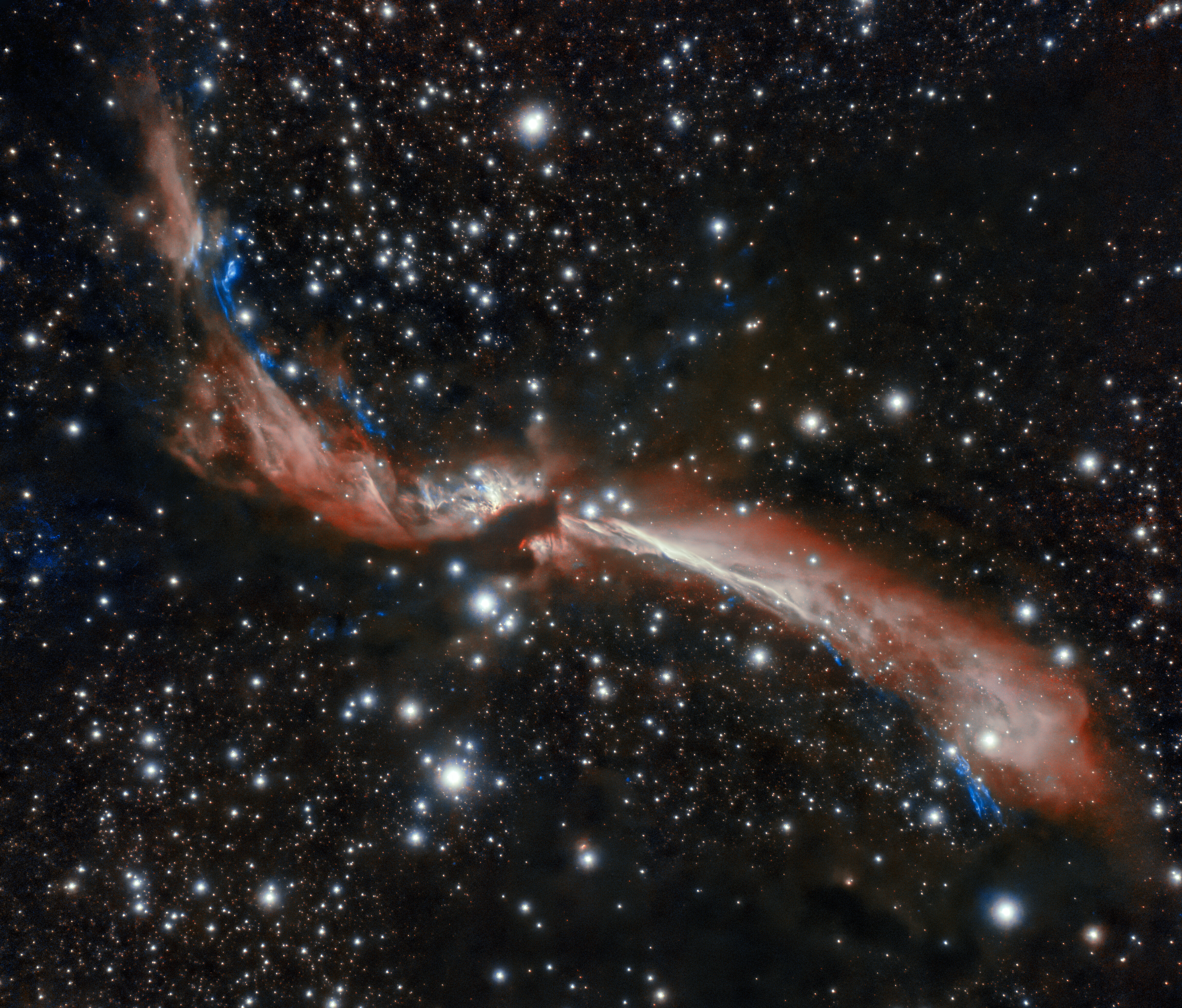
The Hubble Space Telescope has snapped a striking view of a multiple star system called XZ Tauri, its neighbour HL Tauri and several nearby young stellar objects. XZ Tauri is blowing a hot bubble of gas into the surrounding space, which is filled with bright and beautiful clumps that are emitting strong winds and jets. These objects illuminate the region, creating a truly dramatic scene. This dark and ominous landscape is located some 450 light-years away in the constellation of Taurus (The Bull). It lies in the north-eastern part of a large, dark cloud known as LDN 1551. Just to the left of center in this image, embedded within a rust-coloured cloud, lies XZ Tauri. While it appears to be a single star, this bright spot actually consists of several stars. It has long been known to be a binary, but one of these two stars is thought also to be a binary, making a total of three stars within a single system. This is not the first time that Hubble has observed XZ Tauri - between the years of 1995 and 2000, a hot bubble of gas was spotted expanding outwards from the system. This bubble can be seen as the small orange lobe very close to the top left of XZ Tauri. This gas is speeding out from the star system, leaving a trail spanning tens of billions of kilometers. As the bubble travels it hits slower moving material, triggering pulses of light and rippling shockwaves. Above and to the right of XZ Tauri, an equally epic scene is unfolding. Wisps of deep red seem to be streaking away from the blue-tinged clumps on the right. This bright blue patch contains a star known as HL Tauri, which is associated with Herbig-Haro object HH 150. Herbig-Haro objects are streaks of hot gas blasted into space by newborn and newly forming stars and LDN 1551 is particularly rich in these dramatic objects. In the bottom right of this Hubble image is another Herbig-Haro object known as HH 30, associated with the variable star V1213 Tauri. The star itself is hidden within a flat, bright disc of dust that is split in half by a dark lane. This dust blocks direct light from V1213 Tauri, but the star is visible via its reflected light and the prominent, knotty jets it is blasting out into space. Hubble previously viewed HH 30, alongside XZ Tauri, with its Wide Field Planetary Camera 2 between the years of 1995 and 2000. The observations were used to image and study the changes in disc brightness and jet strength over the five-year period. V1213 Tauri's strong magnetic field forms the jets by funnelling and shepherding gas from the disc, accelerating it along the star's magnetic poles to form two narrow beams.
Image Credit: ESA/Hubble and NASA
Acknowledgement: Judy Schmidt
Image enhancement: Jean-Baptiste Faure

Saturday, September 6, 2014

Young Stellar Object SSTC2D J033038.2+303212

Young Stellar Object SSTC2D J033038.2+303212
Click on the image for full resolution (6.0 MB)

This new Hubble Space Telescope image shows a variety of intriguing cosmic phenomena. Surrounded by bright stars, towards the upper middle of the frame we see a small young stellar object (YSO) known as SSTC2D J033038.2+303212. Located in the constellation of Perseus, this star is in the early stages of its life and is still forming into a fully grown star. In this view from Hubble's Advanced Camera for Surveys (ACS) it appears to have a murky chimney of material emanating outwards and downwards, framed by bright bursts of gas flowing from the star itself. This fledgling star is actually surrounded by a bright disc of material swirling around it as it forms - a disc that we see edge-on from our perspective. However, this small bright speck is dwarfed by its cosmic neighbour towards the bottom of the frame, a clump of bright, wispy gas swirling around as it appears to spew dark material out into space. The bright cloud is a reflection nebula known as [B77] 63, a cloud of interstellar gas that is reflecting light from the stars embedded within it. There are actually a number of bright stars within [B77] 63, most notably the emission-line star LkHA 326, and its very near neighbour LZK 18. These stars are lighting up the surrounding gas and sculpting it into the wispy shape seen in this image. However, the most dramatic part of the image seems to be a dark stream of smoke piling outwards from [B77] 63 and its stars - a dark nebula called Dobashi 4173. Dark nebulae are incredibly dense clouds of pitch-dark material that obscure the patches of sky behind them, seemingly creating great rips and eerily empty chunks of sky. The stars speckled on top of this extreme blackness actually lie between us and Dobashi 4173.
Image Credit: ESA/Hubble and NASA
Image enhancement: Jean-Baptiste Faure