Showing posts with label Exoplanets. Show all posts

Sunday, May 26, 2024

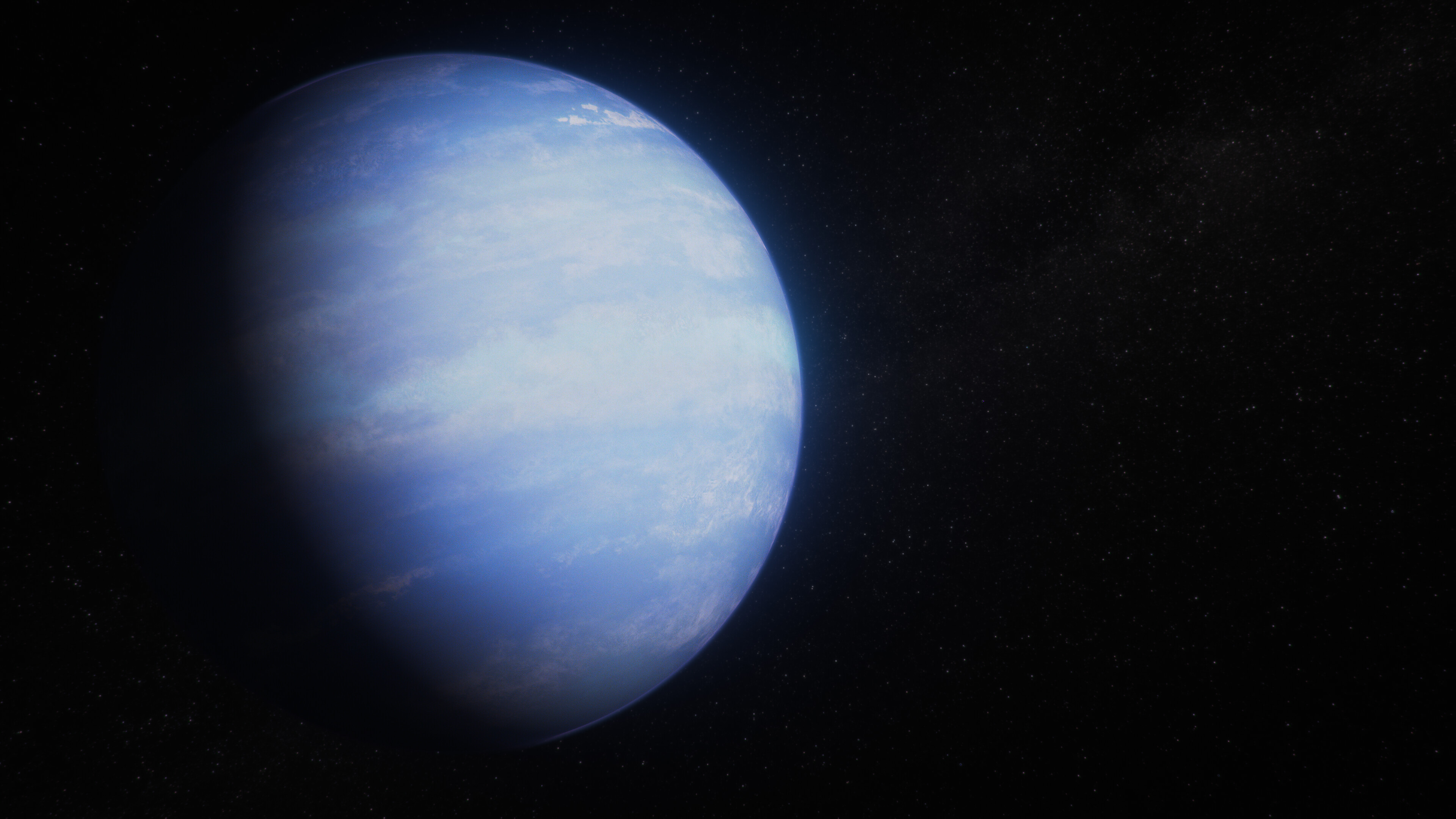
Warm Gas-Giant Exoplanet WASP-107 b

Warm Gas-Giant Exoplanet WASP-107 b
Click the image for higher resolution (1.1 MB)

This artist's concept shows what the exoplanet WASP-107 b could look like based on recent data gathered by NASA's James Webb Space Telescope along with previous observations from Hubble and other space- and ground-based telescopes.
WASP-107 b is a -warm Neptune' exoplanet orbiting a relatively small and cool star approximately 210 light-years from Earth, in the constellation Virgo. The planet is about 80% of the size of Jupiter in terms of volume, but has a mass less than 10% of Jupiter's, making it one of the least dense exoplanets known.
WASP-107 b orbits its star at a distance about 5 million miles (0.055 astronomical units, or AU), completing one circuit in 5.72 days. The planet is tidally locked: it rotates at the same rate that it orbits the star, which means that one side is permanently lit, with the other in continuous darkness, so there is no day–night cycle. The orbit of WASP-107 b is slightly elliptical, which means that the gravitational pull between the star and planet changes continuously as the planet moves toward and away from the star during its orbit.
Observations of 0.8- to 12-micron infrared light captured by the Hubble Space Telescope's WFC3 (Wide Field Camera 3), and Webb's NIRCam (Near-Infrared Camera), NIRSpec (Near-Infrared Spectrograph), and MIRI (Mid-Infrared Instrument), suggest that the planet has a relatively large core surrounded by a relatively small mass of hydrogen and helium gas, which has been inflated by tidal heating of the interior. WASP-107 b has not been directly imaged by any telescope.
Image Credit: NASA, ESA, CSA, R. Crawford (STScI)

Saturday, August 1, 2020

Planet in the TRAPPIST-1 System

Planet in the TRAPPIST-1 System
Click on the image for higher resolution (3.0 MB)

This artist's impression shows the view from the surface of one of the planets in the TRAPPIST-1 system. At least seven planets orbit this ultra cool dwarf star 40 light-years from Earth and they are all roughly the same size as the Earth. They are at the right distances from their star for liquid water to exist on the surfaces of several of them.
This artist's impression is based on the known physical parameters for the planets and stars seen, and uses a vast database of objects in the Universe.
Image Credit: ESO/N. Bartmann/spaceengine.org

Tuesday, February 4, 2020

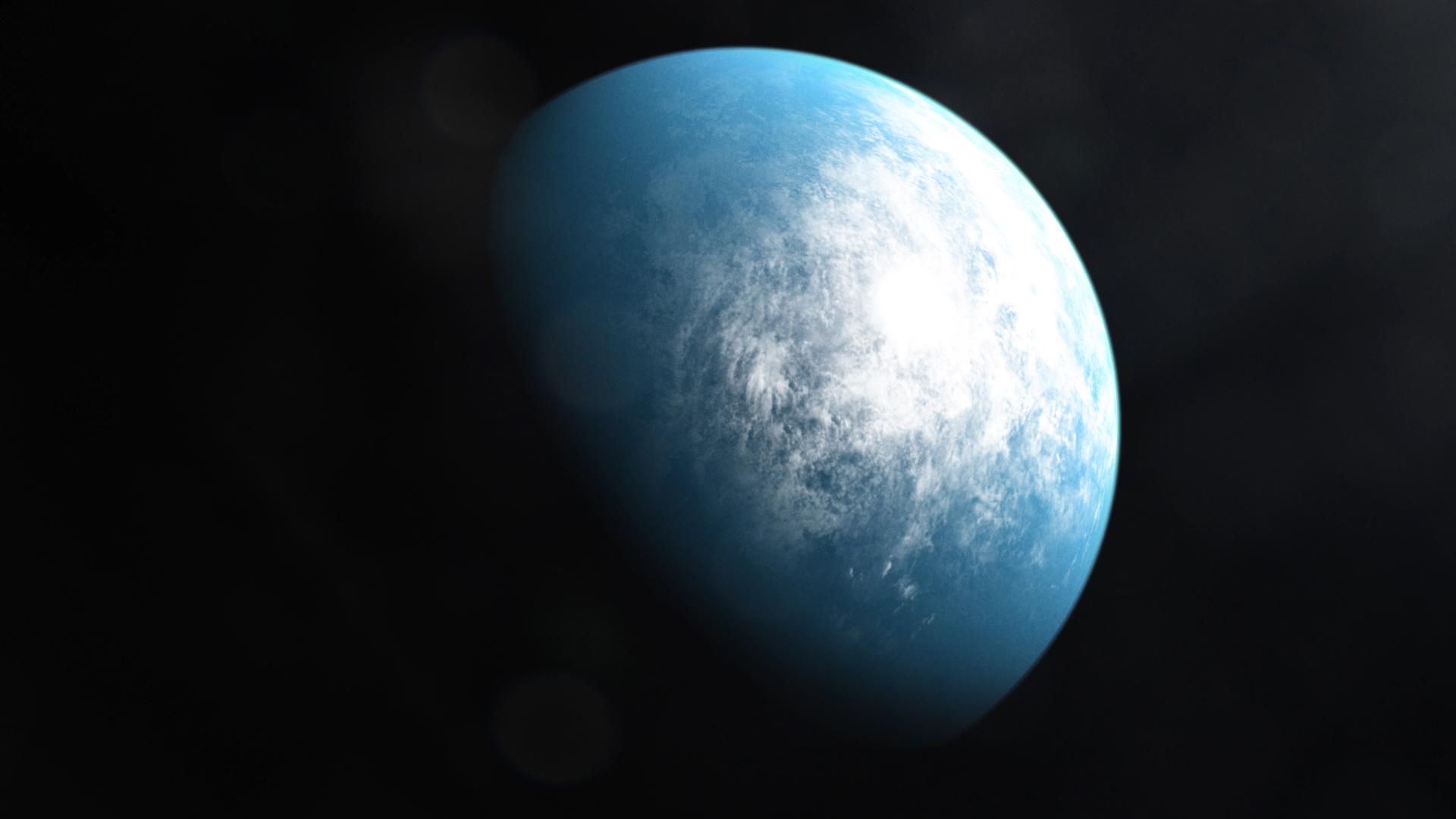
Earth-size Habitable-zone Planet TOI 700 d

Earth-size Habitable-zone Planet TOI 700 d
Click on the image for higher resolution

About 100 light-years away, in our own Milky Way galaxy, in the constellation Dorado, sits a planetary system named TOI 700. It is home to TOI 700 d (illustrated here), the first Earth-size habitable-zone planet discovered by TESS, NASA's Transiting Exoplanet Survey Satellite. Scientists confirmed the find, called TOI 700 d, using NASA's Spitzer Space Telescope and have modeled the planet's potential environments to help inform future observations. TOI 700 d is one of only a few Earth-size planets discovered in a star's habitable zone so far. Others include several planets in the TRAPPIST-1 system and other worlds discovered by NASA's Kepler Space Telescope.
While the exact conditions on TOI 700 d are unknown, scientists can use current information, like the planet's size and the type of star it orbits, to generate computer models and make predictions. Researchers at NASA's Goddard Space Flight Center in Greenbelt, Maryland, modeled 20 potential environments of TOI 700 d to gauge if any version would result in surface temperatures and pressures suitable for habitability.
Their 3D climate models examined a variety of surface types and atmospheric compositions typically associated with what scientists regard to be potentially habitable worlds. Because TOI 700 d is tidally locked to its star, the planet’s cloud formations and wind patterns may be strikingly different from Earth's. One simulation included an ocean-covered TOI 700 d with a dense, carbon-dioxide-dominated atmosphere similar to what scientists suspect surrounded Mars when it was young. The model atmosphere contains a deep layer of clouds on the star-facing side. Another model depicts TOI 700 d as a cloudless, all-land version of modern Earth, where winds flow away from the night side of the planet and converge on the point directly facing the star.
Image Credit: NASA/Goddard Space Flight Center

Saturday, January 5, 2019

A view of the planet orbiting Proxima Centauri

A view of the planet orbiting Proxima Centauri
Click on the image for higher resolution (7.4 MB)

This artist's impression shows a view of the surface of the planet Proxima b orbiting the red dwarf star Proxima Centauri, the closest star to the Solar System. The double star Alpha Centauri AB also appears in the image to the upper-right of Proxima itself. Proxima b is a little more massive than the Earth and orbits in the habitable zone around Proxima Centauri, where the temperature is suitable for liquid water to exist on its surface.
Image Credit: ESO/M. Kornmesser

Wednesday, September 14, 2011

Artists's impression of the rocky super-Earth HD 85512 b

Artists's impression of the rocky super-Earth HD 85512 b
Click on the image for full resolution (5.2 MB)

This artist's impression shows the planet orbiting the Sun-like star HD 85512 in the southern constellation of Vela (The Sail). This planet is one of sixteen super-Earths discovered by the HARPS instrument on the 3.6-meter telescope at ESO's La Silla Observatory. This planet is about 3.6 times as massive as the Earth and lies at the edge of the habitable zone around the star, where liquid water, and perhaps even life, could potentially exist. The HARPS spectrograph on the 3.6-meter telescope at ESO's La Silla Observatory in Chile is the world's most successful planet finder. The HARPS team, led by Michel Mayor (University of Geneva, Switzerland), today announced the discovery of more than 50 new exoplanets orbiting nearby stars, including sixteen super-Earths. This is the largest number of such planets ever announced at one time. The new findings are being presented at a conference on Extreme Solar Systems where 350 exoplanet experts are meeting in Wyoming, USA. "The harvest of discoveries from HARPS has exceeded all expectations and includes an exceptionally rich population of super-Earths and Neptune-type planets hosted by stars very similar to our Sun. And even better - the new results show that the pace of discovery is accelerating," says Mayor. In the eight years since it started surveying stars like the Sun using the radial velocity technique HARPS has been used to discover more than 150 new planets. About two thirds of all the known exoplanets with masses less than that of Neptune were discovered by HARPS. These exceptional results are the fruit of several hundred nights of HARPS observations. Working with HARPS observations of 376 Sun-like stars, astronomers have now also much improved the estimate of how likely it is that a star like the Sun is host to low-mass planets (as opposed to gaseous giants). They find that about 40% of such stars have at least one planet less massive than Saturn. The majority of exoplanets of Neptune mass or less appear to be in systems with multiple planets. With upgrades to both hardware and software systems in progress, HARPS is being pushed to the next level of stability and sensitivity to search for rocky planets that could support life. Ten nearby stars similar to the Sun were selected for a new survey. These stars had already been observed by HARPS and are known to be suitable for extremely precise radial velocity measurements. After two years of work, the team of astronomers has discovered five new planets with masses less than five times that of Earth.
The full resolution image weighs 5.2 MB, so please be patient when downloading!
Credit: ESO/M. Kornmesser