Showing posts with label Supernovae. Show all posts

Saturday, August 3, 2024

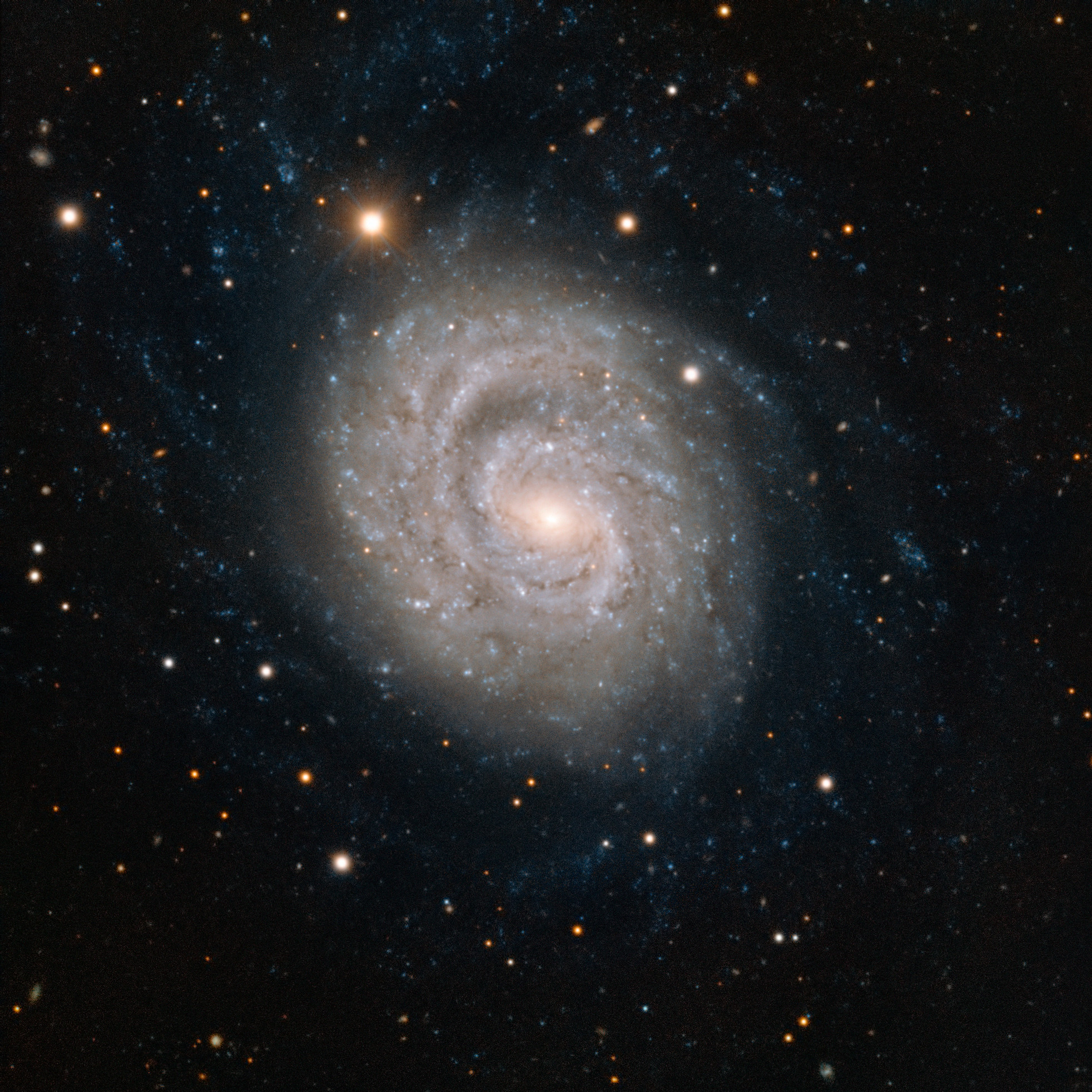
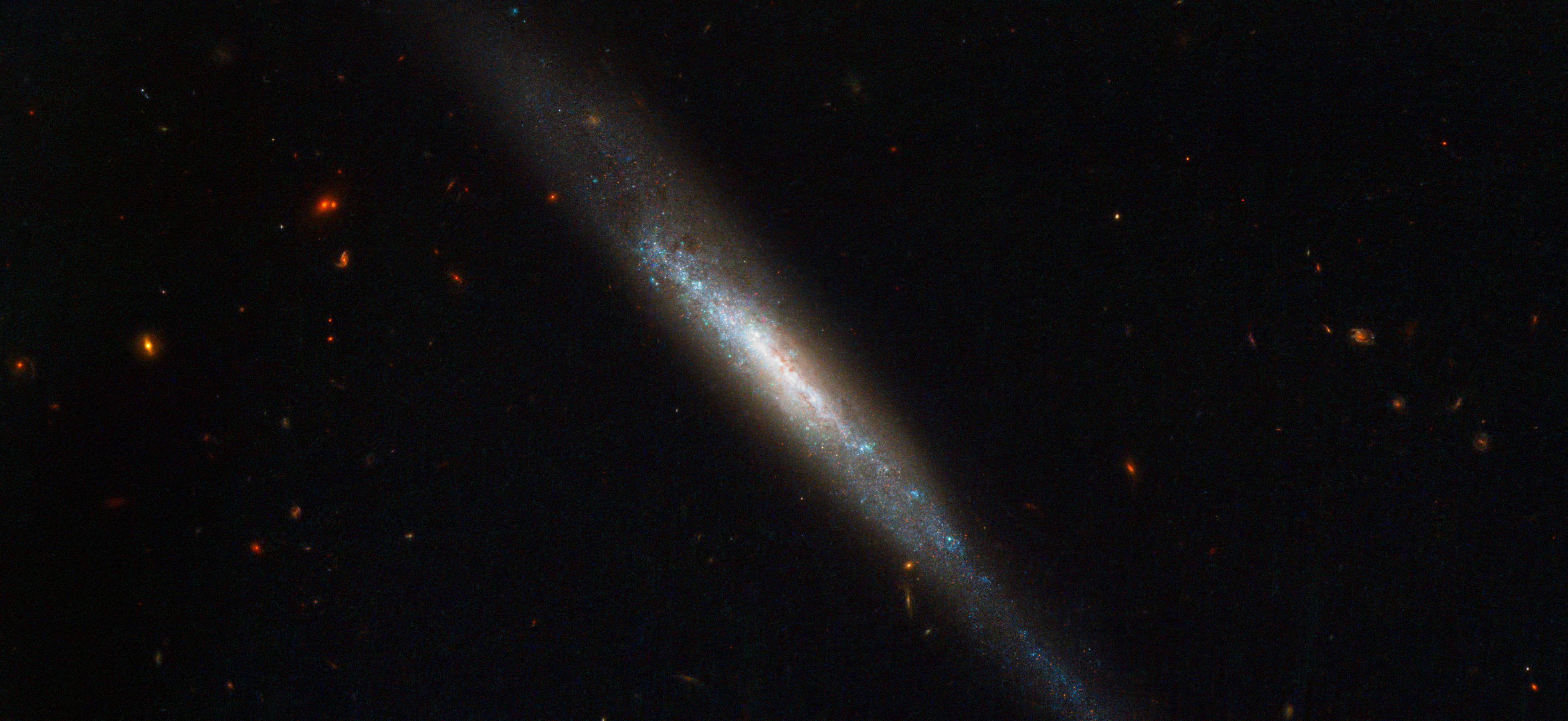
Spiral Galaxy NGC 3810

Spiral Galaxy NGC 3810
Click the image for higher resolution (4.7 MB)

Measuring the distance to truly remote objects like galaxies, quasars and galaxy clusters is a crucial task in astrophysics, particularly when it comes to studying the early Universe, but it's a difficult one. Only in the case of a few nearby objects like the Sun, planets and some nearby stars can we measure their distances directly. Beyond that, various indirect methods need to be used; one of the most important is by examining Type Ia supernovae, and this is where the Hubble Space Telescope comes in.
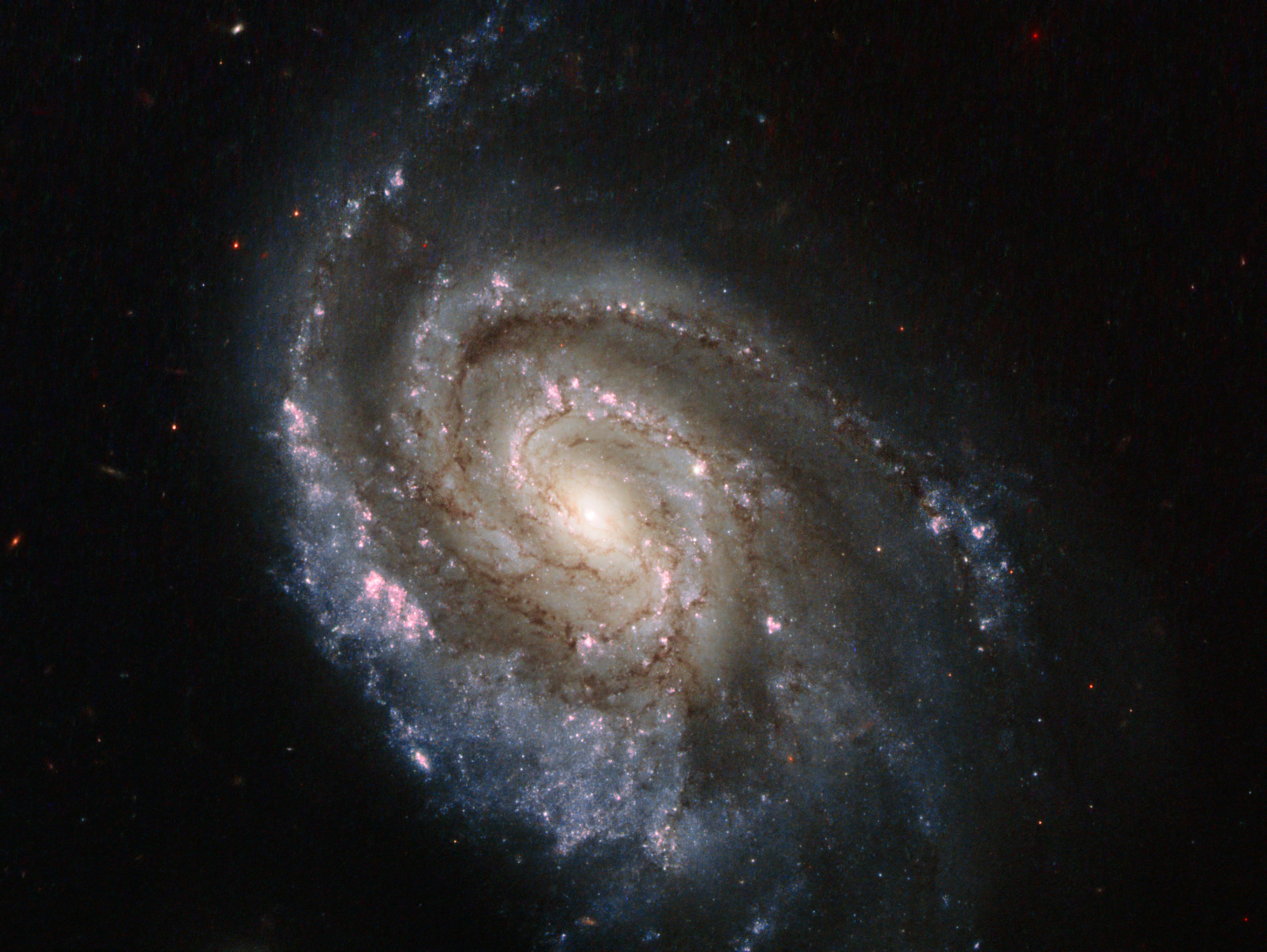
NGC 3810, the galaxy featured in this image, was the host of a Type Ia supernova in 2022. In early 2023 Hubble focused on this and a number of other galaxies to closely examine recent Type Ia supernovae. This kind of supernova results from a white dwarf exploding, and they all have a very consistent brightness. That allows them to be used to measure distances: we know how bright a Type Ia supernova should be, so we can tell how far away it must be from how dim it appears. One uncertainty in this method is that intergalactic dust in between Earth and a supernova blocks some of its light. How do you know how much of the reduction in light is caused by distance, and how much by dust? With the help of Hubble, there's a clever workaround: take images of the same Type Ia supernovae in ultraviolet light, which is almost completely blocked by dust, and in infrared light, which passes through dust almost unaffected. By carefully noting how much light comes through at each wavelength, the relationship between supernova brightness and distance can be calibrated to account for dust. Hubble can observe both these wavelengths of light in great detail with the same instrument. That makes it the perfect tool for this experiment, and indeed, some of the data used to make this beautiful image of NGC 3810 were focused on its 2022 supernova. You can see it as a point of light just below the galactic nucleus, or in the annotated image here.
There are many ways to measure cosmic distances; because Type Ia supernovae are so bright, they are one of the most useful and accurate tools, when they're spotted. Many other methods must be used as well, either as an independent check against other distance measurements or to measure at much closer or farther distances. One such method that also works for galaxies is comparing their rotation speed to their brightness; based on that method, NGC 3810 is found to be 50 million light-years from Earth.
Image Credit: ESA/Hubble and NASA, D. Sand, R. J. Foley
Image enhancement: Jean-Baptiste Faure

Saturday, October 3, 2020

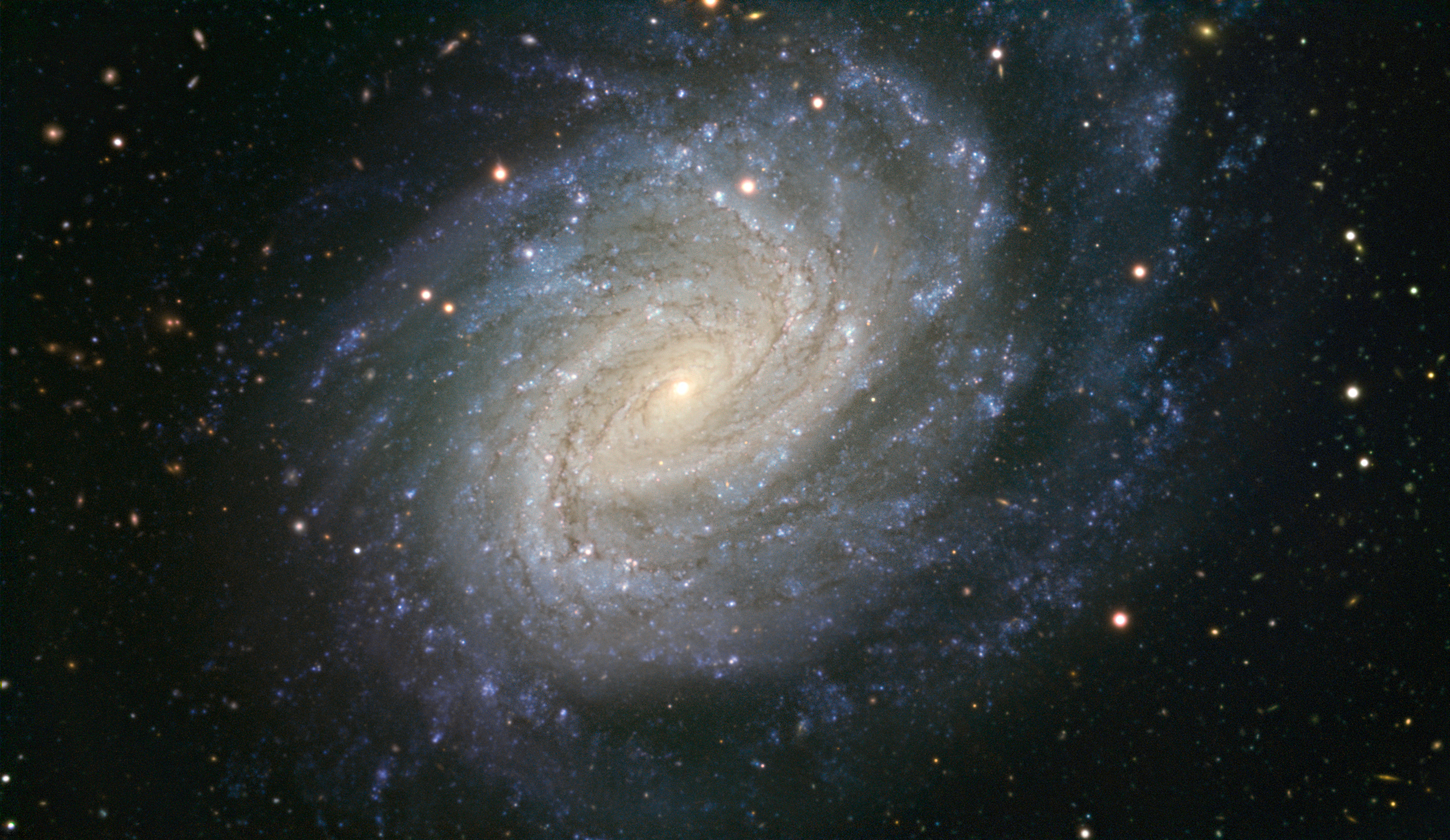
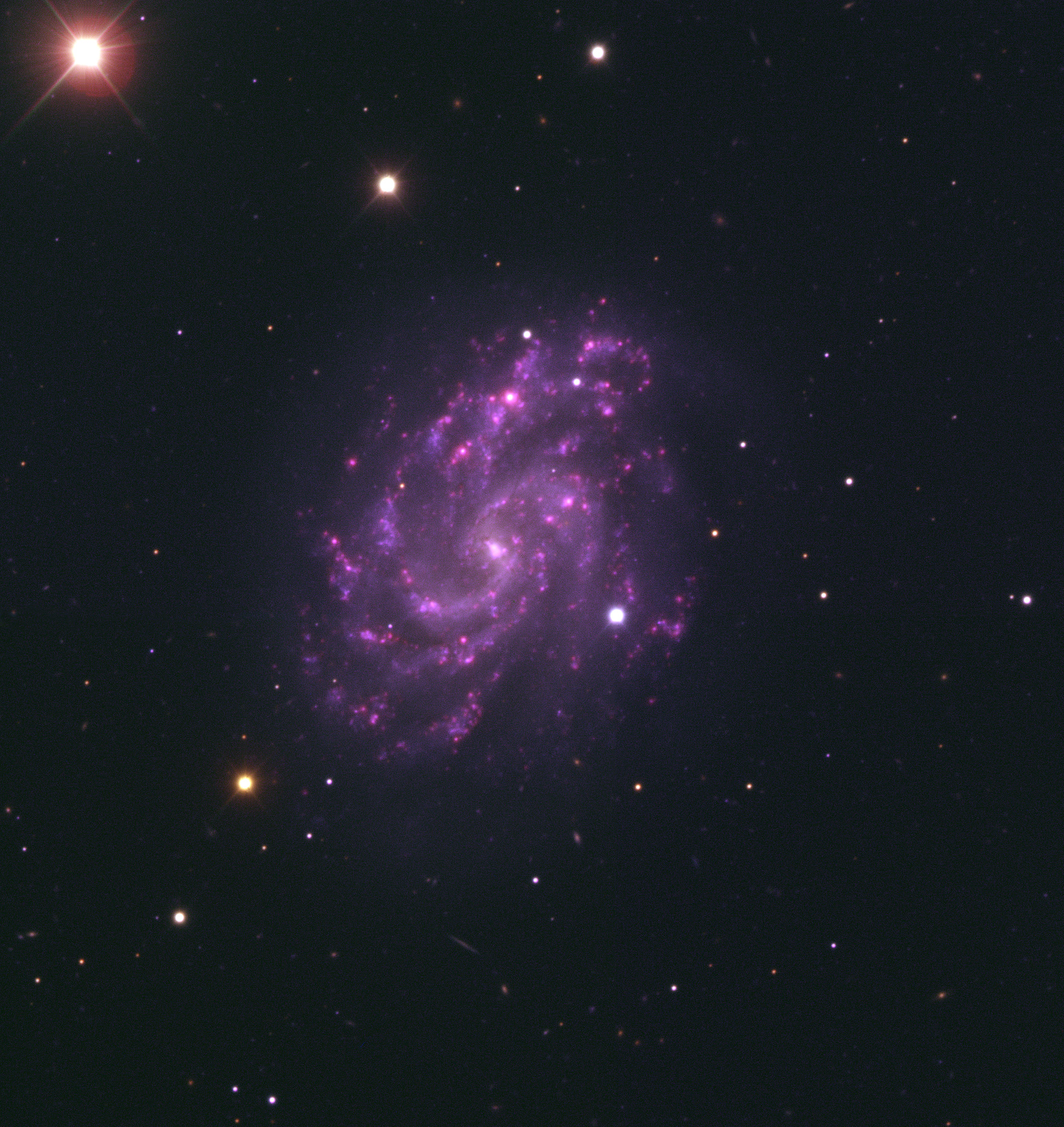
Galaxy NGC 2525 and Supernova SN2018gv

Galaxy NGC 2525 and Supernova SN2018gv
Click on the image for higher resolution (5.7 MB)

Pictured here is the captivating barred spiral galaxy NGC 2525. Located nearly 70 million light-years from Earth, this galaxy is part of the constellation of Puppis in the southern hemisphere. Together with the Carina and the Vela constellations, it makes up an image of the Argo from ancient greek mythology.
Another kind of monster, a supermassive black hole, lurks at the center of NGC 2525. Nearly every galaxy contains a supermassive black hole, which can range in mass from hundreds of thousands to billions of times the mass of the Sun.
Hubble has captured a series of images of NGC 2525 as part of one of its major investigations; measuring the expansion rate of the Universe, which can help answer fundamental questions about our Universe's very nature. ESA/Hubble has now published a unique time-lapse of this galaxy and its fading supernova, clearly visible on the left in this image.
The supernova is formally known as SN2018gv and was first spotted in mid-January 2018. Supernovae like this one can be used as cosmic tape measures, allowing astronomers to calculate the distance to their galaxies.
Image Credit: ESA/Hubble and NASA, A. Riess and the SH0ES team
Acknowledgment: Mahdi Zamani
Image enhancement: Jean-Baptiste Faure

Saturday, May 2, 2015

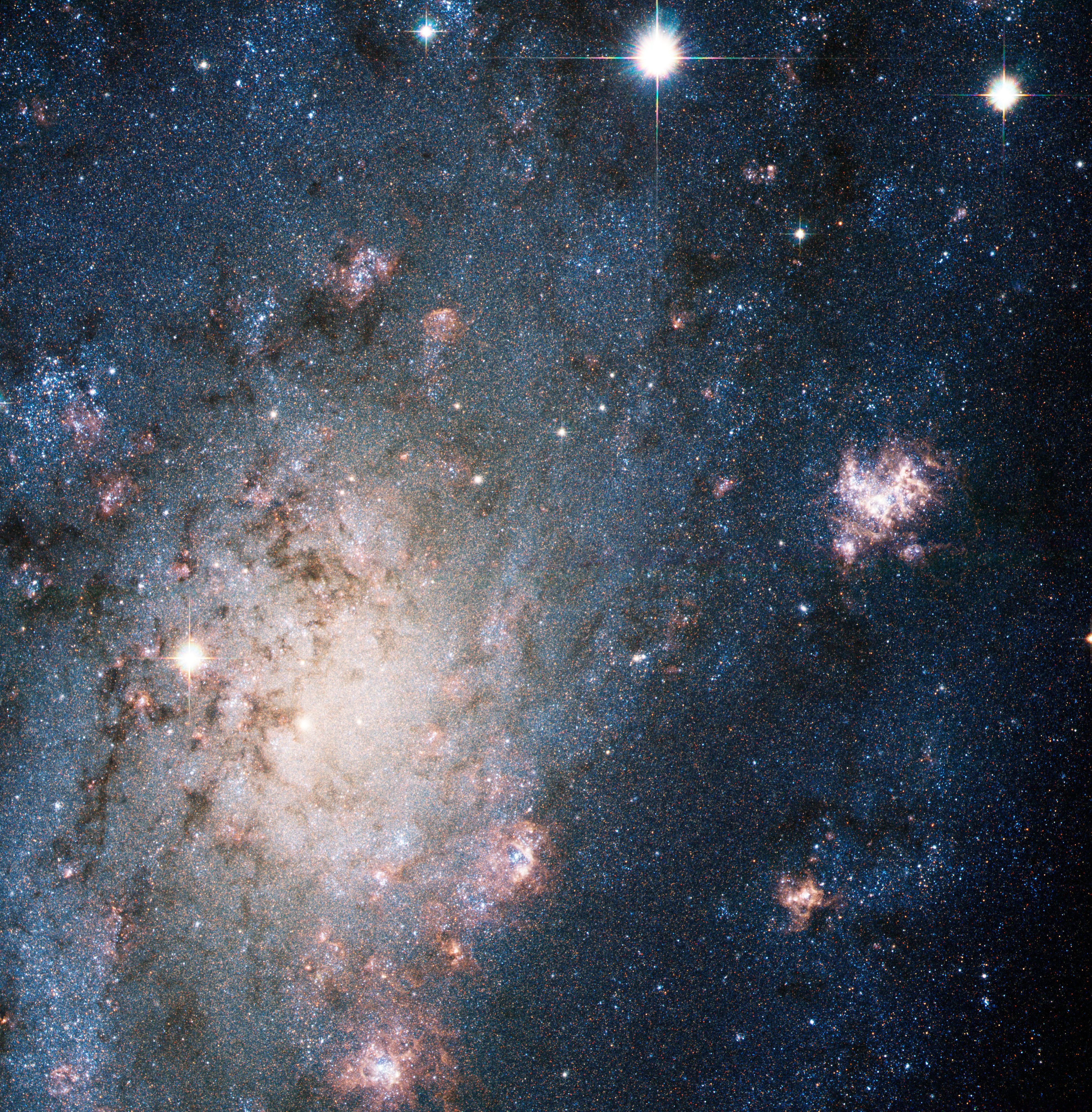
Peculiar Galaxy ESO 162-17

Peculiar Galaxy ESO 162-17
Click on the image for full resolution (5.0 MB)

This galaxy goes by the name of ESO 162-17 and is located about 40 million light-years away in the constellation of Carina. At first glance this image seems like a fairly standard picture of a galaxy with dark patches of dust and bright patches of young, blue stars. However, a closer look reveals several peculiar features. Firstly, ESO 162-17 is what is known as a peculiar galaxy – a galaxy that has gone through interactions with its cosmic neighbours, resulting in an unusual amount of dust and gas, an irregular shape, or a strange composition. Secondly, on 23 February 2010 astronomers observed the supernova known as SN 2010ae nestled within this galaxy. The supernova belongs to a recently discovered class of supernovae called Type Iax supernovae. This class of objects is related to the better known Type-Ia supernovae. Type Ia supernovae result when a white dwarf accumulates enough mass either from a companion or, rarely, through collision with another white dwarf, to initiate a catastrophic collapse followed by a spectacular explosion as a supernova. Type Iax supernovae also involve a white dwarf as the central star, but in this case it may survive the event. Type Iax supernovae are much fainter and rarer than Type Ia supernovae, and their exact mechanism is still a matter of open debate. The rather beautiful four-pointed shape of foreground stars distributed around ESO 162-17 also draws the eye. This is an optical effect introduced as the incoming light is diffracted by the four struts that support the Hubble Space Telescope's small secondary mirror.
Image Credit: ESA/Hubble and NASA
Image enhancement: Jean-Baptiste Faure

Thursday, February 26, 2015

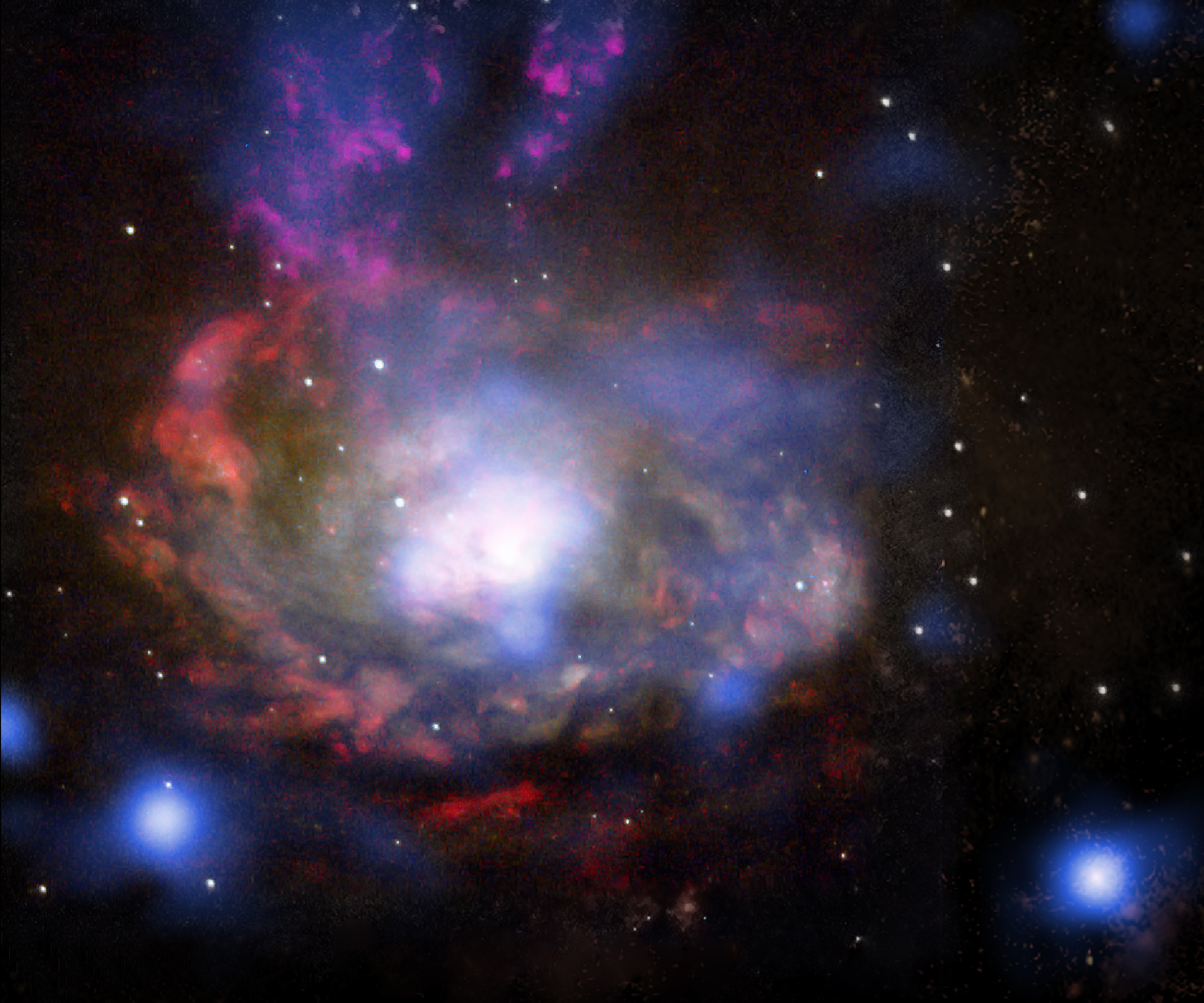
Spiral Galaxy NGC 4424

Spiral Galaxy NGC 4424
Click on the image for full resolution

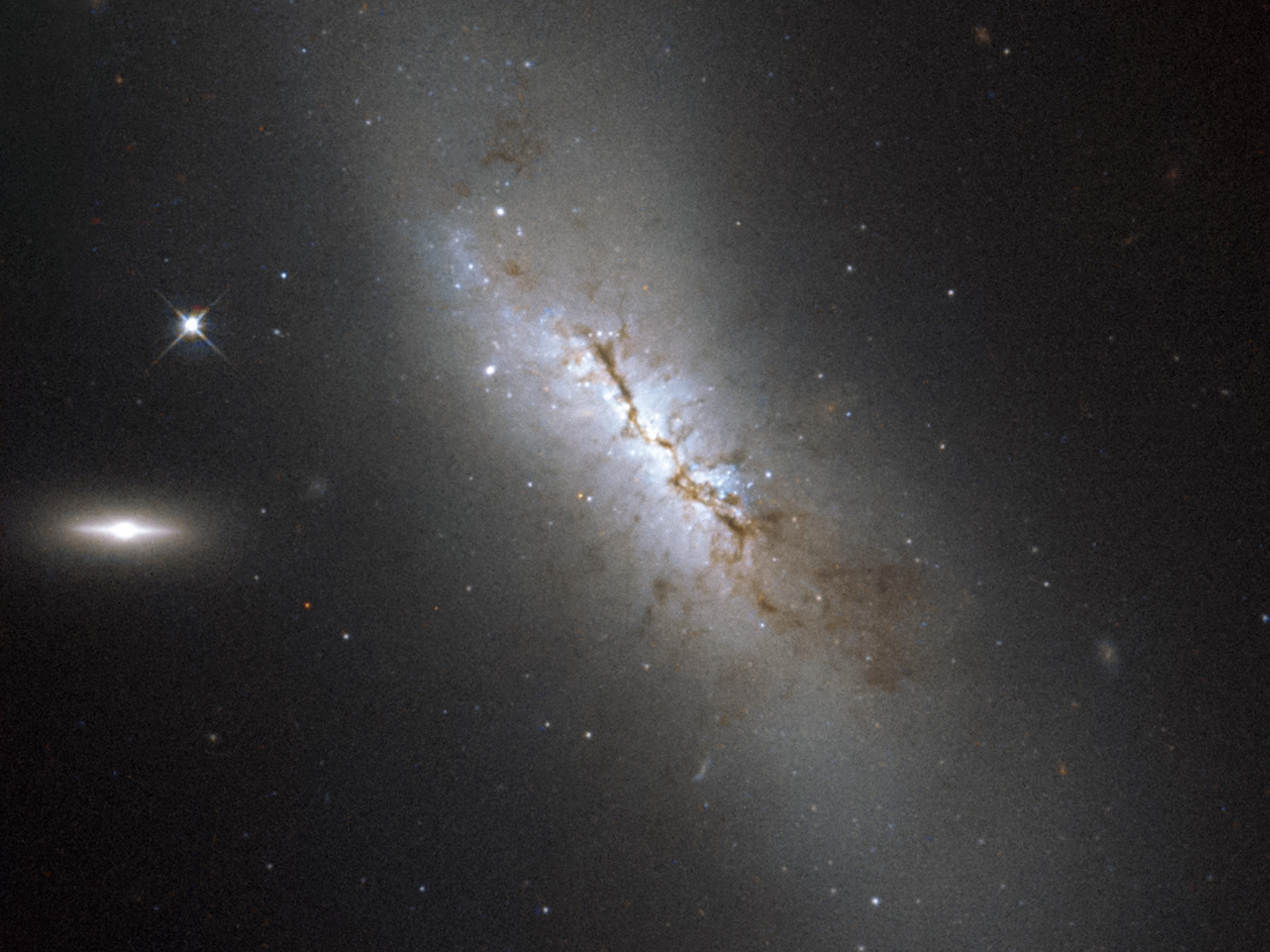
The galaxy pictured here is NGC 4424, located in the constellation of Virgo. It is not visible with the naked eye but has been captured here with the Hubble Space Telescope. Although it may not be obvious from this image, NGC 4424 is in fact a spiral galaxy. In this image it is seen more or less edge on, but from above you would be able to see the arms of the galaxy wrapping around its center to give the characteristic spiral form. In 2012 astronomers observed a supernova in NGC 4424 - a violent explosion marking the end of a star's life. During a supernova explosion, a single star can often outshine an entire galaxy. However, the supernova in NGC 4424, dubbed SN 2012cg, cannot be seen here as the image was taken ten years prior to the explosion. Along the central region of the galaxy, clouds of dust block the light from distant stars and create dark patches. To the left of NGC 4424 there are two bright objects in the frame. The brightest is another, smaller galaxy known as LEDA 213994 and the object closer to NGC 4424 is an anonymous star in our Milky Way. A version of this image was entered into the Hubble's Hidden Treasures image processing competition by contestant Gilles Chapdelaine.
Image Credit: ESA/Hubble and NASA
Acknowledgement: Gilles Chapdelaine
Image enhancement: Jean-Baptiste Faure
Saturday, March 1, 2014

Open Star Cluster M7

Open Star Cluster M7
Click on the image for full resolution (18.1 MB)

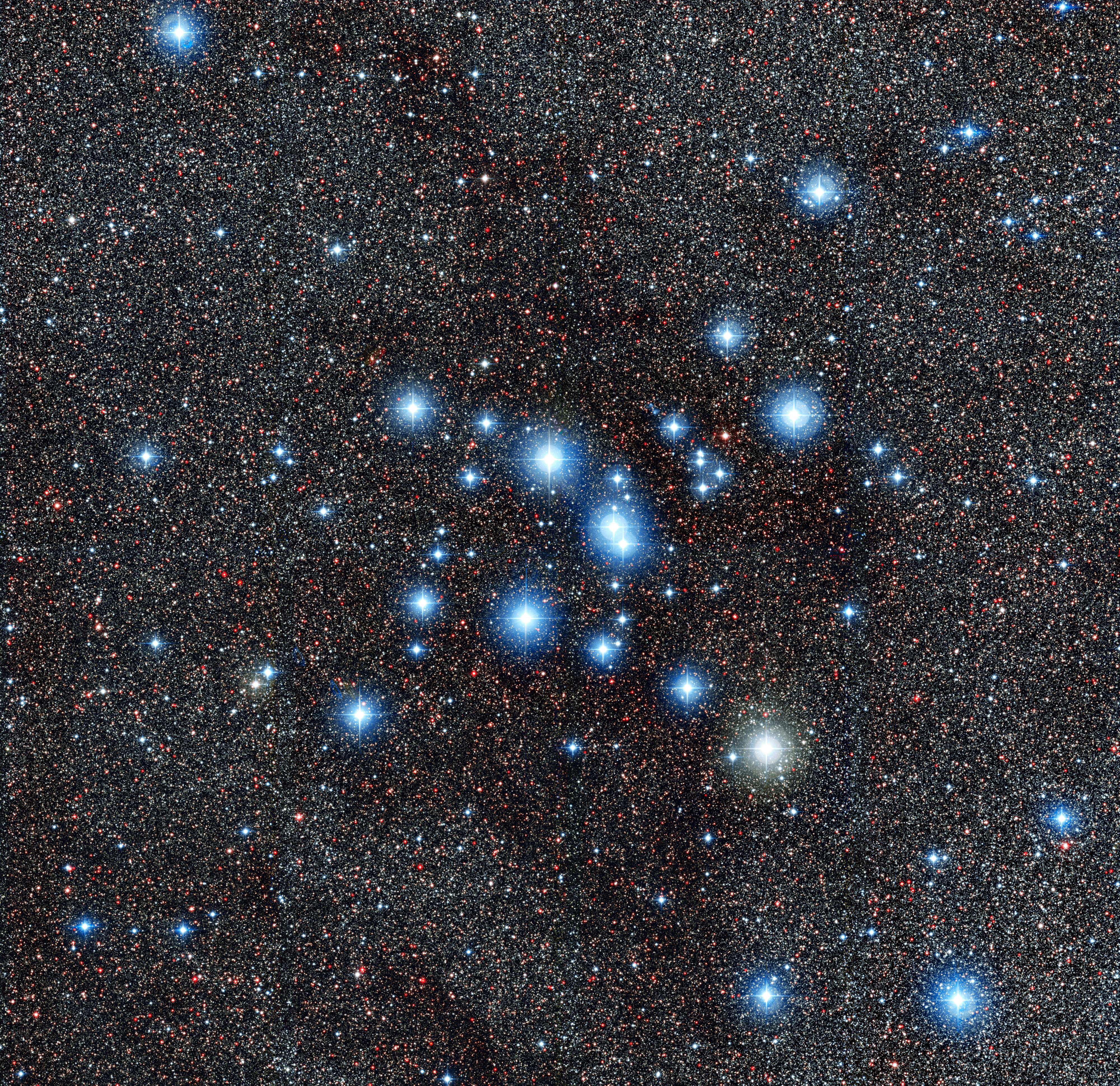
This new image from the Wide Field Imager on the MPG/ESO 2.2-meter telescope at ESO's La Silla Observatory in Chile, shows the bright star cluster M7 (Messier 7), also known as NGC 6475. Easily spotted by the naked eye in the direction of the tail of the constellation of Scorpius, this cluster is one of the most prominent open clusters of stars in the sky and an important research target. M7, also known as NGC 6475, is a brilliant cluster of about 100 stars located some 800 light-years from Earth. In this new picture from the Wide Field Imager on the MPG/ESO 2.2-meter telescope it stands out against a very rich background of hundreds of thousands of fainter stars, in the direction of the center of the Milky Way. At about 200 million years old, M7 is a typical middle-aged open cluster, spanning a region of space about 25 light-years across. As they age, the brightest stars in the picture - a population of up to a tenth of the total stars in the cluster - will violently explode as supernovae. Looking further into the future, the remaining faint stars, which are much more numerous, will slowly drift apart until they become no longer recognisable as a cluster. Open star clusters like M7 are groups of stars born at almost the same time and place, from large cosmic clouds of gas and dust in their host galaxy. These groups of stars are of great interest to scientists, because the stars in them have about the same age and chemical composition. This makes them invaluable for studying stellar structure and evolution. An interesting feature in this image is that, although densely populated with stars, the background is not uniform and is noticeably streaked with dust. This is most likely to be just a chance alignment of the cluster and the dust clouds. Although it is tempting to speculate that these dark shreds are the remnants of the cloud from which the cluster formed, the Milky Way will have made nearly one full rotation during the life of this star cluster, with a lot of reorganisation of the stars and dust as a result. So the dust and gas from which M7 formed, and the star cluster itself, will have gone their separate ways long ago. The first to mention this star cluster was the mathematician and astronomer Claudius Ptolemy, as early as 130 AD, who described it as a "nebula following the sting of Scorpius", an accurate description given that, to the naked eye, it appears as a diffuse luminous patch against the bright background of the Milky Way. In his honour, M7 is sometimes called Ptolemy's Cluster. In 1764 Charles Messier included it as the seventh entry in his Messier catalogue. Later, in the 19th century, John Herschel described the appearance of this object as seen through a telescope as a "coarsely scattered cluster of stars" - which sums it up perfectly.
Image Credit: ESO
Image enhancement: Jean-Baptiste Faure

Wednesday, November 13, 2013

Supernovae in Spiral Galaxy NGC 6984

Supernovae in Spiral Galaxy NGC 6984
Click on the image for full resolution (3.0 MB)

Supernovae are intensely bright objects. They are formed when a star reaches the end of its life with a dramatic explosion, expelling most of its material out into space. The subject of this new Hubble image, spiral galaxy NGC 6984, played host to one of these explosions back in 2012, known as SN 2012im. Now, another star has exploded, forming supernova SN 2013ek - visible in this image as the prominent, star-like bright object just slightly above and to the right of the galaxy's center. SN 2012im is known as a Type Ic supernova, while the more recent SN 2013ek is a Type Ib. Both of these types are caused by the core collapse of massive stars that have shed - or lost - their outer layers of hydrogen. Type Ic supernovae are thought to have lost more of their outer envelope than Type Ib, including a layer of helium. The observations that make up this new image were taken on 19 August 2013, and aimed to pinpoint the location of this new explosion more precisely. It is so close to where SN 2012im was spotted that the two events are thought to be linked; the chance of two completely independent supernovae so close together and of the same class exploding within one year of one another is a very unlikely event. It was initially suggested that SN 2013ek may in fact be SN 2012im flaring up again, but further observations support the idea that they are separate supernovae - although they may be closely related in some as-yet-unknown way.
Image Credit: ESA/Hubble and NASA
Image enhancement: Jean-Baptiste Faure
Thursday, March 21, 2013

Spiral Galaxy NGC 1637 and Supernova SN 1999em

Spiral Galaxy NGC 1637 and Supernova SN 1999em
Click on the image for full resolution (1.6 MB)

This image from ESO's Very Large Telescope at the Paranal Observatory in Chile shows NGC 1637, a spiral galaxy located about 35 million light-years away in the constellation of Eridanus (The River). In 1999 scientists discovered a Type II supernova in this galaxy and followed its slow fading over the following years. This year the Lick Observatory in California reported the discovery of a new supernova in the spiral galaxy NGC 1637. It was spotted using a telescope that had been specially built to search for these rare, but important cosmic objects. Follow-up observations were requested so that the discovery could be confirmed and studied further. This supernova was widely observed and was given the name SN 1999em. After its spectacular explosion in 1999, the supernova’s brightness has been tracked carefully by scientists, showing its relatively gentle fading through the years. The star that became SN 1999em was very massive - more than eight times the mass of the Sun - before its death. At the end of its life its core collapsed, which then created a cataclysmic explosion. When they were making follow up observations of SN 1999em astronomers took many pictures of this object with the VLT, which were combined to provide us with this very clear image of its host galaxy, NGC 1637. The spiral structure shows up in this image as a very distinct pattern of bluish trails of young stars, glowing gas clouds and obscuring dust lanes.
The full resolution image weighs 1.6 MB, so please be (a little) patient when downloading!
Image Credit: ESO
Image enhancement: Jean-Baptiste Faure

Sunday, September 2, 2012

Spiral Galaxy NGC 5806 and Supernova SN 2004dg

Spiral Galaxy NGC 5806 and Supernova SN 2004dg
Click on the image for full resolution (3.7 MB)

A new image from the NASA/ESA Hubble Space Telescope shows NGC 5806, a spiral galaxy in the constellation Virgo (the Virgin). It lies around 80 million light years from Earth. Also visible in this image is a supernova explosion called SN 2004dg. The exposures that are combined into this image were carried out in early 2005 in order to help pinpoint the location of the supernova, which exploded in 2004. The afterglow from this outburst of light, caused by a giant star exploding at the end of its life, can be seen as a faint yellowish dot near the bottom of the galaxy. NGC 5806 was chosen to be one of a number of galaxies in a study into supernovae because Hubble's archive already contained high resolution imagery of the galaxy, collected before the star had exploded. Since supernovae are both relatively rare, and impossible to predict with any accuracy, the existence of such before-and-after images is precious for astronomers who study these violent events. Aside from the supernova, NGC 5806 is a relatively unremarkable galaxy: it is neither particularly large or small, nor especially close or distant. The galaxy's bulge (the densest part in the centre of the spiral arms) is a so-called disk-type bulge, in which the spiral structure extends right to the centre of the galaxy, instead of there being a large elliptical bulge of stars present. It is also home to an active galaxy nucleus, a supermassive black hole which is pulling in large amounts of matter from its immediate surroundings. As the matter spirals around the black hole, it heats up and emits powerful radiation. This image is produced from three exposures in visible and infrared light, observed by Hubble's Advanced Camera for Surveys. The field of view is approximately 3.3 by 1.7 arcminutes.
The full resolution image weighs 3.7 MB, so please be patient when downloading!
Credit: ESA/Hubble and NASA
Image enhancement: Jean-Baptiste Faure
Wednesday, August 1, 2012

Spiral Galaxy NGC 1187 and Supernova SN 2007Y

Spiral Galaxy NGC 1187 and Supernova SN 2007Y
Click on the image for full resolution (3.3 MB)

A new image taken with ESO's Very Large Telescope shows the galaxy NGC 1187. This impressive spiral lies about 60 million light-years away in the constellation of Eridanus (The River). NGC 1187 has hosted two supernova explosions during the last thirty years, the latest one in 2007. This picture of the galaxy is the most detailed ever taken. The galaxy NGC 1187 is seen almost face-on, which gives us a good view of its spiral structure. About half a dozen prominent spiral arms can be seen, each containing large amounts of gas and dust. The bluish features in the spiral arms indicate the presence of young stars born out of clouds of interstellar gas. Looking towards the central regions, we see the bulge of the galaxy glowing yellow. This part of the galaxy is mostly made up of old stars, gas and dust. In the case of NGC 1187, rather than a round bulge, there is a subtle central bar structure. Such bar features are thought to act as mechanisms that channel gas from the spiral arms to the centre, enhancing star formation there. Around the outside of the galaxy many much fainter and more distant galaxies can also be seen. Some even shine right through the disc of NGC 1187 itself. Their mostly reddish hues contrast with the pale blue star clusters of the much closer object. NGC 1187 looks tranquil and unchanging, but it has hosted two supernovae explosions since 1982. A supernova is a violent stellar explosion, resulting from the death of either a massive star or a white dwarf in a binary system. In October 1982, the first supernova seen in NGC 1187 - SN 1982R was discovered at ESO's La Silla Observatory and more recently, in 2007, the amateur astronomer Berto Monard in South Africa spotted another supernova in this galaxy - SN 2007Y. A team of astronomers subsequently performed a detailed study and monitored SN 2007Y for about a year using many different telescopes. This new image of NGC 1187 was created from observations taken as part of this study and the supernova can be seen, long after the time of maximum brightness, near the bottom of the image. These data were acquired using the FORS1 instrument attached to the ESO's Very Large Telescope at the Paranal Observatory in Chile. SN 2007Y is still faintly visible in this picture and is marked with a circle.
The full resolution image weighs 3.3 MB, so please be patient when downloading!
Credit: ESO
Image enhancement: Jean-Baptiste Faure

Tuesday, February 21, 2012

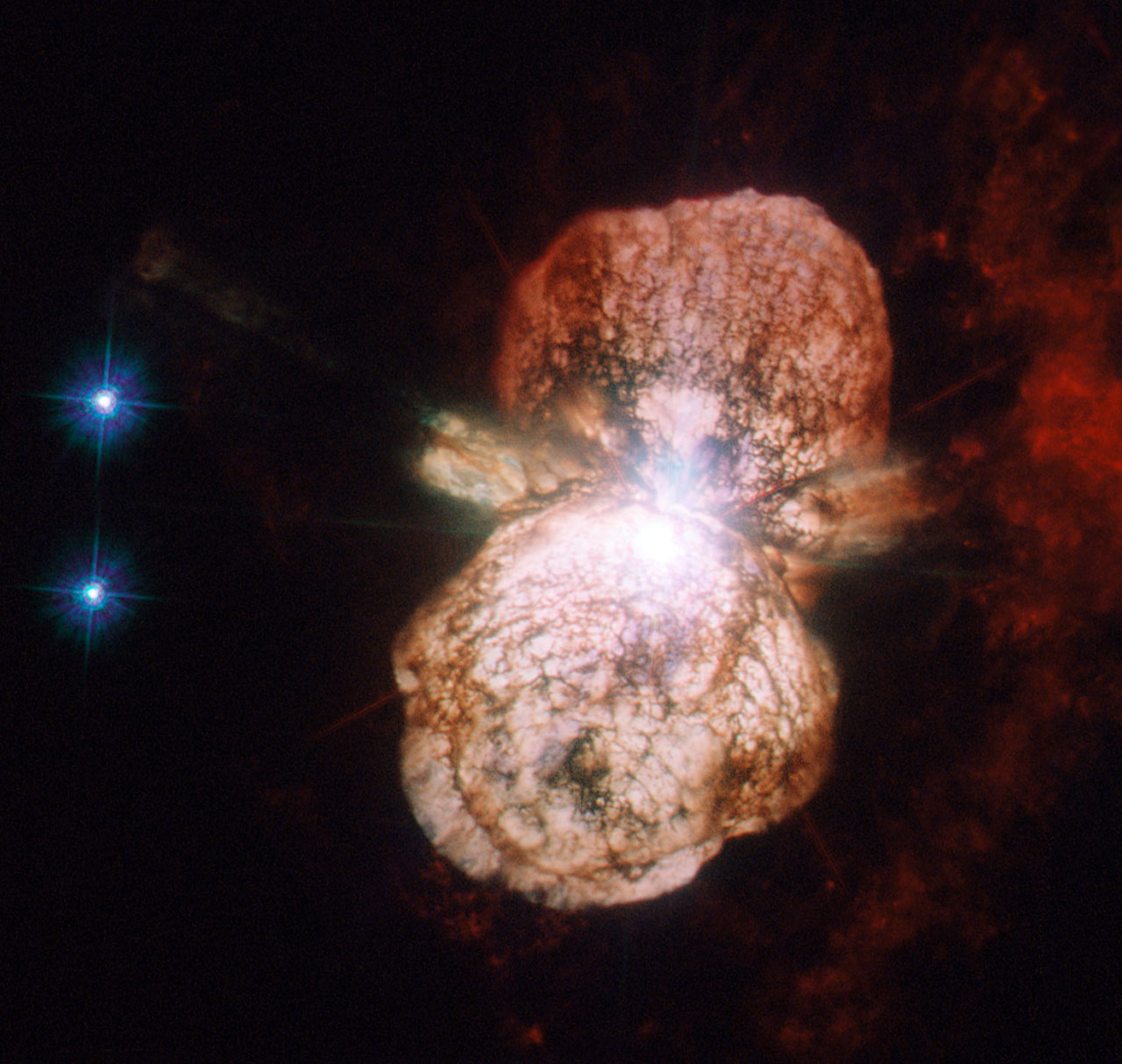
Eta Carinae: a future bright Supernova!

Eta Carinae: a future bright Supernova!
Click on the image for full resolution (1.38 MB)

At the turn of the 19th century, the binary star system Eta Carinae was faint and undistinguished. In the first decades of the century, it became brighter and brighter, until, by April 1843, it was the second brightest star in the sky, outshone only by Sirius (which is almost a thousand times closer to Earth). In the years that followed, it gradually dimmed again and by the 20th century was totally invisible to the naked eye. The star has continued to vary in brightness ever since, and while it is once again visible to the naked eye on a dark night, it has never again come close to its peak of 1843. The larger of the two stars in the Eta Carinae system is a huge and unstable star that is nearing the end of its life, and the event that the 19th century astronomers observed was a stellar near-death experience. Scientists call these outbursts supernova impostor events, because they appear similar to supernovae but stop just short of destroying their star. Although 19th century astronomers did not have telescopes powerful enough to see the 1843 outburst in detail, its effects can be studied today. The huge clouds of matter thrown out a century and a half ago, known as the Homunculus Nebula, have been a regular target for Hubble since its launch in 1990. This image, taken with the Advanced Camera for Surveys High Resolution Channel is the most detailed yet, and shows how the material from the star was not thrown out in a uniform manner, but forms a huge dumbbell shape. Eta Carinae is not only interesting because of its past, but also because of its future. It is one of the closest stars to Earth that is likely to explode in a supernova in the relatively near future (though in astronomical timescales the "near future" could still be a million years away). When it does, expect an impressive view from Earth, far brighter still than its last outburst: SN 2006gy, the brightest supernova ever observed, came from a star of the same type. This image consists of ultraviolet and visible light images from the High Resolution Channel of Hubble's Advanced Camera for Surveys. The field of view is approximately 30 arcseconds across.
The full resolution image weighs 1.38 MB, so please be (a little) patient when downloading!
Credit: ESA/Hubble and NASA
Image enhancement: Jean-Baptiste Faure
Friday, January 27, 2012

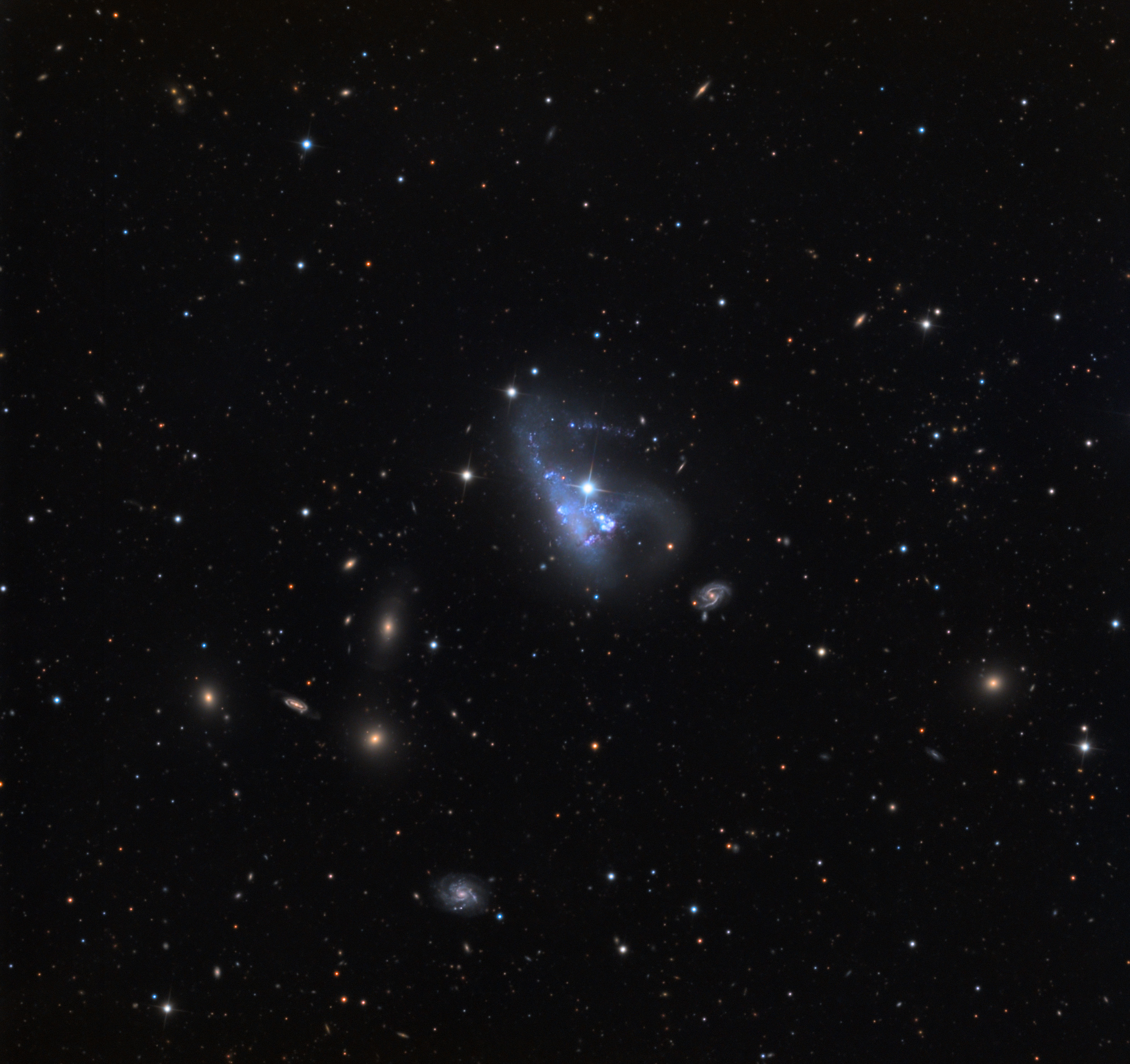
Irregular Galaxy NGC 3239 and SN 2012A

Irregular Galaxy NGC 3239 and SN 2012A
Click on the image for full resolution

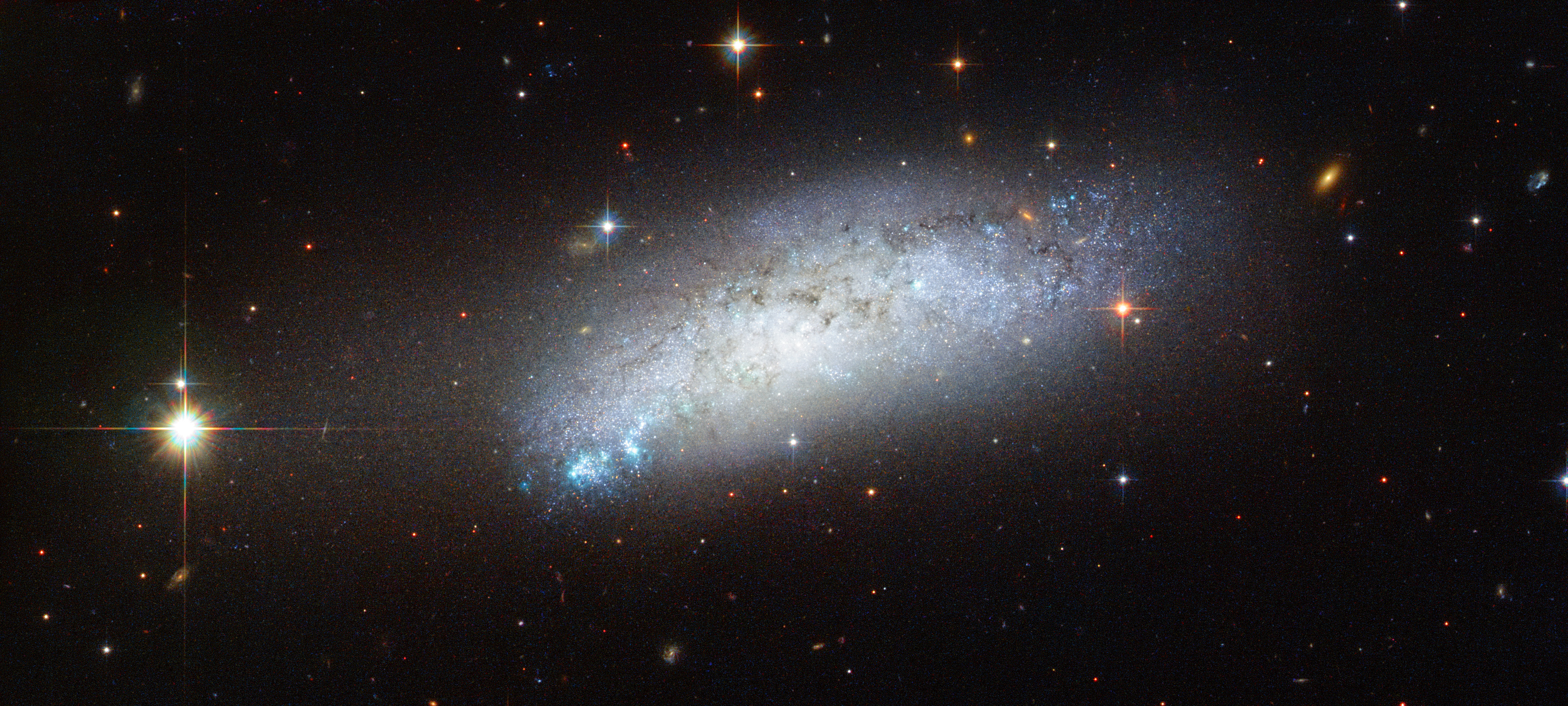
About 40,000 light-years across, pretty, irregular galaxy NGC 3239 lies near the center of this lovely field of galaxies in the galaxy rich constellation Leo. At a distance of only 25 million light-years it dominates the frame, sporting a peculiar arrangement of structures, young blue star clusters and star forming regions, suggesting that NGC 3239 (aka Arp 263) is the result of a galaxy merger. Appearing nearly on top of the pretty galaxy is a bright, spiky, foreground star, a nearby member of our own Milky Way galaxy almost directly along our line-of-sight to NGC 3239. Still, NGC 3239 is notable for hosting this year's first confirmed supernova, designated SN 2012A. It was discovered early this month by supernova hunters Bob Moore, Jack Newton, and Tim Puckett. Indicated in a cropped version of the wider image, SN 2012A is just below and right of the bright foreground star. Of course, based on the light-travel time to NGC 3239, the supernova explosion itself occurred 25 million years ago, triggered by the core collapse of a massive star.
Credit & Copyright: Adam Block, Mt. Lemmon SkyCenter, University of Arizona
Image enhancement: Jean-Baptiste Faure

Friday, October 14, 2011

SN2011fe in M101 as imaged by the Mayall 4-meter telescope!

SN2011fe in M101 as imaged by the Mayall 4-meter telescope!
Click on the image for full resolution (1.47 MB)

This close-up image of the nearby galaxy M101 was obtained with the Mayall 4-meter telescope at Kitt Peak National Observatory. M101 is a spiral galaxy in the constellation Ursa Major and is quite similar to our own Galaxy. It is about 20 million light years (6.4 Mpc) away. The supernova is clearly visible as the bright, bluish star in the upper, right portion of the image. It is the closest Type 1a supernova to be observed since 1972. This image was obtained on September 18th, 2011, about two weeks after the supernova achieved its peak brightness. This image was created by combining images taken in four filters: B (blue), V (green), I (orange), and Hydrogen-Alpha (red). In the image north is to the left and east is down.
The full resolution image weighs 1.47 MB, so please be (a little) patient when downloading!
Credit: T.A. Rector (University of Alaska Anchorage), H. Schweiker & S. Pakzad NOAO/AURA/NSF
Post-processing: Jean-Baptiste Faure

Monday, July 18, 2011

Edge-on Spiral Galaxy IC 755 hosts Supernova Explosion!

Edge-on Spiral Galaxy IC 755 hosts Supernova Explosion!
Click on the image for full resolution (3.9 MB)

The NASA/ESA Hubble Space Telescope has imaged an elongated stream of stars, gas and dust called IC 755, which is actually a spiral galaxy that we are seeing edge-on. In 1999 a star within IC 755 was seen to explode as a supernova and named SN 1999an. The supernova was discovered by the Beijing Astronomical Observatory Supernova Survey and three years later Hubble was used to study the environment in which the explosion took place. The inclination of the galaxy made the supernova a challenging target as many other intervening objects obscured the view. Valuable data were obtained and suggest that before detonation the star may have been around 20 times more massive than our Sun, and that it was likely to have been in the region of 14 million years old. Supernovae like SN 1999an are classified as Type IIs and they are dramatic events that mark the end of the lives of massive stars. They have an important role to play in galaxy evolution as many elements are formed during the explosion and are ejected with such force that they are distributed far and wide. Shockwaves also help to mix material within the host galaxy and may spark new rounds of star formation. Billions of stars make up galaxies like IC 755 and many will become supernovae, using their final moments to breathe new life into the rest of the Universe. This picture was created from multiple images taken with the Wide Field Camera of Hubble's Advanced Camera for Surveys. Exposures through a blue filter (F435W) are coloured blue, exposures through a yellow-green filter (F555W) are coloured green and images through a near-infrared filter (F814W) are shown as red. The total exposure times per filter are 430 s and the field of view is 3.3 x 1.5 arcminutes.
The full resolution image weighs 3.9 MB, so please be patient when downloading!
Credit: ESA/Hubble and NASA

Tuesday, March 15, 2011

Galaxy NGC 5584 and Supernova SN 2007af captured by the VLT

Galaxy NGC 5584 and Supernova SN 2007af captured by the VLT
Click on the image for full resolution

This is a colour-composite of the barred spiral galaxy NGC 5584. It is based on data collected by the Paranal Science Team with the FORS1 instrument on Kueyen, the second 8.2-meter Unit Telescope of ESO's Very Large Telescope. The Type Ia supernova SN 2007af is the bright object seen slightly below and to the right of the galaxy's centre. Astronomers use Cepheid variables and Type Ia supernovae as reliable distance markers to measure the universe's expansion rate and NGC 5584 was one of eight galaxies astronomers studied to measure the universe's expansion rate. In those galaxies, astronomers analyzed more than 600 Cepheid variables, including 250 in NGC 5584. Astronomers search for Type Ia supernovae in nearby galaxies containing Cepheid variables so they can compare true brightness of both types of stars. They then use that information to calibrate the measurement of Type Ia supernovae in far-flung galaxies and calculate their distance from Earth. Once astronomers know accurate distances to galaxies near and far, they can determine the universe's expansion rate.
NGC 5584 and its bright supernova were observed on the nights of 16, 19 and 22 March 2007 through a B, V, R, H-alpha and OII filter. The total exposure time is about 28 minutes. The observers are Susana Randall, Claudio Melo and Swetlana Hubrig, and the day astronomer was Dominique Naef (all ESO). Henri Boffin (ESO) processed the data and made the colour-composite, and Haennes Heyer (ESO) made the final adjustments.
Credit: ESO

Monday, March 7, 2011

Hubble snaps hyper-bright Supernova in nearby Galaxy NGC 2403

Hubble snaps hyper-bright Supernova in Spiral Galaxy NGC 2403
Click on the image for full resolution (10.1 MB)

The explosion of a massive star blazes with the light of 200 million Suns in this NASA/ESA Hubble Space Telescope image. The stellar blast, near the top right corner in the picture, is called a supernova. The supernova is so bright in this image that it easily could be mistaken for a foreground star in our Milky Way Galaxy. And yet, this supernova, called SN 2004dj, resides far beyond our galaxy.
Annotated view of NGC 2403 and Supernovae
Click on the image to enlarge
Its home is in the outskirts of NGC 2403, a galaxy located 11 million light-years from Earth. Although the supernova is far from Earth, it is the closest stellar explosion discovered in more than a decade.
This Type II-P supernova was discovered by Koichi Itagaki, a Japanese astronomer on July 31, 2004. At the time of its discovery, its apparent brightness was 11.2 visual magnitude; the discovery occurred after the supernova had reached its peak magnitude. The supernova's progenitor is a star in a young, compact star cluster in the galaxy NGC 2403, in Camelopardalis. The cluster had been cataloged as the 96th object in a list of luminous stars and clusters by Allan Sandage in 1984; the progenitor is therefore commonly referred to as Sandage 96.
The full resolution image weighs 10.1 MB, so please be patient when downloading!
Credit: NASA, ESA, A.V. Filippenko (University of California, Berkeley), P. Challis (Harvard-Smithsonian Center for Astrophysics), et al.

Thursday, February 24, 2011

Wide-field Digitized Sky Survey 2 (DSS2) image of Betelgeuse

Wide-field Digitized Sky Survey 2 (DSS2) image of Betelgeuse
Click on the image to enlarge

This image of Betelgeuse is a colour composite made from exposures from the Digitized Sky Survey 2 (DSS2). The field of view is approximatelly 2.0 x 2.0 degrees. No ultra-sharp resolution here, but a beautiful reddish Betelgeuse in a rich starfield!
Credit: ESO/Digitized Sky Survey 2
Acknowledgment: Davide De Martin

Tuesday, February 22, 2011

The sharpest ever image of soon-to-be-supernova Betelgeuse!

The sharpest ever image of soon-to-be-supernova Betelgeuse!
Click on the image to enlarge

Image of the supergiant star Betelgeuse obtained with the NACO adaptive optics instrument on ESO's Very Large Telescope. The use of NACO combined with a so-called "lucky imaging" technique, allowed the astronomers to obtain the sharpest ever image of Betelgeuse, even with Earth's turbulent, image-distorting atmosphere in the way. The resolution is as fine as 37 milliarcseconds, which is roughly the size of a tennis ball on the International Space Station (ISS), as seen from the ground. The image is based on data obtained in the near-infrared, through different filters. The field of view is about half an arcsecond wide, North is up, East is left.
Also called Alpha Orionis, Betelgeuse is a red supergiant star marking the shoulder of the winter constellation Orion the Hunter. Astronomers believe Betelgeuse is only 10 million years old, but has evolved rapidly because of its high mass. It is thought to be a runaway star from the Orion OB1 Association, which also includes the late type O and B stars in Orion's belt-Alnitak, Alnilam and Mintaka. Currently in a late stage of stellar evolution, Betelgeuse is expected to explode as a Type II supernova, possibly within the next million years. Betelgeuse is already old for its size class and is expected to explode relatively soon compared to its age. Solving the riddle of mass-loss will be the key to knowing when a supernova may occur, an event expected anytime in the next million years. Supporting this hypothesis are a number of unusual features that have been observed in the interstellar medium of the Orion Molecular Cloud Complex, which suggest that there have been multiple supernova explosions in the recent past. Betelgeuse's suspected birthplace in the Orion OB1 Association is the probable location for such supernovae. Since the oldest subgroup in the association has an approximate age of 12 million years, the more massive stars likely had sufficient time to evolve to this stage. Also, because runaway stars are believed to be caused by supernova explosions, there is strong evidence that OB stars μ Columbae, AE Aurigae and 53 Arietis all originated with such an explosion in Ori OB1 2.2, 2.7 and 4.9 million years ago.
At its current distance from Earth, such a supernova explosion would be the brightest recorded, outshining the Moon in the night sky and becoming easily visible in broad daylight.
Professor J. Craig Wheeler of The University of Texas at Austin predicts the supernova will emit 1053 ergs of neutrinos, which will pass through the star's hydrogen envelope in around an hour, then reach the solar system several centuries later. Since its rotational axis is not pointed toward the Earth, Betelgeuse's supernova is unlikely to send a gamma ray burst in the direction of Earth large enough to damage ecosystems. The flash of ultraviolet radiation from the explosion will likely be weaker than the ultraviolet output of the Sun. The supernova could brighten to an apparent magnitude of −12 over a two-week period, then remain at that intensity for 2 to 3 months before rapidly dimming. The year following the explosion, radioactive decay of cobalt to iron will dominate emission from the supernova remnant, and the resulting gamma rays will be blocked by the expanding envelope of hydrogen. If the neutron star remnant becomes a pulsar, then it could produce gamma rays for thousands of years.
Because Betelgeuse is between 497 and 789 lightyears away from Earth, Betelgeuse may have already become a supernova centuries ago; if so, the light is still in transit.
Credit: ESO and P. Kervella

Beautiful Spiral Galaxy NGC 1559 and bright Supernova SN 2005df

Beautiful Spiral Galaxy NGC 1559 and bright Supernova SN 2005df
Click on the image to enlarge

Colour-composite image of the spiral galaxy NGC 1559 in the Reticulum constellation, obtained with the multi-mode FORS1 instrument on ESO's 8.2-meter VLT. The supernova, SN 2005df, is visible as the bright star just above the galaxy. Many background galaxies can also be seen in this image.
Credit: ESO

Stunning composite image featuring SN 1996cr in Circinus Galaxy

Stunning composite image featuring SN 1996cr in Circinus Galaxy
Click on the image to enlarge

This composite image shows the central regions of the nearby Circinus galaxy, located about 12 million light years away. Data from NASA's Chandra X-ray Observatory is shown in blue and data from the NASA/ESA Hubble Space telescope is shown in yellow ("I-band"), red (hydrogen emission), cyan ("V-band") and light blue (oxygen emission). When enlarging the image, you may see the blue source near the lower right hand corner of the image which is the supernova SN 1996cr, that has finally been identified over a decade after it exploded. The supernova was first singled out in 2001 as a bright, variable object in a Chandra image, but it was not confirmed as a supernova until years later, when clues from a spectrum obtained with ESO's Very Large Telescope led the team to start the real detective work of searching through data from 18 different telescopes, both ground- and space-based, nearly all of which was in the archives. SN 1996cr is one of the nearest supernovae in the last 25 years.
Credit: X-ray (NASA/CXC/Columbia/F.Bauer et al); Visible light (NASA/STScI/UMD/A.Wilson et al.)
Credit: ESO

Saturday, February 19, 2011

Hubble's famous image of Supernova 1994D in Galaxy NGC 4526

Hubble's famous image of Supernova 1994D in Galaxy NGC 4526
Click on the image to enlarge

Hubble Space Telescope image of supernova 1994D in galaxy NGC 4526. NGC 4526 is a lenticular galaxy in the Virgo cluster. Far away, long ago, a star exploded. Supernova 1994D, visible as the bright spot on the lower left, occurred in the outskirts of disk galaxy NGC 4526. Supernova 1994D was not of interest for how different it was, but rather for how similar it was to other supernovae. In fact, the light emitted during the weeks after its explosion caused it to be given the familiar designation of a Type Ia supernova. If all Type Ia supernovae have the same intrinsic brightness, then the dimmer a supernova appears, the farther away it must be. By calibrating a precise brightness-distance relation, astronomers are able to estimate not only the expansion rate of the universe (parameterized by the Hubble Constant), but also the geometry of the universe we live in (parameterized by Omega and Lambda).
Credit: NASA/ESA, The Hubble Key Project Team and The High-Z Supernova Search Team