Showing posts with label Jupiter. Show all posts

Thursday, October 14, 2021

Jupiter's Icy Moon Europa

Jupiter's Icy Moon Europa
Click on the image for higher resolution

Observations by the Hubble Space Telescope recently revealed water vapour in the atmosphere of Ganymede, one of Jupiter's moons. A new analysis of archival images and spectra has now revealed that water vapour is also present in the atmosphere of Jupiter's icy moon Europa. The analysis found that a water vapour atmosphere is present only on one hemisphere of the moon. This result advances our understanding of the atmospheric structure of icy moons, and helps lay the groundwork for upcoming science missions which will explore Jupiter's icy moons.
Europa – one of Jupiter's 79 moons – is both the sixth closest moon to Jupiter and the sixth largest moon in the Solar System. It is an icy orb larger than the dwarf planet Pluto with a smooth, icy surface scarred by cracks and fissures. The surface of the moon is a bleak environment with an average temperature of −170 °C and only a tenuous atmosphere. However, astronomers suspect that Europa harbours a vast ocean underneath its icy surface, which some scientists speculate could host extraterrestrial life. Now, for the first time, an astronomer has discovered evidence for persistent water vapour in the atmosphere of Europa.
Using a technique that recently resulted in the discovery of water vapour in the atmosphere of Jupiter's moon Ganymede, an astronomer has found evidence of water in Europa's trailing hemisphere – the portion of the moon that is always opposite to its direction of motion. The asymmetric distribution of water vapour was predicted by previous studies based on computer simulations, but had not previously been detected observationally.
“The observation of water vapour on Ganymede and on the trailing side of Europa advances our understanding of the atmospheres of icy moons,” commented Lorenz Roth of the KTH Royal Institute of Technology in Stockholm, Sweden, the author of this study. “The detection of a stable H2O abundance on Europa is surprising because the surface temperatures are so low.”
To make this discovery, Roth delved into archival Hubble datasets, selecting ultraviolet observations of Europa from 1999, 2012, 2014 and 2015 while the moon was at various orbital positions. These observations were all taken with one of Hubble's most versatile instruments – the Space Telescope Imaging Spectrograph (STIS). These ultraviolet STIS observations allowed Roth to determine the abundance of oxygen – one of the constituents of water – in Europa's atmosphere, and by interpreting the strength of emission at different wavelengths he was able to infer the presence of water vapour.
Previous observations of water vapour on Europa have been associated with transient plumes erupting through the ice, analogous to geysers here on Earth but more than 100 kilometers high. The phenomena seen in these plume studies were apparently transient inhomogeneities or blobs in the atmosphere. The new results, however, show similar amounts of water vapour to be present spread over a larger area in observations spanning from 1999 to 2015. This suggests the long-term presence of a water vapour atmosphere on Europa's trailing hemisphere. Despite the presence of water vapour on Europa's trailing hemisphere there is no indication of H2O on the leading hemisphere of Europa.
This reprocessed colour view of Jupiter's moon Europa was made from images taken by NASA's Galileo spacecraft in the late 1990s.
Image Credit: NASA/JPL-Caltech/SETI Institute
Image enhancement: Jean-Baptiste Faure

Wednesday, February 17, 2021

Hubble's sharpest image of Jupiter and Europa

Hubble's sharpest image of Jupiter and Europa
Click on the image for higher resolution

This latest image of Jupiter, taken by the Hubble Space Telescope on 25 August 2020, was captured when the planet was 653 million kilometers from Earth. Hubble's sharp view is giving researchers an updated weather report on the monster planet's turbulent atmosphere, including a remarkable new storm brewing, and a cousin of the Great Red Spot changing colour – again. The new image also features Jupiter's icy moon Europa.
Image Credit: NASA, ESA, A. Simon (Goddard Space Flight Center), and M. H. Wong (University of California, Berkeley) and the OPAL team
Image enhancement: Jean-Baptiste Faure

Sunday, August 2, 2020

Jupiter's Magnificent Swirling Clouds

Jupiter's Magnificent Swirling Clouds
Click on the image for higher resolution

A multitude of magnificent, swirling clouds in Jupiter's dynamic North North Temperate Belt is captured in this image from NASA's Juno spacecraft. Appearing in the scene are several bright-white "pop-up" clouds as well as an anticyclonic storm, known as a white oval. This color-enhanced image was taken at 4:58 p.m. EDT on Oct. 29, 2018 as the spacecraft performed its 16th close flyby of Jupiter. At the time, Juno was about 4,400 miles from the planet's cloud tops, at a latitude of approximately 40 degrees north.
Citizen scientists Gerald Eichstädt and Seán Doran created this image using data from the spacecraft's JunoCam imager. JunoCam's raw images are available at www.missionjuno.swri.edu/junocam for the public to peruse and process into image products.
Image Credit: Enhanced Image by Gerald Eichstädt and Sean Doran (CC BY-NC-SA)/NASA/JPL-Caltech/SwRI/MSSS

Wednesday, November 13, 2019

Jupiter's Northern Hemisphere

Jupiter's Northern Hemisphere
Click on the image for higher resolution

This stunning image of Jupiter's stormy northern hemisphere was captured by NASA's Juno spacecraft as it performed a close pass of the gas giant planet. Some bright-white clouds can be seen popping up to high altitudes on the right side of Jupiter's disk.
Juno took the four images used to produce this color-enhanced view on May 29, 2019, between 3:52 a.m. EDT and 4:03 a.m. EDT, as the spacecraft performed its 20th science pass of Jupiter. At the time the images were taken, the spacecraft was between 18,600 kilometers (11,600 miles) and 8,600 kilometers (5,400 miles) above Jupiter's cloud tops, above a northern latitude spanning from about 59 to 34 degrees.
Image Credit: NASA/JPL-Caltech/SwRI/MSSS/Kevin M. Gill

Io's shadow on Jupiter

Io's shadow on Jupiter
Click on the image for higher resolution

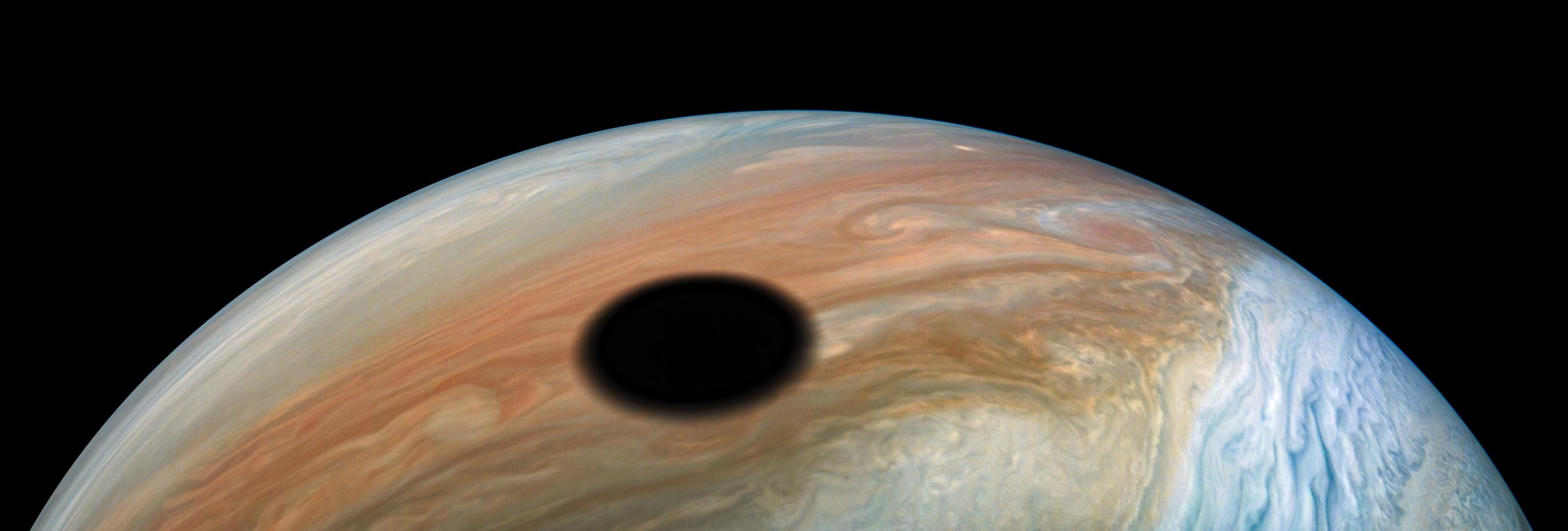
Jupiter's volcanically active moon Io casts its shadow on the planet in this dramatic image from NASA's Juno spacecraft. As with solar eclipses on the Earth, within the dark circle racing across Jupiter's cloud tops one would witness a full solar eclipse as Io passes in front of the Sun.
Such events occur frequently on Jupiter because it is a large planet with many moons. In addition, unlike most other planets in our solar system, Jupiter's axis is not highly tilted relative to its orbit, so the Sun never strays far from Jupiter's equatorial plane (+/- 3 degrees). This means Jupiter's moons regularly cast their shadows on the planet throughout its year.
Juno's close proximity to Jupiter provides an exceptional fish-eye view, showing a small fraction near the planet's equator. The shadow is about 3,600 kilometers (2,200 miles) wide, approximately the same width as Io, but appears much larger relative to Jupiter. A little larger than Earth's Moon, Io is perhaps most famous for its many active volcanoes, often caught lofting fountains of ejecta well above its thin atmosphere.
Image Credit: NASA/JPL-Caltech/SwRI/MSSS

Thursday, December 12, 2013

Io as seen by the Galileo spacecraft

Io as seen by the Galileo spacecraft
Click on the image for full resolution

Two sulfurous eruptions are visible on Jupiter's volcanic moon Io in this color composite image from the robotic Galileo spacecraft that orbited Jupiter from 1995 to 2003. At the image top, over Io's limb, a bluish plume rises about 140 kilometers above the surface of a volcanic caldera known as Pillan Patera. In the image middle, near the night/day shadow line, the ring shaped Prometheus plume is seen rising about 75 kilometers above Io while casting a shadow below the volcanic vent. Named for the Greek god who gave mortals fire, the Prometheus plume is visible in every image ever made of the region dating back to the Voyager flybys of 1979 - presenting the possibility that this plume has been continuously active for at least 18 years. This digitally sharpened image of Io was originally recorded in 1997 from a distance of about 600,000 kilometers. Recent analyses of Galileo data has uncovered evidence of a magma ocean beneath Io's surface.
Image Credit: Galileo Project, JPL, NASA
Image enhancement: Jean-Baptiste Faure

Saturday, December 24, 2011

Dramatic Voyager 1 view of Jupiter's Great Red Spot

Dramatic Voyager 1 view of Jupiter's Great Red Spot
Click on the image to enlarge

This dramatic view of Jupiter's Great Red Spot and its surroundings was obtained by Voyager 1 on Feb. 25, 1979, when the spacecraft was 9.2 million kilometers (5.7 million miles) from Jupiter. Cloud details as small as 160 kilometers (100 miles) across can be seen here. The colorful, wavy cloud pattern to the left of the Red Spot is a region of extraordinarily complex end variable wave motion. The Jet Propulsion Laboratory manages the Voyager mission for NASA's Office of Space Science.
Credit: NASA/JPL

Sunday, October 9, 2011

Ongoing Volcanic Eruption on Jupiter's satellite Io

Ongoing Volcanic Eruption on Jupiter's satellite Io
Click on the image to enlarge

An active volcanic eruption on Jupiter's moon Io was captured in this image taken on February 22, 2000 by NASA's Galileo spacecraft. Tvashtar Catena, a chain of giant volcanic calderas centered at 60 degrees north, 120 degrees west, was the location of an energetic eruption caught in action in November 1999. A dark, "L"-shaped lava flow to the left of the center in this more recent image marks the location of the November eruption. White and orange areas on the left side of the picture show newly erupted hot lava, seen in this false color image because of infrared emission. The two small bright spots are sites where molten rock is exposed to the surface at the toes of lava flows. The larger orange and yellow ribbon is a cooling lava flow that is more than more than 60 kilometers long. Dark, diffuse deposits surrounding the active lava flows were not there during the November 1999 flyby of Io. This color mosaic was created by combining images taken in the near-infrared, clear, and violet filters from Galileo's camera. The range of wavelengths is slightly more than that of the human eye. The mosaic has been processed to enhance subtle color variations. The bright orange, yellow, and white areas at the left of the mosaic use images in two more infrared filters to show temperature variations, orange being the coolest and white the hottest material. This picture is about 250 kilometers across. North is toward the top and illumination from the Sun is from the west (left).
Credit: NASA/JPL/University of Arizona

Wednesday, July 20, 2011

Voyager 1's family portrait of Jupiter and 3 Galilean Satellites

Voyager 1's family portrait of Jupiter and 3 Galilean Satellites
Click on the image for full resolution

Jupiter, its Great Red Spot and three of its four largest satellites are visible in this photo taken Feb. 5, 1979, by Voyager 1. The spacecraft was 28.4 million kilometers (17.5 million miles) from the planet at the time. The innermost large satellite, Io, can be seen against Jupiter's disk. Io is distinguished by its bright, brown-yellow surface. To the right of Jupiter is the satellite Europa, also very bright but with fainter surface markings. The darkest satellite, Callisto (still nearly twice as bright as Earth's Moon), is barely visible at the bottom left of the picture. Callisto shows a bright patch in its northern hemisphere. All three orbit Jupiter in the equatorial plane, and appear in their present position because Voyager is above the plane. All three satellites show the same face to Jupiter always -- just as Earth's Moon always shows us the same face. In this photo we see the sides of the satellites that always face away from the planet. Jupiter's colorfully banded atmosphere displays complex patterns highlighted by the Great Red Spot, a large, circulating atmospheric disturbance. This photo was assembled from three black and white negatives by the Image Processing Lab at Jet Propulsion Laboratory. JPL manages and controls the Voyager project for NASA's Office of Space Science.
Credit: NASA/JPL

Friday, April 22, 2011

NASA's Galileo highest resolution image of Jupiter's moon Io

NASA's Galileo highest resolution image of Jupiter's moon Io
Click on the image for full resolution

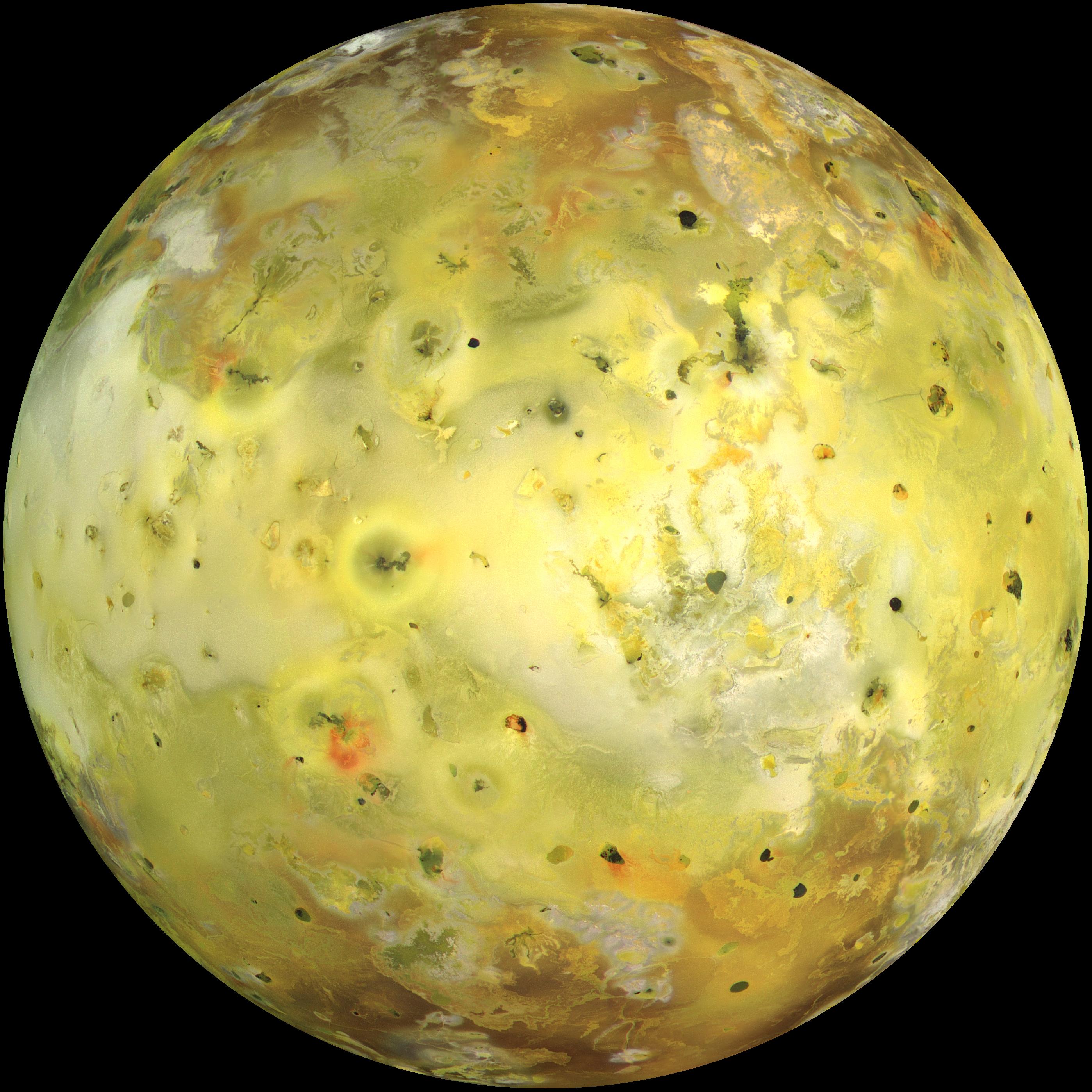
NASA's Galileo spacecraft acquired its highest resolution images of Jupiter's moon Io during its closest pass to Io since orbit insertion in late 1995. This color mosaic uses the near-infrared, green and violet filters (slightly more than the visible range) of the spacecraft's camera and approximates what the human eye would see. Most of Io's surface has pastel colors, punctuated by black, brown, green, orange, and red units near the active volcanic centers. Bright red areas were seen previously only as diffuse deposits. However, they are now seen to exist as both diffuse deposits and sharp linear features like fissures. Some volcanic centers have bright and colorful flows, perhaps due to flows of sulfur rather than silicate lava. In this region bright, white material can also be seen to emanate from linear rifts and cliffs.
North is to the top of the picture and the sun illuminates the surface from almost directly behind the spacecraft. This illumination geometry is good for imaging color variations, but poor for imaging topographic shading. However, some topographic shading can be seen here due to the combination of relatively high resolution (1.3 kilometers or 0.8 miles per picture element) and the rugged topography over parts of Io. The image is centered at 0.3 degrees north latitude and 137.5 degrees west longitude. The resolution is 1.3 kilometers (0.8 miles) per picture element. The images were taken on 3 July 1999 at a range of about 130,000 kilometers (81,000 miles) by the Solid State Imaging (SSI) system on NASA's Galileo spacecraft during its twenty-first orbit.
Credit: NASA/JPL/University of Arizona

Tuesday, March 8, 2011

NASA's Juno spacecraft nearing completion at Lockheed Martin

NASA's Juno spacecraft nearing completion at Lockheed Martin
Click on the image for full resolution (2.5 MB)

NASA's fully assembled Juno spacecraft is currently undergoing testing at Lockheed Martin Space Systems near Denver. Technicians are inspecting some of the spacecraft's components. All three solar array wings can be seen installed and stowed, and the spacecraft's large high-gain antenna in place on top. Juno is scheduled to ship from Lockheed Martin's facility to Kennedy Space Center in April, where it will undergo final preparations for launch in August 2011. The solar-powered spacecraft will orbit Jupiter's poles to find out more about the gas giant's origins, structure, atmosphere and magnetosphere.
The full resolution image weighs 2.5 MB, so please be patient when downloading!
Credit: NASA/JPL-Caltech/LMSS

Sunday, January 2, 2011

Cassini spacecraft celebrates 10 years since Jupiter encounter

Cassini spacecraft celebrates 10 years since Jupiter encounter
Click on the image for full resolution

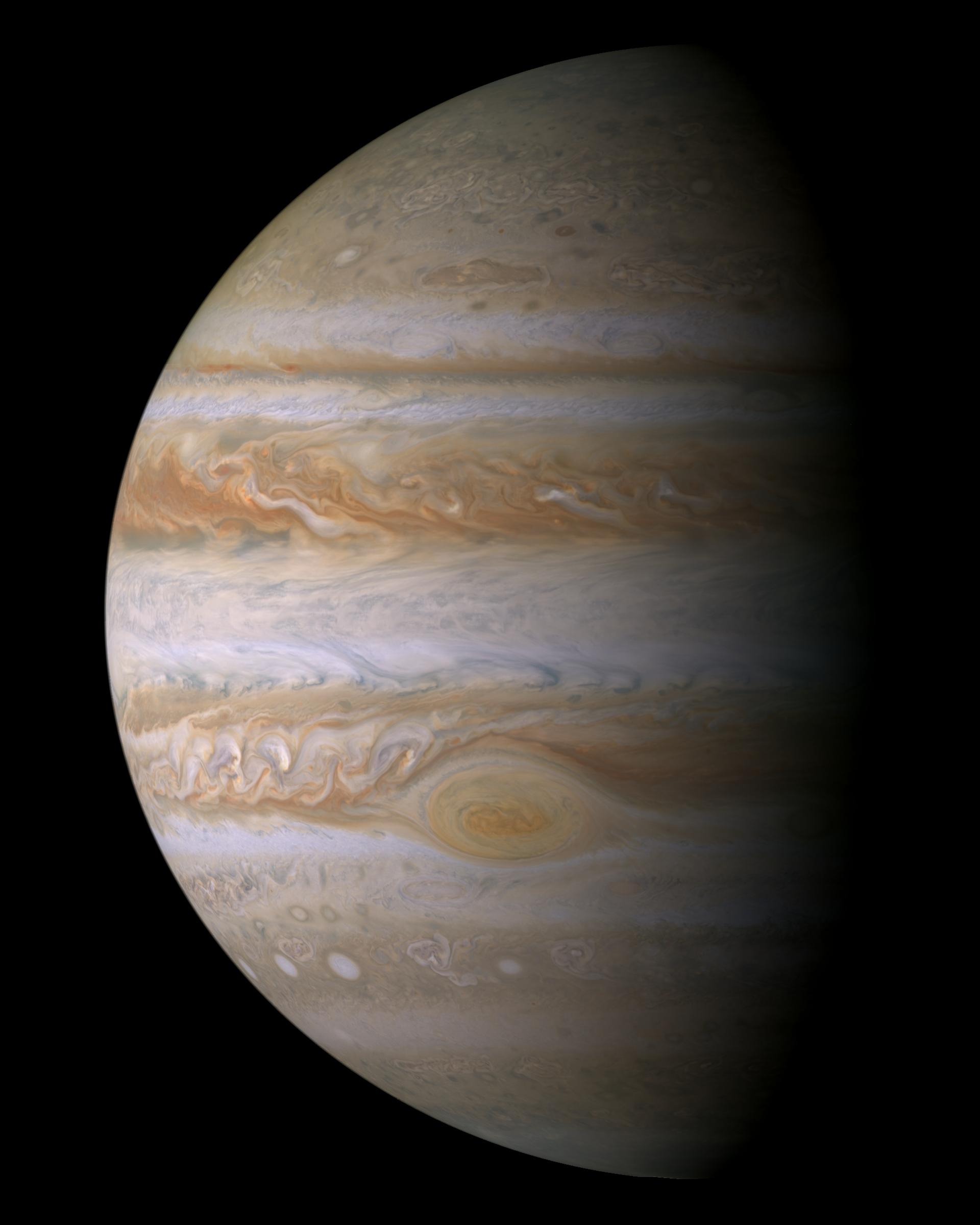
This true color mosaic of Jupiter was constructed from images taken by the narrow angle camera onboard NASA's Cassini spacecraft on December 29, 2000, during its closest approach to the giant planet at a distance of approximately 10 million kilometers (6.2 million miles).
It is the most detailed global color portrait of Jupiter ever produced; the smallest visible features are approximately 60 kilometers (37 miles) across. The mosaic is composed of 27 images: nine images were required to cover the entire planet in a tic-tac-toe pattern, and each of those locations was imaged in red, green, and blue to provide true color. Although Cassini's camera can see more colors than humans can, Jupiter's colors in this new view look very close to the way the human eye would see them.
Everything visible on the planet is a cloud. The parallel reddish-brown and white bands, the white ovals, and the large Great Red Spot persist over many years despite the intense turbulence visible in the atmosphere. The most energetic features are the small, bright clouds to the left of the Great Red Spot and in similar locations in the northern half of the planet. These clouds grow and disappear over a few days and generate lightning. Streaks form as clouds are sheared apart by Jupiter's intense jet streams that run parallel to the colored bands. The prominent dark band in the northern half of the planet is the location of Jupiter's fastest jet stream, with eastward winds of 480 kilometers (300 miles) per hour. Jupiter's diameter is eleven times that of Earth, so the smallest storms on this mosaic are comparable in size to the largest hurricanes on Earth.
Unlike Earth, where only water condenses to form clouds, Jupiter's clouds are made of ammonia, hydrogen sulfide, and water. The updrafts and downdrafts bring different mixtures of these substances up from below, leading to clouds at different heights. The brown and orange colors may be due to trace chemicals dredged up from deeper levels of the atmosphere, or they may be byproducts of chemical reactions driven by ultraviolet light from the Sun. Bluish areas, such as the small features just north and south of the equator, are areas of reduced cloud cover, where one can see deeper.
Credit: NASA/JPL/Space Science Institute