



Click the image for higher resolution (6.2 MB)
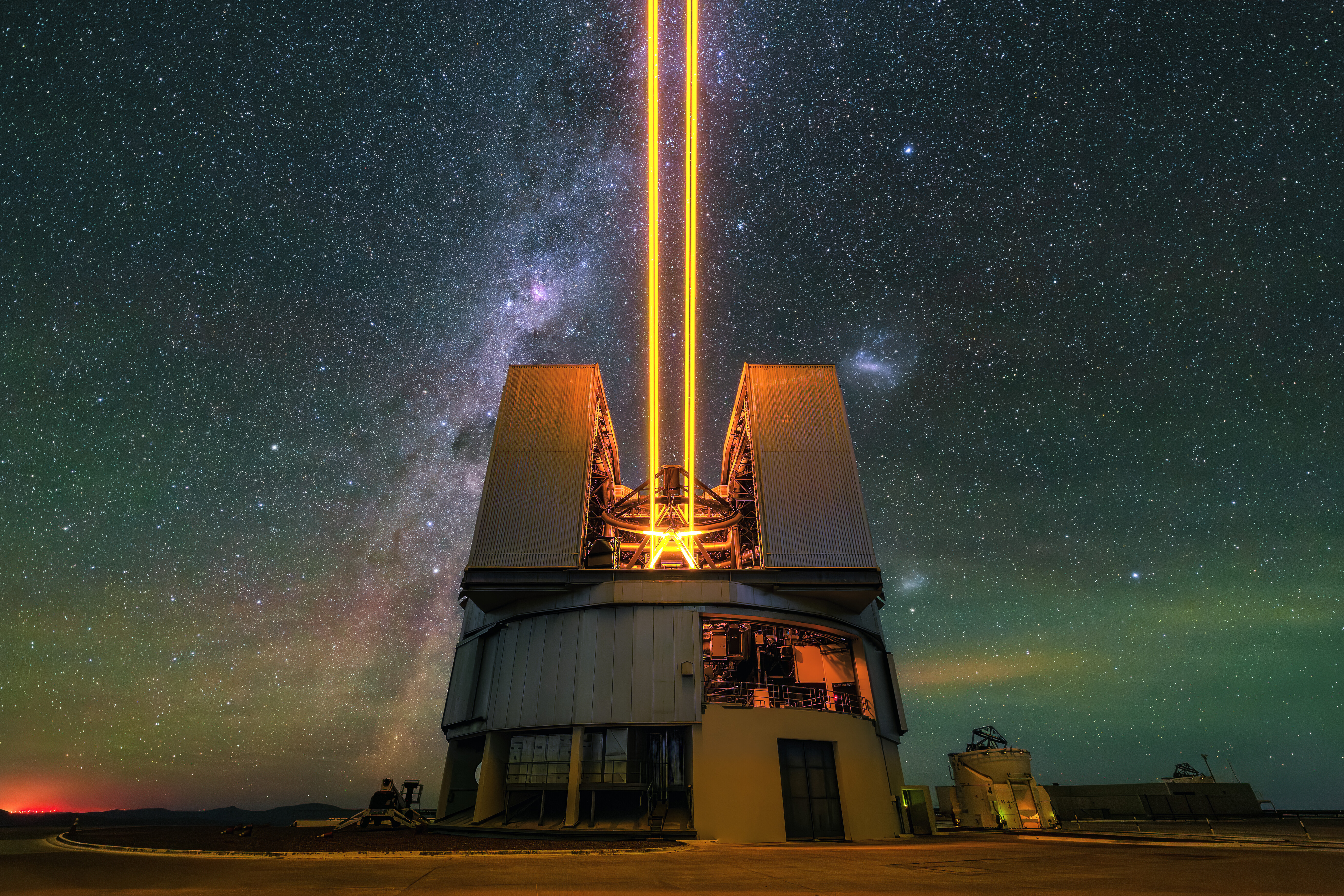
This photo is a majestic portrait of UT4, one of the four 8-m telescopes of ESO's Very Large Telescope (VLT). Framed against the star-filled sky of the Paranal Observatory, this telescope is much more than a passive observer. From within its dome, it pierces the peaceful night with four laser beams.
These lasers are projected from the 4 Laser Guide Star Facility (4LGSF), which UT4 uses to create its own artificial stars in the sky. The lasers create these points of light by exciting sodium atoms in the atmosphere, about 90 km above the ground, causing them to glow. These "stars" then act as guides, and by studying how they are blurred by the atmosphere the telescope learns how to adjust for atmospheric turbulence – the same turbulence that makes every little star twinkle.
The adjustments are made by UT4's adaptive optics system, which can precisely deform the telescope's secondary mirror to cancel out atmospheric disturbances measured by the system. Using adaptive optics, a ground-based telescope can take much sharper images than the atmosphere would normally allow – it's almost as good as sending the VLT up into space.
Soon, the other three 8-m telescopes of the VLT will be equipped with one laser each. This is part of a series of upgrades of the VLT Interferometer and its GRAVITY+ instrument, which can combine the light of several telescopes to create a huge "virtual" telescope. Another massive eye on the sky, ESO's Extremely Large Telescope (ELT), is nearing completion not far from Paranal, and will be equipped with at least 6 lasers, to deliver the sharpest images possible with a ground-based telescope.
Image Credit: ESO/A. de Burgos Sierra


0 comment(s):
Post a Comment